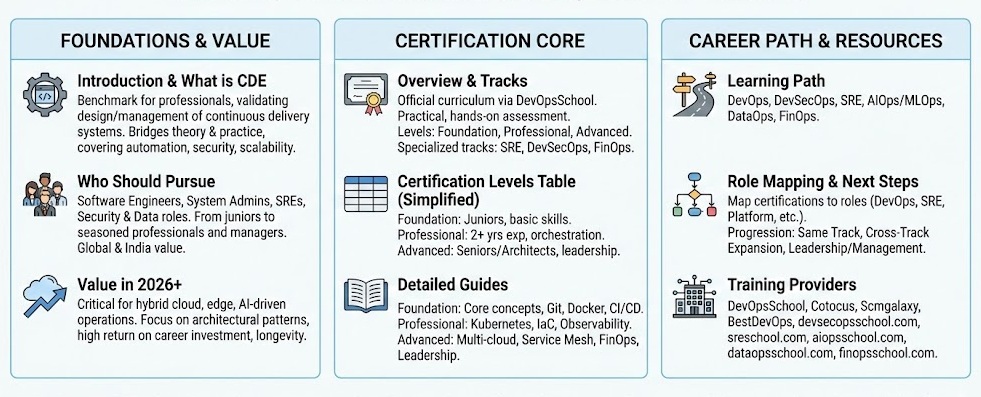
Understanding the Role of Certified DevOps Engineer (CDE) in Today’s Industry
Modern software delivery is no longer a linear process that ends at deployment. Teams are now responsible for reliability, scalability, security, and cost control long after code reaches production. In this environment, Certified DevOps Engineer (CDE) has emerged as a meaningful benchmark for professionals who manage the full lifecycle of software systems.
Organizations adopting cloud-native architectures, platform engineering models, and continuous delivery pipelines require engineers who understand systems holistically. DevOps is no longer a support function; it is a core engineering capability. This blog is written for engineers, SREs, platform and cloud professionals, security and data specialists, as well as managers responsible for delivery outcomes.
The objective of this guide is not to promote a certification blindly, but to explain what Certified DevOps Engineer (CDE) actually represents in real production environments. It helps readers decide whether this certification aligns with their current role, experience level, and long-term career goals.
What Certified DevOps Engineer (CDE) Represents in Practice
Certified DevOps Engineer (CDE) is a professional certification designed to validate practical delivery and operations skills. It measures whether an engineer can design, automate, deploy, and operate continuous delivery systems under real-world constraints.
Unlike certifications that focus on a single cloud provider or toolchain, Certified DevOps Engineer (CDE) emphasizes DevOps principles that apply across environments. These principles include automation, repeatability, collaboration, observability, and reliability, all of which remain relevant regardless of technology choices.
The curriculum is intentionally designed to close the gap between conceptual knowledge and execution. It covers version control, CI/CD pipelines, containerization, infrastructure as code, and observability. These are the same competencies used by modern engineering teams running distributed and microservices-based systems at scale.
Who Benefits Most from Certified DevOps Engineer (CDE)
Certified DevOps Engineer (CDE) is relevant to professionals across multiple roles and career stages. Early-career engineers and system administrators can use it to transition into DevOps roles through a structured and principle-driven learning path. It helps avoid the confusion caused by chasing tools without understanding underlying engineering patterns.
Mid-level and senior engineers benefit from formalizing their delivery and automation experience. Site Reliability Engineers strengthen their approach to reliability and observability, while security professionals gain a solid foundation for integrating security into CI/CD pipelines.
Data engineers and MLOps practitioners also find value when managing infrastructure-heavy data platforms. The certification has global relevance and is especially valuable in India’s fast-growing technology ecosystem, where skilled DevOps professionals remain in short supply.
Why Certified DevOps Engineer (CDE) Continues to Matter Beyond 2026
Enterprise environments are becoming increasingly complex due to hybrid cloud adoption, edge deployments, and AI-driven platforms. Engineers are expected to maintain consistency and reliability across diverse systems. Certified DevOps Engineer (CDE) addresses this challenge by focusing on long-lasting engineering disciplines.
Rather than anchoring learning to tools with short lifespans, the certification emphasizes enduring patterns such as CI/CD architecture, infrastructure automation, testing strategies, and observability models. These skills remain relevant even as platforms evolve.
Organizations increasingly seek engineers with depth in one domain and working knowledge across the entire delivery pipeline. Certified DevOps Engineer (CDE) supports this skill profile, making it a strong investment for long-term career stability, adaptability, and compensation growth.
How the Certified DevOps Engineer (CDE) Program Is Delivered
The Certified DevOps Engineer (CDE) program is delivered through the official curriculum available on
the Certified DevOps Engineer course page
and is hosted on
the DevOpsSchool platform.
The program follows a progressive learning model, starting from fundamental DevOps concepts and advancing toward architectural decision-making. It is maintained by industry practitioners to reflect real production environments rather than academic scenarios.
Assessment is practical and scenario-driven. Candidates are evaluated on their ability to apply DevOps practices under realistic conditions. Continuous updates are guided by industry feedback to ensure long-term relevance.
Certification Levels and Specialization Options within CDE
Certified DevOps Engineer (CDE) follows a tiered progression aligned with career growth. The Foundation level focuses on DevOps culture, automation basics, and core tooling. The Professional level emphasizes orchestration, infrastructure automation, and CI/CD system design. The Advanced level addresses large-scale architecture, optimization, and organizational transformation.
In addition to the core progression, specialization options allow professionals to align learning with specific responsibilities. Reliability-focused engineers can pursue SRE-oriented content, security-focused professionals can follow DevSecOps paths, and senior engineers can explore FinOps-oriented learning for cloud cost governance.
Complete Certified DevOps Engineer (CDE) Certification Overview
| Track | Level | Who it’s for | Prerequisites | Skills Covered | Recommended Order | Official Link |
|---|---|---|---|---|---|---|
| Core DevOps | Foundation | Junior Engineers, Students | Basic Linux & Coding | Git, Docker, CI/CD basics | First | View Course |
| Core DevOps | Professional | Engineers with industry experience | Foundation-level knowledge | Kubernetes, Terraform, Jenkins | Next | View Course |
| Core DevOps | Advanced | Senior Engineers, Architects | Professional-level mastery | Service Mesh, Scalability, IaC | Final | View Course |
| SRE Track | Professional | Reliability Engineers | System administration experience | SLOs, SLIs, Error Budgets | Parallel | View Course |
| Security Track | Professional | Security Engineers | Security fundamentals | Secrets, SAST/DAST, Compliance | Parallel | View Course |
What to Expect from Each CDE Certification Level
Certified DevOps Engineer (CDE) – Foundation
This level validates understanding of DevOps fundamentals, delivery workflows, and automation basics. Candidates are expected to build simple CI pipelines, containerize applications, and manage structured version control workflows.
Preparation typically starts with core concept review, followed by hands-on labs and a complete end-to-end deployment project. A common mistake at this level is treating DevOps as a set of tools instead of a system-wide practice.
Progression options include deeper specialization within DevOps, parallel movement into SRE roles, or leadership-oriented certifications for team leads.
Certified DevOps Engineer (CDE) – Professional
The Professional level validates the ability to operate production-grade DevOps environments. It focuses on container orchestration, infrastructure automation, monitoring, and controlled deployment strategies.
Candidates should be capable of operating Kubernetes clusters, automating infrastructure provisioning, and managing production incidents. Preparation requires significant hands-on practice and real troubleshooting scenarios.
Many candidates underestimate the importance of state management and observability at this stage. Successful professionals build muscle memory by working through realistic failures.
Certified DevOps Engineer (CDE) – Advanced
The Advanced certification targets engineers who design platforms rather than just operate them. It validates architectural decision-making, large-scale automation strategy, and cost-aware system design.
Candidates are expected to design disaster recovery architectures, implement service mesh solutions, and optimize systems for performance and cost. Preparation focuses on architecture reviews, design documentation, and peer evaluation.
A frequent mistake at this level is over-engineering solutions without considering long-term operational overhead and team maturity.
Choosing a Learning Direction After or Alongside CDE
Engineers can apply Certified DevOps Engineer (CDE) along several career paths. Traditional DevOps paths focus on CI/CD automation and developer productivity. DevSecOps paths integrate security throughout the delivery lifecycle. SRE paths emphasize reliability and incident response.
AIOps and MLOps paths address infrastructure automation for AI systems. DataOps paths focus on data pipeline automation and quality. FinOps paths help engineers and managers control and optimize cloud spending.
Role-Based Certification Alignment
| Role | Recommended Certifications |
|---|---|
| DevOps Engineer | CDE Foundation, CDE Professional |
| Site Reliability Engineer | CDE Professional, Certified SRE Professional |
| Platform Engineer | CDE Professional, CDE Advanced |
| Cloud Engineer | CDE Foundation, Cloud Associate Certifications |
| Security Engineer | CDE Foundation, Certified DevSecOps Professional |
| Data Engineer | CDE Foundation, Certified DataOps Professional |
| FinOps Practitioner | CDE Foundation, Certified FinOps Professional |
| Engineering Manager | CDE Foundation, DevOps Leadership Track |
Career Progression After Certified DevOps Engineer (CDE)
Professionals may continue deeper within the same DevOps track, broaden expertise across SRE or DevSecOps, or transition into leadership roles. CDE provides technical credibility that supports informed decision-making in engineering management roles.
Rather than locking professionals into a single role, the certification keeps career options flexible across delivery, reliability, platform, and leadership paths.
Training Ecosystem Supporting Certified DevOps Engineer (CDE)
CDE candidates are supported by training and ecosystem partners such as DevOpsSchool, Cotocus, Scmgalaxy, BestDevOps, devsecopsschool.com, sreschool.com, aiopsschool.com, dataopsschool.com, and finopsschool.com. Each contributes specialized expertise across DevOps, reliability, security, data, AI, and cloud financial management.
Final Thoughts on the Value of Certified DevOps Engineer (CDE)
Certified DevOps Engineer (CDE) is not valuable because of the certificate itself. Its value lies in the discipline it reinforces. Modern engineering requires professionals who can automate delivery, observe systems, recover from failure, and scale responsibly.
For engineers willing to apply these principles consistently, Certified DevOps Engineer (CDE) offers a strong, future-proof foundation. Career growth does not come from collecting certificates, but from embodying the practices they represent—and this certification provides a clear path toward that goal.
📞 Call to Action & Contact Details
End the article with the following contact information:
📞 USA: +1 (469) 756-6329
📞 India: +91 99057 40781
✉️ Email: Contact@DevOpsSchool.com