Introduction: Problem, Context & Outcome
Engineering teams release software faster than ever, yet instability, broken pipelines, and rising cloud costs continue to block real progress. These problems rarely come from missing tools. Instead, weak architectural decisions create long-term friction. Modern DevOps success depends on designing platforms that scale, remain secure, and evolve smoothly. Certified DevOps Architect addresses this challenge by moving DevOps focus from execution to architecture. Supported by enterprise-grade learning from DevOpsSchool, this guide explains how DevOps architecture strengthens delivery outcomes and career growth. Readers gain clarity on purpose, relevance, and long-term value.
Why this matters: architecture defines stability, velocity, and future scalability.
What Is Certified DevOps Architect?
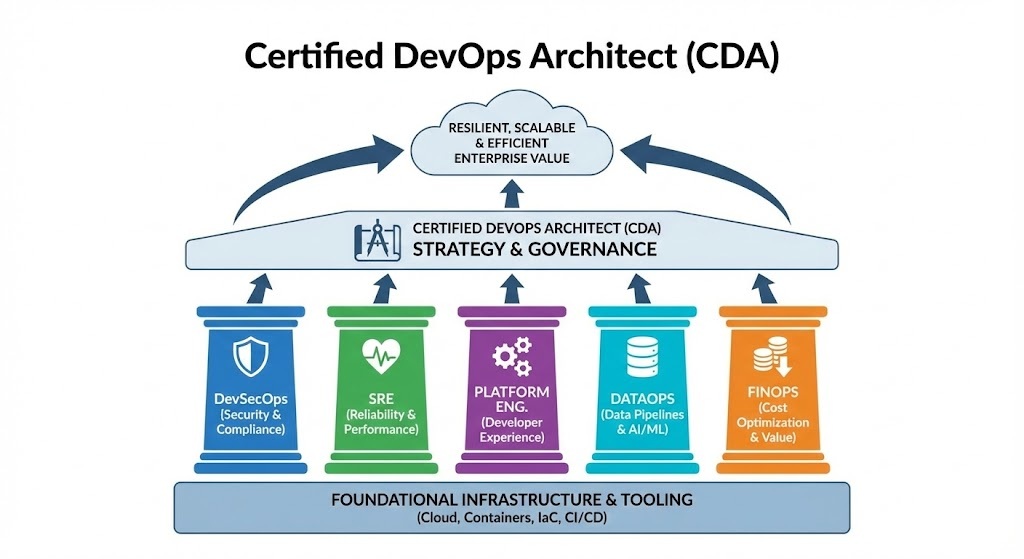
Certified DevOps Architect focuses on designing complete DevOps platforms that support teams, tools, and business goals. Instead of isolating technologies, it builds system-level understanding across CI/CD, cloud platforms, security integration, and operational reliability. Engineers learn how workflows interact with governance, environments, and organizational structure. As delivery systems grow complex, architecture provides control and predictability. Certified DevOps Architect prepares professionals to design DevOps systems that perform reliably under scale and pressure.
Why this matters: strong architecture prevents recurring failures and technical debt.
Why Certified DevOps Architect Is Important in Modern DevOps & Software Delivery
Organizations now operate across distributed teams and multi-cloud platforms. Traditional DevOps practices alone cannot manage this complexity. Certified DevOps Architect addresses pipeline sprawl, environment drift, security delays, and uncontrolled cloud costs. It aligns DevOps with Agile delivery, CI/CD automation, cloud-native platforms, and SRE practices. Architecture-led DevOps enables rapid delivery without sacrificing reliability.
Why this matters: modern software delivery demands architectural leadership.
Core Concepts & Key Components
DevOps Platform Architecture
Purpose: Build reusable and consistent delivery platforms
How it works: Architects define pipeline, environment, and integration standards
Where it is used: Enterprise CI/CD ecosystems
Cloud-Native Architecture
Purpose: Support elasticity and fault tolerance
How it works: Architects design containerized and service-based platforms
Where it is used: Public, private, and hybrid cloud environments
Security Embedded in Design
Purpose: Reduce risk early
How it works: Architects integrate security checks into pipelines
Where it is used: Regulated and security-focused organizations
Reliability Engineering
Purpose: Improve uptime and recovery
How it works: Architects design monitoring, alerting, and failure handling
Where it is used: Mission-critical production systems
Cost-Aware DevOps Design
Purpose: Control infrastructure spending
How it works: Architects align architecture with usage patterns
Where it is used: Cloud-first enterprises
Why this matters: architecture connects engineering execution with business priorities.
How Certified DevOps Architect Works (Step-by-Step Workflow)
First, architects analyze business goals, delivery constraints, and team maturity. Next, they design DevOps platforms aligned with application lifecycles. Then, they standardize CI/CD workflows to support testing, security checks, and releases. After that, they integrate observability and reliability strategies. Finally, they continuously refine architecture using production feedback and scaling requirements.
Why this matters: structured workflows replace chaos with predictability.
Real-World Use Cases & Scenarios
Large enterprises standardize DevOps architecture to support multiple product teams. Financial organizations apply architectural DevOps to meet compliance demands without slowing releases. SaaS companies use scalable platforms to support global users. Developers, DevOps engineers, QA teams, SREs, and cloud engineers collaborate through shared architectural standards. Businesses deliver faster while reducing operational risk.
Why this matters: architecture enables collaboration at scale.
Benefits of Using Certified DevOps Architect
- Productivity: Shared platforms reduce repetitive work
- Reliability: Architecture-led systems prevent outages
- Scalability: Platforms grow without redesign
- Collaboration: Common standards align teams
Why this matters: benefits increase as systems and teams expand.
Challenges, Risks & Common Mistakes
Teams often focus on tools instead of architecture. Some build overly complex platforms that teams cannot maintain. Others ignore cost and security until failures appear. Certified DevOps Architect highlights these risks and promotes continuous architectural review.
Why this matters: early corrections prevent expensive recovery.
Comparison Table
| Traditional DevOps | Architecture-Led DevOps |
|---|---|
| Tool-centric | System-centric |
| Reactive fixes | Preventive design |
| Isolated pipelines | Shared platforms |
| Manual governance | Policy-driven workflows |
| Late security | Security by design |
| High cloud cost | Cost-aware planning |
| Team silos | Cross-team alignment |
| Fragile scaling | Elastic growth |
| Incident response | Failure prevention |
| Short-term focus | Long-term stability |
Why this matters: architecture sustains DevOps success.
Best Practices & Expert Recommendations
Architects should design for failure and recovery. They should standardize platforms while allowing controlled flexibility. Regular architecture reviews should rely on production metrics. Clear communication across teams remains essential.
Why this matters: best practices protect delivery speed.
Who Should Learn or Use Certified DevOps Architect?
DevOps engineers gain platform ownership. Cloud engineers improve scalability decisions. SREs strengthen reliability planning. Developers understand delivery workflows. QA teams align testing with pipelines. Experienced professionals gain the greatest value.
Why this matters: architecture skills multiply professional impact.
FAQs – People Also Ask
What is Certified DevOps Architect?
It focuses on DevOps platform design at scale.
Why this matters: design drives system stability.
Is it suitable for beginners?
It suits experienced professionals best.
Why this matters: experience improves understanding.
Does it focus on tools?
It emphasizes principles over tools.
Why this matters: tools change frequently.
Is it relevant for cloud roles?
Yes, cloud platforms rely on architecture.
Why this matters: most systems run in the cloud.
Does it include security?
Yes, security integrates into design.
Why this matters: early protection reduces risk.
Is it globally relevant?
Yes, architecture challenges exist worldwide.
Why this matters: skills apply universally.
Does it help managers?
Yes, it improves technical judgment.
Why this matters: better decisions reduce failure.
Can it improve career growth?
Yes, architects gain higher responsibility.
Why this matters: impact drives advancement.
Does it replace experience?
No, it strengthens experience.
Why this matters: practice reinforces learning.
Is it future-proof?
Yes, it teaches enduring principles.
Why this matters: longevity matters in careers.
Branding & Authority
Enterprise DevOps success depends on platforms built with architectural clarity and operational discipline. Certified DevOps Architect aligns learning with real production challenges rather than theoretical frameworks. DevOpsSchool delivers globally recognized DevOps education focused on system thinking, scalability, and enterprise-ready delivery practices. Organizations trust architecture-driven learning to build long-term technical capability and reduce delivery risk.
Why this matters: credible learning builds confident professionals.