Introduction
Modern engineering teams face unprecedented pressure to deliver high-quality software at lightning speed. We designed this comprehensive guide to help you navigate the DevOps Certified Professional (DCP) framework, which serves as a standard for technical excellence in the industry today. Professionals across the globe utilize DevOpsSchool to acquire these vital skills and validate their expertise in automation and cloud-native architecture. Furthermore, this resource clarifies how individuals can transition from traditional operations into high-impact platform engineering roles.
Consequently, mastering these core competencies allows you to drive significant value within any technical organization. This guide acts as your strategic mentor, providing a clear and unbiased roadmap for your professional development. We focus on practical outcomes that directly influence your career growth and earning potential. By following this path, you ensure that your skills remain relevant in a rapidly shifting technology landscape.
What is the DevOps Certified Professional (DCP)?
The DevOps Certified Professional (DCP) validates an engineer’s practical ability to build and maintain robust automation pipelines. It prioritizes hands-on production experience over abstract theoretical concepts, ensuring that candidates can handle real-world infrastructure challenges. Moreover, the program aligns perfectly with modern enterprise workflows by emphasizing continuous integration and rapid feedback loops. Engineers who hold this credential demonstrate a deep understanding of how to stabilize complex distributed systems while increasing deployment frequency.
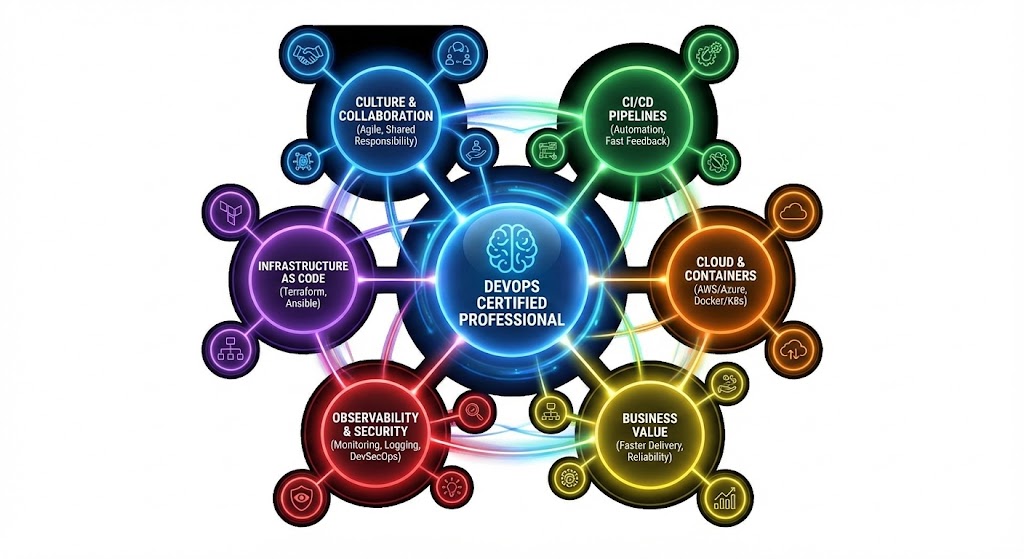
Additionally, the framework encourages a holistic view of the software development lifecycle. It moves beyond simple tool proficiency and focuses on the underlying principles of flow and observability. This approach ensures that you can design systems that scale effectively without increasing operational toil. Therefore, the industry views the DCP as a mark of a professional who can lead technical transformations.
Who Should Pursue DevOps Certified Professional (DCP)?
Software developers, systems administrators, and cloud engineers find immense value in this certification track. It specifically targets those who want to move away from manual interventions and embrace a culture of programmable infrastructure. Furthermore, Site Reliability Engineers (SREs) use this program to sharpen their automation skills and improve system resilience. Even technical managers benefit by gaining a deeper perspective on the workflows their teams utilize daily.
In addition to technical roles, security professionals and data engineers should consider the DCP to better integrate their domains into the DevOps pipeline. The program offers global relevance while addressing the specific needs of the rapidly growing Indian tech market. Consequently, anyone responsible for the delivery and stability of software products will find this training indispensable. We recommend this path for both ambitious beginners and seasoned experts looking to formalize their knowledge.
Why DevOps Certified Professional (DCP) is Valuable Today and Beyond
The current market demands a high level of agility that only automated workflows can provide. Companies across every sector are migrating to the cloud, creating a massive vacuum for skilled DevOps practitioners. The DCP provides a future-proof skill set that remains valuable regardless of which specific tools become popular in the coming years. Moreover, individuals who master these principles often command higher salaries and secure leadership positions more quickly.
Furthermore, the certification demonstrates your commitment to engineering excellence and continuous learning. It provides a competitive edge during the hiring process by offering third-party validation of your technical capabilities. As organizations continue to adopt microservices and container orchestration, your knowledge of these areas will make you a critical asset. Consequently, the return on your time investment remains exceptionally high in both the short and long term.
DevOps Certified Professional (DCP) Certification Overview
DevOpsSchool delivers the training for this program and hosts the official assessment modules. The certification follows a structured approach that tests your ability to solve practical problems in a simulated production environment. It avoids simple memorization and instead requires you to configure pipelines, manage containers, and secure infrastructure. This rigorous method ensures that every certified professional possesses the skills to contribute to a team immediately.
Additionally, the program structure covers the entire spectrum of the DevOps lifecycle. You will encounter modules focused on version control, automated testing, and cloud-native deployment strategies. The organizers update the content regularly to reflect the latest industry standards and best practices. Therefore, you can trust that the knowledge you gain is current and applicable to modern enterprise challenges.
DevOps Certified Professional (DCP) Certification Tracks & Levels
The program offers a logical progression through three distinct levels of expertise. The Foundation level introduces the core philosophy of DevOps and the essential tools for version control. It builds the necessary mindset for engineers to collaborate effectively across departmental silos. Once you master these basics, you can advance to more complex technical challenges.
The Professional level dives deep into container orchestration and infrastructure automation. This track focuses on building resilient systems that can handle high traffic and frequent updates. Finally, the Advanced and Expert levels allow for specialization in areas like security or reliability engineering. These tracks prepare you for high-level architectural roles and strategic technical leadership.
Complete DevOps Certified Professional (DCP) Certification Table
| Track | Level | Who it’s for | Prerequisites | Skills Covered | Recommended Order | Official Link |
| Core DevOps | Foundation | New Engineers | Basic IT knowledge | Git, CI Basics | 1st | Click Here |
| Core DevOps | Professional | Systems Admins | Foundation Level | Docker, K8s, IaC | 2nd | Click Here |
| DevSecOps | Specialist | Security Pros | Professional Level | Vault, SAST, DAST | 3rd (Optional) | Click Here |
| SRE | Specialist | Platform Leads | Professional Level | SLOs, Monitoring | 3rd (Optional) | Click Here |
| Leadership | Master | Senior Architects | 5+ Years Exp | Strategy, Scaling | 4th | Click Here |
Detailed Guide for Each DevOps Certified Professional (DCP) Certification
DevOps Certified Professional (DCP) – Foundation Level
What it is
This introductory certification confirms your understanding of the DevOps movement and the fundamental tools that enable it. It establishes a baseline for all subsequent specialized learning paths.
Who should take it
Aspiring engineers and IT professionals who want to understand the modern software delivery process should start here. It also suits project managers who need to speak the same language as their technical teams.
Skills you’ll gain
- Mastery of Git for version control.
- Basic understanding of Continuous Integration.
- Knowledge of DevOps culture and team collaboration.
Real-world projects you should be able to do
- Create a collaborative repository with branching strategies.
- Set up a simple automated build script.
- Map out a basic value stream for a software product.
Preparation plan
- 7-14 Days: Focus on Git command-line basics and cultural theory.
- 30 Days: Complete introductory labs and practice exams.
- 60 Days: Review complex scenarios and finalize your understanding of the lifecycle.
Common mistakes
- Neglecting the cultural aspects in favor of only learning tools.
- Skipping the Linux command-line fundamentals.
Best next certification after this
- Same-track option: DCP Professional Level.
- Cross-track option: Cloud Practitioner.
- Leadership option: Certified Scrum Master.
DevOps Certified Professional (DCP) – Professional Level
What it is
The Professional level validates your ability to manage production-grade infrastructure using advanced automation tools. It proves that you can handle the complexities of containerized environments at scale.
Who should take it
Engineers who already hold the Foundation certificate and want to specialize in technical automation should pursue this. It is the primary credential for dedicated DevOps and SRE roles.
Skills you’ll gain
- Advanced Kubernetes orchestration and management.
- Infrastructure as Code using Terraform.
- Complex CI/CD pipeline design and optimization.
Real-world projects you should be able to do
- Build a fully automated blue-green deployment pipeline.
- Provision a secure cloud environment using code.
- Containerize a complex legacy application for cloud deployment.
Preparation plan
- 7-14 Days: Deep dive into Docker and Kubernetes architecture.
- 30 Days: Hands-on labs focusing on IaC and Terraform.
- 60 Days: Build a complete end-to-end pipeline project.
Common mistakes
- Ignoring security best practices while building pipelines.
- Failing to document automated processes properly.
Best next certification after this
- Same-track option: DCP Master Level.
- Cross-track option: Certified Kubernetes Administrator (CKA).
- Leadership option: Engineering Management certification.
Choose Your Learning Path
DevOps Path
This path focuses on creating a seamless flow between development and operations through aggressive automation. You will learn to eliminate bottlenecks and reduce the time it takes to move code from a developer’s machine to production. Furthermore, this track prepares you to manage the entire toolchain that supports modern software delivery. Consequently, you become the primary driver of agility within your technical organization.
DevSecOps Path
The DevSecOps track emphasizes the integration of security directly into the automated pipeline. You will learn how to automate vulnerability scanning and compliance checks without slowing down the development process. Moreover, this path teaches you to handle secrets securely and manage infrastructure with a security-first mindset. It is an essential track for organizations operating in highly regulated industries like finance or healthcare.
SRE Path
Site Reliability Engineering focuses on using software engineering practices to solve operational problems. You will learn to build systems that are self-healing and highly observable, ensuring maximum uptime for your applications. Furthermore, this track teaches you to manage error budgets and incident response effectively. It is the ideal path for those who enjoy the challenge of maintaining large-scale distributed systems.
AIOps / MLOps Path
This specialized track applies DevOps principles to the unique challenges of machine learning and artificial intelligence. You will learn to automate the training, deployment, and monitoring of ML models in production environments. Moreover, this path addresses the complexities of data versioning and model decay over time. It represents a cutting-edge field with a high demand for engineers who understand both AI and automation.
DataOps Path
DataOps focuses on improving the quality and reducing the cycle time of data analytics. You will learn to build automated pipelines for data integration, transformation, and delivery to end-users. Furthermore, this path emphasizes collaboration between data scientists, engineers, and business stakeholders. It ensures that your organization can rely on its data for critical decision-making processes.
FinOps Path
The FinOps track brings financial accountability to the variable spend model of the cloud. You will learn how to monitor cloud costs, identify waste, and optimize infrastructure for maximum ROI. Moreover, this path teaches you how to bridge the gap between engineering teams and the finance department. Consequently, you help your organization scale its cloud presence sustainably and efficiently.
Role → Recommended (Topic name) Certifications
| Role | Recommended Certifications |
| DevOps Engineer | DCP Foundation, DCP Professional |
| SRE | DCP Professional, DCP SRE Specialist |
| Platform Engineer | DCP Professional, DCP Master |
| Cloud Engineer | DCP Foundation, Cloud Provider Basics |
| Security Engineer | DCP DevSecOps Specialist |
| Data Engineer | DCP DataOps Specialist |
| FinOps Practitioner | DCP FinOps Specialist |
| Engineering Manager | DCP Foundation, DCP Leadership |
Next Certifications to Take After DevOps Certified Professional (DCP)
Same Track Progression
Once you master the professional level, you should aim for the Master or Expert certifications. These advanced programs focus on architectural design and organizational-wide automation strategies. They prepare you to lead large engineering departments through complex digital transformations. Furthermore, staying on this track ensures that you remain at the absolute forefront of DevOps innovation.
Cross-Track Expansion
Expanding into related areas like SRE or DevSecOps makes you a more versatile and valuable professional. You gain a broader perspective on how different technical domains intersect within the software delivery lifecycle. This knowledge allows you to collaborate more effectively with specialized teams and solve complex, multi-layered problems. Consequently, you become a “T-shaped” engineer with deep expertise and broad knowledge.
Leadership & Management Track
If you aspire to move into management, consider certifications that focus on technical leadership and team dynamics. These programs help you develop the soft skills needed to manage engineers and align technical goals with business objectives. Transitioning into leadership allows you to influence the engineering culture of your entire organization. It is the natural next step for senior engineers who want to have a systemic impact.
Training & Certification Support Providers for DevOps Certified Professional (DCP)
DevOpsSchool
DevOpsSchool delivers an exhaustive curriculum that covers every aspect of the DCP program with a heavy emphasis on hands-on labs. Their trainers possess years of real-world experience, which ensures that the instruction remains practical and relevant to current market needs. Furthermore, they provide a robust platform for learners to experiment with production-grade tools in a safe, simulated environment. The support team remains active in helping students troubleshoot technical issues during their practice sessions. This dedication to student success has made them a leading choice for both individuals and large corporations across India. Consequently, graduates from this program often find themselves well-prepared for the most demanding technical roles in the industry. They continue to update their modules to reflect the newest trends in cloud-native technology.
Cotocus
Cotocus provides high-end technical consulting and specialized training for organizations aiming for advanced digital transformation. They focus on delivering customized learning paths that align with the specific architectural needs of their enterprise clients. Their instructors bring a wealth of knowledge from working on massive, high-scale systems for global tech giants. Moreover, they offer deep-dive sessions on complex topics like Kubernetes networking and advanced observability. This specialized focus makes them an excellent choice for senior engineers who want to push their technical boundaries. They also provide post-training support to ensure that teams can successfully implement their new skills in production. Consequently, they maintain a reputation for excellence among high-level technical professionals and engineering leaders.
Scmgalaxy
Scmgalaxy operates as a massive community-driven hub for DevOps resources and technical training modules. They offer an incredible variety of tutorials, videos, and articles that support the entire DCP learning journey. Their approach focuses on making technical education accessible to everyone, from absolute beginners to experienced veterans. Furthermore, they foster a vibrant community where professionals can exchange ideas and solve technical challenges collaboratively. This peer-to-peer learning environment adds significant value beyond the standard curriculum. Many engineers utilize their resources to stay updated on the latest tool releases and industry best practices. Consequently, they have built one of the largest networks of automation professionals in the world. Their platform remains a vital resource for anyone serious about mastering modern delivery pipelines.
BestDevOps
BestDevOps focuses on providing streamlined and efficient training programs that help engineers gain certifications quickly without sacrificing depth. They offer highly structured modules that prioritize the most critical skills required by top-tier employers today. Their instructors utilize a project-based learning methodology that mirrors the challenges engineers face in real-world jobs. Moreover, they provide excellent interview preparation and career coaching services to help their graduates secure high-paying positions. This holistic approach to career development distinguishes them from more traditional training providers. Furthermore, they offer flexible learning schedules that cater to the needs of working professionals. Consequently, they have a high success rate in helping students transition into dedicated DevOps and SRE roles.
devsecopsschool.com
devsecopsschool.com focuses exclusively on the critical intersection of security and automated delivery. They provide specialized training that teaches engineers how to integrate security tools directly into the CI/CD pipeline. Their curriculum covers advanced topics like container security, secret management, and automated compliance auditing. Furthermore, they emphasize the cultural shift necessary to move security “left” in the development process. This specialization makes them an invaluable resource for organizations handling sensitive data or operating in regulated industries. Their graduates possess the unique ability to maintain high delivery speeds while ensuring maximum system security. Consequently, they are in high demand across the fintech and healthcare sectors.
sreschool.com
sreschool.com provides dedicated training for the Site Reliability Engineering track, focusing on system resilience and scalability. Their programs teach the essential balance between feature delivery and operational stability. You will learn to master observability tools and develop sophisticated incident response strategies that minimize downtime. Furthermore, they provide deep insights into managing error budgets and toil reduction within large engineering organizations. Their instructors are practitioners who have managed high-traffic systems for some of the world’s most successful tech companies. This practical perspective ensures that the training remains grounded in reality. Consequently, they prepare engineers to handle the immense pressure of maintaining global-scale platforms.
aiopsschool.com
aiopsschool.com addresses the growing need for artificial intelligence within IT operations through specialized AIOps training. They teach you how to apply machine learning algorithms to monitoring data to predict and prevent system failures. Their curriculum bridges the gap between data science and traditional operations, creating a new class of versatile engineers. Furthermore, you will learn how to automate the lifecycle of ML models using MLOps principles. This cutting-edge training ensures that you stay ahead of the curve as the industry moves toward more intelligent automation. Their programs are ideal for forward-thinking professionals who want to lead the next wave of technical innovation. Consequently, they attract students from both the software engineering and data science communities.
dataopsschool.com
dataopsschool.com focuses on bringing the agility of DevOps to the world of data engineering and analytics. They provide comprehensive training on building automated data pipelines that are reliable, scalable, and secure. Their curriculum emphasizes the importance of data quality and continuous integration for data-driven applications. Furthermore, you will learn how to orchestrate complex data workflows using modern tools and platforms. This specialization is vital for organizations that rely on real-time data for their core business operations. Their graduates help teams reduce the time it takes to turn raw data into actionable insights. Consequently, they play a crucial role in modern digital-first enterprises.
finopsschool.com
finopsschool.com provides essential training for managing and optimizing cloud expenditures in a DevOps environment. They teach you how to bring financial transparency to engineering teams and drive accountability for cloud usage. Their curriculum covers cost allocation, waste identification, and the technical strategies for reducing cloud bills. Furthermore, you will learn how to build a collaborative culture between the engineering, finance, and business departments. This skill set is becoming increasingly valuable as organizations look to scale their cloud footprint without breaking their budgets. Their graduates provide a direct impact on a company’s bottom line by improving cloud ROI. Consequently, they are highly valued by CFOs and technical leaders alike.
Frequently Asked Questions (General)
- How do I start my journey with the DCP program?You should begin by reviewing the Foundation level requirements and enrolling in an introductory course at DevOpsSchool.
- Does this certification require any coding knowledge?While you do not need to be a software developer, having a basic understanding of scripting and Linux is highly beneficial.
- How much time should I dedicate to studying each week?We recommend at least 10 to 15 hours of focused study and hands-on lab practice for the best results.
- Are the exams conducted in person or online?Most providers offer proctored online exams, allowing you to complete the assessment from your preferred location.
- What is the validity period of a DCP certificate?The certificate typically remains valid for two to three years, after which you should pursue a higher level or recertify.
- Can this certification help me get a job in India?Yes, the Indian tech market has a massive demand for certified DevOps professionals across all major metropolitan cities.
- Is the DCP recognized by major cloud providers like AWS or Azure?The DCP focuses on tool-agnostic principles that complement certifications from specific cloud providers.
- What happens if I fail the exam on my first attempt?Most providers allow you to retake the exam after a brief waiting period, though additional fees may apply.
- Do I get hands-on experience during the training?Yes, the program emphasizes practical labs where you build real pipelines and manage actual infrastructure.
- Is there a community for DCP certified professionals?Yes, you can join various online forums and local meetups to connect with other experts in the field.
- Does the DCP cover Kubernetes and Docker?Yes, these tools are central to the Professional level curriculum and the modern DevOps ecosystem.
- How does the DCP compare to other DevOps certifications?The DCP is unique because of its heavy focus on real-world production scenarios and industry-vetted practices.
FAQs on DevOps Certified Professional (DCP)
- How does the DCP program improve team collaboration?The program teaches engineers to break down silos and share responsibility for the entire delivery pipeline. By using a common set of tools and methodologies, development and operations teams can work together more effectively. Consequently, this leads to faster release cycles and higher system stability.
- What specific automation tools will I master in this program?You will gain proficiency in a wide range of industry-standard tools including Git, Jenkins, Docker, and Kubernetes. Furthermore, you will learn to use Ansible for configuration management and Terraform for provisioning infrastructure. This diverse toolset ensures you can work in almost any modern technical environment.
- Is the DCP suitable for someone coming from a traditional QA background?Absolutely, the DCP provides an excellent path for QA professionals to transition into automated testing and DevSecOps roles. It teaches you how to integrate quality checks directly into the CI/CD pipeline. This shift allows you to contribute to the speed and reliability of software delivery.
- How does the DCP address the challenge of cloud cost management?The program includes specialized tracks like FinOps that teach you how to monitor and optimize cloud spending. You will learn technical strategies to identify underutilized resources and reduce waste. Consequently, you help your organization maintain a cost-effective and sustainable cloud infrastructure.
- Does the certification cover the security aspects of the pipeline?Yes, security is a core component of the DCP, with a dedicated track for DevSecOps. You will learn how to automate security scans and manage vulnerabilities throughout the development lifecycle. This ensures that security becomes an enabler of speed rather than a bottleneck.
- What role does the DCP play in a digital transformation initiative?The DCP provides the technical foundation and cultural mindset necessary for a successful digital transformation. It empowers engineers to lead the move toward automation and cloud-native practices. Furthermore, it ensures that the organization can deliver value to customers more frequently and reliably.
- How does the program keep up with the fast pace of technical change?DevOpsSchool and other partners regularly update the curriculum to include the latest tools and best practices. They collaborate with industry experts to ensure the training remains relevant to the current needs of the market. Consequently, your certification reflects the most modern engineering standards.
- Can I pursue the DCP if I am currently in a management role?Yes, technical managers benefit from the DCP by gaining a deeper understanding of the processes their teams manage. It helps you make better-informed decisions about tool selection and architectural strategy. Moreover, it allows you to lead your team with greater technical authority and empathy.
Final Thoughts: Is DevOps Certified Professional (DCP) Worth It?
Technical excellence is the only way to survive in the competitive software landscape. The DevOps Certified Professional (DCP) offers a structured and rigorous path to achieving that excellence. As a mentor with decades of experience, I have seen many engineers transform their careers by mastering these automation principles. It moves you from being a reactive problem-solver to a proactive system architect.
Furthermore, the DCP provides more than just technical skills; it gives you a common language to share with the best engineers in the world. It signals to the market that you understand how to deliver value at scale without compromising on quality or security. While the journey requires significant effort and dedication, the rewards in terms of career growth and professional satisfaction are unparalleled. Therefore, if you want to lead the future of software engineering, I highly recommend that you start your DCP journey today.