Introduction
The AWS Certified Data Engineer – Associate serves as a critical benchmark for professionals who want to master cloud-native data orchestration. This guide provides a strategic framework for software engineers, platform architects, and systems administrators aiming to convert raw data into high-value intelligence. As modern enterprises shift toward decentralized data structures, proficiency in AWS data services has become a fundamental requirement for maintaining robust infrastructure. By engaging with this roadmap, DevOpsSchool students and global tech practitioners can effectively navigate the complexities of data ingestion and security. We designed this analysis to help you determine exactly how this certification fits your professional trajectory and technical goals.
What is the AWS Certified Data Engineer – Associate?
This credential validates your capacity to implement and oversee resilient data pipelines within the cloud. Rather than prioritizing abstract theory, the exam focuses on the practical execution of data lifecycle management on the AWS platform. It highlights the growing importance of “DataOps,” where the reliability of data systems carries the same weight as the application code itself. Engineers must prove they can select optimal storage and compute engines to satisfy specific performance and budget constraints. This certification confirms that a specialist can manage production-level workloads while following the AWS Well-Architected Framework.
Who Should Pursue AWS Certified Data Engineer – Associate?
Mid-level engineers who manage large-scale data flows or support analytics departments will find this path highly rewarding. Software developers transitioning into data roles and SREs responsible for data persistence also gain significant advantages from this curriculum. In both Indian and global markets, companies actively seek “Hybrid Engineers” who possess a deep understanding of both infrastructure and data governance. Technical leaders overseeing data departments benefit by establishing a technical baseline to evaluate architectural choices and tool investments. Even motivated beginners can use this structured syllabus to enter the expanding field of data engineering.
Why AWS Certified Data Engineer – Associate is Valuable in 2026 and Beyond
The exponential growth of telemetry and application data ensures that data engineering remains a recession-proof career choice. Enterprise reliance on real-time analytics and machine learning requires the stable foundation that only certified data engineers provide. This certification offers long-term value because it concentrates on core principles like data modeling and cost optimization that endure despite tool updates. Professionals with this credential prove their dedication to remaining relevant in a business landscape where data serves as the primary asset. Choosing this certification delivers a significant return on investment by unlocking specialized roles in high-growth sectors.
AWS Certified Data Engineer – Associate Certification Overview
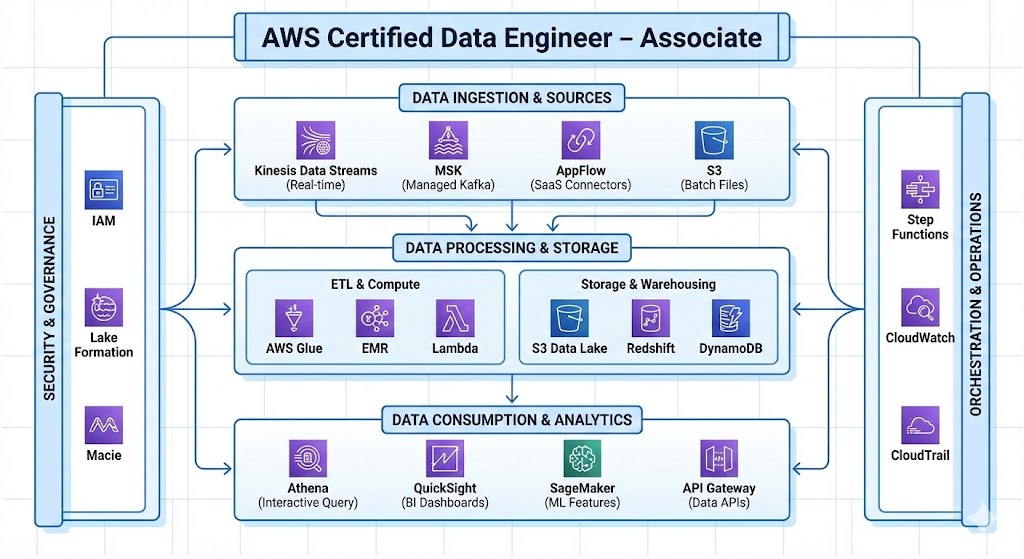
Candidates access the program through official training modules hosted on DevOpsSchool to ensure they receive a comprehensive education. This associate-level path utilizes a performance-based assessment to verify that you can execute tasks rather than just recall definitions. The learning journey depends on both the candidate’s focus and the structured guidance provided by the hosting platform. The curriculum covers four essential domains: ingestion and transformation, storage management, operations support, and security compliance. This balanced approach ensures that you understand the full range of responsibilities inherent in modern data management.
AWS Certified Data Engineer – Associate Certification Tracks & Levels
The ecosystem follows a clear progression that begins with foundational cloud concepts and advances toward specialized expertise. While this Associate level remains the core focus, it functions within a larger framework of professional-level architecture and specialty credentials. Specialization tracks enable engineers to pivot into domains like security or machine learning after they master the associate content. This hierarchy ensures that as you move from a contributor to a senior leader, a corresponding certification validates your growing technical depth. Mapping these levels to your personal milestones helps create a measurable and transparent growth plan.
Complete AWS Certified Data Engineer – Associate Certification Table
| Track | Level | Who it’s for | Prerequisites | Skills Covered | Recommended Order |
| Data Engineering | Associate | Data Engineers, SREs | Cloud Foundation | ETL, Glue, Redshift | 1 |
| Data Analytics | Advanced | Data Architects | Associate Level | Athena, Kinesis, EMR | 2 |
| Cloud Architecture | Professional | Solutions Architects | Associate Level | Multi-tier Design | 3 |
| Security | Specialty | Security Engineers | Associate Level | KMS, IAM, Encryption | 4 |
| Database | Specialty | Database Admins | Associate Level | Aurora, DynamoDB, RDS | 2 |
Detailed Guide for Each AWS Certified Data Engineer – Associate Certification
AWS Certified Data Engineer – Associate
What it is
This certification confirms your ability to build and maintain data pipelines that remain efficient and secure at scale. It demonstrates that you can successfully transform raw datasets into formats ready for analytics and machine learning.
Who should take it
Professionals with at least one year of hands-on experience in cloud infrastructure or data roles should consider this exam. It perfectly suits those who wish to establish their technical authority in AWS data services.
Skills you’ll gain
- Executing complex ETL processes using AWS Glue.
- Configuring data lakes with Amazon S3 and Lake Formation.
- Managing real-time data streams via Amazon Kinesis.
- Scaling data warehouse performance with Amazon Redshift.
- Orchestrating serverless workflows with AWS Step Functions.
Real-world projects you should be able to do
- Construct a real-time analytics pipeline using Kinesis and OpenSearch.
- Deploy an automated ETL system that cleans and partitions data in S3.
- Set up a multi-tenant data lake with fine-grained access controls.
- Refactor Redshift queries to achieve a thirty percent reduction in costs.
Preparation plan
- 7–14 Days: Review the official exam domains and complete three full-length practice tests to find weaknesses.
- 30 Days: Study AWS whitepapers on Redshift and Glue while completing ten hands-on laboratory exercises.
- 60 Days: Launch a complete end-to-end pipeline project and audit all security configurations for compliance.
Common mistakes
- Ignoring the complexity of IAM policies required for secure data access.
- Failing to account for the long-term cost implications of specific storage tiers.
- Memorizing practice questions instead of performing actual tasks in the AWS console.
Best next certification after this
- Same-track option: AWS Certified Data Analytics – Specialty.
- Cross-track option: AWS Certified Solutions Architect – Professional.
- Leadership option: AWS Certified Cloud Practitioner (to improve business communication).
Choose Your Learning Path
DevOps Path
This path emphasizes the automation of data infrastructure using Infrastructure as Code (IaC) tools like Terraform. You learn to integrate data pipelines directly into CI/CD cycles, which ensures that logic changes undergo rigorous testing before deployment. This route attracts engineers who want to manage data platforms with the same rigor applied to software products. It highlights high availability and the automated recovery of critical data services.
DevSecOps Path
The security-first route focuses on protecting sensitive information throughout the entire data lifecycle. You master the use of encryption keys, VPC endpoints, and detailed audit logs via AWS CloudTrail. This path provides essential skills for professionals in regulated industries where data privacy remains the top priority. It successfully merges traditional security engineering with modern data management practices.
SRE Path
Site Reliability Engineers concentrate on the observability and performance of data systems to maintain strict service level agreements. In this track, you set up advanced monitoring with CloudWatch and create alerting systems for pipeline failures. The curriculum helps you build self-healing architectures that manage sudden spikes in data volume without intervention. It appeals most to those who enjoy resolving issues in complex distributed environments.
AIOps / MLOps Path
This track serves as a bridge between foundational data engineering and sophisticated machine learning operations. You focus on building feature stores and automating the delivery of clean data to SageMaker for model training. Mastering data drift detection and maintaining data lineage represent key components of this specialized path. It suits engineers who want to work alongside data science teams.
DataOps Path
DataOps adopts a holistic approach by combining agile methodologies with data engineering to improve output quality. This path teaches you to manage data environments consistently across development and production stages. You explore data versioning and collaborative workflows that allow teams to share a single data lake efficiently. It prepares you to lead major digital transformation initiatives within your organization.
FinOps Path
The FinOps path focuses on the financial oversight of cloud data services to prevent budget overruns. You learn to use AWS Cost Explorer to identify idle Redshift clusters or expensive storage classes that require optimization. This track teaches you to maximize the value of every cloud dollar through smart tagging and lifecycle policies. Organizations looking to scale their data footprint sustainably value this expertise highly.
Role → Recommended AWS Certified Data Engineer – Associate Certifications
| Role | Recommended Certifications |
| DevOps Engineer | Associate + SysOps Administrator |
| SRE | Associate + Advanced Networking |
| Platform Engineer | Associate + Solutions Architect Prof |
| Cloud Engineer | Associate + Developer Associate |
| Security Engineer | Associate + Security Specialty |
| Data Engineer | Associate + Data Analytics Specialty |
| FinOps Practitioner | Associate + Cloud Practitioner |
| Engineering Manager | Associate + Solutions Architect Assoc |
Next Certifications to Take After AWS Certified Data Engineer – Associate
Same Track Progression
After you master the associate level, move toward specialty certifications like Data Analytics or Database Specialty. These exams require a granular understanding of distributed system design and query optimization. This progression solidifies your status as a subject matter expert in the data field. It remains the best choice for those who prefer high-level technical roles over management.
Cross-Track Expansion
Pursuing the Solutions Architect Professional track turns you into a versatile architect who understands the entire cloud ecosystem. This allows you to see how data services interact with networking, compute, and application logic. Broadening your expertise prevents you from becoming siloed in a single domain. It makes you a prime candidate for lead engineering and architectural positions.
Leadership & Management Track
Engineers moving into leadership should combine their technical background with a Cloud Practitioner or business-centric certification. This helps you communicate technical risks and opportunities to executive stakeholders effectively. Understanding cloud economics becomes vital once you assume responsibility for budgets and department strategy. It prepares you for high-level roles like Head of Infrastructure or CTO.
Training & Certification Support Providers for AWS Certified Data Engineer – Associate
DevOpsSchool
DevOpsSchool creates an immersive learning environment that prioritizes hands-on labs and production-grade scenarios. Their curriculum changes frequently to match the latest AWS updates, ensuring that students learn only current technologies. They provide direct access to mentors who have successfully led massive data migrations.
Cotocus
Cotocus specializes in training enterprise teams that need to modernize their data engineering capabilities. Their collaborative approach often involves custom projects that reflect the actual challenges faced by the organization. They provide a clear path from basic cloud knowledge to advanced orchestration.
Scmgalaxy
Scmgalaxy functions as a community hub that offers a massive library of tutorials, blogs, and forums for data professionals. It provides an excellent space for candidates to find peer support and track the latest trends in configuration management. Their community focus encourages continuous learning and networking.
BestDevOps
BestDevOps offers efficient certification courses designed for busy professionals who need results. Their materials target the high-weightage sections of the exam to ensure candidates pass on their first attempt. They provide multiple formats including live instructor-led sessions and self-paced videos.
devsecopsschool.com
This provider focuses on the intersection of security and development, making it the ideal choice for the DevSecOps path. Their training ensures that you bake security into every data pipeline from the very beginning. They cover advanced topics like threat modeling and automated compliance for cloud data.
sreschool.com
Sreschool.com concentrates on infrastructure reliability, offering deep dives into logging, monitoring, and error budgets. For data engineers, this training proves invaluable for building systems that survive failures without losing data. Their practical courses follow the core principles of site reliability engineering.
aiopsschool.com
Aiopsschool.com serves the expanding field of AI operations by teaching engineers how to manage the AI model lifecycle. Their content helps engineers create the high-quality datasets required for successful machine learning. This provider helps you stay ahead of the curve in the AI-driven tech market.
dataopsschool.com
This platform focuses entirely on DataOps principles, offering specialized courses in pipeline automation and data quality. They highlight the process changes required to make data teams more productive and agile. Their curriculum is essential for anyone aiming to lead a modern data department.
finopsschool.com
Finopsschool.com delivers the training necessary to maintain the financial health of a cloud environment. For data engineers, this means building architectures that balance performance with cost-efficiency. They cover everything from basic billing concepts to advanced unit-cost analysis.
Frequently Asked Questions (General)
- How difficult is the associate-level exam for a newcomer?
The exam presents a moderate challenge and requires a firm grasp of both cloud basics and specific data tools. - How much study time should I plan for each day?
Aim for one to two hours of focused study daily to ensure consistent progress. - Do I need to meet strict prerequisites for this exam?
AWS sets no formal prerequisites, but the Cloud Practitioner certification provides a helpful starting point. - Can this certification lead to a higher salary?
Certified professionals typically see a significant increase in their market value and job offers. - What is the ideal order for these certifications?
Most candidates start with Cloud Practitioner, move to Solutions Architect Associate, and then take the Data Engineer Associate. - How long does the credential stay active?
The certification remains valid for three years before you must recertify. - Does the test prioritize coding or the management console?
The exam requires a mix of SQL/Python knowledge and the ability to configure services in the console. - Is an online proctored exam option available?
Yes, you can take the exam from home using a stable internet connection and a compatible computer. - Which resources provide the best hands-on experience?
The AWS Free Tier paired with instructor-led labs offers the most effective practical training. - What score do I need to pass the exam?
The exam features 65 questions, and you generally need a score of at least 720 out of 1000. - Do employers recognize this certification globally?
AWS credentials carry immense weight and recognition across the global technology sector. - Should I focus more on AWS Glue or Redshift?
Both services are vital, but Glue appears very frequently due to its central role in ETL.
FAQs on AWS Certified Data Engineer – Associate
- Which AWS services does the exam cover most?
The curriculum emphasizes AWS Glue, Redshift, S3, Lake Formation, and Kinesis. - Does the test include machine learning questions?
It covers data preparation and transformation specifically for machine learning workflows. - How does this differ from the previous Analytics Specialty?
This exam focuses on the engineering and “plumbing” of data pipelines rather than just analysis. - Is SQL proficiency required?
Yes, you must know how to write and optimize SQL queries for various data stores. - Should I understand Hadoop and Spark?
You need to know how EMR manages these frameworks and how Spark runs within Glue jobs. - How much of the test covers security?
Security is a major pillar; you must understand encryption, IAM roles, and VPC configurations. - What is the role of AWS Lambda in this certification?
Lambda frequently triggers data processing events, such as moving files from S3 to a database. - Is cost optimization a priority on the exam?
Yes, you must identify the most cost-effective storage and compute solutions for different scenarios.
Final Thoughts: Is AWS Certified Data Engineer – Associate Worth It?
This certification represents a powerful investment for any engineer operating in today’s cloud-centric world. It offers a structured methodology for mastering the tools that drive modern business intelligence. While the certificate enhances your resume, the real value comes from the rigorous preparation that trains you to think like an architect. It moves you away from trial and error and toward engineered solutions that are secure and cost-efficient. If you want to future-proof your career and establish technical authority, this is the definitive path to follow. The rising demand for these specific skills ensures that your efforts will yield long-term professional growth.