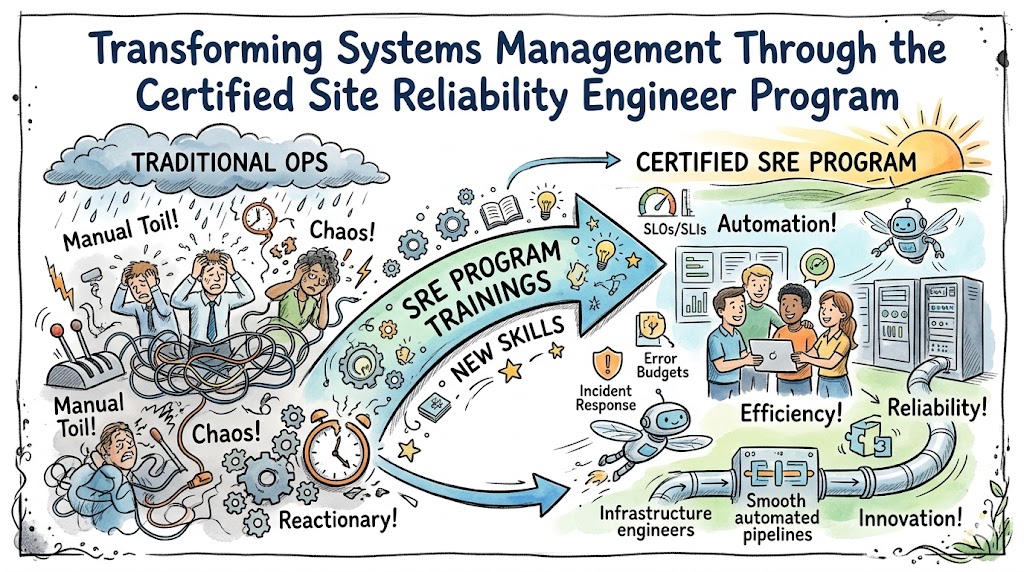
Success in today’s digital economy hinges on the absolute stability of software services under immense global traffic. This guide examines the Certified Site Reliability Engineer credentials, which merge the worlds of software development and IT operations. Professionals at Sreschool designed this specific pathway to help engineers navigate the high-pressure demands of modern cloud environments. By following this structured roadmap, you gain the technical authority needed to lead platform engineering initiatives and make smarter career moves. We provide this overview to ensure you understand how to balance rapid feature deployment with the rigorous requirements of system uptime.
What is the Certified Site Reliability Engineer?
The Certified Site Reliability Engineer designation defines a professional standard for individuals who treat operations as a software problem. This program shifts the focus away from manual system administration by championing automation, error budgets, and data-driven decision-making. It mirrors contemporary enterprise workflows where high availability and self-healing systems represent the baseline for success. By prioritizing production-grade learning, the certification prepares practitioners to manage complex incidents and build scalable infrastructure. It serves as a definitive benchmark for maintaining a perfect equilibrium between innovation speed and infrastructure reliability.
Who Should Pursue Certified Site Reliability Engineer?
Cloud professionals and DevOps engineers who want to specialize in high-scale infrastructure will find this path highly rewarding. Experienced system administrators in India and across the globe can use these certifications to validate their expertise in modern distributed systems. Technical leads and engineering managers also benefit significantly, as they must build and direct resilient SRE teams within their organizations. Security experts and data scientists often pursue this knowledge to ensure their specific platforms remain available under heavy load. The program caters to everyone from newcomers seeking a strong foundation to veterans looking to codify their architectural experience.
Why Certified Site Reliability Engineer is Valuable and Beyond
The global demand for reliability grows every day as businesses move their critical logic into microservices and containerized environments. This certification provides lasting career security because it emphasizes timeless principles like Service Level Objectives rather than just temporary tool versions. As enterprises increasingly adopt Kubernetes and multi-cloud strategies, the ability to manage these complex stacks becomes a primary competitive advantage. You receive a high return on your time investment by learning how to eliminate toil and solve problems at scale. Mastering these reliability concepts ensures you remain a vital contributor to any organization that values constant service availability.
Certified Site Reliability Engineer Certification Overview
The program delivers its specialized curriculum through the official Certified Site Reliability Engineer course and resides on the Website name platform. It employs a practical assessment strategy to confirm that candidates master both the high-level strategy and the low-level execution of reliability. The structure includes various modules covering critical topics like observability, capacity planning, and incident response. Industry experts continuously update the content to reflect the latest changes in the cloud-native and platform engineering landscape. This certification confirms your ability to apply SRE principles to live production systems instead of just testing your ability to memorize facts.
Certified Site Reliability Engineer Certification Tracks & Levels
The certification framework offers three distinct levels—foundation, professional, and advanced—to support different stages of professional growth. The foundation level covers the basics of SLIs and SLOs, while the professional tier dives into deep automation and telemetry. Advanced levels target technical architects who must design reliability strategies for massive, global-scale enterprises. Specialized tracks allow you to tailor your education toward specific domains like DevOps, SRE, or FinOps depending on your current role. These levels provide a transparent career path that leads from individual execution to strategic technical leadership.
Complete Certified Site Reliability Engineer Certification Table
| Track | Level | Who it’s for | Prerequisites | Skills Covered | Recommended Order |
| Core SRE | Foundation | Junior Engineers | Basic Linux | SLOs, SLIs, Toil | 1 |
| Core SRE | Professional | SRE / DevOps | Foundation Level | Automation, CI/CD | 2 |
| Core SRE | Advanced | Lead Architects | Professional Level | Chaos Engineering | 3 |
| Platform | Foundation | Cloud Engineers | Kubernetes Basics | Infrastructure as Code | 1 |
| Platform | Professional | Platform Leads | Cloud Networking | Scaling Systems | 2 |
| Reliability | Professional | Incident Managers | Operations Basics | Incident Response | 2 |
Detailed Guide for Each Certified Site Reliability Engineer Certification
Certified Site Reliability Engineer – Foundation
What it is
This introductory credential validates your understanding of SRE vocabulary and the cultural changes required for high-availability systems. It proves you know the essential metrics that measure the health of a production service.
Who should take it
Fresh graduates and traditional IT staff should take this to align their skills with modern cloud-native standards. It is perfect for professionals with up to two years of experience in technical support or operations.
Skills you’ll gain
- Defining Service Level Indicators (SLIs)
- Creating and managing Error Budgets
- Identifying and reducing operational toil
- Understanding the fundamental SRE vs DevOps link
Real-world projects you should be able to do
- Building a basic monitoring dashboard for a web app
- Drafting a Service Level Agreement (SLA) for a team
- Automating a manual repetitive task using simple scripts
Preparation plan
For a 7-14 day strategy, focus on the core definitions found in the SRE handbook. A 30-day plan allows you to integrate hands-on labs with monitoring tools. The 60-day roadmap permits deep dives into automation and real-world incident case studies.
Common mistakes
- Confusing SLIs with SLOs during the exam
- Focusing only on specific tools while ignoring core SRE philosophy
- Underestimating the human and cultural aspects of reliability
Best next certification after this
- Same-track: Professional SRE
- Cross-track: DevOps Foundation
- Leadership: SRE Team Lead
Certified Site Reliability Engineer – Professional
What it is
The professional level confirms your ability to implement SRE practices using industry-standard tools and automation frameworks. It moves beyond theory to test your technical execution in complex, high-stakes environments.
Who should take it
SREs and DevOps professionals with two to five years of experience who manage production clusters should pursue this. It requires a deep understanding of container orchestration and cloud networking.
Skills you’ll gain
- Building advanced observability and telemetry systems
- Managing automated incident response workflows
- Leading blameless post-mortems for organizations
- Designing resilient, self-healing infrastructure components
Real-world projects you should be able to do
- Deploying a Prometheus and Grafana stack with complex alerting
- Creating a CI/CD pipeline with reliability gates
- Implementing multi-region failover strategies for data
Preparation plan
A 14-day intensive plan requires constant lab work with Kubernetes and cloud APIs. The 30-day strategy should include studying major system failure case studies. Use a 60-day plan to master infrastructure-as-code tools like Terraform.
Common mistakes
- Automating a process before you fully understand the manual steps
- Forgetting to account for network latency in distributed systems
- Over-complicating the monitoring stack with too many alerts
Best next certification after this
- Same-track: Advanced SRE Architect
- Cross-track: Cloud Security Professional
- Leadership: Director of Reliability
Choose Your Learning Path
DevOps Path
The DevOps learning path integrates reliability into every stage of the software delivery lifecycle. You start by mastering automation and configuration management to ensure your environments remain identical across development and production. Eventually, you learn to implement automated rollbacks when your performance metrics drop during a release. This path suits engineers who want to bridge the gap between application code and operational stability. It emphasizes the responsibility of developers for the code they run in production.
DevSecOps Path
This track weaves security requirements into the SRE framework to build systems that are both resilient and safe. You learn to automate security scans and manage secrets within your infrastructure-as-code templates. In this path, reliability includes the ability of the system to recover quickly from a security breach or cyberattack. This specialization is vital for engineers working in finance, healthcare, or government sectors. It ensures that security is a core component of the reliability journey.
SRE Path
The dedicated SRE path focuses heavily on system internals, performance tuning, and global-scale architecture. You spend your time identifying bottlenecks, optimizing database performance, and ensuring high availability across multiple cloud regions. This track teaches you how to manage massive distributed systems and handle complex production incidents under pressure. It requires a deep technical understanding of networking, storage, and operating systems. These professionals serve as the ultimate guardians of the end-user experience.
AIOps Path
The AIOps track explores how machine learning and artificial intelligence can improve the reliability of modern infrastructure. You learn to use predictive analytics to identify potential failures before they impact your customers. By automating alert noise reduction, you help your engineering team focus on the most critical system issues. This path is perfect for engineers who enjoy working with data and advanced automation logic. It represents the future of managing hyper-scale environments efficiently.
MLOps Path
The MLOps specialization focuses on the unique reliability challenges of running machine learning models in production. You learn how to monitor model drift and manage the specialized hardware required for AI and ML workloads. This includes optimizing GPU utilization and scaling data pipelines to meet training and inference needs. Reliability here ensures that AI-driven business features remain accurate and available. This niche field is growing rapidly as more enterprises integrate AI into their core products.
DataOps Path
DataOps applies SRE principles to the quality and reliability of data pipelines and large-scale storage systems. You learn to treat data delivery as a mission-critical service, ensuring that information remains fresh and consistent. This involves building automated recovery for data jobs and monitoring data health across the entire organization. Since reliable data drives modern business decisions, this role provides immense value to stakeholders. It connects data science with the rigor of operational excellence.
FinOps Path
The FinOps track combines financial accountability with cloud resource management through an SRE perspective. You learn to optimize cloud spending without sacrificing the performance or reliability of your applications. This involves creating detailed utilization reports and identifying cost-saving opportunities in your infrastructure. By aligning your technical decisions with the company’s budget, you prove the economic value of reliability. This path is ideal for engineers who want to influence business strategy.
Role → Recommended Certified Site Reliability Engineer Certifications
| Role | Recommended Certifications |
| DevOps Engineer | SRE Foundation, DevOps Professional |
| SRE | SRE Foundation, SRE Professional, Advanced SRE |
| Platform Engineer | SRE Professional, Infrastructure Specialist |
| Cloud Engineer | SRE Foundation, Cloud Architecture |
| Security Engineer | SRE Foundation, DevSecOps Professional |
| Data Engineer | SRE Foundation, DataOps Specialist |
| FinOps Practitioner | SRE Foundation, FinOps Certification |
| Engineering Manager | SRE Foundation, SRE Leadership |
Next Certifications to Take After Certified Site Reliability Engineer
Same Track Progression
Deepening your expertise in the SRE track involves moving toward principal or architectural roles where you design systems for the whole company. You should focus on Chaos Engineering to proactively test the limits of your production environment. This ensures you can handle unpredictable failures in distributed systems without crashing the user experience. Mastering these advanced skills establishes you as a top-tier subject matter expert in system stability. It leads directly to roles like Head of Reliability or Infrastructure Director.
Cross-Track Expansion
Broadening your skills means pursuing certifications in related fields like Cloud Security, Big Data, or FinOps. Understanding how different technical domains intersect with your infrastructure allows you to build more comprehensive systems. For example, a truly successful system must be secure, reliable, and cost-effective all at once. Expanding your knowledge base across different tracks makes you a versatile collaborator and a stronger engineer. It prepares you for Platform Engineering roles that require a diverse and deep toolkit.
Leadership & Management Track
Moving into leadership requires a shift from writing automation code to strategic planning and mentoring people. You should look for certifications that cover SRE team structures, incident management policy, and organizational culture. Learning to communicate the business value of system reliability to non-technical executives is a vital skill. This track prepares you for high-level roles such as VP of Engineering or CTO. It allows you to shape the technical future of your company at scale.
Training & Certification Support Providers for Certified Site Reliability Engineer
DevOpsSchool
This provider offers intensive training and hands-on workshops for various levels of SRE certification. They focus on delivering practical skills through real-world projects and interactive learning sessions. Their trainers update the curriculum frequently to keep pace with industry changes.
Cotocus
Specializing in elite technical mentorship and consulting, this organization provides deep-dive training for senior SRE professionals. They help engineers solve complex architectural challenges through personalized learning paths. Their approach emphasizes high-level strategy and technical mastery.
Scmgalaxy
As a robust community-driven platform, they provide a vast array of tutorials and support resources for SRE candidates. They help learners build a strong foundation in automation and configuration management tools. Their forums offer excellent peer support and networking.
BestDevOps
This training provider focuses on career-ready skills that match the latest SRE and DevOps requirements. They offer comprehensive modules covering everything from basic monitoring to advanced cloud-native orchestration. Their practitioners bring years of field experience to every session.
devsecopsschool.com
This platform makes security a core part of its SRE and DevOps educational programs. They teach you how to build resilient systems that are secure from the ground up. Their courses are essential for professionals in regulated industries.
sreschool.com
The primary center for SRE-specific education, providing a clear path to mastering reliability engineering. They offer various levels of certification to suit engineers at any stage of their career. Their focus remains exclusively on the reliability domain.
aiopsschool.com
This provider focuses on the intersection of artificial intelligence and technical operations to modernize SRE workflows. They offer training on predictive maintenance and automated incident resolution. It is the best place to learn about the future of infrastructure.
dataopsschool.com
Focused entirely on the reliability of data ecosystems, this provider offers specialized training for data architects. They apply SRE rigor to the entire data lifecycle to ensure consistency. Their courses bridge the gap between operations and data science.
finopsschool.com
This organization teaches the financial side of cloud infrastructure management through an SRE perspective. They show engineers how to balance high performance with cost optimization. Their training helps organizations maximize their return on cloud investments.
Frequently Asked Questions
- How hard is the SRE certification exam?The difficulty depends on your chosen level, where foundation exams test core concepts and professional levels require deep technical implementation.
- How much time should I set aside for studying?Most professionals spend four weeks on the foundation level and up to three months mastering the professional level requirements.
- Does the foundation level have any strict prerequisites?No formal prerequisites exist, but you should have a basic understanding of Linux systems and the general software lifecycle.
- What kind of career growth can I expect from this?Certified professionals often qualify for senior SRE roles with significant salary increases in top-tier technology companies.
- Is it possible to skip the foundation exam?We generally recommend completing the foundation first to ensure you understand the specific framework and terminology used here.
- Are the exams more theoretical or practical?The exams blend conceptual questions with scenario-based problems to test your ability to solve real production issues effectively.
- How long does the certification stay valid?The certification typically remains valid for two to three years, after which you must recertify or advance to a higher tier.
- Is this credential recognized by companies outside India?Yes, the program follows global industry standards used by major cloud providers and high-scale tech firms worldwide.
- Does the curriculum focus on one specific cloud provider?The core principles are cloud-agnostic, though the practical labs often utilize platforms like AWS, Azure, or Google Cloud.
- What kind of support do training providers offer?Most providers give you access to lab environments, expert mentorship, and peer communities to help you master the material.
- How does this differ from a standard DevOps cert?SRE focuses specifically on the operational health and long-term reliability of systems using engineering and software methodologies.
- Do companies offer group training for their teams?Many training organizations provide corporate packages to certify entire engineering departments at a discounted rate.
FAQs on Certified Site Reliability Engineer
- How does the certification improve my incident response skills?
It provides structured methods like blameless post-mortems and automated alerting to reduce system downtime significantly.
- Is this program useful for a backend developer?
Yes, it helps developers build more resilient applications and understand how their code performs in live production environments.
- Which tools does the program focus on most?
The curriculum emphasizes observability with Prometheus, orchestration via Kubernetes, and automation using Python, Go, or Shell.
- Will I learn about Chaos Engineering?
Advanced levels include Chaos Engineering to help you proactively identify and fix weaknesses in your distributed systems.
- How does the program address technical debt?
It teaches you to use error budgets to balance the need for new features with the necessity of system stability.
- Do I need advanced coding skills?
Basic programming or scripting skills are necessary because SRE uses software to solve operational and infrastructure problems.
- How important is automation in the certification?
Automation is a central pillar, as the program focuses on reducing manual toil and creating consistent, repeatable infrastructure.
- How does SRE relate to Platform Engineering?
SRE sets the reliability standards that Platform Engineers integrate into the internal tools and platforms used by developers.
Final Thoughts: Is Certified Site Reliability Engineer Worth It?
Earning this certification represents a major leap toward becoming a high-level technical architect in a cloud-first world. It moves you beyond simply operating tools and teaches you the fundamental principles of system stability and scale. The skills you acquire in automation, observability, and incident management provide immediate value to any modern engineering team. While the training requires a significant commitment of time and effort, the long-term career benefits and salary potential are undeniable. If you want to lead in an industry defined by distributed systems and cloud complexity, this certification provides the ideal foundation.