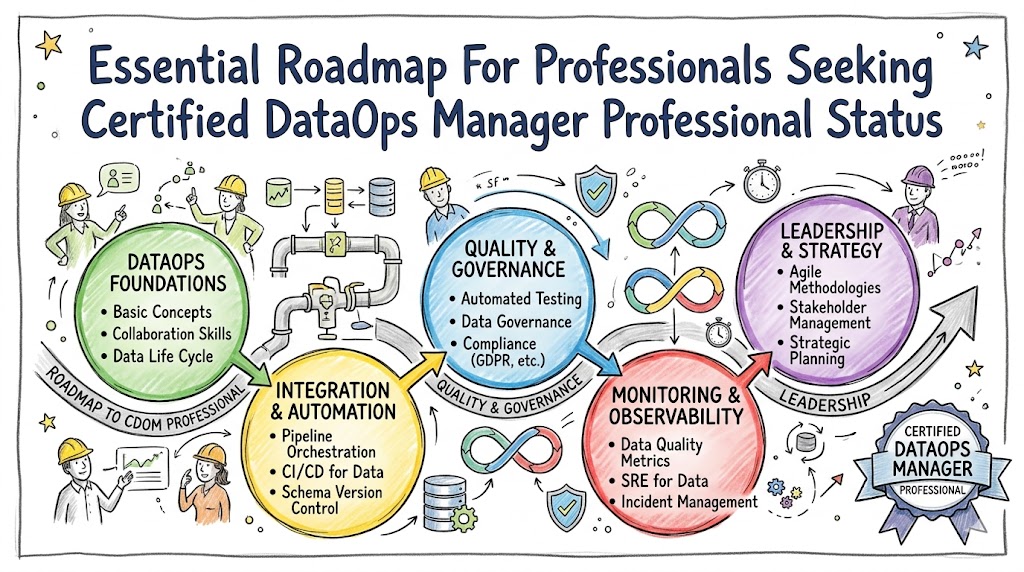
The landscape of modern data management is shifting toward automation and agility, making the CDOM – Certified DataOps Manager a vital credential for today’s leadership. This guide serves professionals navigating the complexities of DataOps within DevOps, cloud-native environments, and platform engineering. By understanding the strategic value provided by DataOpsSchool, engineers and managers can make informed decisions to advance their careers in high-scale data environments.
What is the CDOM – Certified DataOps Manager?
The CDOM – Certified DataOps Manager represents a specialized discipline focused on the intersection of data engineering and operational excellence. It exists to bridge the gap between data science and production-ready infrastructure, emphasizing the delivery of high-quality data at speed. Rather than focusing solely on theoretical frameworks, this certification prioritizes real-world application and modern enterprise practices. It aligns perfectly with current engineering workflows that demand continuous integration and deployment of data pipelines.
Who Should Pursue CDOM – Certified DataOps Manager?
This certification specifically benefits data engineers, site reliability engineers, and cloud professionals who manage large-scale data systems. Security and data governance roles will also find significant value in the structured approach to lifecycle management offered here. Both beginners looking to specialize and seasoned managers aiming to lead data-driven teams can leverage this knowledge for global career opportunities. In the Indian market and across the global tech landscape, these skills are becoming mandatory for senior leadership roles.
Why CDOM – Certified DataOps Manager is Valuable and Beyond
The demand for DataOps expertise is growing as organizations realize that traditional data management cannot keep pace with cloud-native growth. This certification ensures long-term career longevity by providing a framework that remains relevant even as specific tools and technologies evolve. Enterprises are rapidly adopting these practices to reduce technical debt and improve the reliability of their data products. Investing time in this certification provides a high return through increased operational efficiency and specialized marketability.
CDOM – Certified DataOps Manager Certification Overview
The program is delivered via the official portal and is hosted on the primary platform. It utilizes a practical assessment approach that evaluates a candidate’s ability to manage complex data lifecycles and team dynamics. The structure focuses on ownership, accountability, and the technical orchestration required to run production-grade data operations. Participants move through a curriculum designed to mirror the challenges faced by modern data organizations.
CDOM – Certified DataOps Manager Certification Tracks & Levels
The certification is organized into foundation, professional, and advanced levels to cater to different stages of professional growth. Foundation levels focus on the core principles of data flow and automation, while professional tracks dive into specific orchestrations like SRE or FinOps integration. Advanced levels are designed for those moving into executive leadership or principal engineering roles. This tiered approach allows professionals to align their learning path with their specific career trajectory and organizational needs.
Complete CDOM – Certified DataOps Manager Certification Table
| Track | Level | Who it’s for | Prerequisites | Skills Covered | Recommended Order |
| Core DataOps | Foundation | Aspiring Managers | Basic Data Knowledge | Pipeline Basics, Agile | First |
| Engineering | Professional | Data Engineers | 2 Years Experience | Automation, CI/CD | Second |
| Leadership | Advanced | Senior Leaders | 5 Years Experience | Governance, Strategy | Third |
Detailed Guide for Each CDOM – Certified DataOps Manager Certification
CDOM – Certified DataOps Manager – Foundation
What it is
This level validates a fundamental understanding of DataOps principles and the ability to communicate across data and operations teams. It serves as the baseline for all subsequent managerial specializations.
Who should take it
New data managers, junior data engineers, and project managers transitioning into technical data roles should start here. It is ideal for those with limited exposure to automated data pipelines.
Skills you’ll gain
- Understanding the DataOps manifesto
- Basics of automated testing for data
- Collaboration techniques between silos
- Version control for data schemas
Real-world projects you should be able to do
- Documenting a cross-functional data workflow
- Setting up a basic automated data quality check
- Creating a communication plan for data downtime
Preparation plan
- 7–14 Days: Focus on vocabulary, core concepts, and the primary pillars of DataOps.
- 30 Days: Review case studies and practice with basic pipeline documentation tools.
- 60 Days: Deep dive into organizational change management and team structures.
Common mistakes
- Ignoring the cultural aspect of DataOps in favor of only learning tools.
- Skipping the fundamental principles of lean manufacturing applied to data.
Best next certification after this
- Same-track option: CDOM Professional
- Cross-track option: SRE Practitioner
- Leadership option: Engineering Management Core
Choose Your Learning Path
DevOps Path
Professionals on this path focus on integrating data pipelines into existing CI/CD workflows. They prioritize the automation of data infrastructure and the use of containers for data processing. This ensures that data delivery is as fast and reliable as software delivery. It requires a deep understanding of infrastructure as code.
DevSecOps Path
This path emphasizes the security of data at rest and in transit throughout the lifecycle. It involves integrating automated security scanning into data pipelines and ensuring compliance with global regulations. Managers here focus on “shifting left” for data privacy and encryption. It is critical for regulated industries like finance and healthcare.
SRE Path
The SRE path for data focuses on the reliability, availability, and performance of data systems. Professionals learn to apply site reliability engineering principles like SLIs and SLOs to data quality and pipeline uptime. They manage data “toil” through automation and rigorous incident response. This path is vital for high-scale web platforms.
AIOps Path
This specialty involves using artificial intelligence to enhance operational efficiency. Managers learn to deploy machine learning models that predict system failures and automate root cause analysis. It focuses on the bridge between massive data streams and actionable operational intelligence. It is a highly technical track for modern monitoring.
MLOps Path
The MLOps path is dedicated to the lifecycle of machine learning models. It covers everything from data versioning to model deployment and monitoring in production. Managers focus on the reproducibility of experiments and the scaling of model training environments. This is the fastest-growing area for data-heavy organizations.
DataOps Path
The core path focuses exclusively on the orchestration of people, processes, and technology for data delivery. It emphasizes the elimination of bottlenecks in the data supply chain and the improvement of data quality. Managers here are responsible for the overall health of the organizational data culture. It serves as the backbone for all other tracks.
FinOps Path
This path addresses the financial accountability of data operations in the cloud. Managers learn to optimize the costs of data storage and processing without sacrificing performance. It involves deep analysis of cloud billing and the implementation of cost-efficient data architectures. This is essential for maintaining profitability in data-heavy startups.
Role → Recommended CDOM – Certified DataOps Manager Certifications
| Role | Recommended Certifications |
| DevOps Engineer | CDOM Foundation, DevOps Specialist |
| SRE | CDOM Professional, SRE Core |
| Platform Engineer | CDOM Advanced, Infrastructure Lead |
| Cloud Engineer | CDOM Foundation, Cloud Orchestrator |
| Security Engineer | CDOM DevSecOps Specialist |
| Data Engineer | CDOM Professional, Pipeline Expert |
| FinOps Practitioner | CDOM FinOps Associate |
| Engineering Manager | CDOM Advanced Leadership |
Next Certifications to Take After CDOM – Certified DataOps Manager
Same Track Progression
Continuing within the same track involves moving toward expert-level certifications that focus on enterprise-wide architecture. This allows a professional to become the primary authority on DataOps within a large organization. It typically involves mastering complex orchestration and multi-cloud data strategies.
Cross-Track Expansion
Broadening skills across tracks involves taking certifications in SRE or DevSecOps to complement DataOps knowledge. This makes a professional more versatile and capable of leading multidisciplinary engineering teams. It is a strategic move for those aiming for “T-shaped” skill profiles in the job market.
Leadership & Management Track
Transitioning to the leadership track focuses on the business impact of technology and team scaling. These certifications prepare professionals for Director or VP-level roles where strategic planning is more important than hands-on configuration. It emphasizes budgeting, talent development, and long-term technical roadmaps.
Training & Certification Support Providers for CDOM – Certified DataOps Manager
DevOpsSchool
This provider offers extensive resources and hands-on labs tailored for those seeking to master the operational side of software delivery and data management. Their curriculum is updated frequently to reflect the latest industry trends and toolsets required for modern enterprise success.
Cotocus
A specialized training organization that focuses on providing deep technical insights into cloud-native technologies and automated workflows. They are known for their practical approach and their ability to help professionals bridge the gap between theory and production reality.
Scmgalaxy
This platform serves as a massive knowledge hub for configuration management, continuous integration, and data operations. It provides a wealth of community-driven content and professional courses designed to support the entire lifecycle of engineering management.
BestDevOps
Focusing on quality and excellence, this provider offers curated learning paths for engineers who want to stay at the forefront of the DevOps movement. Their programs emphasize the integration of data and operations for improved business outcomes.
devsecopsschool.com
This institution specializes in the intersection of security, development, and operations. Their courses are essential for DataOps managers who need to ensure that data integrity and privacy are maintained throughout the automated pipeline.
sreschool.com
Providing a dedicated focus on site reliability engineering, this provider helps professionals understand how to keep complex data systems running smoothly. Their training covers the essential metrics and automation strategies needed for high availability.
aiopsschool.com
This provider leads the way in teaching how to apply artificial intelligence to IT operations. Their curriculum is vital for managers looking to implement predictive maintenance and automated problem resolution in their data environments.
dataopsschool.com
The primary authority on DataOps education, offering comprehensive certification paths specifically for data managers and engineers. They provide the core framework and technical training necessary to excel in the CDOM certification process.
finopsschool.com
This school focuses on the financial management of cloud resources, providing the tools and knowledge needed to control costs. It is an invaluable resource for DataOps managers who are responsible for the bottom line of data infrastructure.
Frequently Asked Questions
- How difficult is the CDOM certification?
The difficulty is moderate to high, as it requires a blend of technical knowledge and managerial soft skills to pass.
- What is the typical time commitment for preparation?
Most professionals find that 30 to 60 days of consistent study is sufficient to cover the comprehensive curriculum.
- Are there any specific prerequisites for the foundation level?
No formal prerequisites exist, but a basic understanding of data pipelines and agile methodologies is highly recommended for success.
- What is the expected ROI for this certification?
Professionals often see increased salary offers and access to senior leadership roles within data-centric organizations after obtaining this credential.
- In what sequence should I take the certifications?
It is best to start with the Foundation level, followed by the Professional Engineering track, and finally the Advanced Leadership level.
- Does the certification focus on specific tools?
While it mentions tools, the primary focus is on the methodology and principles that apply across various technology stacks.
- How long is the certification valid?
The certification typically remains valid for two to three years, after which renewal or higher-level certification is recommended.
- Is this certification recognized globally?
Yes, the principles taught are based on industry standards used by major enterprises in India, the US, and Europe.
- Can a manager with no coding experience pass this?
While difficult, a manager with strong process knowledge can pass, though some technical literacy in automation is necessary for the labs.
- How does this differ from a standard Data Engineering certificate?
Standard certificates focus on building pipelines, while this certification focuses on managing, scaling, and optimizing the operations around those pipelines.
- Is there a community or alumni network?
Yes, most providers offer access to forums and networking groups where certified professionals share insights and job opportunities.
- Are the exams remote or in-person?
Exams are typically conducted through secure online proctoring, allowing candidates to take them from anywhere in the world.
FAQs on CDOM – Certified DataOps Manager
- What specific management frameworks are covered in the CDOM curriculum?
The curriculum covers Lean, Agile, and Total Quality Management as they specifically apply to data manufacturing and delivery pipelines within the organization.
- Does the CDOM certification cover data privacy laws like GDPR?
Yes, it includes sections on integrating compliance and data governance into the automated DataOps lifecycle to ensure legal standards are met.
- How does CDOM address the problem of “Data Silos” in large enterprises?
It provides communication frameworks and technical orchestration strategies designed to break down barriers between data scientists, engineers, and operational staff.
- Will I learn about cloud cost optimization for big data?
The certification includes FinOps principles tailored for data operations, helping managers reduce waste in storage and compute costs for large datasets.
- Is automated testing of data quality a core part of the exam?
Yes, a significant portion of the assessment focuses on implementing automated checks to ensure data accuracy and consistency across the entire pipeline.
- How does the certification stay updated with changing technology?
The hosting providers regularly update the exam objectives and training materials to include emerging trends like AIOps and advanced metadata management.
- What is the focus of the CDOM Advanced Leadership level?
This level focuses on strategic alignment, budgeting, team scaling, and building a culture of continuous improvement across the entire data organization.
- Can I use this certification to move into a Director of Data Operations role?
The CDOM is specifically designed to provide the credentials and knowledge base required for high-level management and directorial positions in data.
Final Thoughts: Is CDOM – Certified DataOps Manager Worth It?
From a professional standpoint, the CDOM – Certified DataOps Manager is a highly strategic investment for anyone serious about the future of data. As organizations move away from manual data handling toward automated, scalable systems, the role of a DataOps manager becomes indispensable. This certification provides more than just a title; it offers a structured way to think about the complex relationship between data, people, and technology. If you are looking to future-proof your career and take on leadership responsibilities in a data-driven world, the value of this path is clear. It bridges the gap between being a technical contributor and a strategic leader. For those ready to lead the next generation of engineering teams, the journey starts here.