Introduction
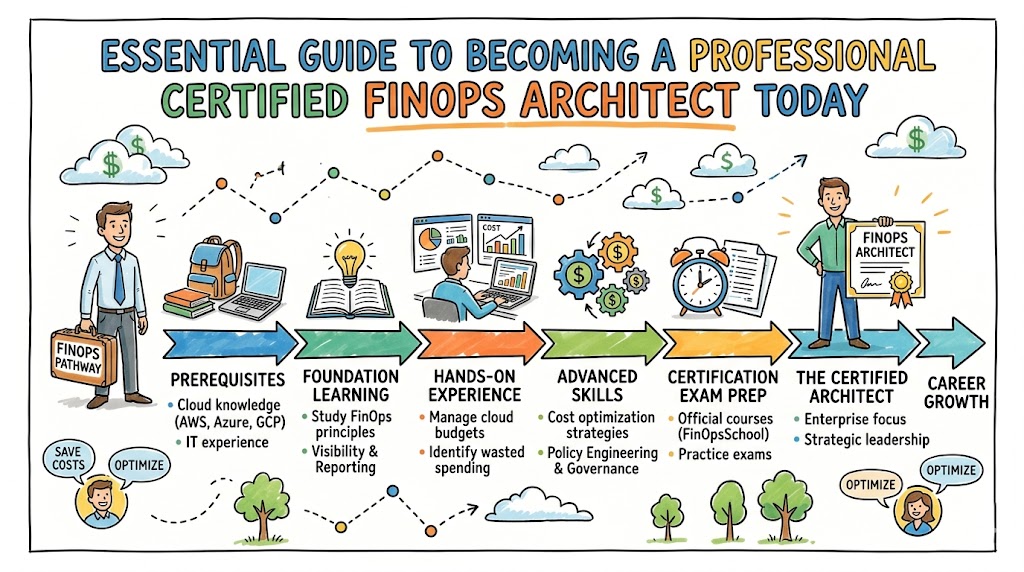
Cloud financial management has evolved into a critical pillar of modern engineering, making the Certified FinOps Architect a vital credential for technical leaders. This guide serves professionals navigating the intersection of DevOps, cloud-native architecture, and cost optimization. By mastering these principles, engineers can ensure that platform scalability does not lead to uncontrolled cloud expenditures. As FinOpsSchool provides the framework for this transition, this article helps you determine if this path aligns with your long-term career trajectory.
What is the Certified FinOps Architect?
The Certified FinOps Architect represents the pinnacle of technical cloud financial management, focusing on the architectural decisions that drive cost efficiency. It exists because high-level engineering choices directly impact a company’s bottom line, requiring a blend of SRE discipline and financial accountability. This program emphasizes production-focused learning, moving beyond basic terminology to address complex enterprise practices. It aligns with modern engineering workflows by integrating fiscal awareness into the very fabric of the software development lifecycle.
Who Should Pursue Certified FinOps Architect?
This path is designed for senior engineers, SREs, and cloud architects who are responsible for large-scale infrastructure and platform budgets. Security and data roles also benefit greatly as they learn to balance protection and performance with resource allocation. Beginners can use this to build a solid foundation, while experienced managers gain the vocabulary to bridge the gap between finance and engineering teams. The certification holds significant global and India-specific relevance as local enterprises rapidly scale their multi-cloud environments and seek cost-efficient growth.
Why Certified FinOps Architect is Valuable and Beyond
The demand for architects who understand cloud unit economics is skyrocketing as enterprises move past the initial cloud migration phase and into optimization. This certification provides longevity because it teaches core principles that remain relevant even as specific cloud providers change their pricing models. It helps professionals stay indispensable by proving they can deliver high-performance systems that are also fiscally sustainable. Ultimately, it offers a massive return on time by positioning the holder as a strategic asset capable of influencing executive-level technical decisions.
Certified FinOps Architect Certification Overview
The program is delivered via the official curriculum and hosted on the FinOpsSchool platform, ensuring a standardized and high-quality learning experience. It utilizes a rigorous assessment approach that tests both theoretical knowledge and the ability to apply optimization strategies in complex scenarios. The structure is practical, focusing on the ownership of cloud resources and the implementation of automated guardrails. By completing this program, architects demonstrate a deep understanding of how to govern cloud environments without hindering engineering velocity.
Certified FinOps Architect Certification Tracks & Levels
The certification hierarchy begins with foundation levels that introduce core concepts of visibility and allocation for those new to the domain. The professional level dives deeper into optimization and performance, catering to those who manage active production environments daily. Finally, the advanced architect level focuses on governance, policy-as-code, and large-scale organizational transformation. These levels align with career progression, moving from individual contributor tasks to high-level strategic oversight within the FinOps framework.
Complete Certified FinOps Architect Certification Table
| Track | Level | Who it’s for | Prerequisites | Skills Covered | Recommended Order |
|---|---|---|---|---|---|
| Foundation | Associate | Junior Engineers | Basic Cloud Knowledge | Cost Allocation, Visibility | 1 |
| Professional | Practitioner | DevOps/SRE | 1 Year Cloud Exp | Optimization, Reporting | 2 |
| Advanced | Architect | Cloud Architects | Professional Level | Policy Engineering, Governance | 3 |
| Leadership | Director | Tech Leaders | 5+ Years Exp | Unit Economics, Strategy | 4 |
Export to Sheets
Detailed Guide for Each Certified FinOps Architect Certification
Certified FinOps Architect – Foundation Level
What it is This certification validates a foundational understanding of cloud financial management principles and the basic lifecycle of FinOps. It ensures the candidate can identify various cloud billing components and understand how to allocate costs effectively.
Who should take it This is suitable for junior developers, finance associates, and cloud administrators who need a basic understanding of cloud spending. It is the ideal entry point for anyone transitioning into a cloud-focused role.
Skills you’ll gain
- Understanding cloud billing models.
- Basics of tagging and resource labeling.
- Navigating cloud provider cost explorers.
- Identifying wasted resources.
Real-world projects you should be able to do
- Create a basic cost allocation report for a small department.
- Identify and shut down unattached storage volumes.
Preparation plan
- 7–14 days: Review official documentation and core terminology.
- 30 days: Complete a foundational course and practice with cloud billing consoles.
- 60 days: Not typically required for this level unless new to cloud.
Common mistakes Candidates often overlook the importance of the cultural aspect of FinOps, focusing only on the technical side of the billing console.
Best next certification after this
- Same-track option: Certified FinOps Professional.
- Cross-track option: DevOps Associate.
- Leadership option: Project Management Professional.
Certified FinOps Architect – Professional Level
What it is This level validates the ability to implement optimization strategies and manage the day-to-day operations of a FinOps team. It proves you can translate business requirements into technical cloud cost-saving actions.
Who should take it It is designed for DevOps engineers and SREs who have at least one year of experience managing cloud infrastructure. It suits those responsible for platform efficiency and budget reporting.
Skills you’ll gain
- Advanced commitment-based discount management.
- Developing automated cleanup scripts.
- Building custom dashboards for engineering teams.
- Rightsizing complex container environments.
Real-world projects you should be able to do
- Implement an automated spot instance strategy for non-production workloads.
- Design a multi-account tagging policy that survives organizational changes.
Preparation plan
- 7–14 days: Intensive review of rightsizing patterns.
- 30 days: Hands-on labs focusing on Reserved Instances and Savings Plans.
- 60 days: Full curriculum study including case studies on enterprise migration.
Common mistakes Ignoring the “Inform” phase of FinOps and jumping straight to “Optimize” without proper data visibility is a frequent error.
Best next certification after this
- Same-track option: Certified FinOps Architect.
- Cross-track option: SRE Professional.
- Leadership option: Engineering Manager Certification.
Choose Your Learning Path
DevOps Path
Engineers following this path integrate financial guardrails directly into the CI/CD pipeline. They focus on infrastructure as code tools to ensure that every resource deployed is tagged and compliant with budget limits. This path bridges the gap between fast deployments and fiscal responsibility, ensuring that automated scaling does not cause budget overruns.
DevSecOps Path
This trajectory emphasizes the cost of security tools and the financial impact of compliance-related data storage. Professionals learn to balance high-security data retention policies with the associated cloud storage costs. They implement automated security checks that also audit the cost-efficiency of the security stack itself.
SRE Path
Site Reliability Engineers focus on the intersection of performance, reliability, and cost. They use FinOps data to determine the cost of a “nine” of availability and help the business decide if higher reliability is worth the extra expense. This path treats cost as a key service level indicator.
AIOps Path
Artificial Intelligence for IT Operations professionals use machine learning to predict cloud spending and detect anomalies in real-time. They build automated systems that can proactively adjust infrastructure based on predicted traffic and historical cost data. This path is for those who enjoy data science and automation.
MLOps Path
Machine Learning Operations focus on the massive compute and storage costs associated with training and deploying models. They optimize GPU utilization and manage the lifecycle of massive datasets to minimize egress and storage fees. This path is critical for companies heavily invested in AI research and deployment.
DataOps Path
Data operations experts manage the lifecycle of data pipelines where storage and processing costs can spiral quickly. They focus on optimizing SQL queries, data warehousing configurations, and cold storage migration strategies. This path ensures that data-driven insights do not come at a prohibitive price.
FinOps Path
The pure FinOps path is for those who want to specialize entirely in cloud economics and organizational culture. These individuals lead the central FinOps team, managing relationships between finance, procurement, and engineering. They are responsible for the overall cloud financial health of the entire organization.
Role → Recommended Certified FinOps Architect Certifications
| Role | Recommended Certifications |
|---|---|
| DevOps Engineer | FinOps Practitioner, Terraform Associate |
| SRE | FinOps Architect, Reliability Professional |
| Platform Engineer | FinOps Architect, Kubernetes Administrator |
| Cloud Engineer | FinOps Practitioner, Cloud Solutions Architect |
| Security Engineer | FinOps Associate, Cloud Security Professional |
| Data Engineer | FinOps Practitioner, Data Engineering Professional |
| FinOps Practitioner | FinOps Architect, FinOps Professional |
| Engineering Manager | FinOps Associate, Engineering Leadership |
Export to Sheets
Next Certifications to Take After Certified FinOps Architect
Same Track Progression
For those wanting to reach the absolute top of the field, moving into advanced governance and policy-as-code is the logical next step. This involves mastering complex automation tools that enforce financial policies across thousands of cloud accounts. Deep specialization here often leads to roles like Head of Cloud Infrastructure or Principal FinOps Engineer.
Cross-Track Expansion
Broadening your skills into SRE or Platform Engineering allows you to apply FinOps principles more effectively within the technical stack. Understanding how Kubernetes manages resources or how serverless architectures scale helps you find deeper optimization opportunities. This makes you a more versatile engineer who understands both the “how” and the “cost” of technology.
Leadership & Management Track
Transitioning into leadership requires a shift from technical optimization to strategic value realization. Certifications in engineering management or business administration complement your technical FinOps knowledge. This path prepares you for executive roles like CTO or VP of Engineering where managing large budgets and technical teams is paramount.
Training & Certification Support Providers for Certified FinOps Architect
DevOpsSchool This provider offers extensive training programs that cover the full spectrum of cloud and automated operations. Their curriculum is designed for working professionals who need to gain practical skills quickly and effectively. They provide a robust platform for learning the latest industry tools and methodologies required for modern software delivery.
Cotocus Focusing on high-end consulting and training, this organization helps teams master complex cloud architectures and site reliability practices. Their instructors bring real-world experience into the classroom, ensuring that students learn how to solve actual production problems. They are known for their deep technical expertise in platform engineering.
Scmgalaxy As a community-driven platform, they provide a wealth of resources for software configuration management and continuous integration. Their training modules are highly practical and focused on the automation of the entire development lifecycle. They help engineers stay updated with the rapidly changing landscape of DevOps tools.
BestDevOps This portal specializes in curated content and expert-led training for those aspiring to become leaders in the DevOps space. They emphasize the integration of security and financial awareness into traditional engineering workflows. Their programs are structured to help professionals achieve industry-recognized credentials with confidence.
devsecopsschool.com This institution focuses specifically on the intersection of security and development, providing specialized tracks for security professionals. They teach candidates how to build secure pipelines and manage the financial impact of security infrastructure. Their certifications are highly valued in industries with strict compliance requirements.
sreschool.com Dedicated to the discipline of Site Reliability Engineering, this school provides in-depth training on availability, latency, and performance. They integrate FinOps into their curriculum to show how cost efficiency is a major component of reliable systems. Their labs simulate real-world outages and optimization scenarios.
aiopsschool.com This provider leads the way in teaching how to use artificial intelligence to manage complex IT operations. Their courses cover machine learning models that predict system behavior and optimize resource allocation automatically. They are an essential resource for engineers looking to work at the cutting edge of automation.
dataopsschool.com Focusing on the data lifecycle, this organization helps professionals manage the flow of data from ingestion to insight. They teach the financial implications of data storage and the technical skills needed to optimize large-scale data processing. Their training is vital for modern data engineers and architects.
finopsschool.com As the primary host for the architect program, they offer the most direct and comprehensive path to mastering cloud financial management. Their community and resources are dedicated exclusively to the FinOps framework and its practical application. They provide the tools and networking opportunities needed to succeed in this specialized field.
Frequently Asked Questions
- How difficult is the Architect exam compared to the Associate level?
The Architect exam is significantly more difficult because it requires a deep understanding of infrastructure design and multi-cloud governance. It focuses on application rather than just memorizing definitions. - Is there a prerequisite for the Architect certification?
While not always mandatory, having a professional-level cloud certification or the FinOps Practitioner credential is highly recommended for success. - How much time should I dedicate to studying for this?
Most working professionals spend between 30 to 60 days preparing, depending on their existing experience with cloud billing and architecture. - Does this certification help with career growth in India?
Yes, Indian enterprises and global capability centers are aggressively hiring for FinOps roles to manage their massive cloud spends efficiently. - Is the ROI worth the cost of the exam?
The salary increase associated with FinOps expertise often covers the exam cost within the first few months of a new role or promotion. - Can a non-technical person pass the Architect exam?
It is very challenging for non-technical individuals because the exam covers architectural patterns, containerization, and automation scripts. - How often do I need to recertify?
Certifications typically require renewal every two to three years to ensure you are up to date with the latest cloud pricing models. - Which cloud provider is emphasized in the training?
The training is generally cloud-agnostic, focusing on principles that apply to AWS, Azure, Google Cloud, and Oracle Cloud equally. - What is the most important skill for a FinOps Architect?
The ability to translate technical infrastructure decisions into financial outcomes and communicate them to business stakeholders is the most vital skill. - Are there lab-based questions in the assessment?
Many advanced assessments now include scenario-based questions that simulate real-world architectural challenges and require specific optimization solutions. - How does FinOps differ from traditional IT procurement?
FinOps is a continuous, collaborative practice that involves engineers in the financial process, whereas traditional procurement is often a centralized, one-time activity. - Should I learn Kubernetes before taking this exam?
A basic understanding of Kubernetes is very helpful since container cost allocation is a major topic in modern FinOps architecture.
FAQs on Certified FinOps Architect
- What specific architectural patterns does this program cover for cloud cost efficiency?
The program focuses on patterns like auto-scaling, serverless computing, and spot instance integration. It also covers multi-region data transfer optimization and storage tiering strategies. - Does the certification teach how to build custom FinOps tools?
It covers the logic and requirements for building internal dashboards and automation scripts. It focuses on what these tools should accomplish and how they integrate with cloud APIs. - How does this program address the challenge of shared cost allocation in Kubernetes?
Candidates learn to use labels and namespaces to distribute costs fairly among different teams. It teaches methods for calculating the cost of idle resources within a shared cluster. - Are there specific governance frameworks included in the curriculum?
The curriculum includes policy-as-code frameworks that allow architects to enforce spending limits and resource configurations automatically across the organization. - How does the Architect role interact with the finance department?
The architect provides the technical data and context that finance needs to make accurate forecasts. They act as the bridge that explains why certain technical costs are necessary. - Does the exam cover commitment-based discounts like Savings Plans and RIs?
Yes, it requires a deep understanding of how to calculate the break-even point for different commitment models and how to manage them at scale. - What is the focus on unit economics within the Architect level?
Architects learn to measure the cost of cloud resources against business metrics, such as the cost per transaction or cost per active user. - Is cloud migration cost modeling part of the certification?
It includes strategies for forecasting the cost of moving workloads from on-premises to the cloud, including the “double bubble” cost during the transition phase.
Final Thoughts: Is Certified FinOps Architect Worth It?
Investing in this certification is a strategic move for any engineer who wants to remain relevant in a world where cloud costs are under constant scrutiny. It moves you away from being a “cost center” and positions you as a “value driver” for your organization. The skills you learn are not just about saving money; they are about building better, more efficient systems that allow the business to grow sustainably. If you enjoy the challenge of optimizing complex systems and want to have a direct impact on your company’s profitability, this path is absolutely worth the effort. It provides a rare combination of technical depth and business acumen that is highly sought after in the current market.