Introduction
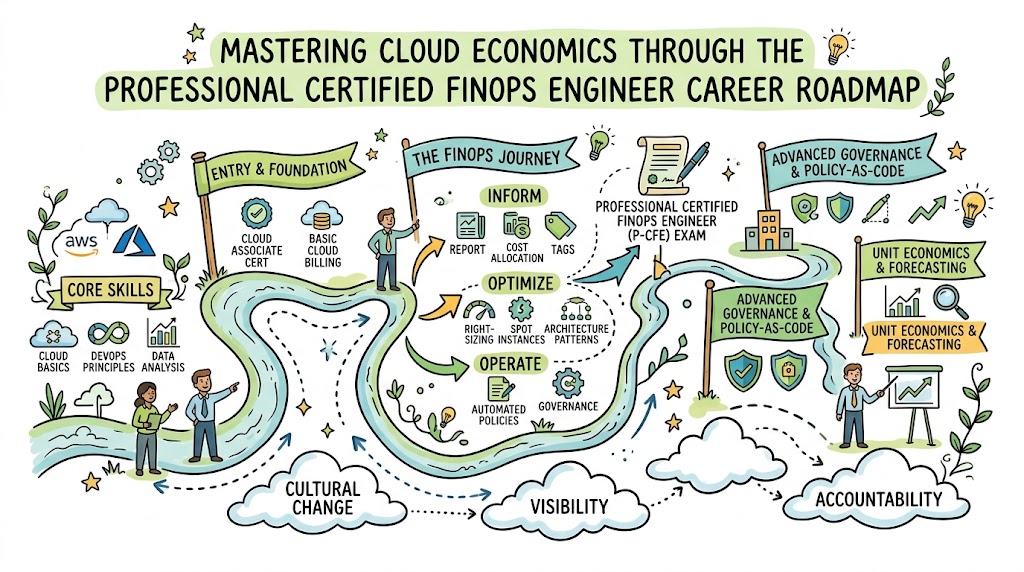
The modern cloud ecosystem demands more than just technical deployment skills; it requires a deep understanding of financial accountability and resource optimization. This guide explores the Certified FinOps Engineer program, a specialized path designed for engineers who want to master the intersection of finance and cloud engineering. As organizations scale their digital footprints, the need for professionals who can bridge the gap between procurement and DevOps has become critical. This certification empowers practitioners to drive cultural shifts within their teams while maintaining high-performance cloud environments. Whether you are an SRE looking to optimize costs or a manager seeking better visibility, FinOpsSchool provides the necessary framework to succeed in these complex roles.
What is the Certified FinOps Engineer?
The Certified FinOps Engineer represents a shift from traditional cost management toward dynamic cloud financial operations. It exists to validate that an engineer understands the lifecycle of cloud spending and can implement automated governance. Unlike theoretical courses, this program focuses on production-ready strategies that align engineering velocity with business value. It bridges the gap between the speed of cloud innovation and the stability of corporate budgeting processes.
Who Should Pursue Certified FinOps Engineer?
Site Reliability Engineers and DevOps professionals benefit immensely from this certification as they handle the infrastructure that generates cloud costs. Platform engineers who build internal tools need this knowledge to embed cost-awareness into the developer experience. Additionally, cloud architects and engineering managers find value in learning how to forecast spending and justify cloud investments to stakeholders. Both seasoned experts and beginners in cloud finance will find the curriculum applicable to global enterprise standards.
Why Certified FinOps Engineer is Valuable in Current Times and Beyond
Cloud spending continues to rise, making financial discipline a permanent requirement for sustainable engineering. This certification ensures longevity in a career by moving beyond simple tool proficiency into the realm of strategic business impact. It helps professionals remain relevant even as cloud providers change their pricing models or services. The return on time invested is high, as companies prioritize hiring individuals who can demonstrate immediate cost-saving capabilities and architectural efficiency.
Certified FinOps Engineer Certification Overview
The program is delivered via the official portal and hosted on the primary website. It focuses on a practical assessment approach rather than simple multiple-choice questions. The ownership of the certification lies with an industry-recognized body that prioritizes hands-on competence in cloud billing and resource tagging. The structure is built to simulate real-world enterprise environments where engineers must manage multi-cloud budgets and complex discount programs.
Certified FinOps Engineer Certification Tracks & Levels
The certification structure typically follows a progression from foundation to advanced professional levels. The foundation track introduces core concepts like the inform, optimize, and operate phases of the lifecycle. Professional tracks dive deeper into automation, policy-as-code, and unit economics for cloud resources. These levels align with career growth, allowing an individual to move from a contributor role into a specialized lead or architect position.
Complete Certified FinOps Engineer Certification Table
| Track | Level | Who it’s for | Prerequisites | Skills Covered | Recommended Order |
| Core Engineering | Associate | Cloud Beginners | Basic Cloud Knowledge | Tagging, Visibility, Reporting | First |
| Optimization | Professional | DevOps / SRE | Associate Cert | Rightsizing, Spot Instances | Second |
| Governance | Specialist | Architects | Professional Cert | Policy Automation, Compliance | Third |
| Leadership | Expert | Managers / Leads | Senior Experience | Unit Economics, Forecasting | Final |
Detailed Guide for Each Certified FinOps Engineer Certification
Certified FinOps Engineer – Associate Level
What it is
This certification validates the fundamental understanding of cloud financial management principles. It ensures the candidate can navigate cloud billing consoles and understand basic cost drivers.
Who should take it
It is suitable for junior cloud engineers or finance analysts who are moving into the cloud space. It serves as a perfect entry point for anyone needing a baseline of cloud vocabulary.
Skills you’ll gain
- Mastery of the FinOps lifecycle phases.
- Ability to generate and interpret cost reports.
- Understanding of cloud billing structures and discounting.
Real-world projects you should be able to do
- Setting up a consistent resource tagging strategy.
- Creating automated cost alerts for development teams.
Preparation plan
- 7–14 days: Intensive review of core documentation and cloud pricing models.
- 30 days: Hands-on practice with billing dashboards and sample data sets.
- 60 days: In-depth study of organizational change management and unit economics.
Common mistakes
- Focusing only on technical tools while ignoring the cultural aspect of finance.
- Underestimating the complexity of multi-cloud billing exports.
Best next certification after this
- Same-track: Professional FinOps Engineer.
- Cross-track: Cloud Architect Certification.
- Leadership: FinOps Lead Practitioner.
Choose Your Learning Path
DevOps Path
This path focuses on integrating cost-visibility directly into the CI/CD pipeline. Engineers learn how to provide immediate feedback to developers regarding the financial impact of their code changes. It emphasizes the “Shift Left” approach for financial accountability. Practitioners will gain skills in infrastructure-as-code and cost-modeling for automated deployments.
DevSecOps Path
The intersection of security and finance involves managing the costs of compliance and monitoring tools. This path explores how to balance high-security postures with efficient resource utilization. It teaches engineers how to identify “zombie” resources that pose both a security risk and a financial drain. Professionals learn to audit cloud environments for both leaks and spend.
SRE Path
Site Reliability Engineers use this path to treat cost as a key performance indicator alongside latency and availability. It focuses on the trade-offs between system redundancy and budget constraints. Engineers learn to implement error budgets that include financial thresholds. This path is essential for those managing large-scale, high-availability distributed systems.
AIOps Path
This track explores the use of machine learning to predict cloud spending and automate rightsizing. Professionals learn to deploy AI models that can identify anomalies in billing data before they become major issues. It involves using intelligent automation to manage fluctuating workloads. The focus is on reducing manual intervention in cost management.
MLOps Path
Machine Learning operations require massive compute power, making cost management a primary concern. This path teaches how to optimize GPU clusters and manage expensive training jobs. It focuses on the financial lifecycle of data pipelines and model deployment. Engineers learn to calculate the ROI of specific AI experiments accurately.
DataOps Path
Data engineers deal with massive storage and egress costs that can spiral out of the control. This path provides strategies for managing data lifecycle policies and optimizing database queries for cost. It covers the financial impact of different data architectures and storage tiers. Practitioners learn to build cost-efficient data lakes and warehouses.
FinOps Path
This is the dedicated specialization for those who want to become full-time cloud financial managers. It covers advanced topics like commitment-based discounts and organizational procurement strategies. The path focuses on the high-level coordination between engineering, finance, and executive leadership. It prepares individuals to lead a dedicated FinOps center of excellence.
Role → Recommended Certified FinOps Engineer Certifications
| Role | Recommended Certifications |
| DevOps Engineer | Associate + Optimization Track |
| SRE | Professional + Governance Track |
| Platform Engineer | Foundation + Automation Track |
| Cloud Engineer | Associate + Multi-Cloud Specialist |
| Security Engineer | DevSecOps Finance Specialist |
| Data Engineer | DataOps Cost Architect |
| FinOps Practitioner | Professional + Leadership Track |
| Engineering Manager | Executive FinOps Overview |
Next Certifications to Take After Certified FinOps Engineer
Same Track Progression
Advancing within the same track involves moving toward expert-level certifications that focus on enterprise-wide governance. This includes mastering policy-as-code and complex contract negotiations with cloud providers. Deep specialization allows an engineer to become the primary authority on cloud value within a large organization.
Cross-Track Expansion
Broadening your skills involves taking certifications in SRE or Security to understand how finance impacts those domains. A cross-functional professional can speak the language of both the CFO and the Lead Developer. This expansion makes an individual indispensable during large-scale digital transformation projects.
Leadership & Management Track
Transitioning to leadership requires a focus on people, process, and organizational culture. Certifications in this track emphasize building FinOps teams and reporting value to the C-suite. It moves the professional from executing technical tasks to defining the long-term cloud strategy for the company.
Training & Certification Support Providers for Certified FinOps Engineer
DevOpsSchool
This provider offers extensive resources for professionals looking to master the technical side of cloud operations. Their programs focus on hands-on labs and real-world scenarios that prepare students for the rigors of modern engineering. They emphasize continuous integration and delivery as the foundation for all cloud work.
Cotocus
This organization specializes in high-end consulting and training for niche cloud technologies. They provide deep insights into infrastructure management and automated governance. Their approach is highly practical, focusing on the specific needs of large-scale enterprise deployments and complex cloud architectures.
Scmgalaxy
As a community-driven platform, this site provides a wealth of information on configuration management and software supply chains. They offer a collaborative environment for learning and troubleshooting technical issues. Their content is designed to help engineers stay updated on the latest industry trends and tools.
BestDevOps
This platform focuses on providing curated content and training for those aspiring to reach the top of the DevOps field. They emphasize best practices and architectural patterns that ensure system reliability and scalability. Their training is geared toward making engineers more efficient and effective in their roles.
devsecopsschool.com
This portal is dedicated to the integration of security into the DevOps lifecycle. They provide specialized training on automated security testing and compliance-as-code. Their curriculum is essential for professionals who need to maintain high security standards without slowing down the development process.
sreschool.com
Focused on site reliability engineering, this provider teaches the principles of building and operating highly available systems. They cover topics like incident management, service level objectives, and system observability. Their training is designed to help engineers reduce downtime and improve system performance.
aiopsschool.com
This provider leads the way in teaching how to apply artificial intelligence to IT operations. They focus on using data science to automate monitoring and issue resolution. Their courses are designed for engineers who want to stay ahead of the curve in automated system management.
dataopsschool.com
Focusing on the lifecycle of data, this school provides training on building robust and scalable data pipelines. They emphasize the collaboration between data engineers and operations teams. Their curriculum covers everything from data ingestion to advanced analytics and storage optimization.
finopsschool.com
This is the premier destination for cloud financial management training. They offer comprehensive courses that cover the entire FinOps framework and prepare students for official certifications. Their focus is on driving cultural change and financial accountability within engineering organizations.
Frequently Asked Questions (General)
- How difficult is the certification exam?The exam is moderate to challenging as it requires a mix of technical knowledge and financial understanding.
- What are the prerequisites for the associate level?No formal prerequisites exist, but basic cloud knowledge is highly recommended for success.
- How long does it take to prepare for the test?Most candidates spend between four and eight weeks depending on their prior cloud experience.
- Is this certification recognized globally?Yes, the frameworks taught are used by major enterprises across the globe for cloud management.
- Does the certification expire?Most certifications in this domain require renewal every two to three years to ensure knowledge remains current.
- What is the return on investment for this program?Professionals often see immediate career growth and the ability to save their organizations significant cloud costs.
- Are there hands-on labs included in the training?Yes, practical labs are a core component to ensure you can apply the concepts in real environments.
- Can I take the exam online?Most certification bodies offer proctored online exams for the convenience of global candidates.
- Does it cover multi-cloud environments?Yes, the principles are designed to be cloud-agnostic and applicable to AWS, Azure, and Google Cloud.
- How does this differ from a standard cloud architect cert?It focuses specifically on financial operations and unit economics rather than just technical architecture.
- Is there a community for certified professionals?There are extensive global communities and local chapters where practitioners share best practices and advice.
- Will this help me move into a management role?Absolutely, as it demonstrates your ability to manage budgets and communicate value to business stakeholders.
FAQs on Certified FinOps Engineer
- Which cloud providers are covered in this certification?The program focuses on universal principles applicable to AWS, Azure, and GCP, ensuring broad industry relevance for engineers.
- How does this certification help with career progression?It validates your ability to manage cloud costs, making you a high-value asset for companies scaling their infrastructure.
- What is the focus of the professional level?The professional level dives deep into automation, advanced forecasting, and the cultural implementation of the FinOps framework.
- Is financial background required to succeed?No, the course is designed for engineers; it teaches the necessary financial concepts from a technical perspective.
- How are the exams structured?The exams typically feature a combination of multiple-choice questions and scenario-based problems to test practical application.
- Can this certification be completed by teams?Yes, many organizations use this as a baseline to align their engineering and finance departments.
- Are there any hidden costs for the certification?The fee usually covers the exam, but additional study materials or training courses may have separate costs.
- What is the primary goal of a FinOps Engineer?The primary goal is to optimize cloud spending while ensuring that engineering teams have the resources they need.
Final Thoughts: Is Certified FinOps Engineer Worth It?
Investing in this certification is a strategic move for any cloud professional who wants to stand out in a crowded market. It moves you away from being a cost-center and positions you as a value-driver for the organization. The skills gained are not just about cutting costs but about making informed decisions that balance speed, quality, and price. As cloud environments become more complex, the ability to manage them financially will be just as important as managing them technically. For those looking to future-proof their careers and take on more senior responsibilities, this path offers a clear and practical roadmap.