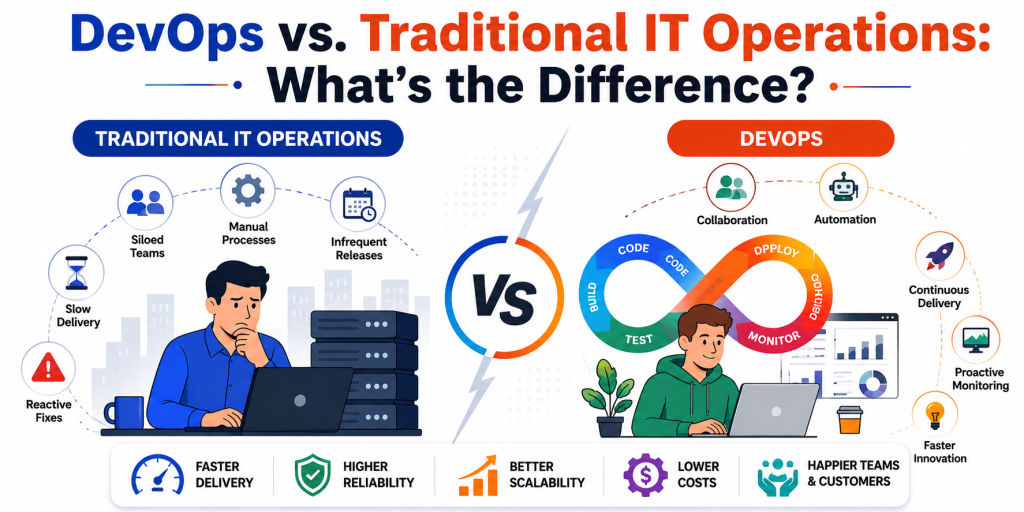
Modern organizations depend on technology to deliver products, services, and customer experiences. As digital transformation continues to accelerate, businesses need faster software delivery, better system reliability, and stronger collaboration between teams. This requirement has led to the rise of DevOps, a modern operational approach that differs significantly from traditional IT operations.
In the past, IT operations teams focused primarily on maintaining infrastructure, managing servers, and ensuring systems remained available. Development teams created software, while operations teams deployed and supported it. Although this model worked for many years, it often created communication gaps, slow release cycles, and operational bottlenecks. As a result, organizations started searching for a better way to align development and operations activities.
This is where Xopsschool and modern operational learning platforms help professionals understand how DevOps practices transform software delivery and infrastructure management. DevOps combines people, processes, and technology to create a culture of collaboration, automation, continuous improvement, and shared responsibility. Understanding the differences between DevOps and traditional IT operations helps organizations make informed decisions and helps professionals build valuable career skills in the modern technology landscape.
Understanding Traditional IT Operations
Traditional IT operations evolved during a time when software releases occurred infrequently and infrastructure changes happened at a slower pace. Organizations usually separated development, testing, security, and operations into different departments. Each team had its own responsibilities, goals, and performance metrics.
In this model, developers focused on building applications while operations teams managed servers, networks, databases, and production environments. Once development finished, software was handed over to operations teams for deployment. This handoff process often created delays because operations engineers needed to validate infrastructure requirements, configure systems, and resolve compatibility issues before deployment.
Traditional operations emphasized stability above everything else. Teams preferred minimizing changes because every modification carried the risk of causing outages or performance issues. While this approach reduced immediate risks, it often slowed innovation and prevented organizations from responding quickly to market demands. As businesses became increasingly dependent on software, these limitations became more visible and difficult to manage.
Another characteristic of traditional operations is the heavy reliance on manual processes. Engineers manually configured servers, updated software, performed deployments, and handled incident management tasks. Although experienced administrators could manage these activities effectively, manual processes increased the possibility of human error and reduced scalability.
Understanding DevOps
DevOps represents a cultural and operational transformation that breaks down barriers between development and operations teams. Rather than working in isolated departments, teams collaborate throughout the software lifecycle. This collaboration enables faster delivery, improved reliability, and more efficient problem-solving.
DevOps encourages automation wherever possible. Infrastructure provisioning, application deployment, testing, monitoring, and recovery procedures become automated workflows rather than manual activities. Automation reduces operational risk while improving consistency across environments.
A core principle of DevOps is continuous improvement. Teams constantly evaluate processes, identify bottlenecks, and implement enhancements. Feedback loops help organizations learn from incidents, customer experiences, and operational metrics. Instead of assigning blame when problems occur, DevOps teams focus on understanding root causes and preventing similar issues in the future.
DevOps also promotes shared ownership. Developers become more aware of production environments, while operations engineers participate earlier in the development process. This shared responsibility improves communication, increases accountability, and creates a stronger focus on delivering value to users.
Traditional IT Operations vs DevOps: Core Differences
The differences between traditional operations and DevOps extend beyond tools and technology. They involve mindset, collaboration, workflow design, and organizational culture.
| Area | Traditional IT Operations | DevOps |
|---|---|---|
| Team Structure | Separate departments | Collaborative teams |
| Deployment Frequency | Infrequent releases | Frequent releases |
| Change Management | Manual approvals | Automated workflows |
| Infrastructure | Manual management | Infrastructure as Code |
| Testing | Late-stage activity | Continuous testing |
| Monitoring | Reactive approach | Proactive approach |
| Incident Response | Siloed responsibility | Shared responsibility |
| Automation | Limited automation | Extensive automation |
| Feedback | Slow feedback cycles | Continuous feedback |
| Culture | Stability-focused | Balance of speed and reliability |
Traditional operations prioritize minimizing risk through strict control processes. DevOps seeks to reduce risk through automation, testing, monitoring, and continuous improvement. While both approaches value reliability, they achieve it through different methods.
Organizations adopting DevOps often discover that faster delivery and higher reliability can coexist when supported by strong engineering practices and effective collaboration.
Key Operational Concepts You Must Know
Understanding operational concepts helps professionals navigate both traditional and modern environments. These concepts form the foundation of effective infrastructure and software management.
Automation
Automation eliminates repetitive manual tasks by using scripts, workflows, and tools. Teams automate server provisioning, deployments, testing procedures, monitoring activities, and incident responses. Automation improves consistency, reduces human error, and allows engineers to focus on higher-value work.
Organizations that embrace automation typically experience faster deployment cycles, improved operational efficiency, and more predictable outcomes. Automation also supports scalability because systems can grow without requiring proportional increases in manual effort.
Continuous Integration
Continuous Integration involves regularly merging code changes into a shared repository. Automated testing validates each change before integration. This practice helps teams identify defects early and maintain software quality throughout development.
By integrating frequently, developers reduce merge conflicts and improve collaboration. Continuous Integration creates a foundation for faster software delivery while maintaining system stability and reliability.
Continuous Delivery
Continuous Delivery extends integration practices by ensuring applications remain deployment-ready at all times. Automated pipelines validate code quality, perform testing, and prepare releases for production deployment.
Organizations using Continuous Delivery can release features quickly and confidently. This capability allows businesses to respond rapidly to customer needs, market opportunities, and competitive pressures.
Infrastructure as Code
Infrastructure as Code enables teams to manage infrastructure using version-controlled configuration files. Instead of manually creating servers and network resources, engineers define infrastructure through code.
This approach improves consistency across environments, simplifies auditing, and supports automated deployments. Infrastructure as Code has become a critical component of modern operational practices because it reduces configuration drift and enhances repeatability.
Monitoring and Observability
Monitoring tracks system health, performance metrics, and operational status. Observability extends monitoring by providing deeper insights into system behavior through logs, metrics, and traces.
Modern organizations rely on observability to understand complex distributed environments. Effective observability helps teams detect issues quickly, troubleshoot problems efficiently, and maintain reliable services.
Incident Management
Incident management involves detecting, responding to, and resolving service disruptions. Modern incident management emphasizes collaboration, communication, and learning rather than assigning blame.
Organizations with mature incident management processes recover more quickly from outages and use incidents as opportunities for continuous improvement.
Platform Implementation vs. Culture — What’s the Real Difference?
Many organizations mistakenly believe that adopting DevOps simply means purchasing new tools or implementing modern platforms. Although technology plays an important role, culture remains the most significant factor in successful transformation.
Platform implementation focuses on technology adoption. Organizations may introduce automation tools, cloud platforms, monitoring systems, container orchestration solutions, and deployment pipelines. These technologies provide the technical foundation for modern operations.
However, technology alone cannot eliminate communication barriers or improve collaboration. Teams may implement advanced platforms while continuing to operate in isolated silos. When this happens, organizations gain limited benefits despite significant investments in technology.
Culture represents the shared values, behaviors, and practices that guide daily operations. DevOps culture encourages transparency, collaboration, experimentation, accountability, and continuous learning. Team members work together toward common objectives rather than optimizing only their departmental goals.
A healthy operational culture encourages knowledge sharing and cross-functional collaboration. Developers gain visibility into production environments. Operations engineers contribute to application design discussions. Security teams participate throughout development rather than acting as final approval checkpoints.
Organizations that prioritize cultural transformation often achieve better outcomes because people and processes evolve alongside technology. The combination of platform modernization and cultural change creates sustainable operational excellence.
Why Culture Often Determines Success
Technology can automate processes, but it cannot create trust between teams. Culture influences how people communicate, solve problems, and respond to challenges. When teams embrace collaboration and shared ownership, they can fully leverage the capabilities of modern operational platforms.
Successful organizations recognize that DevOps transformation requires both technical modernization and cultural evolution. Neglecting either component reduces the effectiveness of the overall initiative.
Real-World Use Cases of Modern Operations
Modern operational practices support a wide range of business objectives across industries. Organizations use DevOps principles to improve software delivery, enhance reliability, and increase operational efficiency.
E-Commerce Platforms
Online retailers experience significant traffic fluctuations during promotions, seasonal events, and product launches. Modern operations teams use automation, cloud infrastructure, and continuous deployment practices to scale services dynamically.
These capabilities allow organizations to handle increased demand without compromising performance. Automated monitoring and incident response systems help maintain customer satisfaction during high-traffic periods.
Financial Services
Banks and financial institutions require both innovation and reliability. Modern operational practices enable faster feature delivery while maintaining strict compliance and security requirements.
Automated testing, deployment pipelines, and infrastructure management reduce operational risk while supporting rapid product development. This balance helps financial organizations remain competitive in evolving markets.
Software-as-a-Service Providers
SaaS companies depend on continuous availability and frequent feature updates. DevOps practices enable these organizations to deploy improvements regularly while maintaining service reliability.
Monitoring systems provide visibility into application performance, while automated recovery mechanisms minimize downtime. Continuous feedback loops help teams improve customer experiences and operational efficiency.
Healthcare Technology
Healthcare organizations manage critical applications that support patient care and operational workflows. Modern operational approaches improve reliability, security, and system availability.
Automation reduces configuration errors, while monitoring capabilities help teams identify issues before they affect users. These improvements contribute to better service quality and operational resilience.
Media and Entertainment Platforms
Streaming services and digital content providers rely on scalable infrastructure and rapid deployment capabilities. Modern operations teams use automation and cloud-native technologies to manage large-scale environments efficiently.
These capabilities help organizations deliver consistent experiences to global audiences while adapting quickly to changing demands.
Common Mistakes in Operations Engineering
Even experienced organizations encounter challenges when implementing modern operational practices. Understanding common mistakes helps teams avoid unnecessary setbacks.
Focusing Only on Tools
Many organizations invest heavily in technology while ignoring process and cultural improvements. Tools can support transformation, but they cannot replace collaboration, communication, and leadership commitment.
Successful operations engineering requires balancing technology adoption with organizational change management.
Excessive Automation Without Planning
Automation provides significant benefits, but poorly designed automation can introduce new risks. Teams should understand existing processes before automating them.
Careful planning, testing, and validation ensure automation improves reliability rather than creating additional complexity.
Ignoring Monitoring Requirements
Some teams focus heavily on deployment automation while neglecting monitoring and observability. Without visibility into system behavior, identifying and resolving issues becomes difficult.
Monitoring should evolve alongside applications and infrastructure to provide comprehensive operational insights.
Lack of Documentation
Documentation remains important even in highly automated environments. Poor documentation can slow onboarding, incident response, and troubleshooting activities.
Teams should maintain clear documentation for architecture, processes, procedures, and operational responsibilities.
Resistance to Change
Operational transformation often encounters resistance from stakeholders who are comfortable with existing processes. Effective communication, training, and leadership support help overcome these challenges.
Organizations that actively manage change initiatives achieve smoother transitions and better outcomes.
Poor Incident Reviews
Some teams treat incidents as isolated events rather than learning opportunities. Effective incident reviews identify root causes, process improvements, and preventive actions.
A learning-focused approach strengthens operational maturity and reduces future risks.
How to Become an Operations Expert — Career Roadmap
Operations engineering offers diverse career opportunities across infrastructure, cloud computing, DevOps, Site Reliability Engineering, platform engineering, and automation disciplines.
Build Strong Technical Foundations
Start by learning core infrastructure concepts, including operating systems, networking, databases, virtualization, and cloud computing. These fundamentals provide the knowledge required to understand complex operational environments.
Practical experience remains essential. Building personal projects and laboratory environments helps reinforce theoretical concepts.
Learn Automation Technologies
Automation skills have become increasingly important in modern operations. Professionals should learn scripting languages, configuration management tools, infrastructure automation platforms, and deployment pipelines.
Automation expertise improves efficiency and creates opportunities for career advancement.
Develop Cloud Knowledge
Cloud platforms play a central role in modern operations. Understanding cloud architecture, scalability, security, networking, and cost optimization helps professionals remain competitive.
Cloud expertise also supports careers in platform engineering, DevOps, and Site Reliability Engineering.
Master Monitoring and Observability
Monitoring skills enable engineers to maintain reliable systems and resolve issues effectively. Professionals should understand metrics collection, log analysis, tracing, alerting strategies, and performance optimization.
These capabilities are highly valued across operational roles.
Strengthen Collaboration Skills
Technical expertise alone is insufficient. Operations professionals must communicate effectively with developers, security teams, business stakeholders, and leadership.
Strong collaboration skills improve project outcomes and support career growth.
Recommended Learning Path
- Linux administration fundamentals
- Networking and security basics
- Scripting and automation
- Cloud platform technologies
- Infrastructure as Code
- Container technologies
- Continuous Integration and Delivery
- Monitoring and observability
- Incident management
- Platform engineering concepts
Potential Career Roles
| Entry Level | Mid-Level | Advanced |
|---|---|---|
| System Administrator | DevOps Engineer | Senior DevOps Architect |
| IT Support Engineer | Cloud Engineer | Platform Engineering Lead |
| Infrastructure Analyst | Site Reliability Engineer | Head of Operations |
| Operations Associate | Automation Engineer | Director of Engineering |
| Network Administrator | Platform Engineer | Chief Technology Officer |
Continuous learning, practical experience, and real-world problem solving help professionals advance through these career stages.
FAQ Section
What is the primary difference between DevOps and traditional IT operations?
Traditional IT operations rely on separate teams and manual processes, while DevOps emphasizes collaboration, automation, and continuous improvement throughout the software lifecycle.
Is DevOps replacing traditional IT operations?
No. DevOps evolves traditional operations rather than replacing them. Many operational responsibilities remain important, but they are performed using modern practices and collaborative approaches.
Why do organizations adopt DevOps?
Organizations adopt DevOps to improve software delivery speed, enhance reliability, reduce operational inefficiencies, and strengthen collaboration across teams.
Does DevOps require coding skills?
Basic scripting and automation skills are highly beneficial because modern DevOps environments depend heavily on automation and Infrastructure as Code practices.
Can small organizations benefit from DevOps?
Yes.
Small organizations often benefit significantly because DevOps practices improve efficiency, reduce manual effort, and enable faster product delivery.
Is automation the same as DevOps?
No.
Automation is an important component of DevOps, but DevOps also includes culture, collaboration, feedback loops, measurement, and continuous improvement practices.
What industries use DevOps?
Many industries use DevOps, including finance, healthcare, retail, telecommunications, manufacturing, education, and technology services.
How long does it take to learn DevOps?
The timeline varies depending on prior experience.
Most professionals require consistent learning and hands-on practice across multiple technologies and operational domains.
What is Infrastructure as Code?
Infrastructure as Code is the practice of managing infrastructure through configuration files and code rather than manual processes.
Is DevOps a good career choice?
Yes.
Organizations across industries continue to invest in modern operational practices, creating strong demand for skilled DevOps and operations professionals.
Final Summary
The comparison between DevOps and traditional IT operations highlights a broader transformation occurring throughout the technology industry. Traditional operations provided stability and control during an era of slower software delivery cycles. However, modern business requirements demand faster innovation, greater agility, and stronger collaboration. DevOps addresses these challenges by combining automation, shared ownership, continuous improvement, and cross-functional teamwork.
Organizations that successfully adopt DevOps gain the ability to deliver software more rapidly while maintaining reliability and security. They improve operational efficiency through automation, enhance visibility through monitoring and observability, and strengthen resilience through proactive incident management practices. At the same time, they recognize that technology alone cannot drive transformation. Culture, communication, and leadership remain essential components of long-term success.