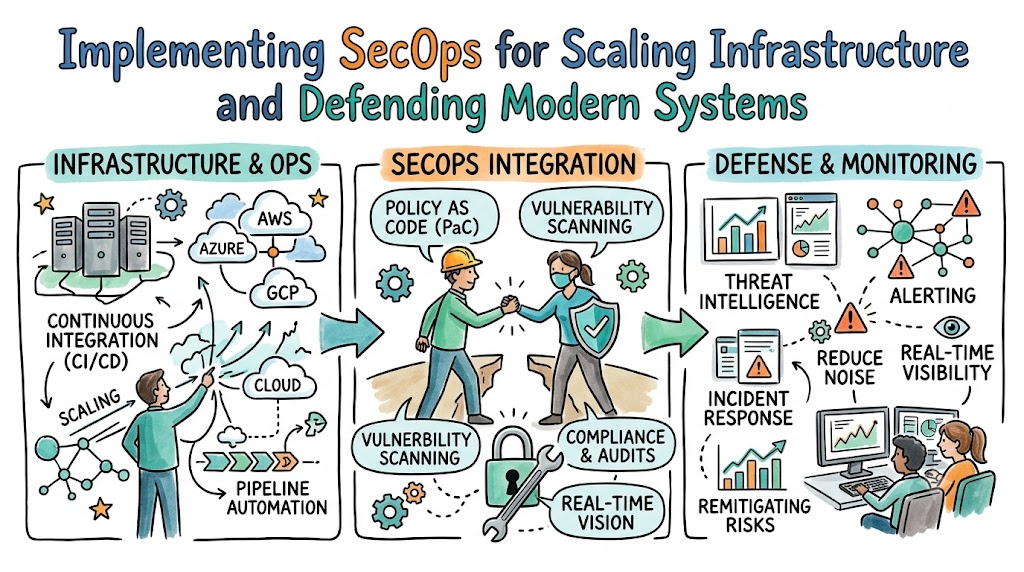
Security operations, commonly known as SecOps, bridges the traditional gap between your security teams and operational staff. Consequently, organizations can no longer afford to treat security as an afterthought or an isolated phase at the end of a deployment cycle. Modern infrastructure demands a continuous, collaborative approach where development, operations, and security teams work in absolute alignment. By integrating automated compliance checks, threat intelligence monitoring, and real-time incident responses directly into your deployment pipeline, SecOps ensures that safety becomes a fundamental part of the daily operational flow.
When organizations adopt this collaborative paradigm, they shift from a reactive state of fighting fires to a proactive state of continuous defense. To successfully establish this within your engineering environment, teams should leverage expert guidance and specialized training resources like Xopsschool. Implementing these strategic practices helps engineering teams build resilient systems that can instantly adapt to evolving threats. Ultimately, the goal is to bake telemetry, monitoring, and automated policy enforcement into every layer of your continuous integration and continuous deployment pipelines, making security invisible yet incredibly powerful.
Core Pillars of Collaborative Security Operations
To build a reliable defense system, engineering teams must establish absolute visibility across the entire infrastructure footprint. For that reason, you should prioritize real-time logging, automated vulnerability scanning, and centralized alert management to eliminate operational blind spots. Whenever developers commit code, automated linters and static application security testing tools must scan the codebase immediately to catch misconfigurations early. Security operations fail when teams work in isolation, which is why your pipeline must automatically reject non-compliant infrastructure changes before they reach production environments.
Moreover, true integration requires that every engineer understands their role in maintaining system integrity. You can achieve this by establishing shared metrics that track the mean time to detect and the mean time to remediate infrastructure vulnerabilities. Instead of blaming individuals for deployment errors, teams should focus on refining the automated guardrails that prevent configuration drift in live environments. By maintaining clear communication channels and shared dashboards, operations and security engineers can collaborate seamlessly during critical system anomalies.
Key Operational Concepts You Must Know
Continuous Telemetry and Distributed Observability
Modern cloud infrastructure produces massive amounts of data every single second, which makes deep distributed observability absolutely essential for maintaining system health. Therefore, you must implement end-to-end tracing and structured logging across every microservice to capture runtime behavior accurately. Whenever a system component behaves erratically, your monitoring tools should immediately correlate metrics with historical baselines to flag potential anomalies. This high-fidelity telemetry allows engineers to detect hidden bottlenecks and malicious traffic patterns before they impact end users.
Furthermore, relying on simple uptime checks is no longer sufficient for complex distributed applications. Teams need to monitor deep internal states by collecting custom application metrics alongside standard CPU and memory utilization data. By feeding these metrics into a centralized log management engine, you can create comprehensive visualization dashboards that provide instant operational clarity. This consistent data stream ensures that your operations engineers can troubleshoot complex performance regressions and security incidents without guessing.
Automated Infrastructure Guardrails
Managing infrastructure manually introduces significant human error, which is why modern engineering groups rely heavily on automated policy enforcement. By utilizing policy-as-code frameworks, you can systematically define your compliance rules in readable configuration files that undergo version control. Consequently, whenever an engineer updates an infrastructure template, automated validation engines check the configuration against your organization’s compliance baselines. This automated feedback loop stops insecure resources, such as public storage buckets or open firewalls, from ever being deployed.
In addition to pre-deployment checks, your automated guardrails must continuously monitor live production environments for unauthorized drift. If a manual configuration change occurs, the automated remediation engine should instantly revert the resource to its declared secure state. This continuous reconciliation loop preserves system integrity and prevents unauthorized modifications from lingering undetected. Embracing these automated practices empowers your development teams to move quickly while maintaining an incredibly strong security posture.
Platform Implementation vs. Culture — What’s the Real Difference?
| Operational Aspect | Platform Implementation Focus | Cultural Alignment Focus |
|---|---|---|
| Primary Objective | Deploying centralized log managers, automated scanners, and secret vaults. | Fostering a shared mindset of accountability, continuous learning, and empathy. |
| Core Execution | Writing infrastructure scripts, configuring Webhooks, and setting up dashboards. | Conducting blameless post-mortems, running workshops, and breaking down silos. |
| Success Metric | Tooling integration coverage, pipeline speed, and automated patch frequency. | Team collaboration, reduction in finger-pointing, and proactive security habits. |
| Long-Term Impact | Provides the technical capability to detect and block active infrastructure threats. | Sustains the operational practices when tools change or scale up. |
Choosing the right technical platform is incredibly important, yet tools alone cannot fix a broken organizational dynamic. If you purchase the most expensive monitoring platform without training your team on how to interpret alerts, your system remains highly vulnerable. Therefore, organizations must balance technical deployments with explicit cultural adjustments that reward transparency and collective problem-solving. When a security incident occurs, the focus must always shift toward improving the collective workflow rather than punishing an individual engineer.
Real-World Use Cases of Modern Operations
Rapid Automated Incident Mitigation
Consider a scenario where a high-traffic web application suddenly encounters a massive distributed denial-of-service attack. In a traditional setting, the operations team would spend hours manually filtering through confusing log files to block malicious IP addresses. However, a mature security operations framework leverages automated playbooks that trigger immediately when traffic thresholds cross a specific limit. The automated system instantly updates edge firewall rules, spins up isolated container instances, and rate-limits suspicious endpoints without manual human intervention.
[Traffic Spike Detected] -> [Automated Playbook Triggers] -> [Firewall Updated at Edge] -> [System Restored]
Because the mitigation happens within milliseconds, your legitimate users experience absolutely zero service disruption during the ongoing attack. Meanwhile, the system automatically collects forensic data and generates a detailed incident report for your engineering team to analyze later. This real-time automation minimizes financial loss, protects brand reputation, and allows your human operators to focus on deeper strategic improvements.
Securing the Automated Deployment Pipeline
Another powerful use case involves protecting the integrity of containerized microservices throughout the continuous delivery lifecycle. When a developer pushes a code update, the automated pipeline constructs a container image and subjects it to binary analysis. The system automatically cross-references the internal software components against updated public vulnerability databases to detect outdated libraries. If the scanner uncovers a critical security vulnerability, the pipeline halts the deployment process and alerts the author automatically.
- Code Commit: The engineer pushes code changes to the central repository.
- Static Scanning: Automated tools inspect code for embedded credentials or flaws.
- Image Analysis: The container image undergoes deep inspection for vulnerable packages.
- Policy Gate: The deployment halts automatically if compliance standards are missed.
By enforcing these automated checks at every single step, you guarantee that malicious code never reaches production servers. This rigorous process gives your business total confidence that every software release meets your strict security standards.
Common Mistakes in Operations Engineering
Excessive Alerting and Alert Fatigue
One of the most frequent errors that engineering teams commit is configuring overly sensitive monitoring thresholds for non-critical systems. When your communication channels are constantly flooded with minor warnings, engineers quickly become desensitized to notifications. As a direct result of this alert fatigue, critical infrastructure warnings get completely ignored among the endless sea of noise. To resolve this, you must meticulously tune your alerting systems so that notifications only trigger when an immediate human action is strictly necessary.
Furthermore, every alert sent to an engineer must include clear, actionable context and links to relevant troubleshooting documentation. If an operator has to spend thirty minutes figuring out why an alert fired, your incident response process is broken. Teams should regularly audit their monitoring configurations to delete outdated rules that no longer serve a clear purpose. Keeping your notification systems clean and focused ensures that your on-call engineers remain sharp and responsive when real emergencies happen.
Mismanaging Credentials and Static Secrets
Hardcoding sensitive api keys, database passwords, and cryptographic tokens directly into code repositories remains a massive vulnerability for many organizations. When teams use static credentials, the risk of accidental exposure via public repositories or internal leaks increases dramatically. Instead, modern security operations mandate the use of dedicated, centralized secret management platforms that encrypt data both at rest and in transit. Your applications should retrieve these credentials dynamically at runtime using short-lived, automatically rotating tokens.
[Application Runtime] -> [Requests Temporary Token] -> [Secret Platform Validates] -> [Access Granted]
Additionally, you must implement strict role-based access control policies to ensure that services only access the specific secrets they need. By auditing secret access logs regularly, security teams can easily detect unauthorized attempts to read sensitive configuration data. Removing static credentials from your workflows significantly reduces your total attack surface and eliminates a major vector for system compromises.
How to Become an Operations Expert — Career Roadmap
Mastering Foundational Systems and Cloud Automation
To build a successful career in modern security operations, you must first develop a deep, unshakeable understanding of operating system internals and networking. You need to know exactly how processes interact with the system kernel, how network packets traverse complex topologies, and how storage subsystems function. Once you master these fundamental concepts, focus your energy on learning cloud automation tools and infrastructure-as-code frameworks. Being able to programmatically define network topologies and server configurations is a foundational skill that every modern platform expert must possess.
Role-Based Skills and Mastery Matrix
- Junior Operations Engineer:
- Focus on mastering Linux system administration, basic bash scripting, and fundamental cloud concepts.
- Learn how to read distributed logs and configure basic monitoring dashboards for application performance.
- Understand the fundamentals of containerization and version control workflows using standard Git commands.
- Senior Security Operations Specialist:
- Master advanced infrastructure-as-code automation and design complex policy-as-code validation frameworks.
- Architect centralized logging architectures that aggregate telemetry from multi-cloud environments safely.
- Lead incident response investigations and design automated self-healing scripts for critical systems.
- Principal Infrastructure Architect:
- Define the long-term organizational strategy for security compliance, automation tooling, and platform engineering.
- Collaborate with business executives to align technical infrastructure investments with corporate security objectives.
- Mentor engineering teams and establish cross-functional cultures that prioritize continuous security improvement.
FAQ Section
- What is the primary difference between standard DevOps and dedicated SecOps workflows?Standard DevOps focuses primarily on breaking down walls between developers and operations to maximize deployment speed and system reliability. On the other hand, SecOps injects security practices directly into that collaborative loop, ensuring that security audits are automated and continuous rather than manual.
- How can small organizations implement automated guardrails without overloading their engineering teams?Small teams should start small by implementing open-source static code analysis tools directly into their existing version control workflows. Focus initially on catching the easiest flaws, such as hardcoded credentials or wide-open network configurations, before scaling up to complex runtime remediation engines.
- Why do traditional static security audits fail in modern containerized cloud environments?Traditional audits happen at static intervals, whereas modern cloud infrastructure changes continuously with every automated software deployment. A point-in-time security audit becomes completely obsolete the moment an engineer pushes a new container image or adjusts a cloud networking route.
- What are the best metrics for measuring the overall success of a security operations initiative?Organizations should carefully track the mean time to detect anomalies, the mean time to fully remediate vulnerabilities, and pipeline failure rates. A successful implementation will show a steady decrease in remediation times and fewer compliance defects reaching production environments.
- How does policy-as-code help organizations maintain strict compliance across multi-cloud deployments?Policy-as-code allows you to write compliance rules in a single, standardized format that evaluates infrastructure templates regardless of the underlying cloud provider. This centralized enforcement ensures that your security guardrails remain perfectly consistent across all your distributed infrastructure platforms.
Final Summary
Successfully implementing security operations requires a balanced combination of advanced automation, deep observability, and an empathetic engineering culture. By treating security as a continuous operational requirement, organizations can safely accelerate their deployment velocity without risking system integrity. Automated guardrails, continuous telemetry tracking, and robust secret management form the technical foundation of this transformative approach.
Ultimately, building a resilient infrastructure comes down to empowering your human engineers with the right skills and mindset. Prioritizing continuous learning and leveraging specialized training platforms will keep your teams ahead of complex, emerging threats. As you refine your pipelines and eliminate operational silos, security transforms from a frustrating bottleneck into a powerful business accelerator.