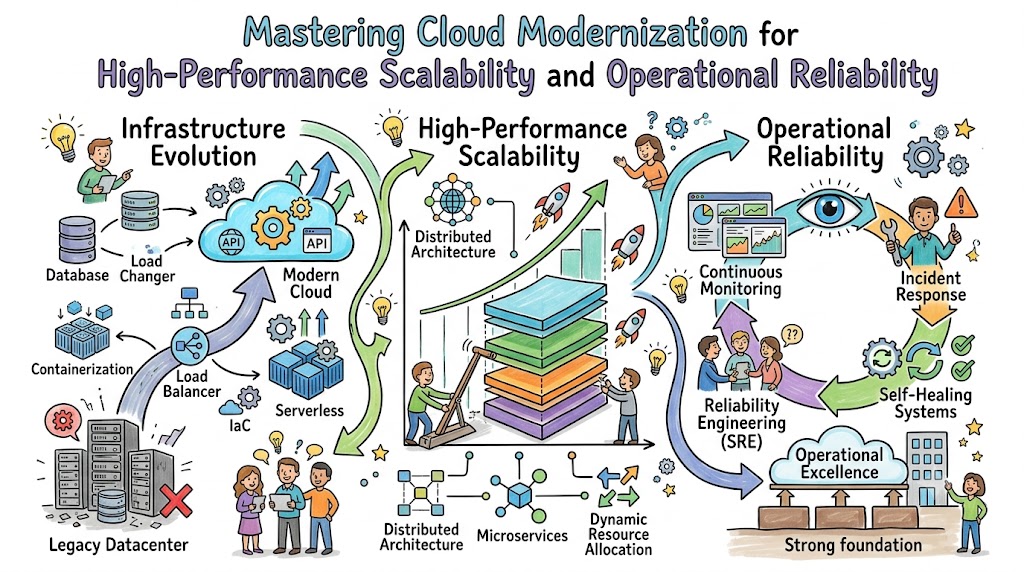
Managing modern cloud infrastructure efficiently requires moving away from legacy provisioning mindsets and adopting automated, data-driven frameworks. Consequently, organizations can no longer rely on manual server management or ad-hoc system monitoring to sustain business growth. A modern cloud operating model must blend continuous integration, dynamic policy enforcement, and proactive threat intelligence into every layer of your architecture. By standardizing continuous delivery and real-time observability, engineering teams eliminate systemic drift while lowering overall infrastructure overhead.
When companies transition to a streamlined operations framework, they transform technical debt into flexible operational velocity. To successfully implement these advanced strategies across your engineering teams, you can explore specialized operational resources provided by Xopsschool. Implementing structured automation practices helps organizations build highly resilient systems that dynamically adapt to workload demands. Ultimately, the goal is to weave automation, security policies, and financial monitoring into a unified management ecosystem.
Strategic Frameworks for Modern Cloud Operations
Building a scalable cloud environment demands complete visibility across your computing footprint and container orchestration systems. For that reason, engineering leaders should implement continuous compliance scanning, automated rightsizing, and centralized log aggregation tools. Whenever your developers check in configuration templates, policy-as-code engines must instantly validate those changes against strict compliance standards. Operations fail when infrastructure changes occur manually, which is why your deployment pipelines must automatically enforce consistent environment definitions.
Furthermore, operational efficiency improves dramatically when engineers take shared ownership of system performance and reliability metrics. You can foster this environment by setting unified operational level objectives that reflect both application availability and budget constraints. Instead of treating system health as a reactive maintenance task, teams should continuously refine automated failover mechanisms and auto-scaling triggers. By maintaining shared operational dashboards, developers and sysadmins can proactively resolve bottlenecks before they impact active workloads.
Key Operational Concepts You Must Know
Automated Configuration Management and IaC
Managing infrastructure manually introduces variance and risk, which is why engineering teams rely heavily on infrastructure-as-code paradigms. By defining your computing resources using declarative configuration files, you can manage your cloud topologies using standard version control workflows. Consequently, whenever an operator updates a network subnet or firewall setting, continuous integration systems test and validate those modifications immediately. This automated deployment feedback loop stops misconfigurations from reaching live production environments and causing unexpected downtime.
In addition to pre-deployment validation, your automated configuration engine must continuously reconcile active cloud resources against declared code baselines. If an unauthorized manual edit creates configuration drift, the automated engine should instantly flag or correct the discrepancy. This continuous reconciliation loop prevents subtle security vulnerabilities from lingering silently within your public cloud accounts. Embracing these automated practices enables your development teams to move faster while maintaining complete operational control.
Comprehensive Telemetry and Dynamic Alerting
Modern distributed applications generate huge volumes of performance metrics, making end-to-end telemetry crucial for maintaining platform performance. Therefore, you must implement unified logging, trace aggregation, and metrics tracking across all your microservices and managed services. Whenever an application service encounters latency spikes, your observability tools should automatically correlate trace data with system-level metrics. This high-fidelity telemetry enables operations engineers to rapidly identify root causes without combing through disconnected server logs.
Furthermore, relying solely on static alert thresholds often leads to noisy channels and missed operational warnings. Modern operations demand dynamic anomaly detection that adjusts alerting logic based on historical traffic patterns and operational baselines. By integrating centralized notification platforms with automated incident playbooks, routine service degradation can trigger self-healing scripts automatically. This proactive approach ensures that your operations team remains focused on long-term platform improvements rather than manual troubleshooting.
Platform Implementation vs. Culture — What’s the Real Difference?
| Operational Aspect | Platform Implementation Focus | Cultural Alignment Focus |
|---|---|---|
| Primary Objective | Provisioning centralized monitoring tools, container orchestrators, and automated CI/CD pipelines. | Cultivating a shared mindset focused on accountability, continuous learning, and system empathy. |
| Core Execution | Writing deployment manifests, building cloud templates, and configuring operational alerts. | Conducting blameless incident reviews, hosting learning sessions, and breaking operational silos. |
| Success Metric | Deployment frequency, pipeline pass rates, and automated service recovery speed. | Cross-team collaboration, reduced operational friction, and proactive optimization habits. |
| Long-Term Impact | Provides the essential technical capabilities to scale workloads and maintain system availability. | Sustains effective operational practices as tools evolve and underlying platforms change. |
Deploying powerful enterprise tools is necessary, yet software platforms alone cannot fix fundamental operational flaws. If you implement expensive monitoring tools without training your teams to analyze telemetry, your systems remain fragile. Therefore, leadership must pair technical deployments with intentional cultural efforts that encourage open communication and continuous improvement. When unexpected outages happen, the focus must remain squarely on improving automated safeguards rather than finding individuals to blame.
Real-World Use Cases of Modern Operations
Automated Traffic Scaling and Self-Healing
Consider a situation where an e-commerce platform experiences a sudden, massive surge in user traffic during an unannounced flash sale. In an unautomated infrastructure setup, engineers would spend critical minutes manually launching virtual machines and adjusting load balators. However, a mature cloud operations strategy utilizes automated scaling policies that react dynamically to real-time telemetry metrics. The underlying system automatically provisions container replicas, allocates compute capacity, and redistributes incoming requests across healthy availability zones.
[Traffic Spike Hits Platform] -> [Metrics Trigger Auto-Scaler] -> [New Nodes Provisioned] -> [Load Balanced Seamlessly]
Because these scaling policies execute automatically, your end users experience smooth application performance without facing latency spikes or timeouts. Meanwhile, telemetry tools continuously monitor system health and automatically isolate any individual node that displays degraded performance. This automated self-healing process protects your core business revenue, preserves customer trust, and keeps operations teams focused on strategic work.
Automated FinOps and Resource Optimization
Another vital use case involves applying automated financial operations practices to control variable cloud infrastructure expenses. When developers launch temporary environment deployments for testing, those unused resources often run continuously, incurring unnecessary charges. An automated operational policy engine routinely scans your cloud inventory for idle virtual instances, unattached storage volumes, and non-compliant configurations. The engine then automatically terminates orphaned resources or alerts the resource owner after a specified idle period.
- Resource Tagging: Every cloud resource receives required owner and project tags during automated deployment.
- Usage Profiling: Background jobs monitor CPU, memory, and network throughput across non-production assets.
- Automated Scheduling: Non-production environments shut down automatically outside standard business hours.
- Cost Anomalies: Machine learning monitors identify unusual spending spikes and notify budget owners instantly.
By enforcing automated resource governance, your organization prevents runaway operational costs without slowing down software development cycles. This disciplined cost management strategy ensures your business maximizes its return on cloud infrastructure investments.
Common Mistakes in Operations Engineering
Suffer From Severe Alert Fatigue
A very common mistake in cloud engineering is setting aggressive, static alerts on minor performance fluctuations. When your engineers receive constant low-priority notifications via email or chat apps, they quickly develop alert fatigue. As a direct consequence of this notification overload, critical production warnings end up buried and ignored during system outages. To fix this problem, operations managers must ruthlessly refine alert conditions so that notifications trigger only when direct human intervention is required.
Furthermore, every operational alert must include concise diagnostic context alongside direct links to actionable runbooks. If an on-call engineer must spend precious minutes figuring out why an alert fired, your incident management workflow needs improvement. Operations teams should regularly review active alerting rules and prune obsolete checks that no longer provide value. Keeping your notification channels lean ensures that your team responds swiftly when genuine production incidents occur.
Neglecting Infrastructure Cost Governance
Failing to integrate financial accountability into your continuous delivery pipelines often leads to unexpected cloud invoices at month-end. Many teams deploy overprovisioned resources during initial development and forget to rightsize them once application traffic stabilizes. Without explicit resource tagging policies and clear ownership metrics, identifying the source of excess cloud expenditure becomes almost impossible. Modern operations demand that cost metrics receive the same level of engineering focus as uptime and system latency.
[Unmonitored Deployment] -> [Overprovisioned Capacity] -> [Silent Budget Overrun] -> [Reactive Financial Fixes]
Additionally, organizations must leverage reserved capacity, savings plans, and spot instances for appropriate workload types. By providing developers with visible cost feedback inside their code repository pull requests, teams can make smarter architecture decisions. Implementing proactive financial controls ensures that your cloud infrastructure scales efficiently without outpacing your operating budget.
How to Become an Operations Expert — Career Roadmap
Mastering Fundamental Systems and Cloud Automation
To build a rewarding career in modern operations engineering, you must start by developing a rock-solid foundation in networking and operating systems. You should understand deep kernel behaviors, container execution models, TCP/IP networking, and storage allocation strategies. Once you establish this foundation, shift your focus toward mastering cloud providers and infrastructure automation tools. Being able to programatically provision, configure, and secure cloud environments using code is an essential requirement for modern platform engineers.
Role-Based Skills and Mastery Matrix
- Junior Cloud Operations Associate:
- Gain deep proficiency in Linux system administration, core shell scripting, and basic networking concepts.
- Learn how to interpret log aggregates, navigate cloud provider consoles, and build basic monitoring panels.
- Understand essential containerization practices and foundational version control workflows using standard Git tools.
- Senior Operations Architect:
- Design multi-region cloud deployment topologies using advanced infrastructure-as-code design patterns.
- Implement centralized observability architectures that seamlessly collect metrics from multi-cloud environments.
- Lead incident response efforts, conduct thorough post-mortems, and build automated self-healing frameworks.
- Principal Infrastructure Director:
- Set long-term technical vision for platform engineering, governance policies, and hybrid infrastructure strategy.
- Align cloud operations budgets with broader organizational goals alongside executive leadership teams.
- Cultivate healthy engineering cultures, sponsor cross-team initiatives, and mentor emerging technical leads.
FAQ Section
- How does modern cloud operations differ from traditional system administration?Traditional system administration relies heavily on manual server provisioning, hardware maintenance, and static network configurations. Modern cloud operations treats infrastructure purely as software, leveraging automation, policy-as-code, and programmatic scaling to manage dynamic, distributed systems efficiently.
- What is the most effective way to begin optimizing cloud spending in an unorganized environment?Start by establishing strict resource tagging policies to gain immediate visibility into which teams and applications own specific assets. Once you identify ownership, shut down orphaned resources, rightsize overprovisioned instances, and leverage automated schedules for non-production environments.
- Why is infrastructure-as-code considered a mandatory requirement for scalable cloud management?Infrastructure-as-code replaces manual configuration steps with version-controlled, repeatable code templates that eliminate human error. This approach enables consistent deployments across environments, simplifies disaster recovery procedures, and creates a clear audit trail for compliance verification.
- How can organizations balance rapid feature deployment with system stability and uptime?Teams can balance speed and stability by implementing continuous integration pipelines that enforce automated testing, security checks, and policy validation. Using progressive deployment strategies like canary releases or blue-green deployments allows you to roll out updates safely while minimizing risk.
- What key metrics should operations teams track to measure overall platform health?Operations teams should track mean time to detect issues, mean time to resolution, deployment success rates, and service level objectives. Additionally, monitoring core performance indicators like request latency, error rates, system throughput, and resource saturation provides complete visibility into application health.
Final Summary
Achieving efficient cloud operations requires a thoughtful balance of automated tooling, real-time observability, and a collaborative engineering culture. By managing infrastructure through code and automating policy enforcement, organizations can scale their computing environments safely and predictably. Continuous telemetry tracking, automated cost governance, and proactive security guardrails form the pillars of a mature cloud platform.
Ultimately, building a high-performing cloud ecosystem depends on investing in your engineering talent and refining your operational processes. Prioritizing ongoing education and utilizing specialized training platforms will keep your technical teams ahead of rapid cloud innovations. As you automate repetitive tasks and eliminate organizational silos, cloud operations evolves from a maintenance burden into a driving force for business growth.