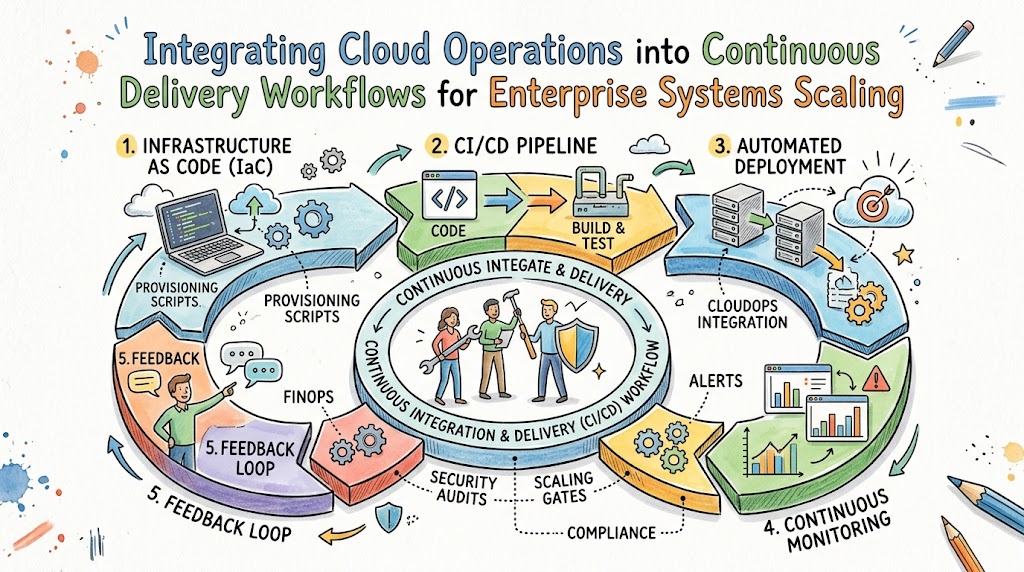
Cloud operations, frequently referred to as CloudOps, focuses on managing, optimizing, and securing cloud infrastructure to ensure continuous system availability. When you combine these operational strategies with continuous integration and continuous deployment pipelines, your development teams can deploy application updates rapidly while maintaining enterprise stability. Furthermore, this integration eliminates manual infrastructure provisioning and allows developers to manage cloud resources directly through automated code repositories.
By embedding cloud management practices into your daily deployment workflows, your organization bridges the gap between infrastructure teams and software developers. To establish these advanced methodologies effectively, engineering teams often rely on expert instruction and dedicated learning platforms like Xopsschool. Merging operational intelligence with automated deployment channels enables teams to scale cloud infrastructure effortlessly, optimize ongoing hosting costs, and prevent unforeseen operational outages during high-traffic release cycles.
Strategic Alignment of Operational Cloud Architecture
Achieving total synergy between cloud operations and deployment pipelines requires a complete shift toward software-defined infrastructure. Consequently, your operational staff must codify all computing environments, network configurations, and storage policies into version-controlled repositories. When engineers declare cloud infrastructure as code, the automated continuous delivery pipeline can validate, test, and deploy operational environments automatically. This unified approach minimizes manual configuration errors and guarantees that staging environments match production systems precisely.
Additionally, this structural alignment demands that performance telemetry and system health checks integrate directly into every release stage. Instead of inspecting cloud health manually after a deployment finishes, continuous monitoring agents must evaluate system metrics in real time. Therefore, if a new release causes unexpected resource consumption or high latency, the pipeline automatically halts the deployment and initiates an instant rollback. This proactive operational feedback loop protects system stability while accelerating delivery cadence.
Key Operational Concepts You Must Know
Dynamic Cloud Resource Provisioning
Traditional infrastructure management required operations teams to provision server capacity manually based on quarterly usage estimates. Conversely, modern cloud operations relies on dynamic automated provisioning that scales infrastructure instantly alongside real-time application demand. When your automated pipeline triggers a new software build, it provisions temporary, isolated testing environments on demand and tears them down immediately after testing completes. This dynamic lifecycle management drastically lowers cloud infrastructure expenses while maintaining pristine, repeatable deployment environments.
Moreover, managing dynamic cloud resources requires strict tagging strategies and automated policy enforcement to prevent orphaned infrastructure. You must ensure that every automated deployment assigns accurate metadata regarding ownership, environment tier, and cost center. Consequently, cloud management tools can continuously monitor running instances and automatically decommission unused storage volumes or idle computing nodes. This automated hygiene maintains operational efficiency across complex multi-cloud ecosystems.
Centralized FinOps and Cost Intelligence
Integrating financial operations, or FinOps, directly into your automated deployment pipeline gives developers immediate visibility into the financial impact of their architectural decisions. Whenever an engineer submits a pull request modifying infrastructure templates, automated scanners can estimate the resulting cost variance before code merges. Therefore, teams can evaluate cost implications early in the software development lifecycle rather than facing unexpected cloud billing spikes at the end of the month.
Furthermore, centralized cost intelligence tools continuously analyze runtime cloud usage patterns to recommend cost optimization opportunities. For instance, the system can automatically identify underutilized cloud instances and suggest right-sizing configurations or reserved capacity models. By integrating these automated financial insights directly into operational dashboards, engineering leaders foster a culture of fiscal accountability without delaying deployment velocity.
Platform Implementation vs. Culture — What’s the Real Difference?
| Operational Aspect | Platform Implementation Focus | Cultural Alignment Focus |
|---|---|---|
| Primary Objective | Deploying automated provisioning scripts, monitoring engines, and cloud portals. | Developing shared responsibility, open communication, and joint accountability. |
| Core Execution | Writing Terraform code, setting up API gateways, and configuring cloud alerts. | Hosting collaborative retrospectives, breaking down silos, and practicing blameless reviews. |
| Success Metric | Deployment frequency, infrastructure spin-up times, and platform uptime metrics. | Cross-team trust levels, knowledge sharing frequency, and organizational agility. |
| Long-Term Impact | Builds the technical infrastructure required to automate complex cloud tasks. | Sustains operational quality and adapts seamlessly when technologies evolve. |
Deploying powerful cloud management platforms provides the necessary technical capabilities, yet technology alone cannot overcome deeply rooted organizational silos. If operations engineers and software developers operate with conflicting goals, automated platforms will merely accelerate bad processes. Therefore, successful integration requires balancing technical platform investments with targeted cultural initiatives that promote shared operational responsibility across all engineering teams.
Real-World Use Cases of Modern Operations
Automated Multi-Region Infrastructure Failover
Imagine a critical public cloud region experiencing a catastrophic network outage during peak business hours. In a traditional operating model, engineers would spend critical hours manually configuring secondary regions and updating DNS records under intense pressure. However, a fully integrated cloud deployment pipeline leverages pre-defined infrastructure templates and automated global traffic routing to execute instant failover routines.
[Primary Region Failure] -> [Health Checks Fail] -> [Traffic Rerouted] -> [Secondary Region Active]
Because the operational framework maintains identical infrastructure definitions across multiple cloud regions, the pipeline continuously validates standby environments. When the primary system fails, automated health probes detect the anomaly and immediately shift incoming traffic to the healthy secondary region. As a result, end users experience minimal service interruption while the primary environment recovers safely.
Automated Cloud Security Patching
Another impactful use case involves executing zero-downtime security patching across large, distributed server fleets. When a critical operating system vulnerability emerges, the automated pipeline constructs newly patched machine images automatically. The deployment engine then performs rolling updates across live production clusters, replacing old nodes systematically while monitoring application error rates.
- Image Generation: The continuous delivery system builds a updated base image with security patches.
- Pipeline Testing: The automated pipeline validates the image against comprehensive integration test suites.
- Rolling Replacement: Production nodes undergo systematic replacement without interrupting live user traffic.
- Verification Gate: Continuous telemetry confirms application health before terminating older server instances.
By automating routine maintenance tasks, operations teams eliminate security vulnerabilities rapidly across thousands of running cloud instances. Consequently, this seamless updating mechanism drastically reduces system exposure windows while completely eliminating manual maintenance windows.
Common Mistakes in Operations Engineering
Overlooking Environment Drift Across Pipelines
A frequent pitfall in cloud operations occurs when engineers perform ad-hoc configuration changes directly on running production servers. Consequently, live environments diverge from the version-controlled templates, causing subtle bugs and deployment failures during subsequent releases. To eliminate environment drift completely, teams must strictly enforce immutable infrastructure principles where running servers are never modified directly.
Instead of patching running servers manually, engineers must update the underlying infrastructure configuration files and trigger a clean pipeline deployment. Furthermore, automated drift-detection engines should continuously audit live cloud resources against declared templates and trigger immediate alerts upon detecting unauthorized changes. Enforcing this operational discipline guarantees absolute consistency across development, staging, and production environments.
Neglecting Cloud Access Control Policies
Granting overly permissive cloud access roles to applications and developers creates massive security risks for enterprise organizations. When teams prioritize speed over governance, cloud credentials often accumulate excessive administrative rights that unauthorized actors can exploit. Therefore, operations engineers must implement strict least-privilege policies where services receive only the specific permissions necessary to execute assigned functions.
[Service Request] -> [Identity Broker Audits] -> [Short-Lived Token Issued] -> [Access Granted]
Additionally, organizations should eliminate static, long-lived cloud API keys in favor of short-lived, dynamically generated tokens. By automating credential rotation and centralizing identity management, you drastically shrink your infrastructure’s attack surface. Regularly auditing access policies ensures that permission boundaries remain tight as application architectures grow.
How to Become an Operations Expert — Career Roadmap
Mastering Cloud Architectures and System Automation
To build a distinguished career in cloud operations engineering, you must first master foundational cloud platforms, virtual networking, and containerization. Understanding how software interacts with cloud storage systems, load balancers, and distributed databases allows you to architect highly available environments. Once you establish this foundation, focus heavily on mastering infrastructure automation, scripting languages, and continuous integration engines.
Role-Based Skills and Mastery Matrix
- Junior Cloud Operations Specialist:
- Gain deep proficiency in cloud vendor consoles, core networking principles, and basic shell scripting.
- Learn to write basic infrastructure templates using standard configuration languages like Terraform or CloudFormation.
- Monitor application logs, interpret cloud metrics, and assist senior engineers during incident resolution.
- Senior Cloud Operations Engineer:
- Architect resilient multi-region infrastructure and design end-to-end continuous delivery deployment pipelines.
- Implement advanced observability solutions, automated self-healing mechanisms, and centralized logging frameworks.
- Lead infrastructure optimization efforts to reduce hosting costs and enforce cloud governance policies.
- Principal Infrastructure Architect:
- Formulate long-term multi-cloud strategies, technical standards, and enterprise governance frameworks.
- Align cloud engineering roadmaps with overarching organizational goals, budget constraints, and compliance mandates.
- Mentor junior and senior engineers while driving a culture of continuous learning and operational excellence.
FAQ Section
- What is the main difference between CloudOps and standard cloud administration?Standard cloud administration focuses primarily on manual system provisioning, basic resource maintenance, and daily troubleshooting tasks. In contrast, CloudOps applies software engineering principles, heavy automation, and continuous delivery pipelines to manage cloud infrastructure dynamically at scale.
- How does integrating CloudOps improve software release speed?Integrating cloud management into your continuous deployment pipeline automates environment creation, configuration validation, and performance testing. Consequently, developers can release new code changes immediately without waiting for infrastructure teams to provision servers manually.
- Why is immutable infrastructure critical for modern cloud deployment pipelines?Immutable infrastructure prevents configuration drift by ensuring that running servers are never altered or patched manually. Instead, updates require building fresh, pre-tested cloud instances from code templates, guaranteeing absolute consistency across all deployment environments.
- What tools are essential for implementing automated cloud operations?Essential tools include infrastructure-as-code platforms like Terraform, continuous integration engines like Jenkins or GitLab CI, container orchestrators like Kubernetes, and centralized observability suites like Prometheus or Datadog.
- How can organizations ensure cloud cost management without slowing down development?Organizations can implement automated FinOps guardrails within continuous integration pipelines to calculate cost estimates during code reviews. Additionally, setting automated resource tagging policies and auto-scaling rules prevents budget overruns without restricting developer autonomy.
Final Summary
Integrating cloud operations directly into your continuous deployment pipeline transforms static infrastructure into a flexible, automated platform that accelerates business growth. By combining automated provisioning, continuous telemetry, and strict governance guardrails, engineering teams can release updates rapidly while maintaining enterprise stability. Eliminating manual configuration steps minimizes human error and allows operations specialists to focus on long-term strategic enhancements.
Ultimately, building a mature cloud engineering practice requires a dedicated commitment to continuous learning, modern tooling, and cross-functional collaboration. Investing in continuous professional development and leveraging expert educational resources empowers teams to navigate evolving cloud architectures confidently. As you refine your deployment workflows and automate complex operations, your cloud infrastructure becomes a key driver of organizational agility and technical innovation.