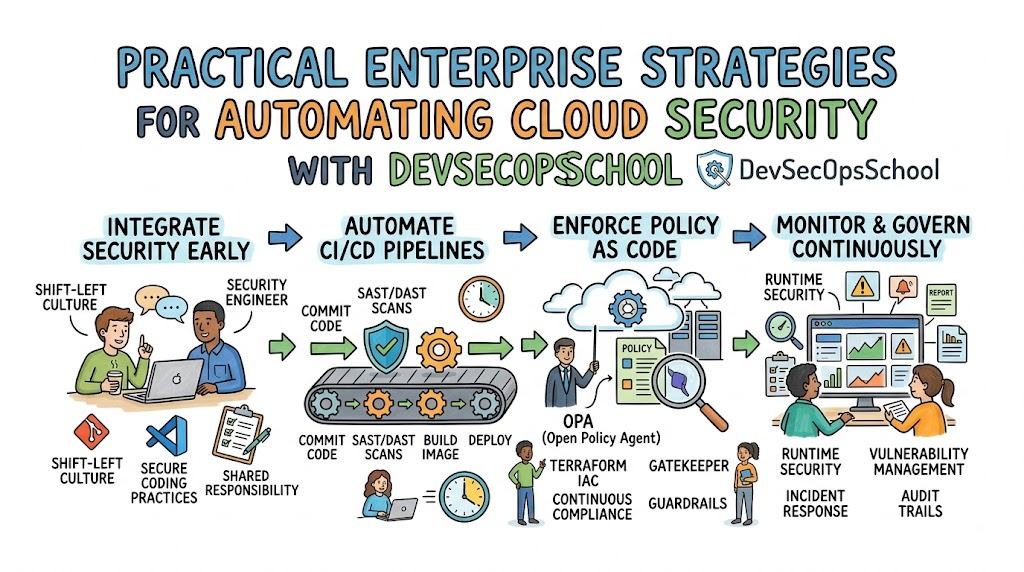
High-velocity engineering teams release product features rapidly, but traditional security gatekeeping frequently delays deployment schedules. Consequently, engineering leaders encounter unexpected system outages, compliance audit failures, and severe data exposure risks.
Organizations resolve these operational bottlenecks by embedding continuous safety guardrails directly into their daily development workflows. DevSecOpsSchool provides intensive, lab-driven educational tracks that teach practitioners how to implement production-grade security automation.
Mastering automated vulnerability detection and infrastructure hardening shields your business against emerging attack vectors. This detailed roadmap reveals actionable operational architectures, enterprise automation frameworks, and career development strategies.
Unpacking The Core DevSecOps Philosophy
DevSecOps merges software engineering, IT operations, and cybersecurity into a unified operational discipline. Outdated release models postponed compliance reviews until final staging checks, triggering massive release bottlenecks.
Shifting controls to the left inserts automated verification engines directly into local coding and continuous build stages. As a result, developers detect configuration flaws and source vulnerabilities early while writing application logic.
This proactive integration transforms security from a bureaucratic blocker into a powerful accelerator for continuous software delivery.
Business Justifications For Proactive Defense Mechanisms
Remediating an active breach within production infrastructure demands significantly more capital than eliminating code defects during initial development sprints. Moreover, dynamic cloud environments evolve constantly, making manual checklist reviews ineffective and unsustainable.
Automated pipeline guardrails enable distributed squads to deploy production updates multiple times daily with total assurance. Furthermore, strong automated defenses protect core business assets, prevent costly downtime, and preserve brand credibility worldwide.
Four Critical Layers Of Pipeline Protection
Constructing a dependable defense framework requires a comprehensive, multi-tiered security approach across the entire software delivery pipeline. Static Application Security Testing inspects proprietary source repositories to catch logic errors before artifact compilation occurs.
Software Composition Analysis tools audit external packages and open-source dependencies to eliminate vulnerable libraries and licensing violations. Dynamic Application Security Testing evaluates staging deployments by executing safe, automated attack simulations against live endpoints.
Finally, automated configuration linters verify that cloud storage rules, access policies, and firewall configurations strictly match enterprise baselines.
Embedding Automated Controls Across CI/CD
Continuous integration platforms deliver consistent quality enforcement when platform engineers insert automated security scanners directly into pipeline jobs. Engineers configure automated runners using GitHub Actions, GitLab CI, or Jenkins to test code automatically on every push.
Whenever a developer opens a pull request, the pipeline analyzes commits for exposed secrets, outdated dependencies, and unsafe functions. If an automated scan flags a critical flaw, the pipeline stops execution immediately and provides clear remediation instructions.
This continuous enforcement guarantees that only vetted, fully compliant code artifacts proceed to production environments.
Codifying Governance With Policy As Code
Policy as Code replaces ambiguous documentation with declarative, version-controlled compliance definitions. Engineering teams deploy frameworks like Open Policy Agent to evaluate system manifests against organizational rules automatically.
Validation engines analyze Terraform configurations, Helm charts, and Kubernetes manifests before cloud platforms provision actual resources. For instance, an automated policy blocks any storage bucket script containing public read permissions.
This automation enforces uniform governance across dozens of autonomous squads without introducing manual approval delays.
Hardening Enterprise Container Clusters
Container environments require targeted defensive measures across node operating systems, runtime daemons, and application pods. Through dedicated Kubernetes Security Training, engineers implement strict Role-Based Access Controls, network segmentation, and mutual transport layer security.
Furthermore, platform teams secure their software supply chains by scanning container images and verifying cryptographic signatures before deployment. Admission controllers intercept Kubernetes API requests to reject unsigned or over-privileged container workloads.
Consequently, platform engineers maintain resilient container clusters that restrict unauthorized lateral movement during potential security breaches.
Multi-Cloud Infrastructure Hardening Protocols
Public cloud platforms require real-time visibility, automated drift detection, and strict least-privilege identity access management. Modern cloud engineers secure infrastructure templates using automated scanners like Checkov and tfsec during active development.
Additionally, centralized secrets management platforms like HashiCorp Vault eliminate hardcoded credentials across application repositories. Cloud monitoring engines track environment telemetry to identify unauthorized access attempts and unapproved resource modifications instantly.
Integrating automated security checks into provisioning workflows establishes durable, self-defending cloud infrastructure.
Strategic Vulnerability Remediation Workflows
Modern vulnerability management demands intelligent contextual prioritization rather than simple alert accumulation. Engineering squads easily experience alert fatigue when automated scanners generate hundreds of unranked findings daily.
Therefore, security engineers prioritize vulnerabilities by analyzing real-world exploit availability, attack surface exposure, and asset criticality. Teams convert high-priority risks into actionable tasks directly within their primary project management systems.
This structured triage workflow resolves critical vulnerabilities swiftly while preserving steady feature development velocity.
Continuous Compliance And Automated Auditing
Manual audit preparation drains engineering hours through tedious evidence gathering, spreadsheet maintenance, and retrospective system reviews. In contrast, compliance automation translates complex regulations like SOC 2, ISO 27001, and HIPAA into automated code checks.
Automated agents continuously inspect system access records, configuration parameters, and encryption states across running workloads. Engineering teams generate comprehensive, audit-ready compliance reports on demand within minutes.
Consequently, automated validation eliminates stressful audit preparation cycles while ensuring uninterrupted regulatory alignment.
Establishing A Shared Security Culture
Automation tools yield minimal results without an organizational culture that promotes shared security ownership. Historically, developers viewed security checks as friction, while security specialists viewed developers as careless.
Forward-thinking organizations overcome this divide by launching Security Champion initiatives, training designated developers within every product squad. Moreover, engineering leaders conduct blameless post-mortem reviews that focus on improving systemic processes rather than punishing individuals.
Providing developers with intuitive tools and practical guidance transforms proactive security into a natural engineering routine.
Avoiding Common Implementation Roadblocks
Organizations often encounter severe roadblocks during security modernization due to preventable implementation mistakes. Teams frequently enable every security scanner simultaneously, overwhelming developers with false-positive alerts.
Consequently, frustrated engineers bypass security checks to meet urgent release deadlines. Another frequent mistake involves treating security automation as a one-time tool purchase rather than an ongoing operational discipline.
Organizations succeed when they introduce scanning tools progressively, calibrate alert thresholds continuously, and prioritize the developer experience.
Upskilling Engineering Talent With Structured Programs
Structured technical education provides engineering teams with the foundational principles and hands-on laboratory experience required for production success. Enrolling in professional DevSecOps Training helps engineers master pipeline automation, cloud security controls, and defensive container architectures.
Participants gain practical experience by remediating real vulnerabilities, resolving simulated pipeline breaches, and hardening live infrastructure under expert instruction. Furthermore, completing a comprehensive DevSecOps Certification Training accelerates team maturity by establishing clear, company-wide engineering standards.
Mapping Targeted Professional Outcomes
Targeted security education delivers specific technical advantages across diverse technical and leadership roles:
| Engineering Role | Primary Technical Focus | Practical Business Impact |
|---|---|---|
| Software Developers | Secure coding patterns, SAST, dependency audits | Eliminate vulnerabilities during active coding sprints |
| DevOps & Platform Engineers | Pipeline automation, IaC scanning, secrets management | Construct automated, self-defending delivery pipelines |
| Security Analysts | Policy as Code, DAST automation, runtime protection | Implement scalable security controls across agile squads |
| Cloud Architects | Multi-cloud governance, least-privilege IAM design | Architect resilient, audit-compliant cloud platforms |
| Engineering Managers | Risk metrics, security culture, tool selection | Minimize deployment risks without sacrificing delivery speed |
Interactive Distance Learning Architecture
Distributed engineering departments require flexible, immersive education formats that fit within demanding project schedules. Participating in interactive DevSecOps Online Training provides direct access to live mentors, on-demand learning modules, and dedicated cloud sandbox environments.
Engineers practice configuring active CI/CD pipelines, integrating automated scanners, and fixing authentic vulnerabilities in real time. Moreover, collaborative virtual classrooms enable professionals to dissect complex architectural problems alongside peers from leading global technology companies.
Developing Specialized Technical Talent In India
Dynamic technology ecosystems across India require engineering professionals capable of defending sophisticated cloud architectures. Pursuing specialized DevSecOps Training in India provides local developers and enterprise teams with globally recognized security proficiencies.
Learners master modern automation frameworks, enterprise tooling, and cloud-native defense strategies through structured practical coursework. Consequently, technology professionals elevate their market credibility, positioning themselves as indispensable assets across enterprise and fast-growth tech organizations.
Validating Competence Through Professional Certification
Industry-recognized credentials confirm an engineer’s technical ability to architect and maintain automated defense pipelines. Obtaining an official DevSecOps Engineer Certification proves hands-on mastery over vulnerability scanning, container security, and pipeline automation.
Hiring managers actively seek certified professionals who can improve organizational security posture immediately without extensive onboarding. Pursuing formal certification validates your technical competencies and accelerates your long-term career growth.
Attaining Elite Professional Standing
Earning distinction as a Certified DevSecOps Professional represents an exceptional achievement in modern cloud security engineering. This credential verifies that an engineer possesses deep architectural expertise alongside proven implementation capabilities.
Certified professionals direct enterprise-wide security transformations, mentor cross-functional squads, and build resilient multi-cloud infrastructures. Furthermore, this prestigious qualification distinguishes candidates during executive hiring processes, unlocking high-impact technical leadership positions worldwide.
Selecting High-Impact Learning Programs
Choosing an effective educational program requires thorough evaluation of curriculum depth, laboratory availability, and instructor credentials. Avoid courses that rely exclusively on static presentations without offering real hands-on sandbox environments.
A production-grade DevSecOps Course must deliver practical exercises using industry tools like SonarQube, Semgrep, Trivy, OPA, and Vault. Additionally, enterprise organizations should confirm that providers offer specialized Corporate DevSecOps Training customized to their specific technology stacks and architectural goals.
Hands-On Technical Labs At DevSecOpsSchool
DevSecOpsSchool delivers realistic, lab-focused education tailored specifically to the operational requirements of modern engineering teams. Students construct end-to-end automated pipelines on active cloud infrastructure rather than memorizing abstract security theories.
Every instructional module combines industry-standard tools, practical vulnerability remediation exercises, and enterprise architecture defense labs. By working directly with production tools and workflows, learners build the technical confidence necessary to protect complex enterprise software systems.
Key Inquiries Concerning DevSecOpsSchool Programs
- What foundational knowledge should students possess before enrolling in a course?Familiarity with basic Linux commands, standard software development concepts, and foundational DevOps utilities like Git and Docker helps you learn effectively.
- Why does automated DevSecOps outperform traditional security workflows?DevSecOps embeds automated security scans directly into CI/CD pipelines, whereas traditional methodologies rely on manual, late-stage security audits.
- Which automation tools will learners practice with during lab sessions?You will work hands-on with SonarQube, Semgrep, OWASP ZAP, Snyk, Trivy, Checkov, HashiCorp Vault, and Open Policy Agent.
- Do participants receive dedicated cloud sandboxes for practical exercises?Learners receive browser-accessible cloud sandbox environments to practice pipeline hardening, container security, and automated scanning workflows.
- Can cross-functional enterprise teams enroll in training together?Enterprise curricula accommodate entire cross-functional units, including developers, QA engineers, site reliability specialists, and security analysts.
- How does Policy as Code prevent configuration mistakes in cloud platforms?Policy as Code evaluates infrastructure scripts against predefined security rules automatically before cloud providers provision actual resources.
- Which professional roles open up after completing a DevSecOps certification?Graduates secure high-impact positions such as DevSecOps Engineer, Security Automation Architect, Cloud Security Specialist, and Platform Engineer.
- How does the curriculum teach container and cluster security?The program covers container image vulnerability scanning, admission controllers, Role-Based Access Control, network policies, and runtime cluster monitoring.
- Do you deliver customized programs for corporate enterprise teams?We offer tailored corporate programs featuring customized schedules, dedicated instructors, and specialized curriculum aligned with your company’s technology stack.
- What learning resources remain accessible to students after graduation?Students retain ongoing access to lab guides, architectural blueprints, session recordings, and private community mentor forums.
Charting Your Engineering Future
Modern software organizations must integrate security directly into their core engineering processes to remain competitive and secure. Development teams that implement automated vulnerability scans, container defenses, and programmatic policy checks deliver high-quality software safely.
DevSecOpsSchool provides engineers with the practical skills, expert guidance, and hands-on laboratory experience required to succeed. Take the initiative today, master automated delivery pipelines, and lead the future of secure cloud engineering.