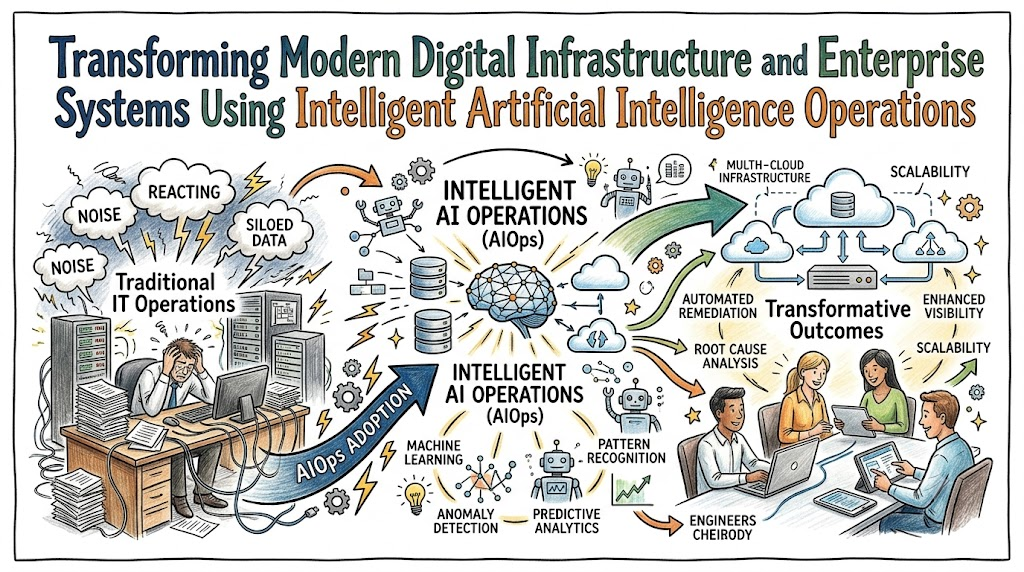
Modern IT ecosystems generate massive streams of operational telemetry across distributed microservices, multi-cloud platforms, and containerized clusters. Consequently, human engineering teams face an overwhelming deluge of log files, metrics, traces, and alert notifications every single day. Artificial Intelligence for IT Operations, widely known as AIOps, addresses this operational crisis by applying machine learning algorithms, big data analytics, and automated decision-making engines to enterprise environments. By aggregating and analyzing cross-domain operational data in real time, these intelligent platforms automatically identify anomalies, pinpoint root causes, and execute corrective measures.
Furthermore, implementing algorithmic operations shifts enterprise management from reactive firefighting to predictive remediation. When engineering departments adopt structured frameworks and hands-on guidance from educational platforms like Xopsschool, they equip their technical workforce to conquer infrastructure complexity. Instead of relying on manual troubleshooting during critical service disruptions, teams leverage algorithmic intelligence to isolate underlying faults within milliseconds. Ultimately, this operational evolution enables organizations to maintain unprecedented system availability while liberating engineers to build resilient, revenue-generating software solutions.
Architectural Evolution of Algorithmic Infrastructure Management
Traditional IT operations relied entirely on static threshold monitoring, rule-based alerts, and siloed administration tools. However, dynamic cloud architectures and ephemeral workloads render static thresholds ineffective, leading to persistent alert storms and delayed incident responses. In contrast, modern intelligent platforms continuously ingest structured and unstructured telemetry from every infrastructure tier. By standardizing diverse log formats into centralized analytic pipelines, these systems construct accurate dependency maps across your digital footprint.
Consequently, statistical machine learning models replace rigid threshold alarms with dynamic baseline scoring. When operational behavior deviates from normal patterns, the analytical engine correlates related events across network, database, and application layers. This cross-system correlation isolates single failure domains from widespread downstream effects. As a direct result, operations teams receive clean, contextual incident notifications rather than hundreds of fragmented alerts.
The Four Core Stages of Intelligent Operational Pipelines
Real-Time Data Ingestion and Normalization
Enterprise infrastructure environments contain heterogeneous data sources that emit metrics, historical logs, distributed traces, and security events simultaneously. Therefore, the first critical stage of any algorithmic pipeline involves streaming this unstructured data into high-throughput message brokers. Normalization engines then strip extraneous noise, parse timestamps, and standardize metric naming conventions across different cloud providers. This unified data foundation guarantees that subsequent machine learning models evaluate accurate, synchronized information.
Algorithmic Pattern Recognition and Anomaly Detection
Once data normalization concludes, advanced machine learning models continuously analyze streaming telemetry against rolling historical baselines. These algorithms account for predictable seasonal variations, such as diurnal traffic spikes or scheduled batch processing cycles, preventing false alarms. Whenever an uncharacteristic pattern surfaces, the anomaly detection engine quantifies the risk level immediately. By detecting subtle operational degradations early, the system alerts engineers long before service disruptions affect end users.
Automated Root Cause Analysis
Pinpointing the origin of complex distributed failures usually consumes hours of tedious manual log investigation. Algorithmic operations eliminate this bottleneck by traversing real-time topology graphs to track error propagation across microservices. The correlation engine cross-references performance anomalies with recent code deployments, configuration updates, and infrastructure changes. Consequently, the platform presents engineers with the exact trigger of the failure alongside high-confidence mitigation recommendations.
Closed-Loop Automated Remediation
Detecting incidents rapidly delivers minimal business value if the subsequent resolution process remains slow and manual. Therefore, mature operational platforms trigger automated remediation scripts and orchestration playbooks the moment a root cause reaches high confidence. The system can automatically restart degraded pods, scale compute clusters, rollback broken configuration changes, or clear congested database pools. This closed-loop automation resolves routine operational issues seamlessly without requiring human intervention.
Key Operational Concepts You Must Know
Dynamic Thresholding and Baseline Modeling
Static threshold alarms trigger countless false positives during harmless traffic surges and miss genuine failures during low-utilization windows. In contrast, dynamic thresholding models compute floating operating boundaries based on historical usage patterns, time of day, and business cycles. The monitoring system continuously recalibrates these statistical envelopes as application architectures and user behaviors evolve over time. Consequently, alerts only trigger when infrastructure performance drifts outside mathematically calculated bounds.
[Incoming Telemetry Stream] -> [Dynamic Baseline Engine] -> [Statistical Evaluation] -> [Actionable Signal]
Event De-Duplication and Alert Noise Suppression
Alert fatigue presents one of the most dangerous operational hazards in enterprise system administration. When an upstream gateway fails, dozens of downstream microservices emit concurrent critical error notifications. Intelligent noise suppression engines group these related alerts into a single unified incident ticket using temporal and topological correlation. As a result, on-call engineers can focus entirely on solving the primary system fault instead of wading through repetitive alerts.
Distributed Topology Mapping
Modern containerized applications create dynamic, transient connections that change continuously throughout the day. Because of this high volatility, static network architecture diagrams become obsolete within minutes. Automated topology mapping engines trace network packets and distributed API calls to generate real-time dependency graphs. This granular visualization allows operations teams to comprehend upstream and downstream service dependencies instantly during critical incidents.
Platform Implementation vs. Culture — What’s the Real Difference?
| Operational Vector | Platform Implementation Strategy | Cultural Transformation Strategy |
|---|---|---|
| Primary Objective | Deploying streaming pipelines, ML algorithms, and log aggregation tools. | Developing an organizational mindset centered on data-driven automation and trust. |
| Operational Execution | Integrating APIs, defining data connectors, and configuring auto-remediation playbooks. | Conducting blameless post-mortems, eliminating operational silos, and upskilling teams. |
| Core Measurement | Event correlation accuracy, alert noise reduction percentage, and ingestion rate. | Team velocity, cross-departmental collaboration, and proactive system design habits. |
| Long-Term Impact | Provides the mechanical automation to process massive operational datasets rapidly. | Ensures teams continuously embrace, refine, and trust automated remediation loops. |
Procuring cutting-edge analytical platforms without preparing your technical staff guarantees low adoption and failed initiatives. If engineers mistrust automated playbooks, they will disable auto-remediation features and revert to manual troubleshooting methods. Therefore, organizations must couple technical platform rollouts with comprehensive training programs that demystify artificial intelligence mechanics. When engineers understand how algorithms calculate confidence scores, they enthusiastically delegate repetitive maintenance tasks to automated systems.
Real-World Use Cases of Modern Operations
Proactive Cloud Capacity Forecasting
Enterprise cloud environments frequently suffer from either expensive over-provisioning or catastrophic capacity exhaustion during unexpected demand surges. An intelligent analytics engine resolves this dilemma by evaluating historical traffic trends, upcoming marketing campaigns, and seasonal demand variations. The predictive model automatically provisions compute resources ahead of projected traffic spikes and terminates idle infrastructure during quiet periods.
[Historical Load Telemetry] -> [Predictive Capacity Model] -> [Automated Scaling Action] -> [Optimized Costs]
Because resource allocation adjusts proactively rather than reactively, applications never experience resource starvation during sudden user surges. Simultaneously, the organization eliminates thousands of dollars in wasted cloud spend each month by decommissioning unneeded virtual machines. This automated balancing act maintains optimal application performance while rigorously safeguarding the corporate infrastructure budget.
Intelligent Network Traffic Anomaly Mitigation
Distributed applications face frequent network disruptions caused by misconfigured routing tables, hardware port degradation, or sudden localized traffic congestion. Intelligent operational systems continuously monitor packet flow, latency variations, and error rates across software-defined networks. When an anomaly engine detects packet loss on a specific network route, it immediately traces the issue to the malfunctioning hardware interface.
- Continuous Monitoring: Telemetry agents stream real-time packet loss and latency metrics.
- Anomaly Detection: Machine learning algorithms flag localized network degradation.
- Path Calculation: The system calculates optimal alternative routing paths automatically.
- Dynamic Rerouting: Orchestration tools update network policies to bypass the degraded node.
By executing these routing updates within seconds, the system preserves end-user connectivity without manual network engineering intervention. Meanwhile, the platform opens an automated maintenance ticket containing precise diagnostic data for the hardware operations crew. This workflow guarantees seamless business continuity while drastically accelerating hardware repair cycles.
Common Mistakes in Operations Engineering
Ingesting Dirty and Unstructured Telemetry
A frequent error in algorithmic implementations involves feeding raw, unvalidated log data directly into machine learning pipelines. If incoming logs feature inconsistent timestamp formats, missing identifiers, or inaccurate severity levels, analytical algorithms produce misleading conclusions. Machine learning accuracy depends entirely on data quality, making thorough data normalization an essential prerequisite. Teams must enforce rigid logging standards across development groups before attempting advanced pattern recognition.
Attempting Full Automation Without Guardrails
Eager engineering groups often implement fully autonomous remediation scripts across production clusters without establishing conservative safety constraints. If an algorithm misinterprets a cascading database failure as a simple container crash, it might repeatedly restart database nodes, causing severe data corruption. To prevent such disasters, teams should initially configure automated engines to recommend actions to human operators. Only after algorithms consistently demonstrate high accuracy should organizations activate closed-loop, unattended remediation.
[Algorithmic Suggestion] -> [Human Verification Stage] -> [Confidence Validation] -> [Autonomous Execution]
Neglecting Continual Model Retraining
Software architectures, deployment frequencies, and user usage patterns evolve continuously throughout an application’s lifecycle. Consequently, machine learning models trained on past operational metrics gradually lose precision when infrastructure changes substantially. Engineering teams must schedule automated model retraining pipelines to account for architecture updates and workload shifts. Treating operational algorithms as self-sustaining systems without ongoing maintenance guarantees degraded anomaly detection over time.
How to Become an Operations Expert — Career Roadmap
Technical Foundation and Progressive Specialization
Mastering algorithmic operations requires a solid foundation in Linux system internals, distributed systems architecture, and modern observability stacks. Aspiring professionals must understand how operating systems handle memory, disk I/O, and networking sockets before analyzing aggregated telemetry. Furthermore, developing proficiency in Python or Go allows engineers to construct custom data processors and automate complex operational workflows effectively.
Role-Based Competency Progression
- Associate Observability Engineer:
- Master centralized logging frameworks, time-series metric databases, and distributed tracing standards.
- Construct actionable visualization dashboards and configure dynamic alerting rules using statistical baselines.
- Write robust shell and Python scripts to automate basic log parsing and operational health checks.
- Senior Intelligent Operations Specialist:
- Design high-throughput streaming pipelines that ingest and normalize multi-cloud infrastructure telemetry.
- Implement machine learning frameworks to perform event correlation, anomaly detection, and noise suppression.
- Develop automated orchestration playbooks that safely remediate infrastructure failures in staging and production.
- Principal Enterprise Infrastructure Architect:
- Establish organization-wide telemetry governance, observability standards, and security compliance baselines.
- Align technical operations strategies with executive business goals to maximize uptime and reduce operational expenditure.
- Mentor cross-functional engineering teams to foster a culture of data-driven automation and continuous reliability improvement.
FAQ Section
- How does algorithmic operations differ from traditional application performance monitoring tools?Traditional monitoring platforms rely heavily on predefined static thresholds and isolated metric charts that require manual human correlation. Conversely, algorithmic operations ingest cross-domain telemetry, automatically correlate disparate events across the entire technology stack, and predict incidents before outages occur.
- Can small startups benefit from intelligent operations platforms, or are they only for enterprises?Startups operating complex microservices or serverless architectures benefit significantly from automated noise reduction and root cause analysis. Implementing lightweight intelligent monitoring early prevents small engineering teams from burning out on repetitive operational firefighting.
- What types of operational data are most critical for training algorithmic systems?Algorithmic platforms require high-fidelity time-series metrics, structured event logs, distributed transaction traces, and network topology data. Combining these four telemetry types provides the mathematical models with sufficient context to perform accurate correlation and anomaly detection.
- Will intelligent automation replace the need for human system administrators and site reliability engineers?Algorithmic tools do not replace human engineers; instead, they eliminate mundane, repetitive diagnostic tasks and alert fatigue. Human engineers remain indispensable for designing robust system architectures, establishing strategic policies, and handling novel edge-case failures.
- What is the typical time frame required to see measurable return on investment from operational automation?Organizations typically experience immediate noise reduction within several weeks of connecting their primary telemetry sources. Full predictive anomaly detection and closed-loop automated remediation mature over several months as machine learning algorithms ingest sufficient operational data.
Final Summary
Integrating intelligent machine learning capabilities into modern IT operations marks a fundamental milestone in enterprise systems engineering. By transforming chaotic telemetry streams into actionable operational insights, organizations conquer the architectural complexity of distributed cloud environments. Automated anomaly detection, intelligent alert correlation, and closed-loop self-healing mechanisms drastically minimize service downtime while protecting engineering teams from cognitive exhaustion.
However, achieving lasting operational excellence requires an equal commitment to organizational culture, technical skill development, and robust data governance. When engineering departments adopt structured educational roadmaps, establish sensible automation guardrails, and foster collaborative team dynamics, intelligent platforms deliver extraordinary reliability. Embracing algorithmic operations ensures your infrastructure remains resilient, scalable, and fully prepared to power modern digital enterprises.