Modern IT systems are huge, fast, and complex. Hundreds of apps and cloud services run at the same time. Because of this, computer systems make millions of log notes and alerts every single day.
Human teams cannot keep up with all this noise. This is where AIOps (Artificial Intelligence for IT Operations) steps in to save the day. You can learn the core basics of these modern platforms at Xopsschool.
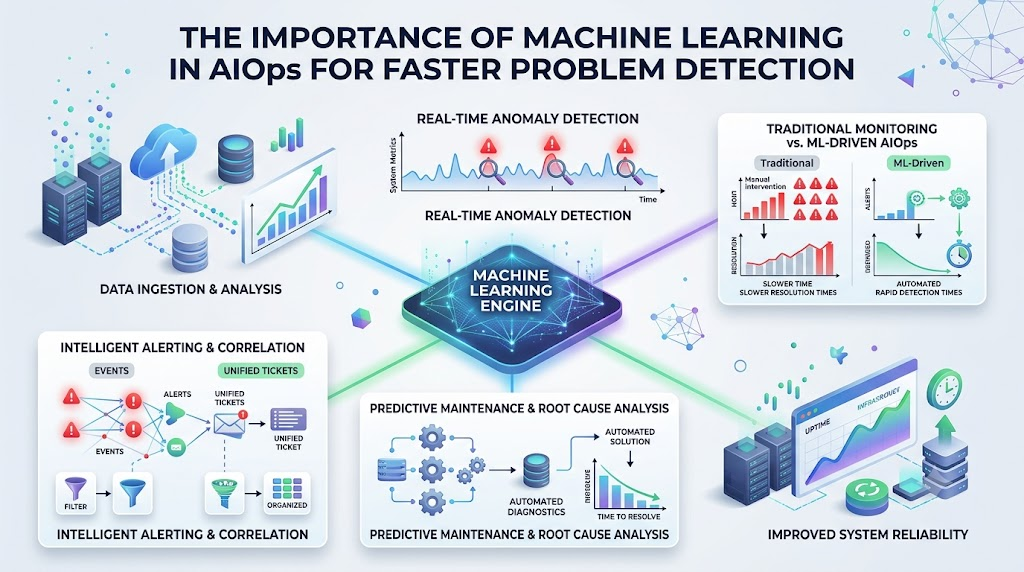
Machine learning acts as the smart engine inside AIOps. It learns system habits, spots hidden clues, and finds problems before real users ever notice them.
Core Pillars of Machine Learning in AIOps
Learning Normal Daily Habits
Computers have regular daily routines just like people do. On Monday mornings, lots of people log in to work. On Saturday nights, traffic might drop.
Smart software watches this daily traffic to learn what a normal day looks like. It builds a safe line of normal numbers.
Because it knows what is normal, it can easily spot anything weird. It does not need a person to tell it what to look for.
Spotting Weird System Behavior
When an app starts breaking, tiny clues appear first. A server might get slightly warmer, or memory might fill up slowly.
These tiny clues are called anomalies. Old tools only ring alarms when things crash completely.
Machine learning catches these small clues early. This stops a small hiccup from turning into a giant outage.
Cleaning Up Alert Noise
When one server fails, it can set off hundreds of noisy alarms at once. This flood of messages confuses workers and slows down the fix.
A smart system bundles related alarms into a single neat folder. It throws out duplicates and points to the real trouble spot.
Engineers can then read one simple note instead of clearing hundreds of false alarms.
Finding the Real Root Cause
Finding why a system broke is often like finding a needle in a haystack. Many moving parts connect to each other in the background.
Machine learning traces connections across apps to find the exact broken piece. It shows engineers where the trouble started.
This helps teams fix issues quickly and keeps services running smoothly.
Key Operational Concepts You Must Know
Telemetry Signals
Computers send three main signals every second:
- Logs: Diary entries written by apps about what just happened.
- Metrics: Simple health numbers like memory, storage, and speed.
- Traces: The exact path a user request takes through the system.
Machine learning reads all three signals at the same time to see the whole picture.
Pattern Matching and Smart Correlation
When things go wrong, clues often pop up together in a chain reaction. A slow database might cause slow web pages a second later.
Old tools treat these as two unrelated bugs. Smart software sees the shared timeline and groups them together.
[Slow Database Query] ---> [Slow Web Page Load] ---> [Single Combined Alert Created]
This connection helps engineers solve one core issue instead of chasing ghost problems.
Platform Implementation vs. Culture — What’s the Real Difference?
| Focus Area | Platform Implementation Focus | Cultural Alignment Focus |
|---|---|---|
| Main Goal | Set up software, feed data, and build dashboards. | Teach teams to trust smart suggestions and learn new habits. |
| Daily Work | Connect logs, tune algorithms, and clean data inputs. | Stop blaming people and share helpful operational notes. |
| Measurement | Faster problem discovery and fewer total alarms. | Happier engineers and better team cooperation. |
| Big Benefit | Finds bugs quickly with smart math formulas. | Keeps teams calm during surprise emergencies. |
Setting up the tech platform gives you tools to track data. Building the right culture makes sure people actually use those tools to work better together.
Real-World Use Cases of Modern Operations
Stopping Memory Leaks Early
Imagine an online shopping cart has a hidden bug that eats memory slowly. With traditional rules, the alert only fires when the website crashes completely.
With machine learning, the system notices that memory usage is creeping up faster than normal. It flags the bad pattern hours in advance.
The operations crew fixes the bad code before a single shopper notices any lag.
Protecting Massive Game Launches
A game company launches a brand-new multiplayer game. Millions of players log on at the exact same time.
[Millions of Players Log On] ---> [Smart Models Predict Surge] ---> [Cloud Servers Auto-Scale]
The smart platform notices the giant spike in requests instantly. It predicts how many extra servers the game needs.
It spins up new game worlds automatically. Players enjoy smooth gameplay without any lag or downtime.
Common Mistakes in Operations Engineering
Feeding Dirty Data to Models
Machine learning needs clean, accurate information to learn good habits. If you feed it broken logs or missing timestamps, it makes bad guesses.
Teams often connect tools without checking data quality first. This causes false alarms and wastes precious time.
Always clean and organize your system data before training your smart models.
Forgetting the Human Touch
Some groups expect computers to fix everything all by themselves. That is a big mistake.
Computers are great at spotting patterns, but humans understand business context. When an engineer ignores alarms because the computer guessed wrong, trust breaks down.
Always keep human engineers in charge of final, critical choices.
How to Become an Operations Expert — Career Roadmap
- Junior Operations Tech:
- Learn how computers connect and talk over networks.
- Practice reading basic system logs and checking server metrics.
- Get comfortable working with cloud basics and Linux terminals.
- Mid-Level AIOps Engineer:
- Learn how basic machine learning models spot anomalies.
- Connect data pipelines to feed clean telemetry into central systems.
- Build automated scripts to group noisy alarms together.
- Lead Reliability Architect:
- Design large systems that repair themselves automatically.
- Help security and engineering teams share operational data smoothly.
- Pick the best platforms to keep apps running without interruption.
FAQ Section
- What is the simplest way to explain AIOps?It is smart software that watches computer systems to catch and fix bugs quickly.
- Can machine learning replace human engineers?No, it simply does the boring reading work so humans can solve big problems faster.
- Why do old-fashioned alarms fail so often?Old rules only check fixed numbers and trigger too many false alerts.
- How long does it take for software to learn system habits?Most tools need a few weeks of activity to learn normal weekly routines.
- Does this help save business money?Yes, finding problems fast prevents website crashes and lost sales.
Final Summary
Modern cloud networks run millions of jobs at incredible speeds. Because systems grow so fast, teams cannot watch every server manually. Machine learning acts like a helpful helper that watches system signals every second of the day.
It spots small errors, cuts down on alert noise, and points engineers directly to the fix. By catching problems early, systems stay healthy, teams stay happy, and users never face unexpected downtime.