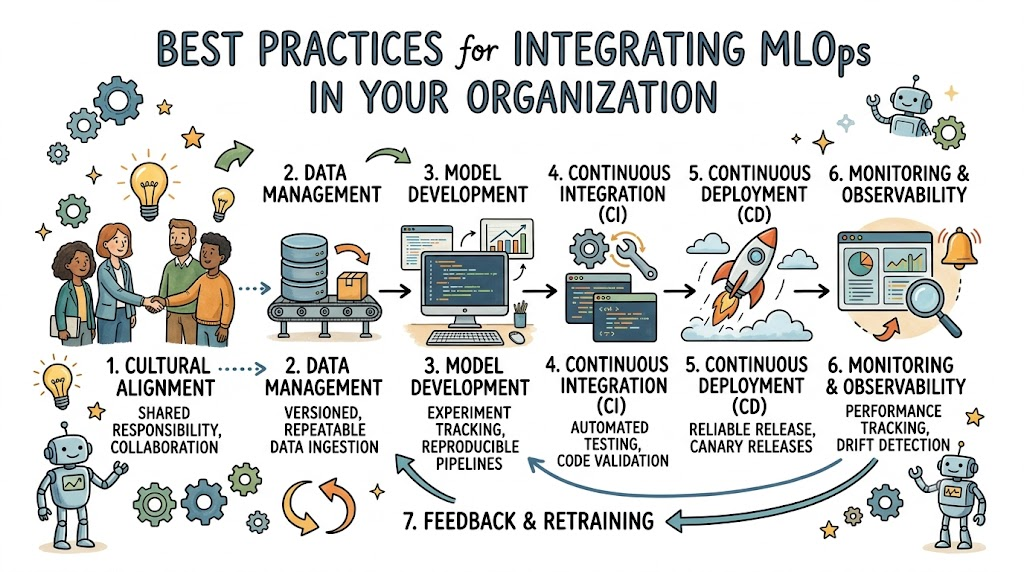
Imagine building a team of helpful robots. First, you show them how to clean your room. They do a great job indoors.
Next, you send them outside to work. Suddenly, rain pours down. The mud makes them slip. They stop working because the outside world changes fast.
Smart computer tools face the exact same problem. That is why growing teams turn to Xopsschool to master these real-world challenges. Teams need a clear system to keep smart programs running smoothly. We call this working system MLOps.
What Does Integrating MLOps Mean?
MLOps stands for Machine Learning Operations. It brings computer scientists and system builders together.
Machine learning teaches computers to spot patterns in information. Operations means keeping those programs running every day without crashes.
Integrating MLOps means adding these habits into your company. You build an automated path from smart ideas to real products. This path makes work faster, safer, and much more reliable.
Why Old Software Rules Are Not Enough
Normal software follows fixed rules written by programmers. For example, clicking a button always opens a menu.
Smart software does not use fixed rules. Instead, it learns from large piles of data.
Because of this, smart software depends on three parts:
- Code: The instructions that tell the machine what steps to run.
- Data: The information and examples used to teach the system.
- Model: The digital brain created after learning from the data.
If your data changes, your whole program changes too. Normal software tools cannot handle this moving target alone.
Best Practice 1: Version Everything You Touch
In school, you save drafts of your homework essays. You might name them Draft One, Draft Two, and Final Draft.
In MLOps, you must save drafts of everything. Never stop at saving just your code.
You must save your training data, your settings, and your models. This rule is called full version control.
| What to Track | What It Contains | Helpful Tool Example |
| Code | Application scripts and logic. | Git |
| Data | Training images, numbers, and text. | DVC |
| Models | Saved model weights and parameters. | MLflow |
When an error happens, you can travel back in time. You can see the exact data and code used for any model.
Best Practice 2: Build Automated Assembly Lines
Doing chores by hand takes forever and leads to mistakes. If you clean thousands of files by hand, you will miss some.
Automated assembly lines fix this issue. In tech, people call these CI/CD pipelines.
CI means Continuous Integration, which tests new code immediately. CD means Continuous Delivery, which shares working tools with users.
Write Code -> Run Auto Tests -> Train Model -> Deploy Safely
When an engineer commits new code, the pipeline wakes up. It tests the code, cleans the data, and checks the results. Nobody has to push buttons manually.
Best Practice 3: Stop Dirty Data Early
Smart models need clean data just like people need clean drinking water. Bad data creates broken, useless models.
Always check your incoming data before training starts. Look for missing numbers, strange words, or broken image files.
Set up automated safety guards. If dirty data arrives, your system should pause and sound an alert.
Fixing bad data early saves hours of wasted computer power. It also prevents your smart tools from learning bad habits.
Best Practice 4: Track Every Single Experiment
Data scientists test hundreds of different recipes to find the best model. They change settings, swap algorithms, and try new data mixes.
If they do not take notes, they forget what worked. That wastes time and repeats old mistakes.
Use an automated experiment tracker. It acts like a digital lab notebook.
The notebook records test scores, training speeds, and file sizes. Then, the whole team can see which recipe won the race.
Best Practice 5: Plan for Real-World Model Drift
A smart model can become less accurate over time. This common problem is called model drift.
The real world never stands still. Customer habits shift, seasons change, and new trends appear.
A model trained on winter clothes will fail during hot summer months. It does not crash, but its answers get worse.
Set up watchtower monitors that track answer quality. When the accuracy score drops below a safe line, notify your team immediately.
Best Practice 6: Set Up Continuous Training Loops
How do you cure model drift? You retrain your model with fresh data!
Mature teams set up Continuous Training loops. The system gathers new real-world data every week.
Next, it checks the data quality and trains an updated model brain. Then, it tests the new brain against the old brain.
Fresh Data Arrives -> Automatic Training -> Head-to-Head Test -> Better Brain Wins
If the new brain wins, it goes live automatically. Your smart tools stay sharp without constant human supervision.
Best Practice 7: Break Down Team Silos
In messy companies, workers sit in separate rooms and rarely talk. Data scientists build models and toss them over a wall to operations teams.
When the model breaks, everyone points fingers at each other. This bad habit slows down work and causes frustration.
MLOps brings everyone onto the same playing field. Data experts, software coders, and platform engineers share one set of goals.
They use shared dashboards and speak the same language. This teamwork turns separate groups into a single, winning crew.
Best Practice 8: Guard Your Models with Good Governance
Smart computer programs make big decisions every single day. They help decide bank loans, sort job resumes, and run medical tools.
Because these jobs matter, you must keep records of every choice. This safe practice is called model governance.
- Audit Trails: Keep a clear log showing who built each model.
- Fairness Checks: Test your models to make sure they treat all people fairly.
- Security Gates: Lock your models so bad actors cannot steal private data.
Good rules protect your customers. They also keep your business safe from legal troubles.
Best Practice 9: Watch Your Cloud Computing Bills
Teaching computer brains requires heavy, expensive machines. Running giant cloud processors all day costs a lot of money.
Many teams waste cash by leaving idle servers turned on overnight. That is like leaving every light on in an empty school.
Set up auto-scaling rules. These rules turn on extra computers only when workloads increase.
When the job finishes, the system shuts those extra machines down. Smart resource management keeps your company budget healthy.
Best Practice 10: Roll Out Updates in Small Steps
Never replace an old system with a brand-new model all at once. If the new model has a hidden bug, every user suffers.
Instead, release new models gradually. Engineers use a method called canary deployments.
Send five percent of your users to the new model first. Watch the error reports closely.
If everything works well, slowly send more users over. If something breaks, roll back to the old model in seconds.
A Simple Checklist for Your Organization
Starting your journey does not have to feel overwhelming. You can build your system step by step using this roadmap:
- Assess Your Team: Find out what tools your team already uses today.
- Pick One Small Project: Choose one simple model instead of changing everything at once.
- Automate Testing: Add basic unit tests to catch code mistakes early.
- Save Every Version: Connect your code and data storage to simple versioning tools.
- Monitor Live Outputs: Watch how your model behaves once real users try it.
Take small, steady steps. Each good habit makes your company stronger.
Building a Bright, Scalable Future
Adopting MLOps is not just about buying fancy software tools. It is about building reliable, repeatable habits across your whole company.
When you version your files, automate your tests, and monitor your results, magic happens. Your engineers stop fighting fires.
Instead, they spend their energy building helpful, creative solutions. Your models stay smart, your data stays clean, and your users stay happy.
Start small, build strong foundations, and let automation carry the heavy load. That is the secret to winning with artificial intelligence.