Modern engineering organizations expect more from DevOps leaders than deployment speed. Leaders now own availability, delivery predictability, security alignment, and cost visibility. These responsibilities demand structured thinking, not just technical depth.
This guide explains how a management-focused DevOps certification supports professionals who influence teams, systems, and outcomes. It targets engineers moving into leadership and managers who already carry operational responsibility.
The content focuses on practical relevance, long-term value, and role alignment across DevOps, cloud, and platform engineering environments.
How Leadership-Focused DevOps Certifications Fit Today
Teams often adopt automation successfully but still struggle with incidents, coordination delays, and unclear ownership. Leadership gaps create these problems, not tool limitations.
Management-oriented DevOps learning addresses this gap by teaching how leaders design workflows, guide behavior, and measure progress. It emphasizes accountability and flow over configuration details.
This approach reflects real enterprise conditions where managers enable teams rather than executing tasks themselves.
Professionals Who Benefit the Most
Senior engineers preparing for people management gain clarity on decision-making and team dynamics. Engineering managers overseeing CI/CD, cloud platforms, or shared services also benefit significantly.
Reliability leaders, platform owners, and cloud leads who coordinate multiple teams find value in structured governance and metric-driven management.
For professionals in India, the certification aligns well with global delivery and distributed team models. Internationally, it supports roles such as DevOps Lead, Platform Manager, and Engineering Manager.
Why This Credential Holds Long-Term Value
Technology stacks change frequently, but delivery challenges remain constant. Organizations continue to face production incidents, release risk, dependency bottlenecks, and escalating cloud costs.
This certification addresses those stable challenges directly. It helps leaders interpret delivery metrics, reliability signals, compliance expectations, and financial constraints.
By focusing on durable leadership skills, the learning stays relevant well beyond specific tools or platforms.
Program Orientation and Learning Model
The program operates through Certified DevOps Manager Certification and runs under DevOpsSchool.
The design favors real-world scenarios over academic testing. Participants demonstrate reasoning, prioritization, and system awareness rather than memorizing definitions.
This structure fits working professionals who already manage live systems, people, and delivery commitments.
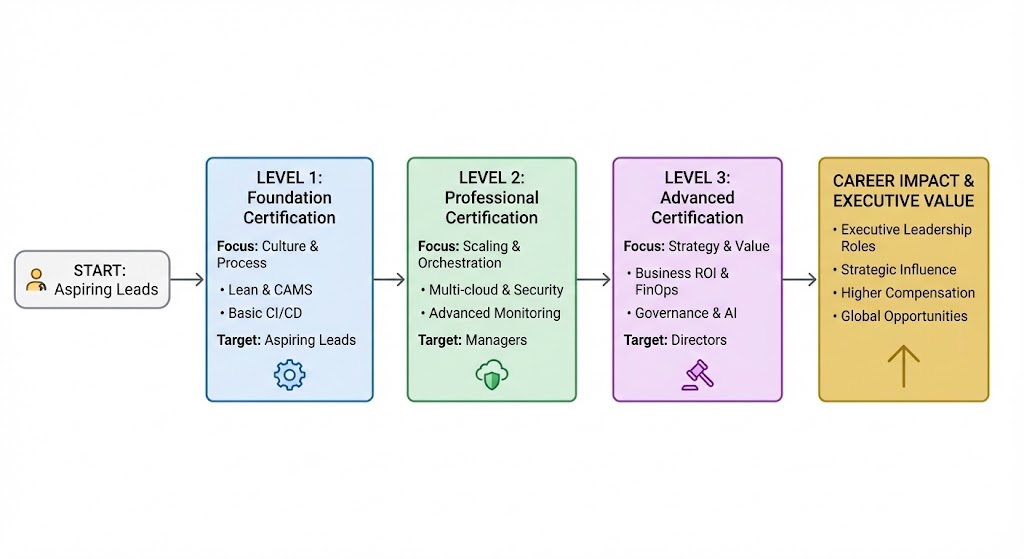
Learning Levels and Responsibility Growth
The program follows a responsibility-driven progression instead of a skill-depth ladder. Early learning establishes leadership context and shared language.
Mid-level learning focuses on coordinating delivery across teams while maintaining reliability and governance.
Advanced learning addresses organization-wide transformation, compliance integration, and value measurement. Each stage expands scope rather than narrowing technical focus.
Certification Structure Summary
| Track | Level | Target Audience | Required Background | Primary Focus | Sequence | Reference |
|---|---|---|---|---|---|---|
| DevOps Leadership | Foundation | New managers, senior engineers | DevOps exposure | Culture, metrics, flow | Step 1 | Certified DevOps Manager |
| DevOps Leadership | Professional | Engineering managers | Team ownership | Scaling, reliability | Step 2 | Certified DevOps Manager |
| DevOps Leadership | Advanced | Senior leaders | Multi-team scope | Strategy, governance | Step 3 | Certified DevOps Manager |
Foundation Level Explained
Objective
This stage builds leadership understanding around how decisions affect DevOps performance and team health.
Intended audience
Senior contributors transitioning into management and newly appointed managers gain the most value.
Core skills
- Collaboration structures
- Delivery and reliability metrics
- Workflow transparency
Practical outcomes
- Define meaningful performance indicators
- Evaluate pipelines from a leadership perspective
- Improve feedback across teams
Preparation strategy
Use two weeks to review DevOps fundamentals. Spend one month mapping workflows. Apply learnings directly to daily work over sixty days.
Common errors
- Over-focusing on tools
- Underestimating people dynamics
Next steps
- Same path: Professional level
- Adjacent path: SRE leadership
- Leadership growth: Management fundamentals
Professional Level Explained
Objective
This stage validates the ability to manage DevOps delivery across teams, platforms, and services.
Intended audience
Engineering managers, platform leads, and senior reliability engineers with operational accountability.
Core skills
- Cross-team alignment
- Incident leadership
- Reliability ownership
Practical outcomes
- Design DevOps operating models
- Lead effective incident reviews
- Align technical metrics with business goals
Preparation strategy
Review leadership concepts in two weeks. Study scaling patterns within a month. Analyze real incidents and delivery data over two months.
Common errors
- Treating DevOps as a silo
- Ignoring organizational constraints
Next steps
- Same path: Advanced level
- Adjacent path: FinOps
- Leadership growth: Program management
Advanced Level Explained
Objective
This stage confirms the ability to lead DevOps at enterprise scale.
Intended audience
Senior managers, directors, and transformation leaders.
Core skills
- Strategic governance
- Compliance alignment
- Change leadership
Practical outcomes
- Drive organization-wide DevOps adoption
- Integrate finance and security into delivery
- Measure business impact
Preparation strategy
Align strategic frameworks in two weeks. Review enterprise cases in one month. Map learning to organizational objectives over sixty days.
Common errors
- Applying frameworks without adaptation
- Ignoring cultural resistance
Next steps
- Same path: Continuous improvement leadership
- Adjacent path: AIOps
- Leadership growth: Executive technology leadership
Selecting a Direction After Completion
DevOps leadership
Manage delivery flow, stability, and ownership clarity.
DevSecOps leadership
Balance compliance requirements with delivery velocity.
SRE leadership
Own availability targets and incident response.
AIOps and MLOps leadership
Guide intelligent automation and data-driven operations.
DataOps leadership
Oversee analytics pipelines and data reliability.
FinOps leadership
Control cloud spend and financial accountability.
Role-Based Recommendations
| Role | Suggested Level |
|---|---|
| DevOps Engineer | Foundation |
| SRE | Professional |
| Platform Engineer | Professional |
| Cloud Engineer | Foundation |
| Security Engineer | Foundation |
| Data Engineer | Foundation |
| FinOps Practitioner | Professional |
| Engineering Manager | Professional to Advanced |
Progressing Beyond the Certification
Deeper specialization
Advance within DevOps leadership to manage broader delivery programs.
Skill expansion
Add reliability, finance, or automation leadership for wider influence.
Leadership evolution
Move toward senior technology and organizational leadership roles.
Training and Support Ecosystem
DevOpsSchool delivers structured leadership-focused DevOps programs.
Cotocus supports enterprise transformation initiatives.
Scmgalaxy blends process knowledge with leadership learning.
BestDevOps prepares engineers for management transitions.
devsecopsschool.com emphasizes security-aware leadership.
sreschool.com develops reliability ownership skills.
aiopsschool.com builds operations intelligence leadership.
dataopsschool.com strengthens data delivery management capability.
finopsschool.com develops cloud financial governance skills.
Frequently Asked Questions (General)
- Is Certified DevOps Manager difficult?
Difficulty depends on experience. Managers with delivery exposure find it practical rather than theoretical. - How long does preparation take?
Most professionals prepare in 30–60 days alongside work. - Is coding required?
Deep coding is not required, but system awareness helps. - Is it suitable for non-technical managers?
It suits managers with engineering exposure more than purely administrative roles. - Does it improve career growth?
It supports progression into higher-responsibility roles. - Is it globally relevant?
Yes, it aligns with global DevOps leadership expectations. - Can beginners pursue it?
It is not recommended without DevOps exposure. - Is it tool-specific?
No, it focuses on principles and operating models. - Does it include real scenarios?
Yes, the learning emphasizes practical decision-making. - Is it useful in service companies?
Yes, especially for managing multiple teams and clients. - Does it require renewal?
Renewal depends on certification policy. - Can it combine with cloud certifications?
Yes, it complements cloud and platform learning.
FAQs on Certified DevOps Manager
- How is this different from DevOps engineer certifications?
It focuses on leadership responsibilities rather than implementation skills. - Does it include cost management?
Higher levels integrate cost and value considerations. - Is it aligned with SRE practices?
Yes, it complements reliability leadership roles. - Can it support transformation roles?
It prepares professionals for organizational change efforts. - Is it useful for remote teams?
It supports distributed delivery models. - Does it address compliance?
Advanced levels cover governance and compliance topics. - Can it pair with cloud certifications?
Yes, cloud expertise strengthens its value. - Is it relevant outside IT services?
It applies to product companies and enterprises alike.
Closing Perspective
This certification serves professionals who already influence delivery outcomes and now carry responsibility for people, platforms, and decisions. It strengthens judgment, alignment, and leadership confidence.
For careers built on accountability rather than task execution, it offers durable and practical value.