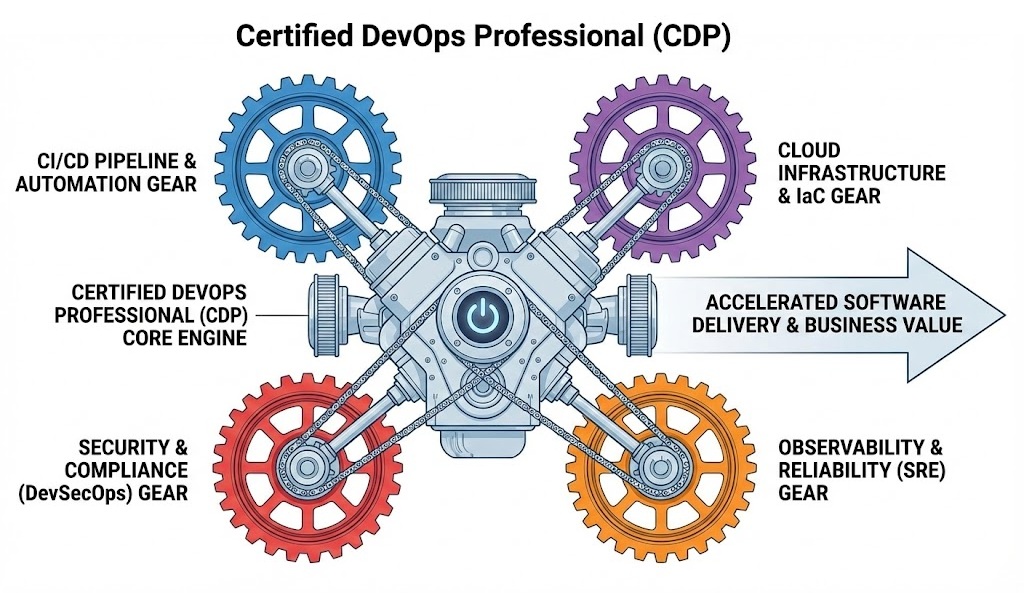
Why Certified DevOps Professional (CDP) Exists
Modern engineering teams no longer separate development and operations as isolated functions. Engineers now own delivery, reliability, security, and cost decisions together. Certified DevOps Professional (CDP) exists to reflect this reality. It formalizes the skills required to run production systems confidently, not just configure tools. CDP focuses on how engineers think, decide, and act when systems operate under real pressure. This approach makes the certification relevant to today’s cloud-native, always-on environments.
How CDP Fits into Real DevOps Careers
Certified DevOps Professional (CDP) does not target beginners who only want conceptual exposure. It supports engineers who already work with deployments, infrastructure, or services and want structured professional growth. CDP aligns naturally with DevOps, SRE, platform engineering, and cloud operations roles. Teams that value ownership and accountability benefit the most from CDP-aligned skills. The certification reinforces habits that reduce downtime, improve delivery speed, and strengthen operational maturity.
What Certified DevOps Professional (CDP) Actually Validates
CDP validates applied engineering capability rather than theoretical knowledge. It confirms that a professional understands end-to-end delivery pipelines, infrastructure automation, observability, and operational feedback loops. Engineers learn to design systems that support scale, resilience, and continuous improvement. CDP rewards candidates who connect tooling decisions to business outcomes. This makes the certification practical rather than academic.
Industry Relevance of Certified DevOps Professional (CDP) After 2026
Enterprises continue to replace tools, platforms, and vendors, but DevOps fundamentals remain stable. Certified DevOps Professional (CDP) stays relevant because it emphasizes principles over products. Engineers who hold CDP can adapt faster to organizational change. The certification protects long-term employability by strengthening transferable skills. This durability gives CDP strong return on learning effort.
Certified DevOps Professional (CDP) Certification Model
The Certified DevOps Professional (CDP) program is delivered through the Certified DevOps Professional (CDP) certification program and hosted on DevOpsSchool. The program focuses on professional readiness instead of entry-level awareness. It evaluates how engineers approach real operational scenarios. The structure mirrors enterprise DevOps challenges rather than lab-only exercises. This alignment makes the certification credible in hiring and internal promotions.
Levels and Skill Progression in CDP
Certified DevOps Professional (CDP) follows a progression that matches career evolution. Foundation stages introduce structured DevOps workflows and collaboration models. Professional levels strengthen automation, monitoring, reliability, and system integration skills. Advanced stages allow specialization across SRE, DevSecOps, FinOps, and DataOps domains. Each level raises expectations around ownership and decision-making. This progression mirrors real engineering responsibility growth.
CDP Tracks and Capability Mapping
| Focus Area | Skill Depth | Ideal For | Core Outcomes |
|---|---|---|---|
| Core DevOps | Foundation | Entry-to-mid engineers | Pipeline literacy and automation |
| Core DevOps | Professional | Experienced engineers | Production-ready delivery systems |
| SRE | Professional | Reliability owners | Uptime, SLOs, incident handling |
| DevSecOps | Advanced | Security-focused teams | Secure pipelines and compliance |
| FinOps | Advanced | Cost-conscious engineers | Spend visibility and optimization |
Certified DevOps Professional (CDP): Foundation Level
This level builds disciplined DevOps thinking. Engineers learn how teams design pipelines, automate environments, and collaborate effectively. The certification suits engineers transitioning into DevOps ownership. Candidates gain confidence in workflows that support continuous delivery. This level prepares professionals for deeper system responsibility.
You should be able to:
- Create basic CI/CD workflows
- Automate environment provisioning
- Support simple deployment strategies
Preparation guidance:
Experienced engineers may need two weeks, while beginners often benefit from a month of hands-on practice.
Certified DevOps Professional (CDP): Professional Level
The professional level validates production maturity. Engineers demonstrate control over deployment pipelines, observability, and operational reliability. This level fits engineers who manage live systems. The certification reinforces disciplined execution under real constraints. Professionals gain clarity on how small decisions scale into system-wide impact.
You should be able to:
- Design resilient CI/CD systems
- Implement monitoring and alerting
- Handle deployment failures confidently
Preparation guidance:
Plan 30 days of structured practice or 60 days if you rely heavily on project-based learning.
Choosing the Right CDP Learning Direction
DevOps-Centric Growth
This path suits engineers focused on delivery automation and platform stability. CDP strengthens release ownership and system consistency. Engineers improve collaboration with developers and product teams. This direction leads toward senior DevOps or platform engineering roles.
Reliability-Focused Growth (SRE)
Engineers who own uptime benefit strongly from CDP concepts. The program builds observability and incident response discipline. Professionals learn to balance reliability with delivery speed. This path fits engineers responsible for critical services.
Security-Oriented Growth (DevSecOps)
Security engineers gain operational credibility through CDP. The certification teaches how to embed security into pipelines instead of bolting it on later. Engineers reduce friction between security and delivery. This path suits regulated environments.
Data and AI-Driven Operations
CDP provides the operational backbone needed for DataOps and AIOps practices. Engineers stabilize pipelines before adding intelligence. This sequencing reduces noise and failure rates. It supports teams operating complex data platforms.
Cost and Efficiency Focus (FinOps)
FinOps professionals benefit from CDP’s system-level visibility. Engineers learn how usage patterns affect cost. Teams gain control over cloud spend without sacrificing performance. This path strengthens engineering-finance collaboration.
Role-Based CDP Recommendations
| Role | Suggested CDP Path |
|---|---|
| DevOps Engineer | Foundation → Professional |
| Site Reliability Engineer | Professional → SRE Track |
| Platform Engineer | Professional → Advanced |
| Cloud Engineer | Foundation → Professional |
| Security Engineer | Professional → DevSecOps |
| Data Engineer | Foundation → DataOps |
| FinOps Practitioner | Professional → FinOps |
| Engineering Manager | Foundation → Leadership |
What to Do After Completing CDP
Deepen Technical Expertise
Engineers who stay in the same track gain deep specialization. This choice suits professionals aiming for architect or principal roles. Depth builds authority and trust.
Expand Across Domains
Cross-domain learning improves system-wide understanding. Engineers collaborate better across teams. This option suits staff-level engineers and technical leaders.
Move Into Leadership
Many engineers use CDP to transition into leadership. The certification strengthens technical credibility. Leaders make better trade-offs and guide teams more effectively.
Training and Ecosystem Support
Several platforms support Certified DevOps Professional (CDP) learning through structured education, consulting exposure, and community knowledge sharing. These include DevOpsSchool, Cotocus, Scmgalaxy, BestDevOps, devsecopsschool.com, sreschool.com, aiopsschool.com, dataopsschool.com, and finopsschool.com. Each contributes differently through training, content, or specialization. Professionals should choose based on learning style and career goals.
Common Questions Engineers Ask About CDP
Engineers often ask whether CDP feels difficult. The answer depends on real-world exposure. Practicing engineers usually find it approachable. Preparation time varies based on experience. CDP does not demand deep coding skills but expects operational clarity. The certification remains vendor-neutral and globally relevant. Teams value CDP because it signals production readiness rather than tool familiarity.
Final Mentor Advice on Certified DevOps Professional (CDP)
Certified DevOps Professional (CDP) rewards engineers who want long-term relevance, not shortcuts. It does not inflate titles or promise instant outcomes. Instead, it strengthens how professionals think about systems, responsibility, and delivery. Engineers who apply CDP concepts at work gain the most value. If you plan to grow in DevOps, SRE, or platform engineering, CDP provides a solid and honest foundation.