Introduction
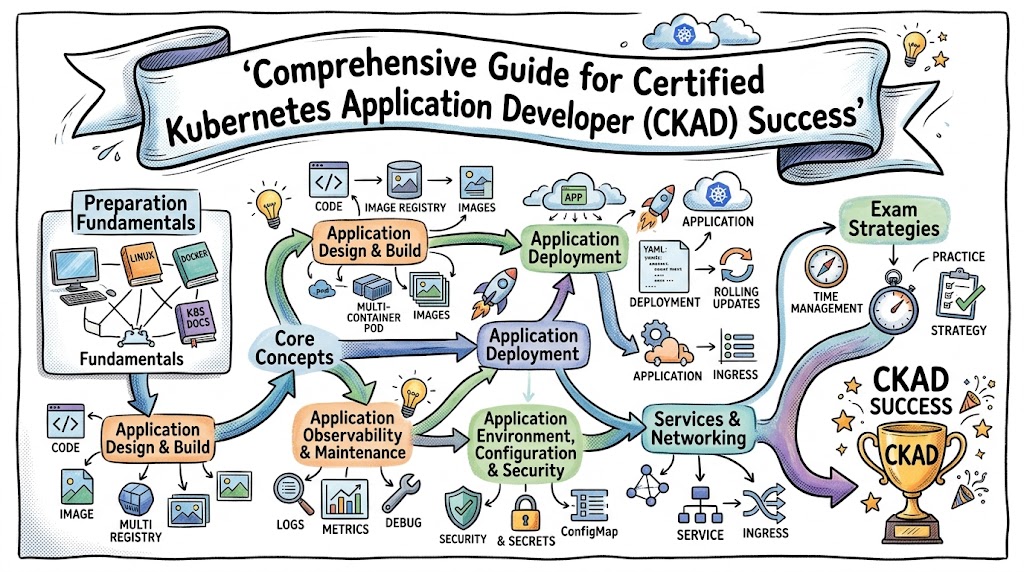
Cloud-native development transforms how teams build and scale software, and the Certified Kubernetes Application Developer (CKAD) stands as the gold standard for validating these skills. This manual guides developers and platform engineers through the intricate process of mastering container orchestration in a live environment. You will learn to design, build, and troubleshoot production-ready applications while securing a competitive edge in the global tech market. DevOpsSchool provides the expert mentorship and hands-on labs necessary to turn these complex technical concepts into career-defining strengths.
What is the Certified Kubernetes Application Developer (CKAD)?
The Certified Kubernetes Application Developer (CKAD) program provides a performance-based assessment that tests your ability to solve real-world problems. Unlike traditional exams that rely on multiple-choice questions, this certification requires you to interact with a live command-line interface. It exists to verify that an engineer can configure core Kubernetes primitives to support scalable and reliable microservices. Organizations rely on this benchmark to ensure their staff can handle the daily operational challenges of a containerized infrastructure.
Who Should Pursue Certified Kubernetes Application Developer (CKAD)?
Software developers, SREs, and cloud-native architects who manage containerized workloads find this certification most beneficial. It also serves as a critical stepping stone for security professionals and data engineers who need to understand how applications behave within a cluster. Beginners use this path to build a solid technical foundation, while senior managers gain the technical empathy required to lead engineering departments. This credential carries significant weight across the Indian IT landscape and within major global enterprises.
Why Certified Kubernetes Application Developer (CKAD) is Valuable and Beyond
Kubernetes has become the universal language of the cloud, making this certification an essential asset for long-term career stability. This program focuses on vendor-neutral skills that apply to every major cloud provider, including AWS, Azure, and Google Cloud. You will see a significant return on investment as your ability to automate and optimize workloads leads to more senior roles. Mastering these patterns ensures that you remain a vital part of any modern engineering team, regardless of future tool changes.
Certified Kubernetes Application Developer (CKAD) Certification Overview
The program utilizes the official curriculum provided by the training link and remains hosted on the designated website platform. You must complete a series of technical tasks within a specific time limit to demonstrate your practical command of the system. This hands-on ownership model ensures that every certified individual possesses the actual skills needed to contribute to a project from day one. It removes the guesswork for employers and provides a clear map for your professional development.
Certified Kubernetes Application Developer (CKAD) Certification Tracks & Levels
The curriculum follows a logical progression from foundational application design to advanced cluster interactions. You can choose specialized tracks that align with your specific career goals, such as focusing on security, data operations, or financial management. These levels help you build a comprehensive portfolio of skills that mirror the responsibilities of lead developers and architects. Each track ensures that you stay ahead of industry trends while mastering the core components of the Kubernetes API.
Complete Certified Kubernetes Application Developer (CKAD) Certification Table
| Track | Level | Who it’s for | Prerequisites | Skills Covered | Recommended Order |
| App Lifecycle | Foundation | New Developers | Linux Skills | Pods, YAML basics | 1 |
| Core Dev | Professional | Software Engineers | Basic K8s | Deployments, Services | 2 |
| Security | Specialist | SecOps Engineers | CKAD Core | Network Policy, Secrets | 3 |
| Optimization | Expert | Platform Leads | Advanced CKAD | Quotas, Liveness Probes | 4 |
Detailed Guide for Each Certified Kubernetes Application Developer (CKAD) Certification
Certified Kubernetes Application Developer (CKAD) – Expert Level
What it is
This level validates your ability to architect complex, multi-container applications and manage their entire lifecycle within a cluster. It proves you can implement advanced configuration and security patterns to meet enterprise requirements.
Who should take it
Senior developers and DevOps leads who have extensive experience managing production clusters should pursue this. It fits those who want to certify their expertise in optimizing resource usage and application reliability.
Skills you’ll gain
- Building multi-container pods using sidecar and ambassador patterns.
- Designing sophisticated networking and service discovery routes.
- Implementing automated health checks and rolling updates.
- Managing stateful data with persistent volumes and claims.
- Securing application traffic using fine-grained network policies.
Real-world projects you should be able to do
- Deploy a high-availability microservices application with automated scaling.
- Configure a secure multi-tenant environment using namespaces and quotas.
- Create a robust logging and monitoring stack for a containerized workload.
Preparation plan
- 7–14 Days: Master imperative commands and the official documentation structure to save time.
- 30 Days: Work through diverse lab scenarios that cover networking, storage, and troubleshooting.
- 60 Days: Perform multiple timed mock exams to ensure you can complete tasks under pressure.
Common mistakes
- Ignoring the context or namespace when applying new configurations.
- Manually writing large YAML files instead of generating them with the CLI.
- Failing to test the application’s connectivity after making networking changes.
Best next certification after this
- Same-track option: Certified Kubernetes Administrator (CKA).
- Cross-track option: Certified Kubernetes Security Specialist (CKS).
- Leadership option: Cloud-Native Strategy for Managers.
Choose Your Learning Path
DevOps Path
The DevOps track focuses on the intersection of code development and infrastructure automation through continuous delivery. You will learn to use Kubernetes as a target for automated pipelines, ensuring fast and reliable software releases. This path emphasizes the reduction of manual intervention to improve team agility and code quality. It is perfect for those who want to lead digital transformation efforts within their organizations.
DevSecOps Path
This security-centric path integrates defensive measures directly into the application design and deployment phases. You will master tools for container scanning, secret management, and runtime security within the Kubernetes ecosystem. This ensures that every piece of code you deploy meets high-security standards from the very beginning. It attracts engineers who are passionate about protecting data in cloud-native environments.
SRE Path
The Site Reliability Engineering path concentrates on the stability and performance of large-scale distributed systems. You will focus on observability, error budgets, and incident response to maintain high service availability. This path teaches you how to automate the management of cluster resources to prevent system downtime. It is the ideal choice for engineers who enjoy solving complex operational puzzles.
AIOps Path
AIOps professionals apply artificial intelligence to simplify and automate the vast amount of data generated by Kubernetes. You will learn to use machine learning to detect anomalies and predict infrastructure failures before they impact users. This path represents the cutting edge of automated maintenance and proactive system management. It suits forward-thinking engineers who want to stay at the forefront of technical innovation.
MLOps Path
The MLOps path addresses the specific challenges of running machine learning models on containerized infrastructure. You will focus on orchestrating data pipelines and serving models at scale while maintaining model accuracy. This ensures that your organization can deploy AI solutions quickly and reliably. It is a vital track for data scientists and engineers working on large-scale AI projects.
DataOps Path
DataOps professionals focus on the speed and reliability of data delivery for analytics and application workloads. You will learn to handle the persistence and storage challenges associated with running databases on Kubernetes. This track ensures that data remains accessible and consistent across a dynamic, distributed environment. It attracts specialists who want to master high-performance data architecture.
FinOps Path
The FinOps path teaches you how to manage the costs of running cloud-native applications without sacrificing performance. You will learn to track resource consumption and implement strategies that maximize the value of your cloud spend. This role bridges the gap between engineering, finance, and business leadership. It is essential for managing the growing complexity of cloud budgets in large enterprises.
Role → Recommended Certified Kubernetes Application Developer (CKAD) Certifications
| Role | Recommended Certifications |
| DevOps Engineer | CKAD, CKA, Jenkins Professional |
| SRE | CKAD, Prometheus Specialist, CKA |
| Platform Engineer | CKAD, Terraform Associate, CKA |
| Cloud Engineer | CKAD, Cloud Architect (AWS/Azure/GCP) |
| Security Engineer | CKAD, CKS, Cloud Security Cert |
| Data Engineer | CKAD, Data Engineering Specialty |
| FinOps Practitioner | CKAD, FinOps Practitioner Cert |
| Engineering Manager | CKAD, Agile or DevOps Leadership |
Next Certifications to Take After Certified Kubernetes Application Developer (CKAD)
Same Track Progression
Deepening your Kubernetes expertise usually involves moving from application development to full cluster administration. Taking the CKA allows you to understand the underlying infrastructure and how the control plane manages node communication. This transition provides a holistic view of the ecosystem, making you a more effective troubleshooter. It ensures you can build and maintain the environments where your applications run.
Cross-Track Expansion
Broadening your skills into security or infrastructure automation creates a more versatile professional profile. The CKS certification offers deep insights into securing the container supply chain and hardening the cluster environment. You might also explore tools like Terraform or Ansible to manage the infrastructure that supports your Kubernetes clusters. This cross-disciplinary approach makes you highly valuable in hybrid and multi-cloud environments.
Leadership & Management Track
Transitioning into leadership requires shifting your focus from individual technical tasks to overall team strategy. You will learn to manage budgets, set technical roadmaps, and foster a culture of continuous improvement. Leadership certifications in DevOps or Agile help you translate technical success into business value. This path prepares you for high-level roles such as Director of Engineering or VP of Cloud Infrastructure.
Training & Certification Support Providers for Certified Kubernetes Application Developer (CKAD)
DevOpsSchool
This organization provides a hands-on learning environment that mirrors the actual challenges found in the CKAD exam. Their instructors bring decades of industry experience to the classroom, ensuring you learn practical solutions rather than just theory. They offer a comprehensive suite of labs and study materials to support your success.
Cotocus
Providing specialized consulting and training, this company focuses on helping engineering teams master complex cloud-native technologies. Their programs emphasize architectural best practices and operational efficiency in production environments. They help professionals build the confidence needed to manage enterprise-scale clusters.
Scmgalaxy
This platform serves as a massive knowledge hub for the global DevOps community, offering tutorials and technical documentation. It provides a wealth of resources for troubleshooting and learning the nuances of container orchestration. Many engineers use this site as their primary reference for staying updated on Kubernetes changes.
BestDevOps
This provider offers high-intensity bootcamps designed for rapid skill acquisition and exam preparation. Their curriculum focuses on the most critical parts of the Kubernetes API to ensure you pass the test on your first try. They prioritize outcome-based learning for busy professionals.
devsecopsschool.com
This school focuses entirely on the intersection of security and modern deployment practices. Their courses teach you how to build secure containers and implement rigid network policies within your clusters. It is the premier destination for security-minded developers.
sreschool.com
Dedicated to the principles of Site Reliability Engineering, this school teaches you how to maintain high-availability systems. Their Kubernetes training focuses on observability, scaling, and proactive incident management. It provides the skills needed to keep production environments running smoothly.
aiopsschool.com
This institution explores the use of artificial intelligence to automate and optimize infrastructure operations. Their courses cover the latest trends in using machine learning to manage complex containerized systems. It is perfect for engineers who want to lead the next wave of automation.
dataopsschool.com
This provider specializes in the unique challenges of managing data pipelines and stateful workloads on Kubernetes. Their training covers everything from persistent storage to data locality in distributed systems. It is the best choice for data-focused cloud professionals.
finopsschool.com
This school focuses on the financial management and cost optimization of cloud-native infrastructure. They teach you how to balance performance requirements with budget constraints to ensure profitable cloud operations. It is a vital resource for anyone managing cloud spend at scale.
Frequently Asked Questions (General)
- Is the CKAD exam harder than the CKA?
Most people find the CKAD more focused on application logic, while the CKA requires a deeper understanding of infrastructure and networking.
- How many times can I retake the test?
Most exam vouchers include one free retake if you fail to reach the passing score on your first attempt.
- Can I use a second monitor during the exam?
No, the proctoring rules usually restrict you to a single monitor to ensure the integrity of the testing environment.
- Does this certification help with career growth in India?
Yes, the Indian tech market has a massive demand for Kubernetes skills, making this one of the most valuable credentials available.
- What happens if my session expires during the test?
You should contact the proctor immediately to resume your session and ensure you don’t lose your progress.
- Should I use imperative commands or YAML files?
You should prioritize imperative commands because they are much faster and less prone to errors during the timed exam.
- How long does it take to get the results?
The exam provider typically sends the results to your email within 24 hours of completing the test.
- Is there a local testing center I can visit?
No, the exam is exclusively conducted online through a proctored web browser environment.
- Do I need to be an expert in Linux?
You should have a strong grasp of the Linux command line, as you will perform all tasks in a terminal.
- Are there any prerequisites for the CKAD?
There are no formal prerequisites, though knowing Docker and basic YAML is highly recommended before starting.
- Does the exam include Helm?
Yes, the current version of the CKAD curriculum includes the use of Helm for package management and deployments.
- Can I use the official Kubernetes documentation?
You are allowed to have one tab open to the official Kubernetes docs, but you cannot use external search engines.
FAQs on Certified Kubernetes Application Developer (CKAD)
- How do I manage time effectively during the test?
Skip the questions that take too long and return to them after you have answered all the easier ones.
- What version of Kubernetes will I encounter?
The exam usually runs on a stable version released within the last six to nine months.
- Is it possible to pass without work experience?
Yes, if you spend significant time in hands-on lab environments, you can pass the exam through dedicated practice.
- What text editors are available in the terminal?
Vim and Nano are the most common editors provided in the testing environment for modifying YAML files.
- Are network policies a major part of the exam?
Yes, you must understand how to isolate traffic between pods using various selector labels.
- How do I verify my work during the exam?
Always run a “get” or “describe” command on the resource you just created to ensure it is running correctly.
- Does the exam test on Custom Resource Definitions?
Basic knowledge of CRDs is helpful, but the core focus remains on standard Kubernetes API objects.
- Can I use my own aliases in the terminal?
Yes, you can set up aliases at the beginning of the exam to speed up your command-line workflow.
Final Thoughts: Is Certified Kubernetes Application Developer (CKAD) Worth It?
Taking the leap to earn this certification proves your dedication to mastering the most important technology in the cloud today. It forces you to demonstrate real competence in a live environment, which counts far more than a simple theoretical understanding. While the journey requires intense focus and dozens of hours of practice, the resulting professional opportunities justify every moment spent. You gain more than just a credential; you acquire the technical confidence to build the future of software on a global scale. This investment in your skills will continue to pay dividends as organizations across the world double down on their cloud-native strategies.