Introduction
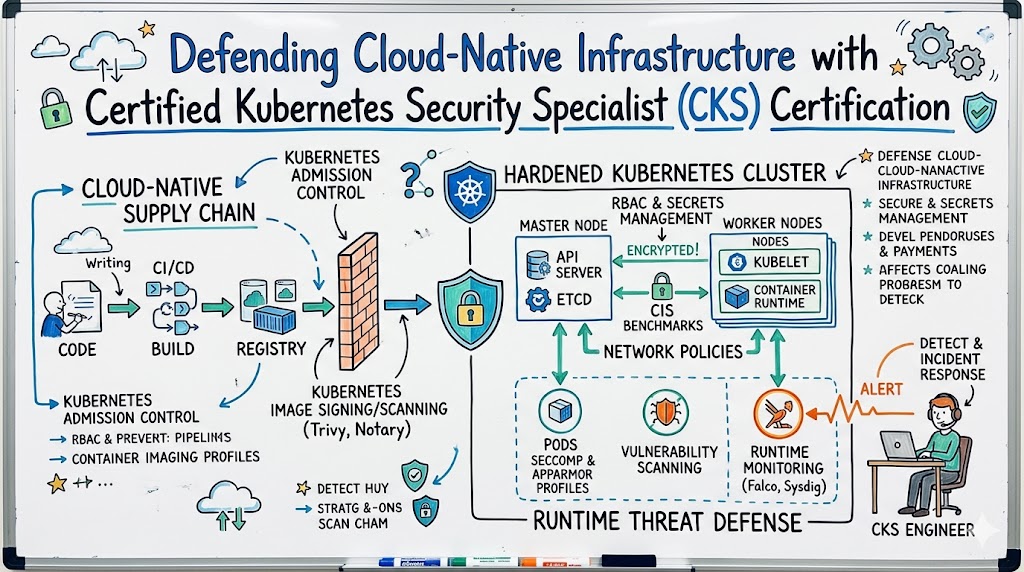
Modern technology stacks rely heavily on containerization, making the Certified Kubernetes Security Specialist (CKS) one of the most vital credentials for today’s engineering workforce. This rigorous program provides DevOpsSchool learners with the hands-on expertise necessary to protect clusters from sophisticated digital threats. As enterprises shift toward distributed architectures, they demand professionals who can secure every layer of the cloud-native stack, from the initial build to the final production runtime. This guide outlines how engineers can leverage this certification to anchor their careers in the rapidly expanding field of DevSecOps.
What is the Certified Kubernetes Security Specialist (CKS)?
The Certified Kubernetes Security Specialist (CKS) functions as a high-stakes, performance-based exam that validates an engineer’s ability to secure containerized applications. It focuses on the practical application of security protocols rather than theoretical knowledge, requiring candidates to fix vulnerabilities in live environments. This certification ensures that practitioners can manage the security lifecycle of a cluster while adhering to enterprise-grade compliance standards. By mastering these skills, engineers protect their organizations from common pitfalls like misconfigured APIs and insecure container images.
Who Should Pursue Certified Kubernetes Security Specialist (CKS)?
Cloud Engineers, SREs, and Platform leads who manage Kubernetes clusters daily will find this certification immensely beneficial. Security analysts moving into cloud-native territory use this track to understand how to apply defensive strategies within orchestrated environments. While senior professionals use it to validate their architectural choices, aspiring DevSecOps engineers can use it to prove their readiness for high-level responsibilities. Regardless of whether you operate in India’s tech centers or on a global stage, this credential marks you as a specialist in infrastructure integrity.
Why Certified Kubernetes Security Specialist (CKS) is Valuable and Beyond
Securing the supply chain has become a top priority for organizations migrating mission-critical workloads to the cloud. Because Kubernetes now serves as the backbone for global digital services, specialized security skills ensure long-term career stability and high market value. Earning this certificate demonstrates your commitment to protecting sensitive data, which directly impacts an organization’s bottom line and reputation. It keeps your skills sharp and relevant as the industry moves toward automated security and “zero-trust” networking.
Certified Kubernetes Security Specialist (CKS) Certification Overview
Candidates access this program through the official training modules and complete their assessment on the primary platform. The certification follows a purely practical model, forcing candidates to solve complex configuration issues under a strict time limit. The Cloud Native Computing Foundation (CNCF) maintains the curriculum, ensuring it reflects the latest security best practices and open-source tools. Engineers must prove their competence in areas like system hardening, microservice protection, and runtime threat detection.
Certified Kubernetes Security Specialist (CKS) Certification Tracks & Levels
Professionals usually begin their journey with the CKA (Administrator) level before advancing to the CKS specialization. After achieving this professional status, many engineers pursue niche tracks like DevSecOps automation or Advanced Runtime Security. These levels align with a natural career path, moving from general administration to high-level security architecture. Each stage introduces more complex tools, such as admission controllers and automated scanning engines, to build a multi-layered defense strategy.
Complete Certified Kubernetes Security Specialist (CKS) Certification Table
| Track | Level | Who it’s for | Prerequisites | Skills Covered | Recommended Order |
| Core Hardening | Professional | DevSecOps Engineers | CKA Certification | Cluster Security, RBAC, Network Policies | 1st |
| Compliance & Audit | Advanced | Security Architects | CKS Knowledge | OPA, Auditing, Benchmarking | 2nd |
| Runtime Analysis | Specialization | SREs | CKS Knowledge | Falco, Seccomp, AppArmor | 3rd |
| Supply Chain | Specialization | Platform Engineers | CKS Knowledge | Image Signing, Admission Controllers | 4th |
Detailed Guide for Each Certified Kubernetes Security Specialist (CKS) Certification
Certified Kubernetes Security Specialist (CKS) – Professional Level
What it is
This credential confirms your ability to secure the entire Kubernetes environment. It validates that you can minimize the attack surface and respond to active threats effectively.
Who should take it
Senior DevOps professionals and Cloud Architects who want to master the defensive side of orchestration should prioritize this exam.
Skills you’ll gain
- Hardening the host OS and the Kubernetes API server.
- Implementing least-privilege access via RBAC.
- Creating Network Policies to isolate sensitive workloads.
- Detecting suspicious activity using runtime security tools.
- Securing the container build process and registry.
Real-world projects you should be able to do
- Configure a cluster that meets all CIS Kubernetes Benchmark requirements.
- Set up an automated pipeline that blocks insecure images from deployment.
- Implement a centralized logging and auditing system for security events.
Preparation plan
- 7–14 days: Review the core CKA concepts and practice basic Linux system administration.
- 30 days: Focus on mastering third-party security tools like Falco and Trivy.
- 60 days: Run through simulated exams to ensure you can solve tasks quickly and accurately.
Common mistakes
- Forgetting to set the correct context between different exam questions.
- Over-complicating Network Policy rules instead of using simple, effective logic.
- Ignoring the documentation, which serves as a vital resource during the test.
Best next certification after this
- Same-track option: Advanced Cloud-Native Security.
- Cross-track option: Certified Cloud Security Professional (CCSP).
- Leadership option: CISO Management Training.
Choose Your Learning Path
DevOps Path
This route integrates security checks directly into the continuous integration and deployment cycles. You learn to treat security as a first-class citizen alongside code and infrastructure. It focuses on using automation to catch vulnerabilities before they ever reach production environments. Engineers on this path become experts at maintaining speed without sacrificing safety.
DevSecOps Path
Focusing on the “Shift Left” philosophy, this path demands a deep understanding of software supply chain security. You master tools that sign images and verify their integrity during the deployment phase. This specialization suits those who want to build end-to-end secure pipelines for large-scale enterprise applications.
SRE Path
Reliability engineers follow this path to protect system uptime against malicious actors and internal misconfigurations. You focus heavily on runtime monitoring, auditing, and incident response within the cluster. This path teaches you how to maintain a resilient posture while managing high-traffic, dynamic workloads.
AIOps Path
In this track, you explore how machine learning models can identify anomalous behavior within your Kubernetes logs. You learn to automate the detection of sophisticated attacks that traditional rule-based systems might miss. This represents the cutting edge of proactive infrastructure defense and automated remediation.
MLOps Path
Securing the specialized workloads used for machine learning requires unique strategies covered in this track. You focus on isolating GPU-intensive tasks and protecting the massive datasets used for training. This ensures that your ML models remain secure from data poisoning and unauthorized access.
DataOps Path
Professionals here focus on the security of the data layer, including persistent volumes and database connections. You master encryption at rest and in transit to ensure that sensitive information remains protected across the cluster. This path is essential for industries like finance and healthcare that handle regulated data.
FinOps Path
This track examines the intersection of security configurations and cloud resource costs. You learn how to implement security measures that don’t bloat the cloud bill, such as optimizing log storage and monitoring frequency. It provides a strategic view of building a cost-effective yet robust security infrastructure.
Role → Recommended Certified Kubernetes Security Specialist (CKS) Certifications
| Role | Recommended Certifications |
| DevOps Engineer | CKA, CKS, DevSecOps Professional |
| SRE | CKS, Cloud-Native Runtime Security |
| Platform Engineer | CKS, Infrastructure as Code |
| Cloud Engineer | Cloud Provider Security, CKS |
| Security Engineer | CKS, CISSP, Pentesting |
| Data Engineer | CKS, Data Security Specialist |
| FinOps Practitioner | CKS, FinOps Certified |
| Engineering Manager | CKS (Foundation), IT Compliance |
Next Certifications to Take After Certified Kubernetes Security Specialist (CKS)
Same Track Progression
Deepen your expertise by exploring advanced service mesh security using Istio or Linkerd. You can also specialize in eBPF-based security, which provides deep visibility into the kernel without slowing down applications. Staying within the CNCF ecosystem ensures you remain at the forefront of cloud-native innovation.
Cross-Track Expansion
Expand your reach by mastering the security tools specific to major cloud providers like AWS, Azure, or GCP. Understanding how Kubernetes interacts with external IAM systems and managed security services rounds out your profile as a cloud architect. You might also pursue automation-focused certs like Terraform or Ansible security.
Leadership & Management Track
If you aim for executive roles, focus on risk management and governance certifications like CISM or CISA. These programs teach you how to translate technical security risks into business language for stakeholders. This transition allows you to move from individual technical tasks to leading entire security organizations.
Training & Certification Support Providers for Certified Kubernetes Security Specialist (CKS)
DevOpsSchool
DevOpsSchool offers an extensive training program that prioritizes hands-on labs and real-world scenarios. Their instructors guide students through every CKS domain, ensuring a deep understanding of the underlying security principles. They provide excellent post-training support to help candidates clear the exam on their first attempt.
Cotocus
Cotocus provides intensive, short-term bootcamps for busy professionals who need to master CKS quickly. Their streamlined curriculum focuses on the most frequent exam topics and practical time-management strategies. They offer pre-configured lab environments that save students time on setup.
Scmgalaxy
Scmgalaxy hosts a massive repository of community-driven study materials, mock exams, and technical articles. They focus on the practical challenges engineers face when securing production-grade Kubernetes clusters. Their platform serves as a vital hub for peer-to-peer learning and career growth.
BestDevOps
BestDevOps creates high-quality video content and step-by-step tutorials tailored for visual learners. They break down complex security concepts into manageable lessons that intermediate engineers can easily follow. Their focus remains on the effective use of open-source security tools.
devsecopsschool.com
This site specializes exclusively in the DevSecOps movement, providing targeted training for the CKS. They emphasize the integration of security tools into the developer workflow to promote a culture of shared responsibility. Their labs focus on automated vulnerability management and compliance.
sreschool.com
SRESchool teaches security through the lens of system reliability and high availability. Their CKS modules cover how to implement security controls that do not negatively impact application performance. They prepare students to handle security incidents as part of standard SRE operations.
aiopsschool.com
AIOpsSchool bridges the gap between artificial intelligence and infrastructure security operations. They provide unique insights into using AI to automate the response to Kubernetes security events. This platform prepares engineers for the future of self-healing, secure infrastructure.
dataopsschool.com
DataOpsSchool focuses on the unique security challenges of data-intensive workloads in Kubernetes. They provide specialized training on securing storage classes, volumes, and sensitive database secrets. Their curriculum ensures that data engineers can maintain high security standards.
finopsschool.com
FinOpsSchool helps security professionals understand the cost-to-value ratio of their infrastructure choices. They offer guidance on selecting the most efficient security tools and configurations to keep cloud costs under control. This is a must-visit for engineers who manage large-scale cloud budgets.
Frequently Asked Questions (General)
- How does CKS differ from the CKA exam?The CKS focuses entirely on the defensive aspects of Kubernetes, whereas the CKA covers general administration and cluster lifecycle management.
- Can I take CKS without a CKA certificate?No, the CNCF requires a valid CKA certification as a prerequisite before you can schedule the CKS exam.
- How many hours should I spend practicing in the lab?Plan for at least 30 to 50 hours of hands-on practice to ensure you can execute commands quickly and correctly.
- Is the CKS exam conducted in a specific cloud provider?The exam uses a vendor-neutral Kubernetes environment, though it runs on a standard Linux distribution in the cloud.
- What happens if the exam environment fails?You can contact the proctor immediately to resolve technical issues, and you may receive a reschedule if the problem persists.
- Do I need to memorize all the commands?While you don’t need to memorize everything, being familiar with the structure of the official documentation will save you vital time.
- How often does the CKS curriculum change?The CNCF updates the exam periodically to reflect changes in Kubernetes versions and new industry security standards.
- Is this certification recognized globally?Yes, the CKS is globally recognized as the premier credential for Kubernetes security professionals.
- What is the best way to manage time during the exam?Solve the easy questions first and flag the difficult ones for later to ensure you secure the passing points early.
- Are there any age requirements for the CKS?Anyone who meets the CKA prerequisite can take the exam, regardless of their age or educational background.
- Can I use my own notes during the test?No, the exam environment strictly forbids the use of any personal notes or external websites besides the allowed documentation.
- Does the CKS expire?The certification remains valid for two years, after which you must retake the exam to maintain your credential.
FAQs on Certified Kubernetes Security Specialist (CKS)
- Which Linux security modules does CKS cover?The exam covers standard modules like AppArmor and Seccomp to restrict system-level calls from containers.
- Does the exam test Falco configuration?Yes, you must know how to write and implement Falco rules to detect abnormal runtime behavior.
- Is the OPA Gatekeeper part of the curriculum?Yes, candidates must demonstrate how to use admission controllers like Gatekeeper to enforce organizational policies.
- How do I secure the Etcd database during the exam?You will likely need to implement encryption at rest for secrets stored in the Etcd database.
- Is vulnerability scanning a major topic?Yes, the exam tests your ability to use tools like Trivy to identify flaws in container images.
- Does CKS cover the Kubernetes API server hardening?Hardening the API server by disabling insecure ports and enabling specific admission plugins is a core requirement.
- Do I need to understand CIS Benchmarks?Yes, you should understand how to audit a cluster against the CIS Kubernetes Benchmarks to identify gaps.
- Is runtime security more important than build security in CKS?Both are equally important; the exam tests your ability to protect the cluster at every stage of the lifecycle.
Final Thoughts: Is Certified Kubernetes Security Specialist (CKS) Worth It?
Investing your time and effort into the CKS certification pays significant dividends for any serious cloud professional. It forces you to think like a defender, giving you a distinct advantage in a market that increasingly prioritizes security over simple functionality. The practical nature of the assessment means you walk away with real, usable skills that you can apply to production clusters immediately. While the exam presents a significant challenge, the resulting expertise makes you an invaluable member of any modern engineering team. Ultimately, the CKS provides the bridge between being a standard administrator and a true cloud-native security expert.