Introduction
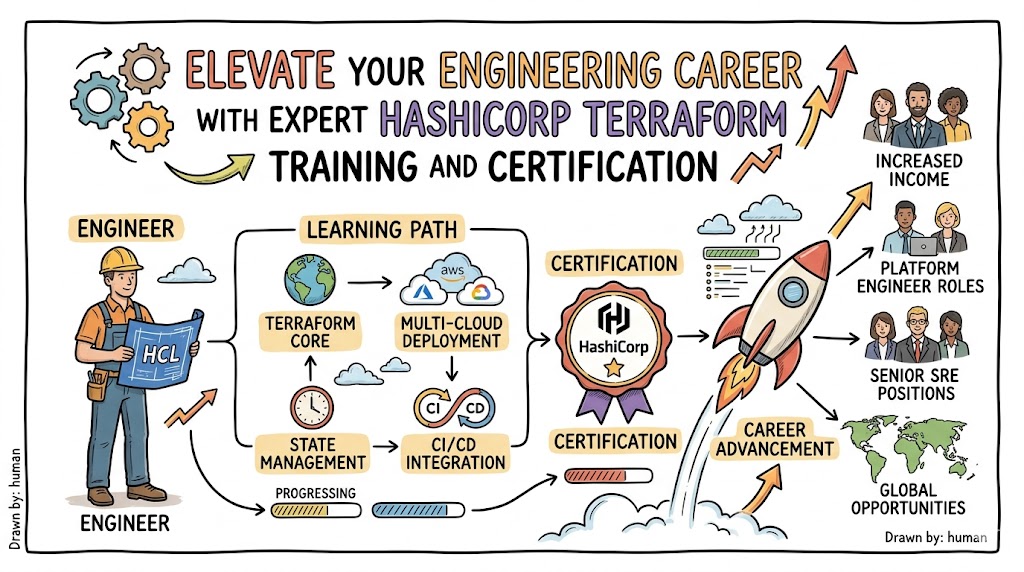
Modern technology landscapes require engineers who can treat infrastructure with the same rigor as application code. This Hashicorp Terraform training empowers you to automate cloud environments, reduce human error, and accelerate deployment cycles across global platforms. By mastering these principles, you position yourself at the forefront of the DevOpsschool movement, gaining the technical authority needed to lead complex digital transformations. This guide serves as your roadmap to navigating the certification landscape and securing your future in a world that demands programmable infrastructure.
What is the Hashicorp Terraform training?
This training program defines the standard for Infrastructure as Code (IaC) excellence in the modern enterprise. It focuses on teaching you how to use a declarative configuration language to provision, change, and version resources safely and efficiently. Instead of clicking through web consoles, you learn to write human-readable code that manages everything from low-level components like compute and storage to high-level DNS entries and SaaS features. The curriculum bridges the gap between manual operations and the high-velocity requirements of cloud-native development.
Who Should Pursue Hashicorp Terraform training?
Cloud engineers, site reliability experts, and system administrators find this training essential for their daily operations. Security professionals also join this track to learn how to bake compliance directly into the provisioning process, while data engineers use it to manage massive analytics clusters. Even engineering managers benefit by understanding the technical workflows that drive their teams’ productivity. Whether you are building a career in India’s booming tech sector or aiming for a role in a global tech giant, these skills provide a universal language for infrastructure management.
Why Hashicorp Terraform training is Valuable and Beyond
The market rewards professionals who can manage multi-cloud environments without being locked into a single vendor’s ecosystem. Because this tool interacts with almost every major service provider, your expertise remains portable and highly sought after regardless of which cloud a company chooses. You gain a competitive edge by proving you can handle the scale and complexity of modern “always-on” systems. Investing in this training ensures that your career path remains upwardly mobile, even as the underlying cloud technologies continue to shift.
Hashicorp Terraform training Certification Overview
The certification process verifies your technical proficiency through a structured assessment delivered via the official training portal and hosted on DevOpsschool. It measures your ability to handle real-world scenarios, such as managing state files, building reusable modules, and implementing multi-environment workflows. The program focuses on the open-source CLI while introducing you to the collaborative power of enterprise-grade features. Earning this credential signals to the industry that you possess the hands-on skills required to maintain production-grade infrastructure.
Hashicorp Terraform training Certification Tracks & Levels
The curriculum offers a clear progression from foundational knowledge to architectural mastery. You begin with core concepts like resource declaration and state management before moving toward advanced topics like policy-as-code and private module registries. Specialized tracks allow you to align your learning with specific career goals, such as focusing on security or financial optimization. Each level reinforces your ability to build stable, scalable, and secure systems that meet the rigorous demands of the modern enterprise.
Complete Hashicorp Terraform training Certification Table
| Track | Level | Who it’s for | Prerequisites | Skills Covered | Recommended Order |
| Core Automation | Associate | Junior DevOps | Cloud Basics | CLI, HCL, State | 1 |
| Team Collaboration | Professional | Mid-Level SRE | Associate | Workspaces, VCS | 2 |
| Security Operations | Specialist | SecOps Lead | Professional | Sentinel, Vault | 3 |
| Platform Strategy | Expert | Principal Architect | 5+ Years Exp | Registry, Scaling | 4 |
Detailed Guide for Each Hashicorp Terraform training Certification
Hashicorp Terraform training – Associate Certification
What it is
This foundational certification proves your grasp of basic automation concepts and your ability to use the tool effectively in a standalone environment. It confirms you understand how to write valid configuration files and manage the lifecycle of basic cloud resources.
Who should take it
Individuals starting their journey in cloud automation or developers who need to manage their own testing environments should target this level. It requires no prior certification, making it the ideal entry point for anyone ready to ditch manual provisioning.
Skills you’ll gain
- Writing clean and efficient HashiCorp Configuration Language code.
- Managing the critical State file to prevent resource conflicts.
- Utilizing variables and outputs to make your code dynamic and reusable.
- Performing core workflow tasks like init, plan, and apply with confidence.
Real-world projects you should be able to do
- Launch a secure, load-balanced web application architecture.
- Build a modular network template for multiple environments.
- Configure a remote backend to enable team collaboration on code.
Preparation plan
- 7–14 days: Study the basic syntax and practice deploying simple resources like S3 buckets or VMs.
- 30 days: Explore more complex topics like module creation and input/output variable management.
- 60 days: Focus on advanced CLI commands and troubleshooting state issues through mock exam scenarios.
Common mistakes
- Forgetting to store the state file in a secure, remote location.
- Neglecting to review the execution plan before making changes to live systems.
- Creating “monolithic” configurations that are difficult to manage and scale.
Best next certification after this
- Same-track option: Terraform Professional.
- Cross-track option: Certified Kubernetes Administrator (CKA).
- Leadership option: HashiCorp Certified Vault Associate.
Choose Your Learning Path
DevOps Path
You focus on making infrastructure an integral part of the CI/CD pipeline. This path teaches you to trigger infrastructure changes automatically whenever you update your application code. By treating servers like software, you ensure that every environment—from development to production—remains perfectly synchronized and easy to audit.
DevSecOps Path
This track prioritizes the “security as code” philosophy by teaching you to build automated guardrails. You learn to write policies that scan your infrastructure for vulnerabilities before you even deploy it. This ensures that your cloud environment stays compliant with corporate and regulatory standards without slowing down the team.
SRE Path
Site Reliability Engineers prioritize the stability and resilience of the systems they manage. On this path, you master advanced state management and disaster recovery techniques. You learn how to use code to restore entire global infrastructures in minutes, ensuring that your organization maintains maximum uptime.
AIOps Path
You explore the intersection of artificial intelligence and infrastructure automation. This path shows you how to use AI-driven insights to adjust your infrastructure settings automatically. You build systems that can predict traffic spikes and scale resources up or down without any human intervention.
MLOps Path
Machine learning workflows require highly specific and often expensive hardware configurations. This track teaches you how to provision and manage the complex GPU clusters and data storage systems needed for AI model training. You ensure that your data science teams always have the exact environment they need.
DataOps Path
Data professionals use this path to automate the setup of massive data warehouses and processing pipelines. You learn to manage services like Snowflake or Databricks via code, ensuring that your data platform remains consistent. This reduces the time spent on “plumbing” and lets you focus on extracting insights.
FinOps Path
This path focuses on the financial health of your cloud environment. You learn to integrate cost-estimation tools into your automation workflow so you can see the price of your infrastructure before you buy it. This helps you eliminate waste and keep your cloud spending aligned with your budget.
Role → Recommended Hashicorp Terraform training Certifications
| Role | Recommended Certifications |
| DevOps Engineer | Associate + Professional |
| SRE | Associate + SRE Path |
| Platform Engineer | Professional + Expert |
| Cloud Engineer | Associate |
| Security Engineer | DevSecOps Specialty |
| Data Engineer | DataOps Path |
| FinOps Practitioner | FinOps Path |
| Engineering Manager | Associate (Overview) |
Next Certifications to Take After Hashicorp Terraform training
Same Track Progression
Deepen your expertise by pursuing advanced certifications that focus on enterprise-scale operations. You will learn how to manage complex organizations, enforce global policies, and optimize resource usage across hundreds of developers. Staying within the same ecosystem allows you to become a true subject matter expert that companies rely on for strategy.
Cross-Track Expansion
Broaden your horizons by earning certifications in container orchestration or secrets management. Pairing your automation skills with Kubernetes or Vault makes you a powerhouse in the cloud-native space. This combination allows you to manage the entire application stack, from the networking layer to the sensitive data layer.
Leadership & Management Track
Transition into leadership by focusing on governance and architectural strategy. These certifications help you understand how to build a culture of automation across an entire company. You learn how to balance the need for speed with the requirements of security and financial responsibility at an executive level.
Training & Certification Support Providers for Hashicorp Terraform training
DevOpsSchool
This provider delivers a rich mix of theoretical knowledge and intensive laboratory exercises. Their instructors bring real-world production experience to every session, ensuring you learn how to solve actual problems rather than just memorizing facts. They offer a mentorship-driven approach that helps you navigate your entire career journey, not just the exam.
Cotocus
Cotocus focuses on enterprise-level training for teams moving toward digital transformation. They specialize in teaching you how to integrate automation tools into existing, complex legacy systems. Their programs are designed to minimize risk while maximizing the efficiency of your cloud migration projects.
Scmgalaxy
Scmgalaxy acts as a massive community hub where you can find endless tutorials and free learning resources. It is the perfect place for self-paced learners who want to see how other engineers solve common automation challenges. Their community forums provide quick answers to specific technical hurdles you might face.
BestDevOps
This platform offers highly curated learning paths that align perfectly with current job market demands. They focus on giving you the templates and “real-world” skills that you can use on your first day at a new job. Their training modules are streamlined to help you achieve certification quickly and efficiently.
devsecopsschool.com
This organization leads the way in teaching the security side of the automation lifecycle. You will learn how to build “unbreakable” systems that automatically reject insecure configurations. It is the gold standard for engineers working in finance, healthcare, or government sectors.
sreschool.com
Sreschool focuses on the reliability and performance metrics that keep systems running smoothly. Their courses teach you how to use automation to monitor health and respond to incidents automatically. This is the primary resource for engineers who are responsible for maintaining 99.9% uptime.
aiopsschool.com
This provider sits at the cutting edge of the industry, teaching you how to apply machine learning to your operations. You will learn how to build “smart” infrastructure that learns from past data to optimize its own performance. It is a must for anyone looking to lead the next wave of IT innovation.
dataopsschool.com
DataOpsSchool teaches you how to apply DevOps principles to the world of big data. You learn to automate the flow of data from source to storage, ensuring that your analytics are always accurate and timely. This training is essential for modern data engineering teams.
finopsschool.com
This platform bridges the gap between the engineering team and the finance department. You learn how to use automation to track every penny spent in the cloud and how to optimize your resources for maximum value. It is vital for maintaining a profitable cloud strategy.
Frequently Asked Questions (General)
- Do I need to be a professional programmer to pass?You do not need to be a software developer, as the language used is very straightforward and readable even for beginners.
- How much does the certification help with salary?Most engineers report a significant pay increase after earning this credential, as it proves they can handle high-value automation tasks.
- Can I practice for free?Yes, you can download the open-source tool and use “free tier” cloud accounts to build your lab environments without spending any money.
- Is the exam proctored?Yes, an online proctor monitors you via your webcam to ensure the integrity of the test and the value of your certification.
- What happens if I don’t pass on my first try?You can usually retake the exam after a short waiting period, though you should check the current policy for specific cooling-off times.
- How long is the certification valid?The credential typically remains active for two years, after which you must renew to prove your skills are still current.
- Does the training cover AWS, Azure, or Google Cloud?The training is vendor-neutral, meaning the skills you learn will apply to any cloud provider that has an available API.
- Are there any age requirements for taking the test?There are no specific age requirements, making this a great option for both students and seasoned professionals looking to pivot.
- Will I have to write code during the exam?While you won’t write an entire project from scratch, you will need to identify and correct errors in provided code snippets.
- Is this skill relevant in the Indian market?Absolutely, Indian tech firms are currently some of the largest recruiters of automation experts in the world.
- Can I use this tool for on-premises servers?Yes, you can manage local data centers using providers for VMware, OpenStack, and other private cloud technologies.
- What is the most difficult part of the exam?Most candidates find state management and complex logic (like loops and conditionals) to be the most challenging sections.
FAQs on Hashicorp Terraform training
- Why should I use variables?Variables allow you to reuse your code for different environments like Dev, Test, and Production without rewriting everything.
- What is a ‘Resource’ in HCL?A resource is any component of your infrastructure, such as a virtual machine, a database, or a network interface.
- How does ‘Plan’ save me from trouble?The plan command shows you exactly what the tool will do before it does it, preventing accidental deletions.
- Can I collaborate with a team?Yes, by using remote backends, multiple people can work on the same infrastructure without overwriting each other’s changes.
- What are ‘Modules’?Modules are containers for multiple resources that you use together, acting like a template for your infrastructure.
- Does the tool manage the OS inside a VM?It typically provisions the VM itself; you usually pair it with tools like Ansible or Chef for OS-level configuration.
- What is a ‘Provider’ exactly?A provider is a plugin that tells the tool how to talk to a specific service’s API, like AWS or Azure.
- Is it possible to undo changes?You can revert to a previous version of your code in Git and run the tool again to restore the old state.
Final Thoughts: Is Hashicorp Terraform training Worth It?
Starting your journey into infrastructure automation represents a pivotal moment in your professional development. I have mentored hundreds of engineers who transformed from manual operators into high-value platform architects by embracing these exact principles. The ability to manage global systems through a few lines of code is not just a job skill; it is a superpower in the modern digital economy. While the initial learning curve requires dedication, the payoff in career longevity and creative freedom is undeniable. If you want to build the future of technology rather than just maintain its past, this certification is your essential first step.