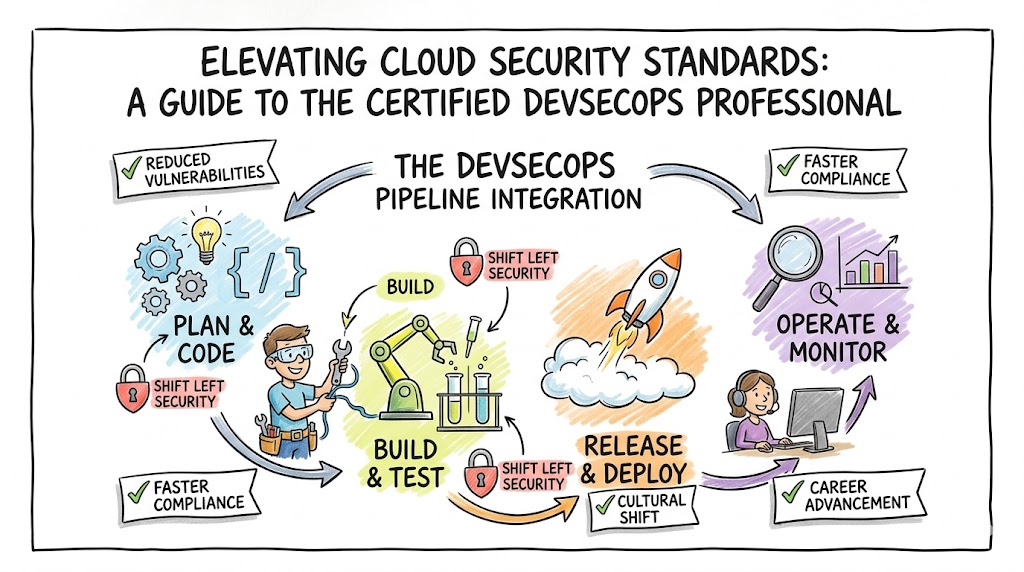
Security now moves at the speed of high-performance code, making the Certified DevSecOps Professional a vital asset for any modern engineering career. This comprehensive roadmap assists SREs and platform engineering experts in mastering the art of “Security as Code” within cloud-native environments. By following the strategies at DevSecOpsschool, you will learn to build resilient pipelines that protect data without ever hindering deployment velocity. This guide serves as your primary resource for navigating professional growth in a landscape where security remains a shared responsibility across all technical teams.
What is the Certified DevSecOps Professional?
This certification validates an engineer’s ability to inject security protocols directly into the heart of the development lifecycle. It prioritizes production-grade skills over simple theoretical knowledge, ensuring that practitioners can secure complex microservices and automated workflows. Modern enterprises rely on these professionals to maintain high-speed releases while simultaneously mitigating sophisticated cyber threats. By earning this credential, you demonstrate a commitment to building systems that are secure by design rather than as an afterthought.
Who Should Pursue Certified DevSecOps Professional?
Cloud architects, software developers, and SREs find immense value in this path as they transition toward more integrated roles. Both entry-level aspirants and veteran technical leaders utilize this certification to align their skills with current industry standards in India and across the globe. Security analysts also benefit by learning how to apply their defensive expertise to automated CI/CD environments. Ultimately, anyone responsible for the reliability and integrity of software delivery should consider this specialized training.
Why Certified DevSecOps Professional is Valuable and Beyond
Companies continue to accelerate their migration to the cloud, creating an urgent need for professionals who can automate compliance and threat detection. This certification provides long-term career stability because it focuses on universal principles of automation that apply across various platforms and toolsets. It offers a clear competitive advantage in the job market, helping you secure high-impact positions within innovative tech organizations. Investing time in these skills ensures you remain an essential part of the engineering team as infrastructure complexity grows.
Certified DevSecOps Professional Certification Overview
The official program resides on the primary training platform and utilizes the robust hosting environment of DevSecOpsschool. It employs a hands-on assessment model that requires candidates to build and secure actual infrastructure components during the exam. This practical focus ensures that every certified professional possesses the technical depth needed to solve real-world problems. The program structure covers everything from initial vulnerability assessments to advanced runtime protection in distributed systems.
Certified DevSecOps Professional Certification Tracks & Levels
The curriculum offers three distinct tiers: foundation, professional, and advanced levels, allowing for a structured career progression. Engineers can also choose specialized tracks that focus on specific domains like FinOps security, AIOps monitoring, or container orchestration. These levels help you build a solid knowledge base before tackling the intricate challenges of enterprise-level security architecture. Each tier represents a significant milestone in mastering the technical and cultural shifts required for successful implementation.
Complete Certified DevSecOps Professional Certification Table
| Track | Level | Who it’s for | Prerequisites | Skills Covered | Recommended Order |
| Core Security | Foundation | New Engineers | Linux Basics | Pipeline Security | 1 |
| Infrastructure | Professional | SRE / DevOps | Container Knowledge | K8s Hardening | 2 |
| Strategy | Advanced | Architects | 5+ Years Experience | Risk Management | 3 |
| Governance | Professional | Managers | Basic Compliance | Auditing Automation | 2 |
| Observability | Professional | SRE / SOC | Monitoring Basics | Threat Hunting | 2 |
Detailed Guide for Each Certified DevSecOps Professional Certification
Certified DevSecOps Professional – Foundation Level
What it is
This credential verifies that a candidate understands the core principles of shifting security left in the development cycle. It covers the basics of integrating automated tools into standard build processes.
Who should take it
Aspiring DevOps engineers and recent graduates should take this to build a strong technical foundation. It also suits traditional sysadmins looking to modernize their security skill set.
Skills you’ll gain
- Automated SAST/DAST implementation
- Basic secrets management
- Understanding CI/CD security gates
- Vulnerability reporting basics
Real-world projects you should be able to do
- Configure a GitHub Action to scan code for hardcoded passwords.
- Set up an automated dependency checker for a web application.
Preparation plan
- 7 Days: Learn the core terminology and install basic scanning tools.
- 30 Days: Practice creating simple pipelines with integrated security checks.
- 60 Days: Build a complete documentation suite for a secure workflow.
Common mistakes
- Focusing exclusively on tools while ignoring the underlying security principles.
- Neglecting the importance of developer communication and feedback.
Best next certification after this
- Same-track option: Professional DevSecOps Engineer
- Cross-track option: Certified SRE Associate
- Leadership option: DevSecOps Team Lead
Certified DevSecOps Professional – Professional Level
What it is
This level proves an engineer can manage complex security requirements across containerized applications and cloud platforms. It focuses on policy enforcement and infrastructure hardening at an enterprise scale.
Who should take it
Intermediate DevOps practitioners and SREs who manage production clusters should pursue this. It targets those ready to implement advanced security orchestration.
Skills you’ll gain
- Admission controller configuration
- Runtime security monitoring
- Infrastructure as Code (IaC) auditing
- Network policy implementation
Real-world projects you should be able to do
- Secure a multi-node Kubernetes cluster using OPA policies.
- Deploy a runtime threat detection system to monitor containers.
Preparation plan
- 7 Days: Dive deep into Kubernetes RBAC and network security.
- 30 Days: Build and test custom security policies for IaC templates.
- 60 Days: Execute a full security audit on a simulated production environment.
Common mistakes
- Implementing overly restrictive policies that break application functionality.
- Failing to automate the remediation of discovered vulnerabilities.
Best next certification after this
- Same-track option: Advanced DevSecOps Architect
- Cross-track option: Cloud Security Expert
- Leadership option: Engineering Manager
Choose Your Learning Path
DevOps Path
Professionals on this path focus on creating high-speed, secure delivery pipelines that empower developers. They master the integration of automated security scanners and quality gates within common CI/CD tools. This role ensures that security remains an invisible yet powerful part of the deployment process. You will become an expert in reducing friction between security goals and development speed.
DevSecOps Path
This specialist track concentrates on the deep technical aspects of building defensive infrastructure. Practitioners spend their time writing “Compliance as Code” and developing custom security automation to protect the entire stack. It requires a blend of offensive security knowledge and operational excellence to stay ahead of modern threats. You will lead the cultural shift toward shared security responsibility within the organization.
SRE Path
Reliability engineers focus on the intersection of system uptime and security resilience. This path teaches you how to build self-healing systems that can withstand and recover from security-related incidents. You will apply the principles of error budgets and observability to security metrics to ensure consistent system performance. This ensures that security incidents do not compromise the overall availability of the service.
AIOps Path
Engineers in this domain utilize machine learning models to analyze vast amounts of system logs for security anomalies. They build automated response systems that can trigger alerts or defensive actions based on predictive patterns. This path prepares you for the future of automated security operations at a massive scale. You will bridge the gap between data science and infrastructure defense.
MLOps Path
This path addresses the unique security challenges of machine learning lifecycles and model deployments. Professionals learn to secure data pipelines and protect models from adversarial attacks or unauthorized access. It ensures that the integrity of the AI decision-making process remains intact throughout the production phase. You will manage the secure delivery of intelligence across the enterprise.
DataOps Path
DataOps specialists focus on the security and privacy of data as it moves through various analytical pipelines. They implement automated encryption, masking, and access controls to maintain compliance with global data regulations. This track ensures that data remains a secure asset rather than a liability during the transformation process. You will protect the lifeblood of the modern digital enterprise.
FinOps Path
This track combines financial accountability with security monitoring to optimize cloud spending and risk. Practitioners learn to identify wasteful resources that could also pose security risks if left unmanaged. It provides a unique view of how cost optimization and security hardening go hand-in-hand in a cloud environment. You will help the business maintain a lean and secure cloud footprint.
Role → Recommended Certified DevSecOps Professional Certifications
| Role | Recommended Certifications |
| DevOps Engineer | Foundation + Professional Core |
| SRE | Professional Core + SRE Security |
| Platform Engineer | Advanced Architecture + Compliance |
| Cloud Engineer | Professional Core + Cloud Defense |
| Security Engineer | Professional + Advanced Tracks |
| Data Engineer | DataOps Security Specialist |
| FinOps Practitioner | FinOps Security + Governance |
| Engineering Manager | Foundation + Compliance Track |
Next Certifications to Take After Certified DevSecOps Professional
Same Track Progression
Deepen your expertise by pursuing advanced architecture certifications that focus on multi-cloud security and global compliance. These programs challenge you to design systems that handle massive traffic while maintaining strict security standards. This progression establishes you as a primary authority in the field.
Cross-Track Expansion
Broaden your impact by learning related disciplines like Site Reliability Engineering or Cloud-Native Architecture. Understanding how security interacts with system performance and scalability makes you a more versatile and valuable engineer. This path leads to “T-shaped” skills that are highly sought after by top-tier tech firms.
Leadership & Management Track
Transition into strategic roles by focusing on engineering management and technical leadership certifications. These paths teach you how to build high-performing teams and manage the organizational changes required for a robust security culture. You will move from executing technical tasks to shaping the long-term vision of the company.
Training & Certification Support Providers for Certified DevSecOps Professional
DevOpsSchool offers extensive training programs that combine practical labs with expert-led sessions to ensure career readiness.
Cotocus provides specialized consulting and training services focused on modernizing engineering workflows and security integration.
Scmgalaxy acts as a major community hub, offering a wealth of resources, tutorials, and certification guides for engineers.
BestDevOps delivers high-quality content and bootcamps specifically designed to bridge the gap between development and operations.
DevSecOpsschool serves as the primary platform for acquiring hands-on skills through industry-recognized certification paths.
Sreschool focuses on the reliability and stability aspects of infrastructure, providing deep dives into modern SRE practices.
Aiopsschool explores the intersection of artificial intelligence and operations, training engineers for the future of automated systems.
Dataopsschool provides targeted education on securing and optimizing data pipelines for modern analytical requirements.
Finopsschool helps professionals master the balance between cloud cost management and operational efficiency.
BestSRE delivers specialized training focused on maintaining high availability while ensuring robust system security.
Frequently Asked Questions
- How difficult is the Certified DevSecOps Professional exam?
The exam maintains a high standard of difficulty because it requires hands-on implementation rather than just multiple-choice answers.
- What is the typical time commitment for preparation?
Most candidates spend between 30 and 60 days preparing, depending on their existing experience with CI/CD tools.
- Are there specific prerequisites for the foundation level?
You should have a basic understanding of Linux commands and version control systems like Git before starting.
- Does this certification help with salary negotiations?
Yes, engineers with verifiable skills often command higher salaries due to the specialized nature of the role.
- Can I take the exam online?
The program offers flexible online proctoring, allowing you to earn your certification from anywhere in the world.
- How long does the certification remain valid?
The certification typically remains valid for two years, after which you may need to renew to stay current.
- Does the course cover Kubernetes security?
The professional and advanced tracks provide extensive training on securing clusters and containerized workloads.
- Is this certification recognized globally?
The program holds significant value across the global tech industry, including major hubs in India and North America.
- What tools will I learn during the program?
You will work with industry-standard tools like Jenkins, Vault, SonarQube, and various open-source scanners.
- Is there a community for certified professionals?
The platform provides access to an exclusive community where you can network with other certified experts.
- How does this differ from a general security certification?
This program focuses specifically on the automation and integration of security within the DevOps lifecycle.
- Are there corporate training options available?
Many providers offer customized corporate bootcamps for teams looking to upskill their entire engineering department.
FAQs on Certified DevSecOps Professional
What specific security tools does the curriculum prioritize for automation?
The program emphasizes a mix of open-source and enterprise-grade tools for pipeline integration. Students learn to select the right tool for specific environments.
How does the program handle the cultural transition to DevSecOps?
Mentors provide practical advice on breaking down silos between developers and security teams. The curriculum includes strategies for fostering shared responsibility.
Will I learn to secure Infrastructure as Code templates?
Yes, the professional track includes detailed modules on scanning Terraform and Ansible scripts for misconfigurations. This ensures your infrastructure is secure before deployment.
Does the certification cover cloud-specific security services?
You will explore security configurations for major providers like AWS, Azure, and Google Cloud Platform. The training ensures you can leverage native features effectively.
Is threat modeling included in the advanced certification level?
The advanced track teaches you how to perform proactive threat modeling for microservices architectures. This helps you identify potential attack vectors early.
How often does the platform update the course content?
Instructors update the curriculum regularly to reflect new security vulnerabilities and evolving industry best practices. This keeps your skills relevant.
Can I pursue this certification if I have no coding background?
While basic scripting helps, the foundation level provides enough context to start. You will build coding skills as you progress.
Does the program provide hands-on labs for practice?
The course includes access to cloud-based labs where you can practice security integrations in a safe environment.
Final Thoughts: Is Certified DevSecOps Professional Worth It?
Investing in your professional growth through this certification offers a clear path toward technical mastery and career longevity. The program strips away the marketing hype and focuses on the hard skills required to protect modern software ecosystems. By mastering these competencies, you transform yourself from a traditional engineer into a highly valued security advocate. This journey requires dedication, but the ability to build safe, reliable, and high-speed systems makes it one of the best investments in the current market.