Introduction
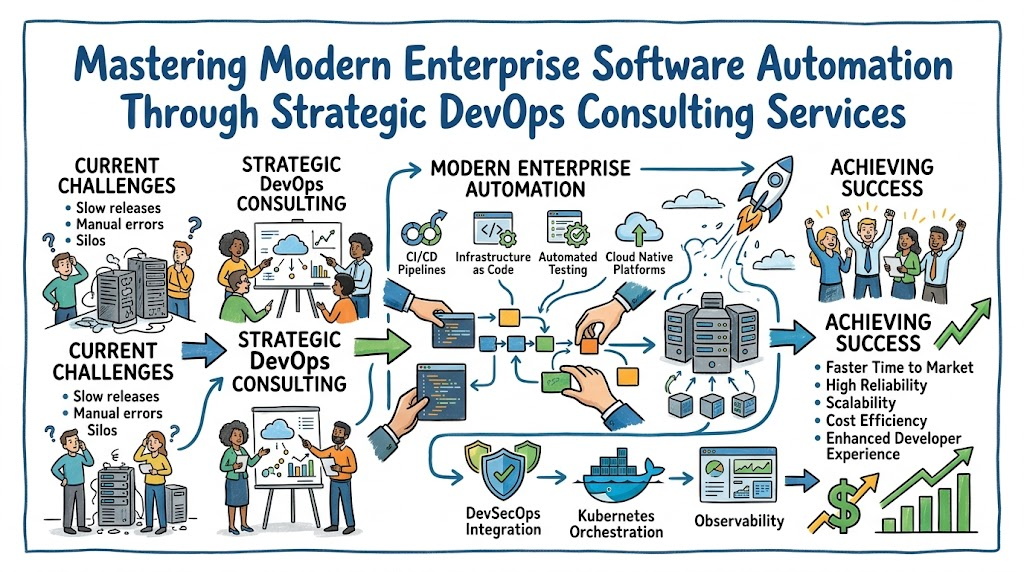
Executing high-speed software releases while preserving system stability requires modern operational strategies. Disconnected development workflows and manual infrastructure tasks slow product momentum while increasing operational risks. Partnering with a skilled DevOps Consulting Company India helps technology leaders eliminate delivery bottlenecks, automate complex deployment pipelines, and optimize infrastructure costs. Consequently, engineering teams ship feature updates continuously with complete confidence.
Transitioning toward cloud-native software delivery demands deep expertise across container orchestration, continuous integration, continuous delivery, and infrastructure management. Organizations that modernize legacy operational frameworks unlock rapid deployment capabilities and higher system reliability. Furthermore, embedding security automation and proactive monitoring ensures compliance across every software release cycle.
Ultimately, modernizing software operations merges cultural alignment, process optimization, and intelligent automation. Technology organizations must adopt self-service developer platforms, automated pipelines, and deep observability to maintain market leadership. This strategic guide provides enterprise engineering teams with actionable insights for seamless digital transformation.
What Is DevOps Consulting?
Strategic engineering advisory services help technology teams evaluate, optimize, and automate end-to-end software delivery operations. Specialized consultants assess existing release workflows, deployment mechanisms, and architecture bottlenecks to construct tailored automation blueprints. By aligning development output with operational capabilities, advisory partners establish smooth release cycles.
Beyond technical tooling, advisory partnerships cultivate modern engineering cultures within software organizations. Senior consultants mentor internal teams, establish standardized deployment practices, and eliminate inefficient handoffs between developers and operators. As a direct result, software deployments become predictable, frequent, and resilient against human error.
Furthermore, experienced consultants guide leadership teams in selecting optimal cloud platforms for specific enterprise workloads. Whether refactoring legacy systems into microservices or managing complex multi-cloud deployments, expert advisory prevents costly architectural mistakes. Consequently, businesses construct robust cloud foundations that support continuous technical innovation.
Why Organizations Need DevOps Consulting Services
Rapidly growing enterprises frequently face deployment friction, unexpected downtime, and scaling limitations. Contracting dedicated DevOps Consulting Services enables technology teams to overcome these operational roadblocks through battle-tested industry practices. External engineering specialists deliver objective technical guidance that speeds up enterprise maturity.
Additionally, internal engineering teams rarely have the spare capacity to research, test, and implement modern cloud automation systems independently. Advisory partners handle this heavy initial engineering effort, allowing internal developers to focus on core product features. Moreover, consultants build proactive security, automated scaling, and continuous monitoring directly into systems from day one.
Finally, strategic advisory engagements optimize overall cloud resource expenditures and engineering efficiency. Eliminating idle infrastructure and automating repetitive tasks lowers monthly cloud operational costs significantly. Therefore, engineering leaders gain higher productivity while maintaining precise control over technology budgets.
CI/CD: The Foundation of Faster Software Delivery
Continuous Integration and Continuous Delivery (CI/CD) pipelines form the primary execution engine of modern software delivery. Automated pipelines compile source code, run automated tests, and validate build safety whenever developers commit code updates to central repositories. Consequently, software engineers discover bugs early, fixing issues long before releases reach live customer environments.
In addition to defect prevention, automated release pipelines remove risky manual deployment steps and human errors. Standardized pipeline stages execute automated security audits, performance testing, and deployment scripts on every build candidate. Thus, organizations launch software updates multiple times daily instead of executing high-risk manual deployments once a month.
To illustrate the concrete performance gains achieved through pipeline automation, compare traditional deployment practices with automated CI/CD workflows:
| Operational Metric | Traditional Manual Deployment | Automated CI/CD Pipeline |
|---|---|---|
| Deployment Frequency | Monthly or Quarterly | Multiple Times Daily |
| Lead Time for Changes | Weeks to Months | Less Than 1 Hour |
| Change Failure Rate | 21% – 30% | Less Than 5% |
| Mean Time to Recovery (MTTR) | 24 to 48 Hours | Less Than 15 Minutes |
Ultimately, a structured CI/CD pipeline converts software deployments into a predictable, repeatable, and fully automated core capability. Engineering teams iterate rapidly, respond to customer demands instantly, and maintain continuous code quality.
Infrastructure as Code Changes Infrastructure Management
Infrastructure as Code (IaC) fundamentally transforms how cloud operations teams provision, configure, and scale cloud environments. Defining network rules, server instances, and storage parameters through version-controlled code templates eliminates manual configuration drift completely. Tools like Terraform and OpenTofu allow engineers to launch identical production environments across multiple global regions within minutes.
Furthermore, IaC brings standard software engineering practices—such as code reviews, automated linting, and continuous integration—directly to cloud management. Storing infrastructure configurations inside central Git repositories creates comprehensive audit trails and enables instant rollbacks during outages. Therefore, recovering from unexpected cloud component failures becomes a fast, automated task.
In addition, treating infrastructure as code encourages active collaboration between software developers and cloud operations engineers. Shared configurations break down operational barriers, enabling developers to request self-service resources safely inside pre-defined security boundaries. This approach accelerates software shipping speed while preserving enterprise governance.
Managed DevOps Services for Continuous Operations
Sustaining automated pipelines, cloud infrastructure, and internal developer tooling requires continuous operational attention and specialized expertise. Enterprise Managed DevOps Services provide technology teams with 24/7 system administration, proactive platform monitoring, and continuous infrastructure tuning. This managed operational support keeps cloud platforms secure, performant, and cost-optimized at all times.
Delegating day-to-day platform management to external specialists allows internal developers to concentrate on strategic software features. Managed service engineers take charge of security patching, platform updates, metric monitoring, and rapid emergency incident resolution. Consequently, organizations eliminate single-point-of-failure risks while acquiring immediate access to senior cloud talent.
Furthermore, managed operational partnerships ensure that cloud applications auto-scale dynamically during traffic spikes. Continuous infrastructure rightsizing prevents over-provisioning and reduces monthly cloud invoices. As a result, enterprises maintain high application availability without inflating internal staffing costs.
AWS DevOps Consulting Services
Amazon Web Services provides an expansive ecosystem of cloud products engineered for global application scaling. However, orchestrating and securing AWS services correctly demands specialized domain expertise. Engaging dedicated AWS DevOps Consulting Services helps businesses optimize workloads using native solutions like AWS EKS, ECS, Lambda, CloudFormation, Terraform, and automated deployment pipelines.
Cloud architects design secure, resilient, and elastic cloud platforms tailored specifically to application demands. Building automated continuous delivery pipelines on AWS accelerates deployment speeds and ensures seamless feature rollouts. Additionally, specialists deploy auto-scaling groups and elastic load balancers to absorb sudden traffic surges effortlessly.
Furthermore, cloud consultants emphasize cost optimization through workload rightsizing, spot instance utilization, and comprehensive resource tagging structures. Continuous automated monitoring ensures full compliance with corporate security standards. Consequently, organizations maximize their AWS return on investment while delivering reliable digital experiences.
DevSecOps Consulting Services
Treating security as a final audit gate right before software launches creates release bottlenecks and severe business risks. Specialized DevSecOps Consulting Services integrate automated security guardrails directly into every phase of the continuous delivery pipeline. This proactive approach catches vulnerabilities early in development, dramatically lowering remediation costs and operational exposure.
Integrating Static Application Security Testing (SAST), Dynamic Application Security Testing (DAST), and container security scanners into automated pipelines guarantees continuous compliance checks. Centralized secrets management platforms prevent hardcoded credentials inside version control systems. Consequently, software developers receive immediate feedback regarding security flaws during active coding sessions.
Furthermore, automated security guardrails streamline compliance audits for standards like ISO 27001, HIPAA, and PCI-DSS. Security specialists establish policies that enforce strict least-privilege access controls and continuous audit logging across environments. As a result, businesses maintain high security standards without delaying software deployment velocity.
Kubernetes Consulting Services
Container orchestration with Kubernetes represents the industry standard for operating scalable microservices architectures. However, managing production Kubernetes clusters across multi-cloud or hybrid environments involves complex technical operations. Expert Kubernetes Consulting Services assist organizations in designing, securing, and operating production-ready cluster environments across AWS EKS, Azure AKS, Google GKE, and enterprise on-premises platforms.
Container specialists implement industry best practices for cluster networking, persistent storage drivers, access policies, and ingress routing. Configuring horizontal pod autoscalers and resource quota limits guarantees maximum application availability and optimal hardware utilization. Consequently, microservices scale dynamically during high-traffic events without manual operator intervention.
Furthermore, advisory partners guide engineering teams through complex cluster migrations, version updates, and multi-tenant security hardening. Standardizing deployment manifests using Helm charts or GitOps workflows simplifies releases across staging and production clusters. As a result, organizations unlock full container scalability while minimizing operational overhead.
Cloud Migration Services India
Migrating legacy on-premises applications to modern cloud environments requires strategic planning, risk management, and technical precision. Enterprise Cloud Migration Services India lead organizations through end-to-end cloud adoption journeys—from initial assessment to final workload cutover. Technical consultants analyze application dependencies to select optimal migration strategies based on business goals.
       [ Legacy Data Center ]
                 │
                 ▼
    ┌──────────────────────────┐
    │ Architecture Assessment  │
    └────────────┬─────────────┘
                 │
                 ▼
    ┌──────────────────────────┐
    │  IaC & Pipeline Setup    │
    └────────────┬─────────────┘
                 │
                 ▼
    ┌──────────────────────────┐
    │  Automated Cloud Cutover │
    └────────────┬─────────────┘
                 │
                 ▼
       [ Cloud Platform ]
During migration execution, cloud engineers construct infrastructure using Infrastructure as Code templates to guarantee consistency and security. Engineers containerize or refactor legacy components where necessary to maximize cloud-native elasticity. Furthermore, automated data migration tools transfer records securely with zero data loss and minimal system downtime.
Following cloud cutovers, consultants perform system optimization, performance tuning, and security validation. Transitioning to cloud-native platforms boosts application uptime, improves business continuity, and accelerates long-term digital innovation.
Platform Engineering Consulting Services
Tool sprawl and fragmented operational workflows frequently slow down engineering throughput in expanding technology organizations. Specialized Platform Engineering Consulting Services resolve this challenge by building modern Internal Developer Platforms (IDPs). These self-service portals provide developers with pre-configured “golden paths” for provisioning infrastructure environments and deployment pipelines automatically.
Instead of submitting manual support tickets to operations teams, developers spin up required infrastructure independently using secure, standardized templates. Platform engineers embed compliance rules, security guardrails, and budget limits directly into the platform interface. Consequently, software developers spend maximum time writing feature code rather than wrestling with complex infrastructure tooling.
Furthermore, platform engineering reduces cognitive load across technical teams by standardizing deployment practices. Centralized platform dashboards offer clear visibility into application status, server logs, and deployment histories. As a result, enterprise technology teams scale engineering capacity efficiently without losing administrative control.
SRE Consulting Services
Site Reliability Engineering (SRE) bridges software development principles with operational management to construct resilient, ultra-reliable systems. Dedicated SRE Consulting Services assist organizations in establishing clear Service Level Indicators (SLIs), Service Level Objectives (SLOs), and Error Budgets. This quantitative framework balances aggressive feature releases with system availability targets effectively.
SRE specialists eliminate manual operational toil through intelligent code automation, continuous testing, and self-healing infrastructure design. When production incidents occur, automated alert routing and structured response runbooks guarantee fast incident resolution. Furthermore, blameless post-mortem reviews allow engineering teams to identify root causes and deploy permanent fixes.
In addition, site reliability experts optimize capacity planning, performance tuning, and chaos engineering practices. Proactively injecting controlled component failures reveals hidden system weaknesses before end-users experience outages. Consequently, organizations achieve ultra-high system availability and maintain exceptional platform reliability SLAs.
Observability Is More Than Monitoring
Basic system monitoring solutions merely report whether server instances are online or offline. In contrast, modern observability delivers deep operational visibility into complex microservices architectures through three core telemetry pillars: metrics, logs, and distributed traces. Implementing complete observability platforms enables engineering teams to uncover exact failure root causes instantly.
                  ┌──────────────────┐
                  │   Observability  │
                  └────────┬─────────┘
                           │
         ┌─────────────────┼─────────────────┐
         │                 │                 │
         ▼                 ▼                 ▼
  ┌─────────────┐   ┌─────────────┐   ┌─────────────┐
  │   Metrics   │   │    Logs     │   │   Traces    │
  │ (Numerical) │   │ (Text Data) │   │ (Flow Path) │
  └─────────────┘   └─────────────┘   └─────────────┘
Distributed tracing tools follow individual user requests across multiple microservices, pinpointing performance latency and failure points instantly. Centralized logging engines aggregate log streams across thousands of containers, enabling rapid root-cause analysis during outages. Furthermore, real-time metric dashboards track vital health indicators like latency, error rates, and resource saturation continuously.
Integrating observability early in application development enables operations teams to catch subtle performance degradations before major outages occur. Real-time telemetry allows engineers to optimize database performance, adjust resource limits, and maintain high application responsiveness continuously.
DevOps Outsourcing Services
Recruiting, onboarding, and retaining certified cloud architects, Kubernetes specialists, and SRE professionals internally requires significant time and capital. Flexible DevOps Outsourcing Services provide immediate access to experienced cloud engineers, platform developers, and security experts. Organizations scale engineering bandwidth dynamically based on project scope, deadlines, and skill requirements.
Outsourced engineering teams integrate directly into existing development workflows, adopting your project management tools, communication channels, and coding standards. Whether requiring short-term expertise for cloud migrations or long-term operational management, outsourcing provides an adaptable solution. Consequently, businesses reduce recruitment overhead and execute technical projects immediately.
Furthermore, external engineering partners bring rich cross-industry experience and exposure to modern tooling standards. This active knowledge transfer upskills internal staff and accelerates overall technical maturity. As a result, businesses maintain technical agility while keeping operational costs flexible and predictable.
How to Choose a DevOps Consulting Company India
Selecting the ideal technical advisory partner requires evaluating technical capabilities, industry track records, and operational alignment carefully. Look for partners with proven mastery across multi-cloud platforms, automated pipeline engineering, and enterprise DevSecOps frameworks. Request detailed case studies and technical client references to verify practical execution capabilities accurately.
To guide your evaluation of prospective technical partners, consider these primary selection criteria:
- Multi-Cloud Capabilities: Demonstrated technical mastery across AWS, Azure, Google Cloud, and complex enterprise hybrid environments.
- DevSecOps Focus: Embedded automated security scanning, vulnerability management, and continuous compliance guardrails.
- Container Orchestration Expertise: Deep practical experience operating production Kubernetes clusters and microservice architectures.
- Cultural Alignment: Clear communication protocols, transparent progress reporting, and a commitment to upskilling internal engineers.
- Flexible Engagement Options: Versatile offerings spanning strategic consulting, managed platform operations, and project outsourcing.
Ultimately, the right consulting firm acts as an essential extension of your engineering organization, driving continuous technical refinement, platform reliability, and business growth.
Common DevOps Mistakes to Avoid
Modernizing software delivery operations represents a significant structural evolution, and many organizations make avoidable mistakes. A frequent error involves treating transformation purely as a software procurement exercise without addressing internal team culture or cross-department communication. Introducing advanced automation platforms without comprehensive developer training causes confusion and reduces tool adoption rates.
Another common pitfall involves attempting to automate broken, overly complex manual processes all at once. Successful digital transformations rely on incremental progress—starting with small, high-impact pilot projects before scaling practices across the enterprise. Furthermore, ignoring security controls during initial pipeline setup introduces severe compliance gaps and system vulnerabilities later.
Finally, failing to track baseline operational metrics like deployment frequency, change failure rate, and recovery time hinders success measurement. Lacking clear data metrics prevents technology leaders from identifying operational bottlenecks accurately. Avoiding these common mistakes ensures a smooth, highly impactful technical transformation.
A Practical DevOps Transformation Roadmap
A structured operational transformation follows an incremental, step-by-step framework to maximize business value while mitigating technical risks.
- Assessment and Architecture Design: Evaluate existing developer workflows, cloud setups, security practices, and operational friction points. Define target architecture blueprints, tooling choices, operational metrics, and security requirements clearly.
- Pilot Pipeline Implementation: Select a non-critical microservice or application to build initial CI/CD pipelines, Infrastructure as Code templates, and container configurations. Validate automated testing, security scanning, and deployment workflows thoroughly.
- Security and Observability Integration: Embed automated security testing (SAST/DAST), dependency checks, and secrets management directly into deployment pipelines. Implement real-time metrics, log aggregation, and distributed tracing across all environments.
- Enterprise Scaling and Self-Service Enablement: Expand automated pipelines across all product engineering groups. Build an Internal Developer Platform offering self-service templates, automated security guardrails, and ongoing engineer training to achieve lasting maturity.
When Should You Use Consulting, Managed Services, or Outsourcing?
Selecting the optimal engagement model depends on internal team experience, project timelines, and long-term business goals. Every organization’s technical needs evolve differently across its growth journey.
- Use DevOps Consulting Services if: You require high-level strategic architecture, cloud migration planning, or initial pipeline automation design.
- Use Managed DevOps Services if: You need continuous 24/7 infrastructure management, proactive system monitoring, incident recovery, and platform tuning from cloud specialists.
- Use DevOps Outsourcing Services if: You face internal engineering resource shortages and need dedicated certified specialists to execute technical projects quickly.
Combining these strategic service models offers flexible solutions for organizations at any growth stage, keeping software delivery fast, secure, and aligned with business targets.
Frequently Asked Questions About DevOpsConsulting
- Addressing complex enterprise needs, what core solutions does a modern automation consultancy deliver?A specialized consulting firm helps organizations automate software delivery pipelines, manage cloud infrastructure, implement security controls, deploy Kubernetes, build self-service developer platforms, and optimize overall operational reliability.
- In what ways does pipeline automation speed up software releases?By replacing manual handoffs with continuous integration and continuous delivery (CI/CD) pipelines, automated testing, and Infrastructure as Code, consulting enables teams to release high-quality code rapidly and safely.
- How do strategic advisory services differ from ongoing managed operations?Consulting focuses on strategic architecture design, transformation planning, and building initial platforms, whereas managed services provide ongoing 24/7 operational maintenance, monitoring, and infrastructure management.
- Why do tech enterprises choose specialized AWS cloud advisors?AWS-specific consulting ensures that your business implements native cloud tools like EKS, ECS, Lambda, and Terraform correctly, maximizing performance while maintaining cloud security and cost optimization.
- How does DevSecOps integration protect continuous delivery workflows?DevSecOps integrates automated security testing, container scanning, and compliance validation directly into CI/CD pipelines early, fixing vulnerabilities before code reaches live production environments.
- What measurable benefits do Kubernetes specialists bring to enterprise applications?Kubernetes experts help design, migrate, secure, and manage containerized environments efficiently, enabling applications to scale dynamically across multi-cloud or hybrid environments without manual intervention.
- How do internal developer platforms enhance developer velocity?Platform engineering creates self-service Internal Developer Platforms (IDPs) and standardized “golden paths,” reducing cognitive load so developers can deploy infrastructure and run applications independently.
- What specific value do SRE frameworks deliver for system uptime?Site Reliability Engineering establishes SLI/SLO frameworks, error budgets, real-time observability, and automated incident management workflows to guarantee high availability and minimal system downtime.
- When should technology leaders choose outsourced engineering bandwidth?Outsourcing is ideal when organizations need immediate access to certified cloud engineers, SREs, or Kubernetes specialists to fill internal skill gaps, handle project surges, or accelerate delivery timelines.
- What expected duration applies to a typical enterprise modernization project?Initial assessment and pilot pipeline implementations usually take 4 to 8 weeks, while scaling platform engineering across large enterprise organizations generally takes 3 to 6 months of iterative work.
Final Thoughts
Elevating software operations empowers technology enterprises to ship features rapidly while preserving platform stability. Integrating automated delivery pipelines, Infrastructure as Code, DevSecOps controls, and continuous observability transforms software engineering into a predictable business advantage. Organizations that establish structured operational practices secure long-term digital leadership and market agility.
Partnering with experienced advisors, managed operations specialists, or outsourced cloud engineers allows businesses to execute modernizations with clarity and speed. Eliminating delivery friction and operational risk empowers software teams to focus on creating outstanding digital products that drive long-term business growth.