Introduction
Engineers who want to dominate the modern tech landscape must move beyond basic automation. The Master in DevOps Engineering (MDE) offers a rigorous path for those who seek to lead high-performance engineering teams. This guide helps you navigate the complexities of platform engineering and cloud-native architectures within the DevOpsSchool ecosystem. Professionals often face a fragmented learning market, but this roadmap consolidates the essential skills into a single, cohesive journey.
Organizations now demand architects who can bridge the gap between development and operations with total efficiency. Consequently, this guide clarifies the specific competencies you need to stay relevant in a competitive global market. You will understand how to choose the right specialization and map your learning to high-impact career roles. Ultimately, this resource empowers you to make informed decisions that will define your professional trajectory for years to come.
Choosing the right certification determines how quickly you move from a junior role to a leadership position. This comprehensive overview evaluates the difficulty, prerequisites, and real-world value of the MDE framework. By following these insights, you position yourself as a vital asset to any enterprise looking to modernize its software delivery pipelines.
What is the Master in DevOps Engineering (MDE)?
The Master in DevOps Engineering (MDE) represents the gold standard for professionals who manage production-grade cloud environments. It exists to provide a standardized, deep-dive curriculum that goes far beyond simple tool-based training. Professionals choose this path because it emphasizes architectural principles, cultural shifts, and the integration of diverse delivery technologies. You will find that this framework aligns perfectly with the demands of modern enterprise workflows and platform engineering practices.
Enterprises struggle with scaling their infrastructure while maintaining high security and reliability standards. The MDE program solves this by focusing on real-world scenarios that engineers face in live production settings. Consequently, you learn how to design systems that handle massive traffic and complex deployment cycles without breaking. This approach ensures that you possess the technical depth to lead digital transformation initiatives effectively.
Modern engineering requires a holistic view of the software delivery lifecycle rather than a narrow focus on individual tools. MDE promotes this mindset by teaching you how to build automated, self-healing platforms that support continuous innovation. You will master the art of infrastructure as code, container orchestration, and automated governance. This certification confirms your status as a senior-level practitioner capable of driving organizational success.
Who Should Pursue Master in DevOps Engineering (MDE)?
Software engineers who want to specialize in infrastructure and platform design find the MDE program indispensable. It offers a clear transition path for those moving from traditional development into site reliability and cloud architecture. Similarly, system administrators use this certification to modernize their skills and move away from manual server management. You will discover that the curriculum meets the needs of both individual contributors and technical leaders.
Site Reliability Engineers (SREs) and Cloud Professionals also benefit from the advanced patterns taught in the MDE framework. The program targets individuals who are responsible for the uptime, performance, and scalability of global applications. Furthermore, security and data professionals gain a competitive edge by learning how to automate their specialized workflows. You can apply these skills in Indian tech hubs or within global distributed engineering teams.
Engineering managers and technical leaders should pursue this knowledge to better oversee complex migrations and team structures. Even if you do not write code daily, understanding the MDE framework helps you make better architectural decisions. Motivated beginners with a strong interest in automation can also use this as an accelerated learning path. Consequently, the program serves a wide range of professionals aiming for excellence in the DevOps domain.
Why Master in DevOps Engineering (MDE) is Valuable and Beyond
The demand for skilled DevOps practitioners continues to rise as companies migrate more services to the cloud. Organizations prioritize engineers who can reduce the time-to-market while maintaining rigorous quality standards. Therefore, earning an MDE credential ensures that your expertise remains highly sought after by top-tier technology firms. You will find that this certification provides a significant return on your time and career investment.
Tools and platforms change frequently, but the core principles of automation and feedback loops remain constant. MDE teaches you these enduring patterns, allowing you to adapt to new technologies without starting your learning from scratch. Consequently, this certification acts as career insurance against the rapid pace of technical obsolescence in the industry. You will develop a versatile skill set that applies to any cloud provider or infrastructure type.
Investing in MDE yields long-term benefits through higher salary potential and access to prestigious leadership roles. Enterprises move away from siloed teams toward integrated platforms, and MDE practitioners lead this evolution. By mastering these competencies, you position yourself at the center of the modern software economy. You will gain the respect of your peers and the trust of executive stakeholders through your technical mastery.
Master in DevOps Engineering (MDE) Certification Overview
The Master in DevOps Engineering (MDE) program delivers its curriculum through the official Master in DevOps Engineering course page. This program sits on the DevOpsSchool platform, where you gain access to high-quality training materials and expert mentorship. It utilizes a multi-level assessment approach that requires you to prove your proficiency through practical, hands-on challenges. You will move through a structured path that builds your confidence as you tackle increasingly complex technical problems.
The ownership of this program ensures that the curriculum stays updated with the latest industry shifts and engineering practices. Candidates move through logical stages, starting with foundation concepts and progressing to advanced specialized tracks. This structure ensures that you do not skip essential steps in your technical development. You will receive a certification that carries significant weight in technical interviews and performance reviews.
Practical labs and real-world projects form the core of the MDE assessment philosophy for all students. Instead of relying on multiple-choice questions, the program requires you to build and fix actual production systems. This rigorous approach ensures that you can handle the pressures of a live environment with ease. Consequently, you graduate with the practical experience that employers value most in senior-level candidates.
Master in DevOps Engineering (MDE) Certification Tracks & Levels
The MDE program categorizes its learning journey into three distinct levels: Foundation, Professional, and Advanced. The Foundation level introduces you to the core pillars of Linux, version control, and basic automation principles. Consequently, it creates a solid technical base for those who are new to the operational side of software engineering. You will learn the essential tools that every DevOps practitioner must master to succeed.
The Professional level dives deep into the “golden triangle” of modern DevOps: Containers, Orchestration, and CI/CD. At this stage, you learn how to manage large-scale Kubernetes clusters and design sophisticated deployment pipelines. This level aligns perfectly with the responsibilities of a mid-to-senior level DevOps engineer in an enterprise setting. You will gain the skills needed to handle production traffic and complex application architectures.
Advanced tracks allow for specialization in domains like DevSecOps, SRE, or FinOps depending on your specific career goals. These tracks focus on the nuances of high-scale environments, including performance tuning and organizational cost optimization. By progressing through these levels, you demonstrate a career trajectory that moves from individual contributor to strategic architect. You will possess the technical maturity required to lead large-scale digital transformation projects.
Complete Master in DevOps Engineering (MDE) Certification Table
| Track | Level | Who it’s for | Prerequisites | Skills Covered | Recommended Order | Official Link |
| Core DevOps | Foundation | Aspiring Engineers | Linux Basics | Git, Docker, CI/CD | 1 | Master in DevOps Engineering |
| Platform Eng | Professional | DevOps Engineers | Foundation Level | Kubernetes, Terraform | 2 | Master in DevOps Engineering |
| Reliability | Professional | SRE Pros | System Admin | Monitoring, SRE | 3 | Master in DevOps Engineering |
| Security | Advanced | Security Pros | Professional Level | Vault, DevSecOps | 4 | Master in DevOps Engineering |
| Intelligence | Advanced | Senior SREs | Professional Level | AIOps, Prometheus | 5 | Master in DevOps Engineering |
| Governance | Advanced | Managers | Professional Level | FinOps, Compliance | 6 | Master in DevOps Engineering |
Detailed Guide for Each Master in DevOps Engineering (MDE) Certification
Master in DevOps Engineering (MDE) – Foundation
What it is
This certification validates your understanding of the essential tools and philosophies that drive a successful DevOps culture. It ensures you can navigate a Linux environment and manage code versions effectively using standard industry workflows.
Who should take it
Junior developers, system administrators, and recent graduates should take this to establish their baseline competency. It also suits project managers who need to understand the technical vocabulary used by their engineering teams every day.
Skills you’ll gain
- Proficiency in Linux command-line operations and advanced shell scripting.
- Mastery of Git workflows, branching strategies, and team repository management.
- Understanding of containerization basics and creating optimized Docker images.
- Familiarity with the core components and stages of an automated CI/CD pipeline.
Real-world projects you should be able to do
- Automate repetitive system maintenance tasks using Bash or Python scripts.
- Containerize a multi-tier web application to ensure consistent deployment environments.
- Set up a basic automated build process that triggers on every code commit.
Preparation plan
- 7-14 Days: Focus heavily on Linux fundamentals and mastering core Git commands in a local terminal.
- 30 Days: Complete hands-on labs for Dockerizing applications and understanding basic container networking.
- 60 Days: Build a full end-to-end basic pipeline and take practice assessments to verify your knowledge.
Common mistakes
- Ignoring the importance of Linux file permissions and standard system hierarchy.
- Overcomplicating Git workflows before mastering the basic commit and push cycle.
- Failing to understand the technical difference between a container image and a running instance.
Best next certification after this
- Same-track option: MDE – Professional
- Cross-track option: Cloud Practitioner (AWS/Azure/GCP)
- Leadership option: Agile Project Management
Master in DevOps Engineering (MDE) – Professional
What it is
The Professional level validates your ability to manage production-grade infrastructure and complex orchestration layers. It focuses heavily on Kubernetes, Infrastructure as Code (IaC), and advanced CI/CD patterns used by large enterprises.
Who should take it
Intermediate DevOps engineers and Cloud Engineers who manage live environments should pursue this designation. It is ideal for those responsible for uptime, rapid deployments, and automated infrastructure scaling.
Skills you’ll gain
- Advanced Kubernetes administration, including managing pods, services, and ingress.
- Implementation of Infrastructure as Code using tools like Terraform or Ansible.
- Designing multi-stage deployment pipelines with automated quality gates and tests.
- Configuring comprehensive monitoring and alerting systems to ensure platform health.
Real-world projects you should be able to do
- Deploy a highly available Kubernetes cluster across multiple availability zones in the cloud.
- Provision an entire cloud staging environment automatically using a single Terraform command.
- Create a Jenkins or GitLab pipeline that performs automated security scanning and unit tests.
Preparation plan
- 7-14 Days: Deep dive into Kubernetes architecture and resource objects like Deployments and Services.
- 30 Days: Practice writing reusable Terraform modules and managing remote state files securely.
- 60 Days: Implement a complete GitOps workflow and troubleshoot complex networking issues in a lab.
Common mistakes
- Hardcoding sensitive information instead of using proper secrets management solutions.
- Neglecting resource limits and requests in Kubernetes, leading to cluster instability.
- Creating “snowflake” servers by performing manual changes instead of using IaC tools.
Best next certification after this
- Same-track option: MDE – Advanced (SRE or DevSecOps)
- Cross-track option: Certified Kubernetes Security Specialist (CKS)
- Leadership option: DevOps Leader (DOL)
Master in DevOps Engineering (MDE) – Advanced
What it is
This level confirms your expertise in specialized domains like reliability, security, or intelligence-driven operations. It focuses on the complex “Day 2” operations involved in managing large, distributed systems at global scale.
Who should take it
Senior architects, lead engineers, and technical directors who design large-scale systems should take this level. It targets professionals who prioritize performance, security, and cost-efficiency over simple connectivity.
Skills you’ll gain
- Implementing zero-trust security models within the automated delivery pipeline.
- Designing observability frameworks using distributed tracing and custom metrics.
- Applying machine learning to operational data for proactive incident response (AIOps).
- Managing cloud costs through detailed FinOps practices and automated governance.
Real-world projects you should be able to do
- Integrate automated compliance checking into a global deployment framework.
- Build a self-healing system that automatically scales or restarts services based on metrics.
- Design a unified dashboard that tracks DORA metrics across an entire engineering organization.
Preparation plan
- 7-14 Days: Study advanced security protocols and encryption-at-rest strategies for cloud data.
- 30 Days: Implement service mesh technologies like Istio and explore distributed tracing patterns.
- 60 Days: Develop a comprehensive disaster recovery plan for a multi-region cloud setup.
Common mistakes
- Focusing solely on tools while ignoring the business impact of downtime or breaches.
- Over-engineering observability systems until they become a source of alert fatigue.
- Failing to document complex architectural decisions for future maintenance and collaboration.
Best next certification after this
- Same-track option: Specialized MDE Micro-credentials
- Cross-track option: MLOps Specialist
- Leadership option: CTO Program
Choose Your Learning Path
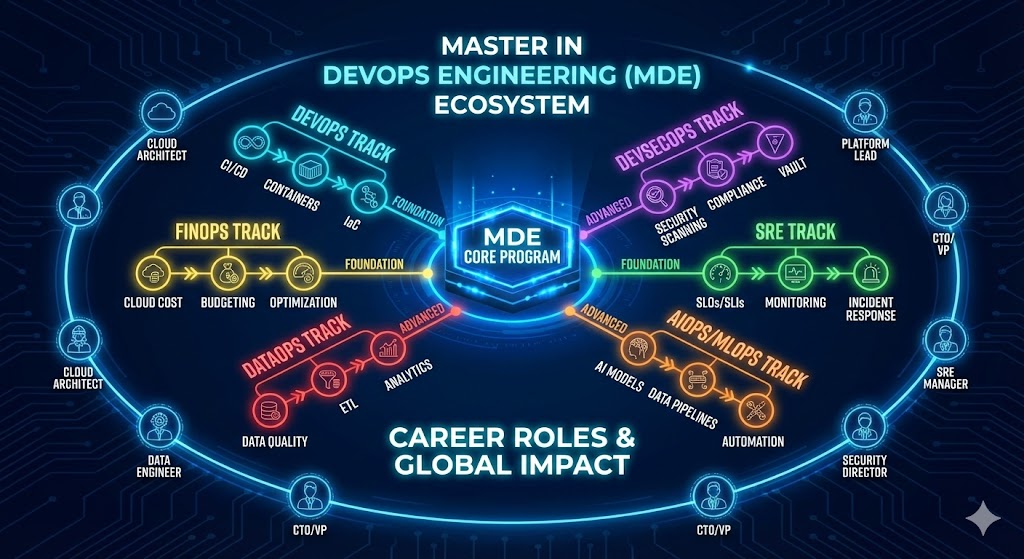
DevOps Path
The traditional DevOps path focuses on the synergy between code and infrastructure for faster delivery. You start by mastering version control and move quickly into containerization and CI/CD automation. This path suits those who enjoy building the technical highway upon which developers drive their code. It emphasizes speed, quality, and repeatability in every software release cycle. You will learn to eliminate bottlenecks and foster a culture of shared responsibility.
DevSecOps Path
This path integrates security into every phase of the development lifecycle rather than treating it as an afterthought. You will learn how to automate vulnerability scanning and manage identities through sophisticated access controls. This track is essential for professionals working in highly regulated industries like finance or healthcare. Consequently, you become the vital bridge between the security team and the engineering department. You will ensure that speed does not come at the cost of safety.
SRE Path
Site Reliability Engineering focuses on the operational health and scalability of production systems. You will learn how to use software engineering principles to solve infrastructure problems and manage service-level objectives (SLOs). This path is ideal for those who enjoy deep-diving into performance bottlenecks and system internals. Therefore, you focus on ensuring that the platform remains stable and responsive under extreme load. You will master the balance between feature velocity and system reliability.
AIOps / MLOps Path
This modern path explores the intersection of artificial intelligence and daily operations management. You will learn how to manage the unique lifecycle of machine learning models, including data versioning and monitoring. Additionally, you use AI to analyze vast amounts of log data to predict and prevent system failures before they occur. This is a high-growth area for engineers interested in data science and automated intelligence. You will lead the shift toward autonomous, self-aware infrastructure.
DataOps Path
DataOps applies DevOps principles to data pipelines to improve data quality and reduce cycle time. You will focus on automating data integration, testing, and deployment to support analytics and business intelligence. This path suits engineers who want to work closely with data scientists and warehouse architects. It ensures that data remains a reliable, high-speed asset across the entire organization. You will build the pipelines that fuel data-driven decision-making in the enterprise.
FinOps Path
FinOps brings financial accountability to the variable spend model of the cloud environment. You will learn how to analyze cloud bills, identify waste, and implement automated scaling to save costs. This path requires a mix of technical knowledge and business acumen to balance performance with budget. Consequently, you help the organization maximize the value of every dollar spent on cloud resources. You will bridge the gap between engineering, finance, and executive leadership.
Role → Recommended Master in DevOps Engineering (MDE) Certifications
| Role | Recommended Certifications |
| DevOps Engineer | MDE Foundation, MDE Professional (Core Track) |
| SRE | MDE Professional (Platform), MDE Advanced (Reliability) |
| Platform Engineer | MDE Professional (Core), MDE Professional (Reliability) |
| Cloud Engineer | MDE Foundation, MDE Professional (Platform) |
| Security Engineer | MDE Foundation, MDE Advanced (Security) |
| Data Engineer | MDE Foundation, MDE Advanced (DataOps) |
| FinOps Practitioner | MDE Professional (Platform), MDE Advanced (Governance) |
| Engineering Manager | MDE Foundation, MDE Advanced (Governance) |
Next Certifications to Take After Master in DevOps Engineering (MDE)
Same Track Progression
Once you complete the MDE levels, you should pursue deep specialization within your chosen domain. This might involve obtaining expert-level certificates in specific tools like Kubernetes or Terraform. Deepening your knowledge in your current track ensures you remain the primary subject matter expert for your team. This focus helps you tackle the most complex technical debt and architectural flaws effectively. You will stay ahead of the curve as your primary tools evolve.
Cross-Track Expansion
Broadening your skills into adjacent areas like security or data operations makes you a more versatile professional. For example, a core DevOps engineer might explore the MDE Advanced Security track to become a DevSecOps specialist. This cross-pollination of skills allows you to see the big picture of the enterprise architecture more clearly. It also provides more flexibility in your career options as industry demands shift over time. You will become a T-shaped professional with deep expertise and broad knowledge.
Leadership & Management Track
If you aspire to move into people management, look toward leadership certifications and business degrees. Transitioning from a technical master to a technical leader requires skills in budgeting, strategy, and team building. You can leverage your MDE background to gain respect from engineering teams while focusing on organizational goals. This path leads to influential roles such as DevOps Manager, VP of Engineering, or CTO. You will learn to manage the human and financial sides of a technical organization.
Training & Certification Support Providers for Master in DevOps Engineering (MDE)
DevOpsSchool
DevOpsSchool provides an extensive support network for professionals who pursue the MDE designation. They offer a blend of interactive sessions and self-paced learning that caters to the schedules of busy working engineers. Their curriculum emphasizes hands-on mastery through labs that use the latest industry tools and production-grade scenarios. Instructors at DevOpsSchool bring decades of real-world experience to the classroom, offering insights that you cannot find in standard textbooks. They maintain a strong community where students can collaborate on projects and share technical knowledge. Many professionals credit DevOpsSchool for providing the practical skills needed to pass the rigorous MDE assessments and advance their careers. They focus on total mastery rather than just passing an exam.
Cotocus
Cotocus focuses on delivering specialized training that meets the unique needs of global enterprises and technical teams. They provide a structured approach to the MDE program that prioritizes the implementation of Infrastructure as Code and advanced orchestration. Their trainers work closely with students to ensure they understand the underlying principles of automation rather than just memorizing commands. Cotocus offers a range of support materials, including detailed study guides and mock assessments that mirror the actual certification process. They help engineers build the confidence needed to manage complex cloud environments and high-velocity delivery pipelines. Their commitment to technical excellence makes them a preferred partner for many professionals seeking a deep understanding of modern DevOps.
Scmgalaxy
Scmgalaxy operates as a massive knowledge repository and community hub for professionals in the software configuration management space. They provide invaluable support for the MDE program through a vast library of tutorials, videos, and technical articles. Their focus on the fundamental roots of version control and build automation helps students build a rock-solid technical foundation. Scmgalaxy also hosts forums where engineers can seek advice from peers and industry experts on specific technical hurdles. They emphasize the cultural shifts required for successful DevOps adoption, helping learners navigate the human side of technical transformation. This comprehensive approach ensures that students gain a well-rounded education that extends far beyond the core MDE curriculum.
BestDevOps
BestDevOps delivers a highly curated learning experience designed to maximize the career impact of the MDE certification. They focus on the specific skills and tools that hiring managers value most in the current technology market. Their training modules prioritize clarity and practical application, allowing students to see the immediate benefits of their learning. BestDevOps provides personalized guidance to help engineers choose the right specialization tracks based on their unique career goals. They utilize real-world case studies to demonstrate how MDE principles solve actual business problems in high-pressure environments. By choosing BestDevOps, professionals gain a strategic advantage in their job search and long-term career progression through expert-led training.
devsecopsschool.com
This provider specializes in the critical intersection of security and the automated software delivery lifecycle. They offer the deep-dive training required to excel in the MDE Advanced Security track and become a proficient DevSecOps engineer. Their curriculum teaches students how to automate vulnerability scanning and implement robust identity management across the entire pipeline. They emphasize a security-by-design approach that helps organizations reduce risk without slowing down the development process. Instructors provide practical insights into the latest security threats and how modern infrastructure can defend against them. Professionals who train here become the primary defenders of their company’s digital assets and delivery speed in a world of increasing cyber threats.
sreschool.com
Sreschool focuses on the technical disciplines of site reliability, system observability, and high-scale performance tuning. They provide the specialized knowledge needed for the MDE SRE track, ensuring that engineers can maintain high uptime for global services. Their training includes advanced modules on distributed tracing, error budgets, and incident response management. Students learn to use software engineering practices to eliminate manual operational tasks and improve system resilience. Sreschool provides a lab-intensive environment where candidates can simulate major system outages and practice rapid recovery techniques. This focus on reliability makes them the ideal choice for engineers who want to manage mission-critical production environments for top-tier technology firms.
aiopsschool.com
Aiopsschool leads the way in training engineers for the future of intelligence-driven infrastructure management. They support the MDE AIOps track by teaching professionals how to leverage machine learning for predictive system maintenance. Their curriculum covers data science fundamentals and how to apply them to massive streams of operational telemetry. Students learn to build systems that automatically identify anomalies and suggest root causes for complex failures. Aiopsschool helps engineers stay at the cutting edge of technical innovation, preparing them for roles that require a mix of operations and data science. This forward-looking approach ensures that your skills remain relevant as the industry moves toward autonomous, self-healing infrastructure.
dataopsschool.com
Dataopsschool addresses the growing need for agility and reliability in modern data engineering and analytics pipelines. They provide the training required for the MDE DataOps track, focusing on the automation of data flows and quality checks. Their instructors teach students how to treat data as code, ensuring that every transformation is versioned and repeatable. This provider helps bridge the gap between data science teams and the operations engineers who support them. By learning at Dataopsschool, you gain the skills needed to manage complex data warehouses and real-time streaming platforms. They help the organization deliver reliable business insights at a fraction of the traditional cycle time through automated delivery.
finopsschool.com
Finopsschool focuses on the financial management and cost optimization of modern cloud-native infrastructures. They offer specialized support for the MDE FinOps track, teaching engineers how to balance performance with budget constraints. Their curriculum includes detailed modules on cloud billing analysis, resource rightsizing, and automated cost-saving policies. Students learn how to foster a culture of financial accountability within their engineering teams and communicate value to stakeholders. Finopsschool provides practical frameworks that help organizations avoid the bill shock often associated with rapid cloud scaling. This training is essential for any professional who wants to lead cost-efficient engineering departments and maximize the return on cloud investment.
Frequently Asked Questions (General)
- How difficult do most students find the MDE exams?Most students consider the exams moderately challenging because they require practical problem-solving rather than simple memorization. You must demonstrate that you can actually configure and fix delivery systems in a live environment.
- Are there specific prerequisites I should meet before starting?You should possess a basic understanding of computer networking and feel comfortable working in a command-line interface. Having experience in at least one scripting language like Python or Bash will also help you succeed.
- What is the typical timeframe for completing all MDE levels?Most working professionals complete the entire journey in six to twelve months of consistent study. You should expect to dedicate several hours each week to labs and theoretical reviews to stay on track.
- Do employers globally recognize the MDE designation?Yes, companies across India and international markets recognize MDE as a sign of high-level technical proficiency. It aligns with the standards expected by top-tier tech firms and major global enterprises.
- Does the program focus on AWS, Azure, or Google Cloud?The program remains cloud-agnostic, teaching you principles and tools like Kubernetes that work across all major cloud providers. This ensures your skills remain portable throughout your entire career.
- What kind of career growth can I expect after certification?Many professionals move into senior DevOps, SRE, or Lead Architect roles with significantly higher salary potential. The certification proves you have the skills to handle high-level technical responsibilities.
- Can I take the certification exams in any order?While you can technically choose, we recommend following the Foundation to Advanced sequence. This ensures you have the necessary base knowledge to understand the more complex topics.
- Is the learning mostly theoretical or hands-on?The MDE program prioritizes hands-on experience, with a large portion of the curriculum dedicated to interactive labs. You learn by building real systems, which is the most effective way to master DevOps.
- How does MDE compare to certifications from specific cloud vendors?MDE provides a broader, more holistic view of the entire software lifecycle compared to vendor-specific certs. It focuses on the integration of multiple tools rather than just one cloud platform’s features.
- Do I need advanced coding skills to pass the MDE?You do not need to be a software developer, but you must master scripting and configuration management. The ability to read and modify code is essential for automating infrastructure effectively.
- How does this certification help engineering managers?It provides managers with the technical depth needed to make informed decisions about technology and team structure. You will better understand the bottlenecks your engineers face and how to solve them.
- Where can I find help if I struggle with a technical lab?Providers like DevOpsSchool offer community forums and instructor support to help you through difficult concepts. Engaging with other students in the community is also an excellent way to find solutions.
FAQs on Master in DevOps Engineering (MDE)
- What is the primary goal of the MDE program?The program aims to create well-rounded engineers who can design, automate, and manage the entire software delivery pipeline. It focuses on creating a seamless link between development teams and production environments to drive speed.
- Does MDE cover the latest versions of tools like Kubernetes?The curriculum authors update the content regularly to ensure it covers the latest stable versions of all included tools. This keeps your training relevant to the actual systems you will manage in your job today.
- How do I maintain my MDE certification over time?To keep the credential active, you usually need to participate in continuing education or pass a renewal exam every few years. This encourages continuous learning and keeps your skills sharp as the industry evolves.
- Is MDE suitable for someone coming from a non-IT background?It is possible, but you should spend extra time mastering Linux and networking basics before attempting the MDE Foundation. The program is intensive and moves quickly into professional-level technical topics.
- How are the MDE exams proctored and delivered?Most exams are delivered online through a secure proctoring service that allows you to take the test from your home. You will need a stable internet connection and a computer that meets the technical requirements.
- What specific value does the SRE track provide?The SRE track teaches you how to use software engineering to solve operational problems, focusing on metrics and reliability. It prepares you for the high-demand site reliability engineering roles at major global companies.
- Are there any group discounts for corporate training?Many providers offer special pricing for companies that want to train their entire engineering teams at once. You should contact the official providers directly to discuss customized corporate packages and training paths.
- What makes MDE different from a standard DevOps course?MDE offers a much deeper, multi-level approach that covers advanced topics like AIOps, FinOps, and global governance. It is a comprehensive career roadmap rather than a simple introduction to a few automated tools.
Final Thoughts: Is Master in DevOps Engineering (MDE) Worth It?
Technical trends move fast, but the principles of efficient delivery remain the foundation of every successful tech company. Therefore, the Master in DevOps Engineering (MDE) is a strategic investment in your professional future. It transforms you from someone who simply follows instructions into a leader who designs the automated systems of the future. You will find that the depth of knowledge you gain pays off in every technical discussion and architectural decision you make.
Throughout my career, I have seen that the most successful engineers are those who understand the big picture. The MDE program provides that perspective by showing you how every tool and process connects to the ultimate business goal. It replaces the stress of constant tool-switching with a solid engineering philosophy that you can apply anywhere. You will gain the clarity needed to navigate the noise of the technology market and focus on what truly matters.
If you want to move beyond basic tasks and take on the challenges of enterprise-scale engineering, this path is for you. It provides the rigor, the community, and the technical depth needed to excel in the most demanding roles in the industry. Take the first step today and start building the skills that will define your career for the next decade. You possess the potential to lead the next wave of digital innovation through technical excellence.