Introduction
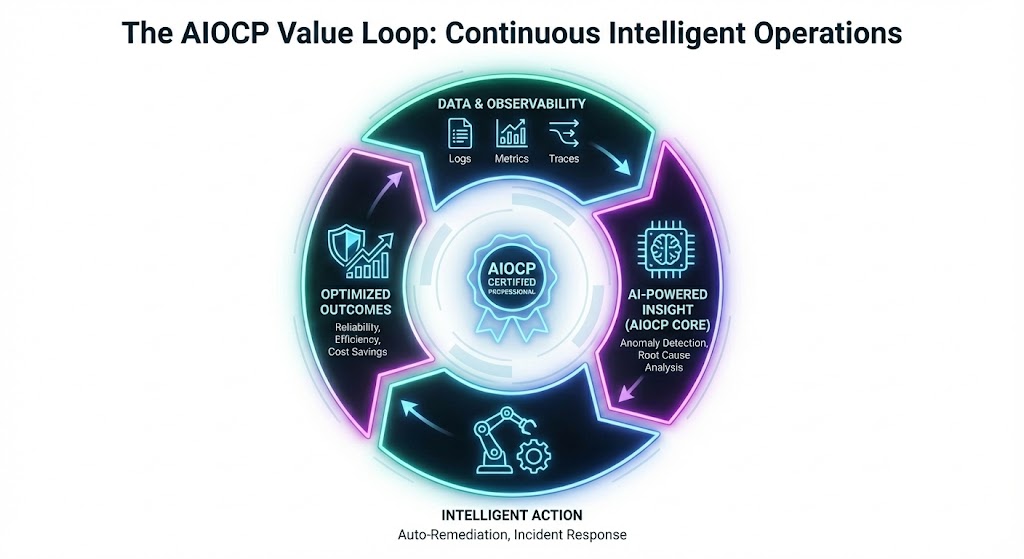
Engineers today face a mountain of telemetry data that no human team can process alone. The AiOps Certified Professional (AIOCP) program offers a definitive solution by teaching you how to apply artificial intelligence to IT infrastructure. This guide clarifies how you can transition from manual monitoring to building intelligent, autonomous systems. By leveraging the expertise found at DevOpsSchool, you gain the skills to predict system failures and automate complex remediation tasks. Whether you lead a platform team or manage cloud resources, this roadmap helps you navigate the high-stakes world of AI-driven operations with total confidence.
What is the AiOps Certified Professional (AIOCP)?
The AiOps Certified Professional (AIOCP) serves as a specialized credential for technical experts who want to revolutionize IT operations using machine learning. It exists to bridge the gap between traditional systems administration and advanced data science. Instead of focusing on simple alerts, the AIOCP curriculum emphasizes the creation of self-healing environments that learn from historical production data. This certification confirms that an engineer can deploy production-grade AI models to manage the velocity and variety of modern cloud-native traffic.
Who Should Pursue AiOps Certified Professional (AIOCP)?
Site Reliability Engineers, Cloud Architects, and DevOps practitioners find the greatest value in this certification track. Security specialists also benefit by learning to detect behavioral anomalies that signify sophisticated cyber threats. This program serves both seasoned professionals in India’s booming tech hubs and global engineers who want to stay ahead of the curve. Even technical managers find it useful for understanding how to justify AI investments and lead transformation initiatives within their organizations.
Why AiOps Certified Professional (AIOCP) is Valuable in 2026 and Beyond
As infrastructure complexity grows, enterprises increasingly rely on AI to maintain their competitive edge. The AiOps Certified Professional (AIOCP) remains valuable because it teaches the durable principles of algorithmic operations rather than just specific tool syntax. This knowledge protects your career against the rapid turnover of software products in the DevOps ecosystem. By mastering these skills, you provide immediate value to organizations that need to slash their mean time to resolution and optimize their expensive cloud footprints.
AiOps Certified Professional (AIOCP) Certification Overview
The certification process utilizes the official curriculum at the specified URL and resides on the hosting platform. Candidates undergo a rigorous assessment that prioritizes practical lab work over simple memorization. The program owners constantly update the materials to reflect the latest breakthroughs in natural language processing and predictive analytics. This ensures that every certified individual can handle real-world enterprise stressors and implement AIOps strategies that produce measurable business results.
AiOps Certified Professional (AIOCP) Certification Tracks & Levels
The AIOCP framework offers three progressive tiers: Foundation, Professional, and Advanced. The Foundation level introduces the core concepts of data ingestion and statistical monitoring. The Professional level requires you to build and integrate machine learning models directly into operational pipelines. The Advanced level focuses on architectural strategy and enterprise-wide AI governance. This tiered approach ensures you develop a deep, specialized expertise that matches your specific career aspirations and experience level.
Complete AiOps Certified Professional (AIOCP) Certification Table
| Track | Level | Who it’s for | Prerequisites | Skills Covered | Recommended Order |
| Operations | Foundation | Aspiring Engineers | Linux Basics | Data Prep, Telemetry | 1 |
| Engineering | Professional | SREs & DevOps | Python & Cloud | ML Modeling, Automation | 2 |
| Strategy | Advanced | Tech Leads / VPs | 5+ Years Exp | AI ROI, Org Strategy | 3 |
| Security | AI-Sec | SecOps Engineers | Networking | Threat Detection | 4 |
Detailed Guide for Each AiOps Certified Professional (AIOCP) Certification
AiOps Certified Professional (AIOCP) – Foundation
What it is
This certification confirms your mastery of the essential components of AI-driven operations. It proves you can identify the different types of operational data and understand the basic AIOps lifecycle.
Who should take it
Junior engineers and students who want to enter the high-demand field of intelligent operations should start here. It also suits traditional IT professionals who need a modern technical refresh.
Skills you’ll gain
- Understanding Metrics, Logs, and Traces.
- Basic data visualization techniques.
- Identifying noise in alerting systems.
- Fundamental Python for data handling.
Real-world projects you should be able to do
- Create a monitoring dashboard that filters out redundant system alerts.
- Organize raw infrastructure logs into a format suitable for AI analysis.
Preparation plan
- 7–14 days: Study the core definitions and history of AIOps.
- 30 days: Practice Python-based data cleaning and visualization.
- 60 days: Complete mock exams and build a basic observability lab.
Common mistakes
- Ignoring the quality of data before trying to apply AI models.
- Focusing too much on tool features rather than underlying data principles.
Best next certification after this
- Same-track: AIOCP Professional.
- Cross-track: AWS or Azure Associate.
- Leadership: ITIL 4 Foundation.
AiOps Certified Professional (AIOCP) – Professional
What it is
This professional tier validates your ability to engineer, deploy, and maintain machine learning models in a live production environment. It focuses on the practical application of AI to solve uptime challenges.
Who should take it
Experienced DevOps engineers and SREs who want to automate their incident response and capacity planning using advanced algorithms.
Skills you’ll gain
- Implementing supervised and unsupervised ML for IT.
- Designing automated self-healing scripts.
- Managing “ModelOps” for infrastructure health.
- Advanced root cause analysis automation.
Real-world projects you should be able to do
- Build a system that predicts a database failure before it impacts users.
- Deploy an AI model that automatically groups thousands of logs into five actionable incidents.
Preparation plan
- 7–14 days: Review specific ML algorithms for time-series forecasting.
- 30 days: Build and test automation workflows in a sandbox environment.
- 60 days: Execute a full end-to-end AIOps project and pass the exam.
Common mistakes
- Creating models that produce too many false positives.
- Failing to document how the AI makes its operational decisions.
Best next certification after this
- Same-track: AIOCP Advanced.
- Cross-track: Certified Kubernetes Administrator.
- Leadership: Agile or Project Management certs.
Choose Your Learning Path
DevOps Path
The DevOps path focuses on making the software delivery life cycle faster and safer through intelligence. You learn to use AI to predict which code commits might cause a production outage. This track emphasizes the use of machine learning to optimize testing and automate the deployment of microservices. It is the best choice for engineers who want to eliminate manual bottlenecks in the CI/CD pipeline.
DevSecOps Path
This path prioritizes security at the speed of AI. You will learn to deploy models that identify and block malicious traffic patterns faster than any human operator. This track focuses on automated threat hunting and ensuring continuous compliance in cloud-native environments. It serves security professionals who want to lead the fight against modern, AI-powered cyberattacks.
SRE Path
The SRE path targets the ultimate goal: 100% uptime through intelligent automation. You focus on building systems that detect performance degradation and take corrective action without human intervention. This track covers the use of AI for managing error budgets and maintaining strict SLOs in complex architectures. It is perfect for those who prioritize system reliability and customer experience.
AIOps / MLOps Path
This specialized track teaches you the “how-to” of operationalizing machine learning. You learn to manage the lifecycle of the very models that monitor your infrastructure. This path bridges the gap between the data scientist and the systems engineer. It suits professionals who want to ensure that their AI tools remain accurate and effective in a changing production landscape.
DataOps Path
The DataOps path ensures that your AI always has high-quality fuel. You learn how to build resilient pipelines that collect, clean, and deliver telemetry data to your AI engines in real-time. This track focuses on monitoring data health and preventing the “data rot” that leads to poor AI performance. It is ideal for engineers who love the challenge of massive data orchestration.
FinOps Path
The FinOps path uses AI to solve the biggest headache in the cloud: cost management. You learn to use predictive analytics to forecast spending and identify wasted resources automatically. This track allows you to prove the financial value of your technical expertise to company leadership. It is essential for anyone managing large-scale, multi-cloud budgets.
Role → Recommended (Topic name) Certifications
| Role | Recommended Certifications |
| DevOps Engineer | AIOCP Foundation + Professional |
| SRE | AIOCP Professional + Advanced |
| Platform Engineer | AIOCP Professional |
| Cloud Engineer | AIOCP Foundation |
| Security Engineer | AIOCP Security Track |
| Data Engineer | AIOCP DataOps Track |
| FinOps Practitioner | AIOCP FinOps Track |
| Engineering Manager | AIOCP Advanced |
Next Certifications to Take After AiOps Certified Professional (AIOCP)
Same Track Progression
After you master the professional tier, you should pursue the Advanced Architect level. This allows you to step into leadership roles where you design the entire AI strategy for your company. You will learn to manage cross-functional teams and ensure that AI initiatives align with long-term business goals.
Cross-Track Expansion
Diversify your skills by earning certifications in container orchestration or specific cloud provider technologies. Understanding how Kubernetes or AWS works underneath allows you to apply your AIOps knowledge more effectively. Certifications in big data processing also provide a strong foundation for managing the massive datasets required for AI.
Leadership & Management Track
If you want to move into the C-suite, combine your AIOCP technical skills with management credentials. Focus on digital transformation strategy and financial leadership. This combination makes you a rare and highly valuable asset who can bridge the gap between complex engineering and business growth.
Training & Certification Support Providers for AiOps Certified Professional (AIOCP)
DevOpsSchool
This provider leads the industry by offering comprehensive, lab-heavy training for the AIOCP certification. They focus on giving students actual access to production-like environments where they can experiment with AI models. Their instructors are active practitioners who provide real-world insights that you won’t find in any textbook or static video course.
Cotocus
This organization helps enterprise teams move from legacy systems to AI-driven infrastructure through targeted training. They offer bespoke AIOCP programs that focus on the specific challenges your company faces. Their training ensures that your team doesn’t just pass an exam but actually improves the reliability of your corporate systems.
Scmgalaxy
This community-driven platform offers a massive library of resources for anyone studying for the AIOCP. They provide free tutorials, scripts, and practice questions alongside their formal training programs. It is an excellent place for self-starters to find the community support and technical tips they need to succeed in their certification journey.
BestDevOps
This provider focuses on high-level engineering standards and the mathematical logic behind AIOps. They cater to experienced professionals who want a deep, academic understanding of how machine learning impacts IT reliability. Their courses are known for being rigorous and highly respected by technical hiring managers across the globe.
devsecopsschool.com
This site focuses exclusively on the intersection of security, automation, and AI. They provide the best training for the AIOCP security track, teaching you how to build intelligent defense systems. Their instructors are cyber security experts who show you how to use AI to win the battle against automated threats.
sreschool.com
This provider focuses on the practical needs of Site Reliability Engineers. Their AIOCP training centers on maintaining uptime through automated incident response and root cause analysis. They offer specialized modules that show you how to integrate AI into your existing SRE toolchain for maximum efficiency.
aiopsschool.com
As a dedicated institution for AIOps, this provider offers the most direct and focused path to becoming an AIOCP. They cover everything from basic data collection to the design of autonomous, self-healing systems. Their entire mission is to turn traditional engineers into AI operations specialists.
dataopsschool.com
This organization teaches you how to manage the data pipelines that are essential for any AIOps project. They focus on data quality, governance, and real-time processing at scale. Their curriculum is vital for ensuring that your AI models always receive the clean data they need to provide accurate insights.
finopsschool.com
This provider helps you master the financial side of the cloud using AI. They offer unique training on how to use machine learning to identify cost-saving opportunities and forecast cloud budgets. This is a must-have skill for engineers who want to show the business value of their technical work.
Frequently Asked Questions (General)
- How does this certification help my career?It distinguishes you as an expert in the fastest-growing area of IT operations, making you a top candidate for senior and lead roles.
- Is the exam hard to pass?The exam is challenging because it requires practical knowledge, but if you complete the recommended labs, you will be well-prepared.
- Can I take the training online?Yes, all the major providers offer flexible online courses that include access to virtual lab environments.
- Do I need to be a data scientist?No, you only need to understand the operational application of data science, not the deep academic theory.
- How long should I study for the Professional level?Most successful candidates spend about 10 hours a week for three months to master the professional curriculum.
- What programming language should I learn?Python is the most important language to learn for this certification because of its dominance in the AI and data fields.
- Does this certification expire?Yes, it usually expires after two or three years to ensure you stay up-to-date with the latest technical advancements.
- Are there practice exams available?Yes, most training providers include mock exams that mimic the format and difficulty of the actual AIOCP assessment.
- Does the course cover open-source AI tools?Yes, the curriculum focuses heavily on popular open-source frameworks that you can use in any enterprise environment.
- Is there a prerequisite for the Foundation level?No, anyone with a basic interest in IT operations and a little bit of Linux knowledge can start the Foundation level.
- How much does the exam cost?Prices vary by provider and region, so it is best to check the official website for the most current pricing information.
- Can this help me get a job in another country?Yes, AIOCP is a globally recognized standard, and the skills it teaches are in high demand in tech hubs everywhere.
FAQs on AiOps Certified Professional (AIOCP)
- How is AIOCP different from a generic AI course?AIOCP is specifically tailored for IT operations, focusing on logs, metrics, and system uptime rather than generic AI topics like image recognition.
- What kind of ROI can my company expect from my certification?Companies usually see a drastic reduction in mean time to repair (MTTR) and significant cloud cost savings once they implement AIOCP principles.
- Do I need my own server to practice?No, the training providers listed above usually provide all the cloud-based lab environments you need as part of your enrollment.
- Will this certification help with my SRE goals?Absolutely; AI is the “secret sauce” that allows SREs to manage thousands of servers without a massive increase in headcount.
- Does the course cover log management?Yes, log ingestion and clustering are core parts of the curriculum, as they provide the data for many AIOps models.
- How often is the curriculum updated?The program owners review and update the content at least once a year to keep pace with the rapid changes in AI technology.
- Can I specialize in a specific cloud provider?While the certification is vendor-neutral, you will learn how to apply these AI principles to AWS, Azure, and Google Cloud.
- Is there any support if I get stuck during my studies?Yes, providers like DevOpsSchool offer access to mentors and community forums where you can get help with technical questions.
Final Thoughts: Is AiOps Certified Professional (AIOCP) Worth It?
If you want to move beyond manual firefighting and start building the future of IT, the AIOCP certification is absolutely worth your time. The industry has reached a tipping point where traditional methods can no longer keep up with the scale of modern business. I have seen many engineers revitalize their careers by embracing these AI-driven workflows. The journey requires a commitment to learning new concepts and practicing in the lab, but the result is a skill set that makes you indispensable to any major enterprise. Don’t wait for the industry to leave you behind—start your AIOCP journey today and become the architect of a smarter, more reliable digital world.