Professionals seeking to dominate the cloud infrastructure landscape will find the Certified Site Reliability Architect program an essential asset for their career toolkit. This comprehensive educational journey, offered by Sreschool, empowers engineers to design systems that maintain peak performance under extreme pressure. Rather than focusing on fleeting tool trends, this curriculum deepens your grasp of core architectural stability and operational efficiency. By following this guide, you will learn how to transform from a traditional operator into a high-level architect capable of steering complex digital transformations. Organizations worldwide now prioritize candidates who possess these specific skills, making this the perfect time to elevate your professional standing through targeted learning and validation.
What is the Certified Site Reliability Architect?
The Certified Site Reliability Architect program defines the modern standard for engineering excellence in high-stakes production environments. It validates a professional’s ability to balance the need for rapid feature deployment with the absolute necessity of system uptime. This certification shifts the focus from simple maintenance to proactive architectural design, ensuring that reliability remains a core component of the development lifecycle.
Furthermore, it bridges the gap between software engineering and systems operations by applying code-centric solutions to infrastructure challenges. Candidates learn to treat operations as an engineering problem, utilizing automation to eliminate manual toil. This methodology aligns perfectly with the needs of large-scale enterprises that require consistent, predictable, and scalable service delivery across global regions.
Who Should Pursue Certified Site Reliability Architect?
Senior developers, systems engineers, and cloud specialists who want to pivot into strategic leadership roles should prioritize this certification. It provides the technical depth required for SREs and Platform Engineers to manage massive distributed systems effectively. Additionally, security professionals and data architects find the reliability principles invaluable for protecting and scaling critical business assets.
Global tech markets, particularly within India’s vibrant IT sector, demonstrate a soaring demand for experts who can architect for resilience. Technical leads and engineering managers also benefit significantly, as the program teaches the metrics-driven approach needed to manage high-performing teams. Whether you are an experienced veteran or an ambitious engineer moving upward, this track offers the specialized knowledge required for top-tier roles.
Why Certified Site Reliability Architect is Valuable and Beyond
Modern enterprises face immense pressure to deliver flawless digital experiences, which places a high premium on architectural reliability. Professionals who master these concepts ensure their career longevity because they provide value that transcends specific software versions or cloud providers. This certification signals to employers that you possess the high-level thinking required to prevent costly outages and optimize system performance.
As companies adopt complex multi-cloud and hybrid environments, the ability to design vendor-neutral, resilient architectures becomes a critical business advantage. Consequently, earning this credential leads to increased influence within your organization and opens doors to lucrative consulting and leadership opportunities. Investing time in this program yields a significant return by placing you at the forefront of the most critical domain in modern computing.
Certified Site Reliability Architect Certification Overview
The official program resides on the dedicated course page and maintains its hosting through Sreschool. It features a rigorous assessment model that prioritizes practical application over rote memorization of technical definitions. This approach ensures that every certified individual can actually implement reliability strategies in a live production environment.
Industry practitioners manage and update the curriculum to keep it aligned with the evolving needs of the tech sector. The program’s modular structure allows you to build expertise at your own pace, moving from fundamental concepts to complex architectural challenges. By maintaining high standards for certification, the program ensures that its graduates carry a credential respected by principal engineers and hiring managers globally.
Certified Site Reliability Architect Certification Tracks & Levels
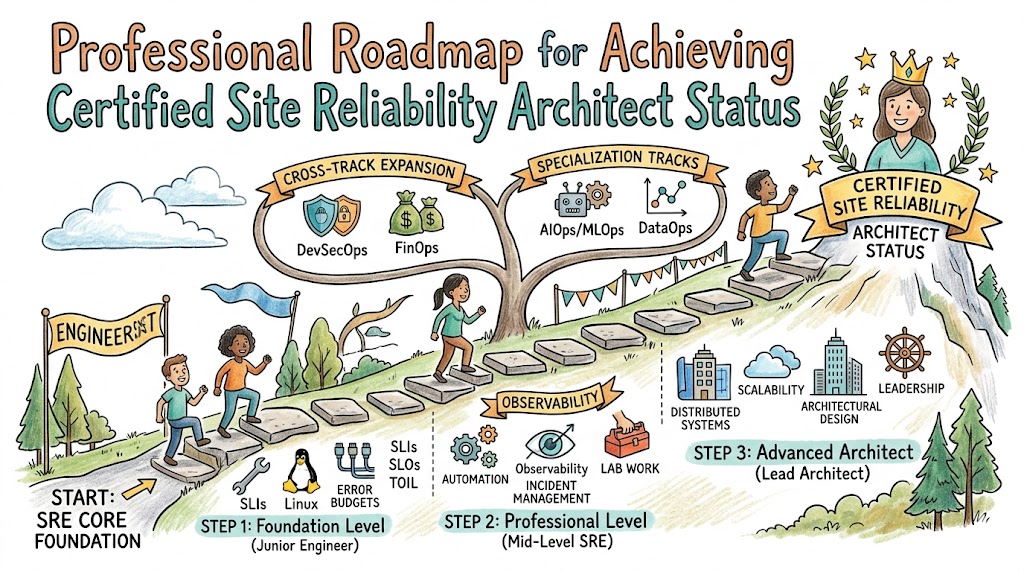
The certification journey begins with the foundation level, where you master the essential vocabulary and culture of reliability. Once you establish this base, you move to the professional level to tackle automation, monitoring, and advanced incident management techniques. Finally, the advanced level focuses on the high-level architectural decisions that govern the stability of massive, distributed systems.
Specialized tracks allow you to customize your education toward specific interests like FinOps for financial optimization or DevSecOps for integrated security. Each level builds upon the previous one, creating a logical progression that mirrors a successful career path in engineering. This structured approach ensures you gain the right skills at the right time as you move toward architectural mastery.
Complete Certified Site Reliability Architect Certification Table
| Track | Level | Who it’s for | Prerequisites | Skills Covered | Recommended Order |
| SRE Core | Foundation | Junior Engineers | Linux Basics | SLIs, SLOs, Error Budgets | 1 |
| SRE Core | Professional | Mid-Level SREs | Foundation Cert | Automation, Observability | 2 |
| Architecture | Advanced | Senior Architects | Professional Cert | Scaling, Failure Domains | 3 |
| DevSecOps | Specialist | Security Pros | Foundation Cert | CI/CD Security, Auditing | 4 |
| FinOps | Specialist | Cloud Managers | Foundation Cert | Cost Optimization, Billing | 5 |
Detailed Guide for Each Certified Site Reliability Architect Certification
Certified Site Reliability Architect – Foundation
What it is
This entry-level certification validates your understanding of the core pillars that support a culture of reliability. It introduces the essential metrics used to measure service health.
Who should take it
Developers, junior operators, and project managers who want to understand how SRE teams function.
Skills you’ll gain
- Implementing Service Level Objectives (SLOs).
- Managing Error Budgets to balance risk.
- Identifying toil within operational workflows.
Real-world projects you should be able to do
- Create a basic reliability roadmap for a web application.
- Define appropriate SLIs for a customer-facing API.
Preparation plan
- 7-14 Days: Focus on the official glossary and core SRE concepts.
- 30 Days: Apply these metrics to a personal or small-team project.
- 60 Days: Not required for this introductory phase.
Common mistakes
Ignoring the cultural aspects of SRE while focusing only on the technical definitions.
Best next certification after this
- Same-track option: Professional SRE level.
- Cross-track option: DevSecOps Specialist.
- Leadership option: SRE Management.
Certified Site Reliability Architect – Professional
What it is
This level moves into the technical implementation of SRE principles through advanced automation and monitoring. It focuses on maintaining high availability in dynamic environments.
Who should take it
Engineers responsible for on-call rotations and the day-to-day stability of production systems.
Skills you’ll gain
- Designing automated self-healing systems.
- Developing deep observability frameworks.
- Executing chaos engineering drills safely.
Real-world projects you should be able to do
- Deploy a full observability stack for a microservices cluster.
- Automate the resolution of common infrastructure failures.
Preparation plan
- 7-14 Days: Deep dive into monitoring and alerting configurations.
- 30 Days: Practice incident response drills in a lab environment.
- 60 Days: Study advanced distributed system patterns and failures.
Common mistakes
Failing to automate repetitive tasks and relying too heavily on manual intervention.
Best next certification after this
- Same-track option: Advanced Architect level.
- Cross-track option: FinOps Specialist.
- Leadership option: Principal Engineer.
Choose Your Learning Path
DevOps Path
Teams following this path prioritize the speed and safety of software delivery through integrated pipelines. You will learn to eliminate the walls between developers and operations by using automation for every stage of the lifecycle. This path emphasizes the creation of reproducible environments and consistent deployment patterns. Consequently, you become a master of the continuous delivery process.
DevSecOps Path
This specialized track puts security at the heart of the development process rather than treating it as a final check. You will learn to automate threat detection and compliance monitoring directly within your CI/CD workflows. This approach ensures that your applications remain secure from the first line of code to the final deployment. It is a vital path for anyone working with sensitive data.
SRE Path
The SRE path focuses on the engineering techniques required to build massive, highly available systems. You will spend your time mastering service level management, incident response, and the reduction of operational toil through software. This path transforms you into a guardian of system performance and reliability. It serves as the primary route for aspiring site reliability architects.
AIOps Path
Engineers on this path leverage artificial intelligence to manage the vast complexity of modern IT environments. You will learn to use machine learning for predictive maintenance and automated root cause analysis. This helps teams identify and fix issues before they impact the end-user experience. It represents the future of automated operations at scale.
MLOps Path
This track applies the principles of reliability specifically to the lifecycle of machine learning models. You will focus on the unique challenges of model deployment, data versioning, and performance monitoring in production. By mastering this path, you ensure that AI-driven features remain stable and accurate over time. It is essential for organizations scaling their data science initiatives.
DataOps Path
The DataOps path applies agile and SRE principles to the management of data flows and storage. You will learn to automate data orchestration to ensure that high-quality information reaches the right systems at the right time. This reduces the friction between data engineering and business analytics. It is a critical role for any data-heavy organization.
FinOps Path
This path focuses on the financial governance of cloud infrastructure to ensure cost-efficient growth. You will learn to bridge the gap between engineering, finance, and business teams to optimize cloud spending. By implementing these strategies, you help your organization achieve the best possible performance for every dollar spent. This is a high-demand skill for modern business leadership.
Role → Recommended Certified Site Reliability Architect Certifications
| Role | Recommended Certifications |
| DevOps Engineer | Foundation, Professional, DevSecOps Specialist |
| SRE | Foundation, Professional, Advanced Architect |
| Platform Engineer | Professional, Advanced, DataOps Specialist |
| Cloud Engineer | Foundation, Professional, FinOps Specialist |
| Security Engineer | Foundation, DevSecOps Specialist, Advanced |
| Data Engineer | Foundation, DataOps Specialist, Professional |
| FinOps Practitioner | Foundation, FinOps Specialist |
| Engineering Manager | Foundation, SRE Management |
Next Certifications to Take After Certified Site Reliability Architect
Same Track Progression
After you master the advanced architect level, you should pursue deep technical specializations in areas like container orchestration or distributed networking. Focusing on these low-level technical components makes you an expert in solving the most difficult scaling bottlenecks. This level of expertise is highly sought after by world-class technology firms.
Cross-Track Expansion
Expanding into complementary fields like FinOps or DevSecOps allows you to view system design through multiple lenses. Understanding the financial and security implications of your architectural choices makes you a more effective and holistic leader. This broad perspective is often a requirement for executive-level technical positions.
Leadership & Management Track
If you wish to lead large organizations, the management track focuses on the strategy and culture behind engineering excellence. You will learn to build resilient teams and align technical goals with broader business objectives. This path prepares you for roles like Director of Engineering or VP of Infrastructure.
Training & Certification Support Providers for Certified Site Reliability Architect
DevOpsSchool
This provider offers high-intensity training programs that focus on the practical application of SRE tools and principles. They provide students with access to complex lab environments where they can practice solving real-world production issues. Their instructors bring years of industry experience to help guide you through the certification process.
Cotocus
This organization specializes in deep-dive technical workshops for engineers who want to master specific parts of the cloud-native ecosystem. They offer targeted learning modules that help bridge the gap between theory and practical engineering skills. Their training is highly respected for its focus on hands-on expertise.
Scmgalaxy
This community-centric platform provides an extensive library of learning resources and community support for DevOps professionals. It acts as a hub for engineers to share knowledge and stay updated on the latest industry trends. Their resources cover everything from basic automation to advanced infrastructure management.
BestDevOps
Focusing on streamlined certification preparation, this provider helps professionals master the core concepts required for the architect exam. Their materials focus on high-impact learning to help you achieve your goals efficiently. They provide the clarity needed to navigate complex architectural topics.
devsecopsschool.com
This institution focuses exclusively on the integration of security into modern engineering workflows. They offer specialized courses that cover automated security testing, compliance, and threat modeling within CI/CD pipelines. This is an essential stop for anyone pursuing the DevSecOps specialist track.
sreschool.com
Serving as the primary platform for the reliability architect program, this site offers the most comprehensive and direct learning path available. Their modules cover the entire spectrum of SRE from foundational definitions to advanced architectural patterns. It is the definitive resource for anyone seeking this specific certification.
aiopsschool.com
This provider leads the way in teaching engineers how to apply artificial intelligence to IT operations. Their curriculum covers predictive analytics and machine learning for infrastructure management. They help professionals prepare for the future of highly automated, intelligent systems.
dataopsschool.com
Focused on the intersection of data engineering and operations, this school teaches how to build reliable and scalable data pipelines. Their training ensures that you can apply SRE principles to keep data flowing accurately and consistently. It is a vital resource for the modern data architect.
finopsschool.com
This organization provides the training necessary to master cloud financial management and cost optimization. They help engineers and managers understand the economic impact of their technical decisions. Their courses are essential for maintaining a profitable and efficient cloud footprint.
Frequently Asked Questions
- Does this certification require prior coding knowledge?
Yes, most architects find that a basic understanding of a language like Python or Go is necessary to automate reliability tasks effectively.
- How long does it take to complete the full architect path?
Most professionals spend six months to a year progressing from the foundation level to the advanced architect designation.
- Can I skip the foundation level if I have experience?
The program generally requires you to pass the foundation exam first to ensure you have a firm grasp of the core SRE vocabulary.
- Is there a heavy focus on cloud-specific tools?
No, the program prioritizes vendor-neutral principles that you can apply to AWS, Azure, Google Cloud, or on-premises environments.
- What is the primary benefit of being a certified architect?
It validates your ability to design systems for high availability, which often leads to higher salary offers and more strategic roles.
- Are the exams purely theoretical?
The higher-level exams include practical, scenario-based questions that test your ability to solve actual architectural problems.
- How does this certification help an engineering manager?
It provides managers with the metrics and cultural frameworks needed to build and lead successful, high-reliability engineering teams.
- Is the certification recognized internationally?
Yes, companies worldwide value this credential as it aligns with global standards for site reliability engineering.
- Do I need to renew my certification?
The program encourages continuous learning to stay updated with the latest industry practices and technical advancements.
- What are the most common topics covered in the advanced level?
The advanced level focuses on distributed systems design, disaster recovery planning, and complex scaling strategies.
- Can I take the training online?
Yes, all modules and assessments are available through the official Sreschool platform for global accessibility.
- What kind of support is available during the learning process?
Students have access to community forums and expert-led sessions through the various training support providers listed in this guide.
FAQs on Certified Site Reliability Architect
- Which specific architectural patterns does the program emphasize for high availability?
The curriculum focuses on patterns like cell-based architecture, circuit breakers, and bulkhead isolation. Mastering these concepts allows you to design systems that can survive the failure of individual components without crashing the entire service.
- How does the program handle the balance between feature velocity and system stability?
You will learn how to use Error Budgets as a formal agreement between developers and operators. This ensures that the team only takes on as much risk as the system’s reliability targets allow, preventing burnout and outages.
- What role does post-mortem analysis play in this certification?
Candidates learn to facilitate blameless post-mortems that focus on systemic improvements rather than human error. This skill is vital for building a sustainable culture of learning and continuous improvement in production environments.
- Does the architect track cover cost-effective reliability strategies?
Yes, you will explore how to achieve reliability targets without over-provisioning expensive cloud resources. The program teaches you to align technical availability with actual business requirements to avoid unnecessary spending.
- How does the curriculum address legacy system migration?
The program provides frameworks for applying modern SRE principles to legacy monolithic applications. This helps organizations gradually improve the stability of older systems while transitioning toward cloud-native architectures.
- What is the significance of “Toil” in the architect’s workflow?
The certification teaches you to identify and automate manual, repetitive tasks that do not provide long-term value. Reducing toil allows architects to focus on creative engineering projects that improve overall system health.
- Are there lab-based scenarios for traffic management?
Yes, the professional and advanced levels involve simulating traffic spikes and load balancing failures. You will learn to implement robust ingress strategies and global traffic management to ensure seamless user experiences.
- How does this certification view the concept of “Observability”?
It goes beyond simple monitoring to teach you how to gain deep insights into internal system states. You will master the use of logs, metrics, and traces to diagnose complex issues in distributed microservices.
Final Thoughts: Is Certified Site Reliability Architect Worth It?
Navigating the path toward becoming a Certified Site Reliability Architect is one of the most rewarding decisions you can make for your professional future. In my years of mentoring senior engineers, I have seen how this specific knowledge transforms a career from a focus on maintenance to a focus on true innovation. It provides you with a professional identity that is deeply respected across the global tech landscape. By committing to this learning path, you ensure that your skills remain at the absolute cutting edge of the industry.
Availability remains the cornerstone of any successful digital business, and experts who can architect for resilience will always be in short supply. If you are ready to stop managing servers and start designing the future of infrastructure, this certification is your primary tool for success. Focus on the core principles, practice in the labs, and let this roadmap guide you to the very top of the engineering hierarchy.