Imagine you build a toy robot. You teach your robot to find red balls in your room. It works great at your desk.
Next, you take your robot outside to the park. Suddenly, the sunlight is bright. The grass is green and tall. Your robot gets confused and cannot find any balls.
Computers running smart tools can fail in the exact same way. That is why smart teams turn to Xopsschool to master these real-world systems. They need a solid plan to keep smart tools working every single day. That special plan has a name: MLOps.
What Does MLOps Actually Mean?
MLOps is short for Machine Learning Operations. It combines two big words: Machine Learning (ML) and Operations (Ops).
Machine learning means teaching a computer to spot patterns using data. Data is just a bunch of facts, numbers, or pictures. Operations means running computer programs smoothly so people can use them without errors.
So, MLOps means setting up a factory line for your smart programs. It helps people build, test, and run computer brains out in the real world.
The Difference Between Normal Code and AI
Most computer code follows clear, strict rules. A coder tells the computer: “If a user clicks this blue button, open a new page.” The rules never change unless a human rewrites the file.
Smart computer brains do not follow simple rules. Instead, they learn from examples. If you show a computer ten thousand pictures of cats, it learns what a cat looks like.
Because of this, smart tools need three things instead of one. They need normal code, heaps of training data, and a learned model.
Normal Software = Code
Smart AI Systems = Code + Data + Machine Learning Model
When new data comes in, the whole system changes. That makes smart tools much harder to track and fix.
Why Smart Projects Get Stuck in the Lab
Many teams build great computer brains inside quiet offices. Scientists test them on their laptops, and the tests look amazing.
Then, the team tries to share the tool with millions of real people. Things break right away.
The computer takes too long to answer questions. It crashes when too many people visit at once. Worst of all, nobody knows how to fix it quickly.
Without a clean setup, smart tools stay stuck in the lab forever. MLOps helps move smart ideas out of the lab and into daily life.
The Three Core Pillars of MLOps
To keep smart tools running, teams focus on three main areas. You can think of them like the legs of a strong three-legged stool:
| Pillar | What It Means | Why It Matters |
|---|---|---|
| People | Data scientists, coders, and system runners. | They talk to each other so nobody works alone. |
| Process | A clear list of steps to build and test things. | It stops careless mistakes before users see them. |
| Platform | The automated tools and computers doing the heavy lifting. | It runs the hard chores without needing manual work. |
When these three parts work together, smart tools stay fast, safe, and helpful.
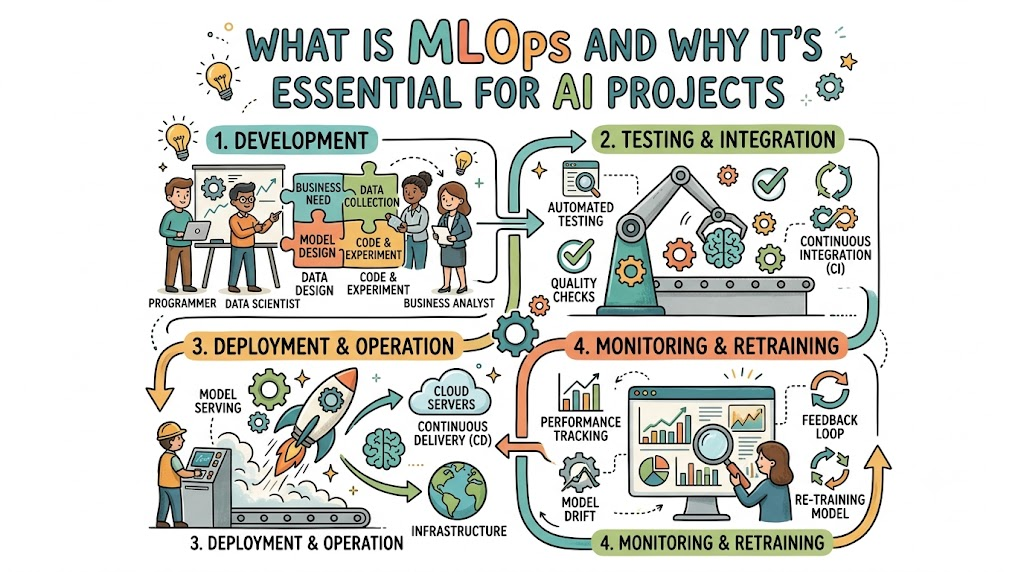
Step 1: Gathering and Cleaning the Data
Smart models eat data just like cars eat fuel. If you put dirty mud into a car tank, the engine stops. If you feed bad data to a computer, it gives silly answers.
First, engineers gather pictures, words, or numbers from safe sources. Next, they clean up the data. They erase duplicate files and fix typos.
Raw Data -> Remove Errors -> Organize Labels -> Clean Training Fuel
Also, teams save copies of their data sets. This step is called data versioning. It works like a video game save point. If something breaks, you can jump back to yesterday’s clean data.
Step 2: Training the Computer Brain
Once the data is clean, the computer starts training. The computer reads the examples over and over. It slowly figures out patterns.
This training step can take hours or even whole weeks. Powerful computers run day and night to finish the math.
MLOps tools track each training run. They write down which recipe worked best.
Coders can look at simple charts to see the winner. Then, they pick the smartest model to share with users.
Step 3: Testing Before Launch
You would not fly in a plane that was never tested. You should not launch a smart computer tool without testing it, either!
Good teams set up robot tests that run on their own. These tests check if the model is fast. They also check if the model makes fair choices.
If the model makes silly guesses, the tests fail automatically. The computer stops the launch before any user gets hurt.
Automated safety gates protect everyone. They keep bad updates away from real people.
Step 4: Serving Answers to the World
Once a model passes its tests, it goes live. This step is called deployment or model serving.
Now, the model lives on big web servers. When a user asks a question on their phone, the phone sends the question to the server.
The server runs the model, gets the answer, and sends it back fast. This whole round trip must happen in less than a second.
MLOps makes sure the servers grow when lots of people show up. If a million people log on, the system spins up more computers automatically.
The Mystery of Model Drift
Here is a big secret: smart models get worse over time! This problem is called model drift.
The real world changes every day. People invent new slang words. Fashion trends shift. Weather patterns change.
If your model only knows last year’s world, it starts making bad guesses today. It does not break like a normal app. Instead, it quietly becomes useless.
Old Knowledge -> World Changes -> Bad Predictions (Model Drift!)
MLOps watches for model drift all day long. When the scores drop, the system rings an alarm bell for the team.
Continuous Training: Teaching New Tricks
How do you fix a drifting model? You teach it new facts!
With a strong setup, you do not have to train the model by hand. The system retrains itself on a schedule.
Every night, the pipeline grabs fresh, clean data from the day. It trains a new version of the model while you sleep.
Next, it compares the new model against the old one. If the new one scores higher, it takes over the job.
This loop is called Continuous Training. It keeps your AI fresh, sharp, and helpful forever.
Saving Money and Cutting Waste
Running massive computers costs a lot of money. If you leave large servers on all night, you waste cash.
MLOps tools turn off big servers the moment training finishes. They only buy the computing power you actually need right now.
Also, teams stop wasting human time. Coders do not have to spend hours copying files by hand.
Instead, automated scripts do the boring chores. That lets humans spend their time solving fun, creative problems.
Better Teamwork and Less Blame
In old companies, data scientists worked alone in a dark room. They threw their finished models over a wall to the server team.
When the model crashed, the server team blamed the data team. Then, the data team blamed the server team. Nobody was happy!
MLOps breaks down that wall. Everyone uses the same dashboards and watches the same metrics.
When an error pops up, the whole team can see the cause instantly. Teams solve problems together with zero finger-pointing.
Keeping Things Fair, Safe, and Legal
Smart models help decide important things today. They help banks approve loans. They help doctors spot sickness in scans.
Because the stakes are high, rules must be followed. Teams must prove that their tools do not cheat or treat people unfairly.
MLOps keeps a clear diary of every single step. It remembers which person trained the model. It remembers which data was used.
If a government inspector asks questions, the team has the answers ready. Everything is open, clear, and honest.
Common Tools You Might Hear About
Engineers use handy software tools to build these pipelines. Here are four popular tools you might hear people mention:
- Kubeflow: Runs smart pipelines inside neat little software boxes called containers.
- MLflow: Acts like a scientist notebook to log scores, tests, and code versions.
- DVC: Works like a giant save button for massive piles of training data.
- Evidently AI: Watches live models to spot drift and send warnings fast.
You do not need to memorize these names today. Just know that they work like power tools in a carpenter’s workshop.
A Simple Checklist for Your AI Journey
Starting your first smart project can feel scary. But you can make it easy by taking small steps:
- Start with clean data: Make sure your examples are true, neat, and organized.
- Track your tests: Write down your scores so you know which model is best.
- Automate your checks: Let computers run the boring safety tests for you.
- Watch your live models: Keep an eye on your tools so they do not drift away.
- Talk to your team: Share your work early and listen to other teammates.
Taking these five steps will keep your projects on track from day one.
The Bright Future of Smart Systems
Artificial intelligence is changing how people learn, work, and play. We see smart tools in video games, cars, and schools.
Building a cool computer demo is fun. But keeping that demo working for millions of happy users is the real prize.
That is why companies care so much about operations today. Without good pipelines, even the smartest computer brain forgets how to work.
MLOps turns wild AI experiments into reliable tools that we can trust every day. It gives smart systems the structure, care, and fuel they need to shine.