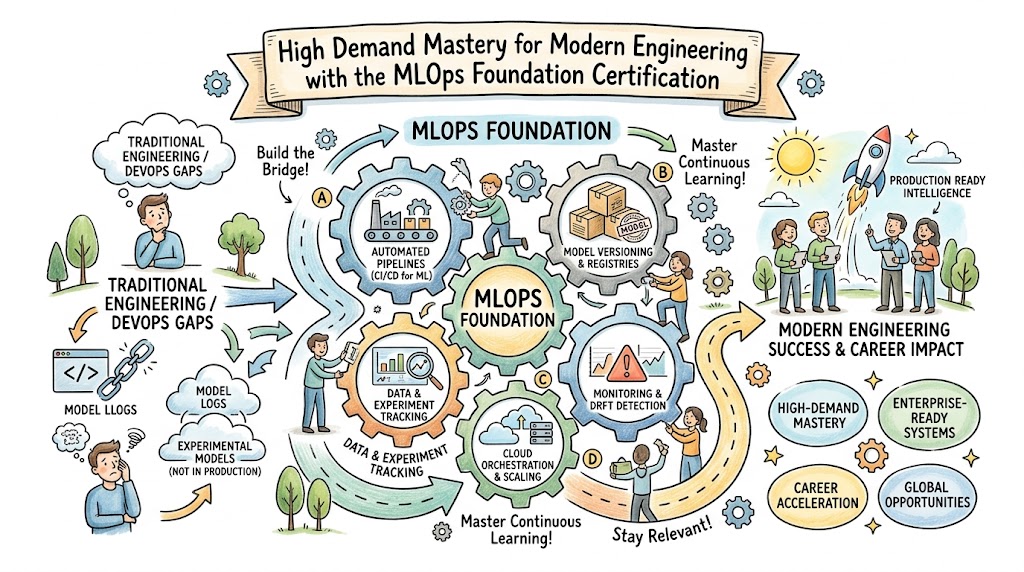
Engineers find themselves at a crossroads as organizations move beyond simple AI experimentation toward full-scale production intelligence. The MLOps Foundation Certification builds a bridge between traditional software development and the complex world of machine learning operations. This guide clarifies the certification path for DevOps professionals, SREs, and platform engineers who want to automate model deployment effectively. Professionals can leverage this roadmap at AIOpsSchool to accelerate their careers and master the art of model lifecycles.
Defining the MLOps Foundation Certification
The MLOps Foundation Certification establishes a rigorous standard for engineers who must maintain machine learning models in live environments. It prioritizes practical, production-focused skills over abstract theoretical concepts to ensure systems remain resilient and scalable. This program reflects the needs of modern enterprises by integrating model management into standard engineering workflows. By earning this credential, you prove your ability to build automated systems that handle data and models with the same discipline as code.
Who Benefits from MLOps Foundation Certification?
Cloud engineers, SREs, and data professionals find immense value in this certification as they transition into AI infrastructure management. Managers also use this framework to understand the technical requirements of deploying data-heavy applications. The curriculum serves both beginners looking for a structured entry point and veterans aiming to specialize in AI operations. Engineers across India and the global tech market gain a competitive edge by mastering these high-demand skills.
The Lasting Value of MLOps Foundation Certification
Organizations increasingly prioritize automated intelligence, which fuels a massive demand for skilled MLOps practitioners. This certification ensures career longevity by teaching core principles that remain relevant even as specific software tools change. Professionals see a significant return on investment because they become essential assets in data-driven digital transformations. Mastering the model lifecycle allows you to remain indispensable in a rapidly shifting technical landscape.
MLOps Foundation Certification Overview
The program utilizes the official course platform and resides on the AIOpsSchool portal for global access. It moves away from passive learning by requiring students to demonstrate competency through practical, real-world assessments. The structure mimics the daily responsibilities of a principal engineer, focusing on automation, security, and system reliability. Professionals who complete this program gain the technical authority to lead MLOps initiatives within their organizations.
MLOps Foundation Certification Tracks & Levels
The certification offers foundation, professional, and advanced tiers to support continuous career progression. Each level introduces higher complexity, moving from basic pipeline automation to advanced multi-cloud architecture. Specialization tracks allow you to focus on specific areas like SRE-based monitoring or DevSecOps security protocols. This logical progression ensures your credentials grow alongside your professional responsibilities.
Complete MLOps Foundation Certification Table
| Track | Level | Who it’s for | Prerequisites | Skills Covered | Recommended Order |
| Core Ops | Foundation | Aspiring Engineers | Linux/Python Basics | Versioning, CI/CD | First |
| Engineering | Professional | Senior DevOps/SRE | Foundation Level | Orchestration, Scale | Second |
| Architecture | Advanced | Tech Leads | Professional Level | Governance, Design | Third |
| Security | Specialist | Security Pros | Cloud Security | Data Privacy, Audits | Optional |
Detailed Guide for Each MLOps Foundation Certification
MLOps Foundation Certification – Foundation Level
What it is
This level confirms your grasp of the machine learning lifecycle and your ability to automate transitions from development to production. It serves as the baseline for all advanced operational AI tasks.
Who should take it
System administrators, junior developers, and data analysts who want to pivot toward the engineering side of AI find this ideal. You only need basic coding and ops knowledge to start.
Skills you’ll gain
- Building automated training pipelines
- Managing data and experiment versioning
- Implementing containerization for models
- Monitoring prediction endpoint health
Real-world projects you should be able to do
- Construct a Jenkins job that triggers model retraining
- Manage a shared DVC repository for data science teams
- Wrap a Python model in Docker for cloud deployment
Preparation plan
- 7 Days: Learn the specific terminology and basic data-centric Git workflows.
- 30 Days: Build automated triggers and practice basic container orchestration.
- 60 Days: Complete a full end-to-end pipeline with automated testing.
Common mistakes
- Spending too much time on algorithm math instead of infrastructure.
- Neglecting data version control in favor of standard code versioning.
Best next certification after this
- Same-track option: MLOps Professional Certification.
- Cross-track option: Kubernetes Administrator (CKA).
- Leadership option: Technical Product Management.
Choose Your Learning Path
DevOps Path
Engineers on this path focus on merging machine learning into existing CI/CD pipelines. You learn to treat models as standard software artifacts that require rigorous automated testing. This track bridges the gap between data science notebooks and stable production environments. Professionals master the deployment strategies necessary for seamless model updates.
DevSecOps Path
This track emphasizes the security of the data supply chain and the integrity of the model itself. You implement vulnerability scanning and protect sensitive training data from unauthorized access. This path uses policy-as-code to ensure AI environments comply with strict regulatory standards. It is a critical requirement for finance and healthcare engineering teams.
SRE Path
The SRE track focuses on the reliability, observability, and latency of production models. You establish Service Level Objectives (SLOs) specifically for prediction accuracy and system performance. This path teaches you how to detect and remediate model drift before it impacts users. It suits those who enjoy maintaining high-availability, distributed systems.
AIOps Path
Professionals here use artificial intelligence to optimize and manage IT infrastructure. You apply machine learning models to logs and metrics to predict system failures before they occur. This specialization helps automate incident response and significantly reduces recovery times. It represents the “AI for Operations” side of modern engineering.
MLOps Path
The dedicated MLOps track dives deep into the specific engineering hurdles of the model lifecycle. You master feature stores, automated hyperparameter tuning, and comprehensive model registries. This path focuses on the unique intersection where data engineering meets software deployment. It prepares you for the specific role of an MLOps Engineer.
DataOps Path
DataOps practitioners ensure that high-quality data flows smoothly through training and inference pipelines. You automate data cleansing, validation, and transformation to prevent “garbage in, garbage out” scenarios. This path is essential for organizations that handle massive, real-time data streams. It guarantees the reliability of the “fuel” that powers AI models.
FinOps Path
Managing the massive costs associated with GPU clusters and cloud training is the primary goal here. You learn to monitor and optimize the financial resources spent on ML experimentation. This track provides visibility into which models generate value and which ones waste budget. Leadership teams highly value engineers who can control AI cloud spend.
Role → Recommended MLOps Foundation Certification
| Role | Recommended Certifications |
| DevOps Engineer | MLOps Foundation, Professional DevOps |
| SRE | MLOps Foundation, Site Reliability Level 1 |
| Platform Engineer | MLOps Foundation, Kubernetes Specialist |
| Cloud Engineer | MLOps Foundation, Cloud Architect |
| Security Engineer | MLOps Foundation, DevSecOps Expert |
| Data Engineer | MLOps Foundation, DataOps Specialist |
| FinOps Practitioner | MLOps Foundation, Cloud Economics |
| Engineering Manager | MLOps Foundation, IT Strategy |
Next Certifications to Take After MLOps Foundation Certification
Same Track Progression
Advancing to the Professional and Advanced tiers of MLOps allows for deeper technical specialization. These levels cover distributed training and edge deployment, which are critical for enterprise-scale platforms. Mastering this progression establishes you as a leading authority in the machine learning infrastructure space.
Cross-Track Expansion
Gaining expertise in Kubernetes or Cloud Architecture complements your MLOps knowledge. Since most AI services run on containerized platforms, certifications like CKA or CKAD prove invaluable. This broadens your technical versatility and allows you to contribute to a wider range of engineering projects.
Leadership & Management Track
Engineers moving into management roles should consider ITIL or PMP certifications to round out their skills. These credentials help you manage budgets and lead cross-functional teams toward strategic goals. You learn how to translate complex MLOps successes into clear business outcomes for stakeholders.
Training & Certification Support Providers for MLOps Foundation Certification
DevOpsSchool
This organization delivers deep-dive automation resources and instructor-led training for global students. Their practical labs simulate enterprise environments to ensure candidates gain real-world experience. They update their curriculum constantly to stay ahead of the latest DevOps and MLOps trends.
Cotocus
Known for specialized engineering consulting, this group helps professionals transition into high-level cloud roles. They create tailored roadmaps that focus on mastering niche technical skills. Their approach blends rigorous hands-on projects with the foundational theory required for long-term success.
Scmgalaxy
This platform serves as a massive community hub for tutorials, forums, and continuous learning materials. It provides excellent resources for staying current with the latest open-source MLOps tools. They emphasize collaborative problem-solving and community support for modern engineers.
BestDevOps
This provider focuses on teaching industry best practices within the DevOps and MLOps domains. Their high-impact courses help busy professionals prepare for certification exams with confidence. They offer a range of preparatory materials designed for maximum efficiency.
devsecopsschool.com
This site provides the primary authority on integrating security protocols into the automated pipeline. Their curriculum is vital for anyone handling sensitive data or working in highly regulated industries. They offer specialized modules on protecting model integrity and ensuring data privacy.
sreschool.com
Engineers who want to master system stability and observability should look to this specialized provider. Their training covers everything from advanced monitoring to error budget management for ML models. They represent the gold standard for learning the “Operations” portion of MLOps.
aiopsschool.com
This dedicated platform focuses exclusively on the intersection of artificial intelligence and IT operations. They deliver the core curriculum for the MLOps foundation path and guide students toward advanced mastery. Their instructors bring decades of industry experience into the classroom.
dataopsschool.com
This provider focuses on the data lifecycle automation necessary for successful machine learning. They teach engineers how to build high-quality data pipelines that prevent production failures. Their courses bridge the gap between pure data science and operational excellence.
finopsschool.com
As cloud costs skyrocket, this provider teaches engineers how to manage the economics of their platforms. They offer specific insights into optimizing the expensive resources required for AI training. This knowledge is essential for senior staff with budgetary oversight.
Frequently Asked Questions (General)
- How hard is the foundation level exam?
The exam requires a clear understanding of the ML lifecycle but remains accessible for anyone with basic engineering skills.
- What is the typical time frame for certification?
Most candidates pass the exam within a 30 to 60-day window of focused preparation.
- Do I need specific prerequisites to begin?
You should possess a basic knowledge of Python, Linux terminals, and core CI/CD concepts.
- Will this certification increase my salary?
Certified MLOps professionals typically access higher-paying roles because their specialized skills are in high demand.
- Is prior data science experience mandatory?
You do not need to be a data scientist, though understanding basic machine learning goals is helpful.
- Do employers worldwide recognize this credential?
Yes, the certification follows industry-standard practices that apply to major tech companies globally.
- How often should I refresh my certification?
Professionals should update their skills or advance to the next level every two years to stay current.
- Does the training include practical labs?
Yes, hands-on exercises form the core of the learning experience to ensure you can build real systems.
- Can I skip straight to professional levels?
Experienced engineers may attempt it, but the foundation level ensures you have no gaps in your core knowledge.
- Which tools will I learn during the course?
The curriculum covers essential tools like Git, Docker, and various ML orchestration frameworks used in the industry.
- Is there an alumni network for graduates?
Yes, you join a global network of professionals who share technical insights and job opportunities.
- How does this differ from standard DevOps?
This certification addresses unique challenges like data versioning and model retraining that standard DevOps does not cover.
FAQs on MLOps Foundation Certification
- Which lifecycle stages does the exam cover?
The test evaluates your knowledge of data ingestion, model training, validation, deployment, and monitoring.
- Do I need to know specific cloud providers?
The principles apply universally, but the course explains how to implement them on AWS, Azure, and Google Cloud.
- Does the exam require heavy math skills?
No, the certification focuses on the infrastructure and operations rather than the mathematical algorithms.
- Will I learn about Generative AI operations?
Yes, the foundational principles of MLOps apply directly to managing Large Language Models and other AI innovations.
- What score do I need to pass?
Candidates must achieve at least a 70% score to demonstrate their mastery of foundational MLOps concepts.
- Are the certification exams proctored?
Yes, secure proctoring ensures the integrity and professional value of the credential for all candidates.
- Can I complete all the training online?
The entire program remains available online to provide maximum flexibility for working professionals.
- Does the certification assist with job searches?
The credential carries significant weight with recruiters and provides access to specialized career resources.
Final Thoughts: Is MLOps Foundation Certification Worth It?
Investing in this certification represents a definitive commitment to your professional future in an AI-centric world. You gain more than just a title; you acquire the technical framework to solve the most pressing challenges in modern software deployment. This path transforms you from a generalist into a high-value specialist capable of leading the next generation of engineering projects.
The confidence you build through this program allows you to bridge the gap between data science and reliable operations. As enterprises continue to integrate AI into every facet of their business, the role of the MLOps engineer becomes increasingly central. Taking this step now ensures you lead that transition rather than following it.