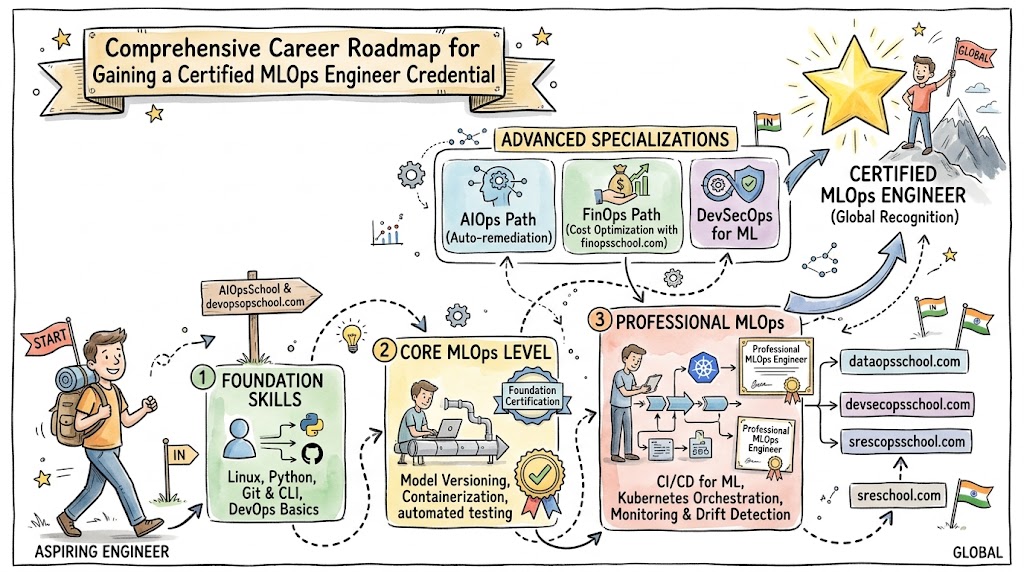
Modern engineering teams now recognize that Certified MLOps Engineer expertise serves as the backbone for sustainable artificial intelligence. This guide empowers software professionals to navigate the complex intersection of data science and systems reliability. By following this structured path, you will learn how to transform experimental models into resilient, production-ready services. Leveraging resources from AIOpsSchool allows you to stay ahead in a competitive global market while mastering the automation of machine learning lifecycles.
What is the Certified MLOps Engineer?
The Certified MLOps Engineer designation validates an engineer’s ability to manage the technical debt associated with machine learning. This program exists to move organizations beyond manual deployments and toward fully automated, self-healing pipelines. It emphasizes the practical application of GitOps, containerization, and monitoring within the context of model behavior. Professionals who hold this credential demonstrate a deep understanding of how to maintain high-performance AI systems in enterprise environments.
Who Should Pursue Certified MLOps Engineer?
Software engineers, SREs, and platform architects benefit most from this certification as they transition into AI-driven infrastructure roles. Data engineers who wish to standardize their delivery processes also find immense value in these modules. Technical leaders in India and around the world use this certification to bridge the gap between their data science and operations teams. Even beginners with a strong interest in automation can use this as a definitive roadmap for their early career development.
Why Certified MLOps Engineer is Valuable and Beyond
Organizations currently face a massive shortage of talent capable of operationalizing AI, making this certification a high-value asset for long-term career growth. It provides the skills necessary to ensure model longevity and reliability regardless of which specific tools a company uses. Professionals who master these workflows become indispensable as enterprises increase their investment in automated decision-making systems. This specialization guarantees a strong return on time by positioning you at the forefront of the next technological wave.
Certified MLOps Engineer Certification Overview
Candidates access the official program through the course link and complete their training on the AIOpsSchool platform. The curriculum uses a hands-on assessment model to verify that engineers can solve real-world architectural bottlenecks. Industry experts own and maintain the content to ensure it reflects current best practices in cloud-native engineering. The modular structure allows learners to focus on specific technical competencies before moving to more complex architectural designs.
Certified MLOps Engineer Certification Tracks & Levels
The program offers three distinct tiers: foundation, professional, and advanced levels to support continuous professional growth. Foundation tracks establish the basics of model versioning, while professional levels introduce complex CI/CD and monitoring strategies. Advanced tracks allow for deep specialization in high-scale infrastructure or financial optimization of AI workloads. This tiered progression ensures that your certification status grows alongside your professional responsibilities and technical expertise.
Complete Certified MLOps Engineer Certification Table
| Track | Level | Who it’s for | Prerequisites | Skills Covered | Recommended Order |
| Operations | Foundation | Junior DevOps/SRE | Python, CLI | Model Tracking, Docker | 1 |
| Engineering | Professional | Cloud Engineers | Kubernetes, ML | CD4ML, Drift Detection | 2 |
| Architecture | Advanced | Senior Architects | System Design | Scalable Clusters, GPUs | 3 |
| Analytics | Professional | Data Engineers | SQL, Pipelines | Feature Stores, Lineage | 2 |
| Governance | Advanced | Security Leads | Compliance | Model Auditing, RBAC | 3 |
Detailed Guide for Each Certified MLOps Engineer Certification
Certified MLOps Engineer – Foundation Level
What it is
This level confirms your ability to containerize machine learning models and manage basic version control for datasets. It serves as the gateway to understanding how operational requirements differ for AI-based software.
Who should take it
Entry-level DevOps engineers and data scientists seeking to improve their deployment workflows should start here. It provides the necessary baseline for anyone moving into a production-focused role.
Skills you’ll gain
- Building Docker images for ML models
- Managing data versions with DVC
- Automating basic testing scripts
- Understanding model registry concepts
Real-world projects you should be able to do
- Create a reproducible environment for a training script
- Setup a GitHub Action to validate model files
- Implement a basic model registry on a local server
Preparation plan
Spend the first 14 days mastering Docker and Git fundamentals. Use the 30-day mark to complete all foundation labs on the platform. By day 60, you should be able to explain the entire lifecycle to a peer.
Common mistakes
Many candidates fail to appreciate the importance of data versioning compared to code versioning. Others ignore the nuances of environment reproducibility, leading to failed deployments in later stages.
Best next certification after this
- Same-track option: Professional MLOps Engineer
- Cross-track option: Kubernetes Administrator (CKA)
- Leadership option: Team Lead for AI Infrastructure
Certified MLOps Engineer – Professional Level
What it is
The professional level validates your expertise in building end-to-end automated pipelines that handle model retraining and deployment. It focuses on the “Continuous Delivery for Machine Learning” philosophy.
Who should take it
Mid-career engineers responsible for maintaining production models should pursue this level. It targets those who need to manage the ongoing health and performance of live AI services.
Skills you’ll gain
- Orchestrating ML workloads on Kubernetes
- Designing automated retraining triggers
- Implementing real-time drift monitoring
- Managing high-performance Feature Stores
Real-world projects you should be able to do
- Build a pipeline that retrains a model when data drift occurs
- Setup a Prometheus and Grafana stack for model metrics
- Deploy a model using a progressive rollout strategy
Preparation plan
Focus on Kubernetes and Kubeflow for the first 14 days. Use 30 days to build a multi-stage deployment pipeline. By 60 days, you should master the integration of monitoring tools with automated alerting.
Common mistakes
Candidates often overlook the cost implications of automated retraining. Another frequent error involves setting overly sensitive alerts that lead to “alert fatigue” within the operations team.
Best next certification after this
- Same-track option: Advanced MLOps Architect
- Cross-track option: SRE Certified Professional
- Leadership option: MLOps Engineering Manager
Choose Your Learning Path
DevOps Path
This path concentrates on the integration of ML assets into traditional software delivery cycles. You will learn how to treat models as first-class citizens within Jenkins or GitLab environments. It bridges the gap between standard development and data science experimentation.
DevSecOps Path
Security-minded engineers use this track to protect the model supply chain and ensure data privacy. It teaches you how to implement scanning for model weights and secure the APIs that serve predictions. This is critical for engineers working in highly regulated industries.
SRE Path
The SRE track focuses on the reliability, latency, and throughput of machine learning services. You will master the art of scaling GPU clusters and managing the performance of real-time inference engines. This path ensures your AI products meet strict Service Level Objectives.
AIOps Path
Engineers in this track use machine learning to automate the management of IT infrastructure. You will build systems that predict outages and automatically resolve configuration drifts. It represents the pinnacle of automated systems management for cloud environments.
MLOps Path
This core path covers the entire lifecycle from data preparation to model retirement. You will learn the specific patterns required to manage technical debt in ML systems. It remains the most popular and direct route for specialized engineering roles.
DataOps Path
DataOps focuses on the quality, speed, and reliability of the data feeding your models. You will learn to build resilient data lakes and feature stores that provide a steady stream of high-quality inputs. This path provides the essential foundation for any successful ML strategy.
FinOps Path
This track addresses the economic challenges of running large-scale AI workloads in the cloud. You will learn strategies to optimize compute costs and manage the high price of model training. It is an essential skill for senior leaders managing infrastructure budgets.
Role → Recommended Certified MLOps Engineer Certifications
| Role | Recommended Certifications |
| DevOps Engineer | MLOps Foundation + Professional Track |
| SRE | Professional Track + SRE Specialization |
| Platform Engineer | Advanced Infrastructure for ML |
| Cloud Engineer | Professional Level Cloud-Native MLOps |
| Security Engineer | DevSecOps for Machine Learning |
| Data Engineer | DataOps + Core MLOps Foundation |
| FinOps Practitioner | FinOps for AI + Infrastructure Track |
| Engineering Manager | MLOps Strategy and Leadership |
Next Certifications to Take After Certified MLOps Engineer
Same Track Progression
Deepen your existing expertise by pursuing specialized architectural credentials that focus on edge computing or massive-scale distributed training. These certifications prove you can handle the most demanding hardware-software challenges in the industry. Moving toward a principal architect role requires this level of deep technical commitment.
Cross-Track Expansion
Broaden your marketability by exploring certifications in Site Reliability Engineering or Cybersecurity. Understanding how machine learning fits into the larger enterprise ecosystem makes you a much more versatile hire. This expansion allows you to oversee the entire production lifecycle rather than just the model deployment.
Leadership & Management Track
Prepare for a move into senior leadership by focusing on AI strategy and project management certifications. Leading a specialized engineering team requires a balance of technical foresight and business acumen. This track helps you translate technical successes into measurable corporate growth and team development.
Training & Certification Support Providers for Certified MLOps Engineer
DevOpsSchool
This provider delivers high-impact training focused on the tools that drive modern automation. They emphasize hands-on labs where students build actual pipelines using Jenkins and Terraform. Their instructors bring real-world production experience into every session.
Cotocus
Engineers seeking deep technical dives into cloud-native architectures often choose this provider. They specialize in container orchestration and advanced infrastructure as code strategies. Their curriculum meets the needs of high-scale enterprise engineering teams.
Scmgalaxy
This platform offers a massive repository of resources and community-driven insights into configuration management. They provide excellent documentation and tutorials for mastering the various versioning tools used in MLOps. It serves as a vital knowledge hub for active learners.
BestDevOps
This organization provides mentorship-led programs that focus specifically on career outcomes and job readiness. They align their training with the current hiring trends found in the global tech market. Students receive guidance on how to apply their skills in professional interviews.
devsecopsschool.com
This site focuses exclusively on the intersection of security and the DevOps pipeline. They offer specialized training on how to secure machine learning models and protect sensitive data. It is the premier resource for engineers specializing in secure AI.
sreschool.com
This provider focuses on the principles that keep massive systems running reliably. They teach observability, performance tuning, and incident response specifically for cloud environments. Their courses help engineers meet demanding service level agreements for AI products.
aiopsschool.com
As a leader in AI operations, this platform provides the most advanced technical tracks for MLOps specialization. They focus on the cutting edge of automation and model governance. The training ensures you stay current with the latest industry standards.
dataopsschool.com
This school addresses the critical need for data quality and pipeline reliability. They teach the engineering practices required to manage large-scale data flows for machine learning. It is the go-to resource for aspiring DataOps professionals.
finopsschool.com
Engineers use this site to master the financial aspects of cloud computing and AI infrastructure. They provide the frameworks needed to track, manage, and reduce the high costs of model training. It is vital for anyone managing significant cloud budgets.
Frequently Asked Questions
- How hard is the final exam for the Certified MLOps Engineer?
The exam presents a significant challenge because it tests practical deployment skills rather than just theory. You must demonstrate your ability to solve architectural problems in a timed, proctored environment. - What is the typical timeframe for completing the training?
Most students complete the core requirements within 30 to 60 days of focused study. Your prior experience with Linux and Python will heavily influence how quickly you progress. - Does the program require previous machine learning experience?
You do not need a degree in data science, but you should understand the basic ML lifecycle. The program focuses on the engineering aspects of model delivery rather than algorithm development. - Will this certification help me find a job in India?
Yes, the demand for MLOps talent in India’s growing tech sector is exceptionally high. Major global firms and local startups actively seek engineers with verified operational skills. - Is it better to take the foundation or professional track first?
We recommend starting with the foundation track to ensure you have no gaps in your basic automation skills. This builds a solid base for the more complex professional-level labs. - Are the labs performed in a real cloud environment?
The training includes access to live lab environments where you build and deploy models on actual clusters. This hands-on experience is a core requirement for passing the assessment. - How often should I renew my MLOps certification?
Technical skills in this field evolve quickly, so we suggest a renewal every two years. This keeps your profile aligned with the latest versions of tools and industry standards. - Can I access the training materials after I pass the exam?
Most providers grant ongoing access to their resource libraries and community forums for a set period. This allows you to stay updated on new developments within the MLOps ecosystem. - Does the exam focus on a specific cloud provider?
The certification focuses on cloud-agnostic tools like Kubernetes and MLflow to ensure your skills are portable. This makes you valuable to any company regardless of their specific cloud vendor. - How does this certification differ from a standard DevOps cert?
It specifically addresses the unique challenges of machine learning, such as data drift and model retraining. Traditional DevOps certifications do not cover the data-centric workflows required for AI. - Is there a community forum for students to discuss labs?
Yes, the program includes access to active community forums where you can collaborate with other students. This peer-to-peer support is invaluable for solving complex lab scenarios. - What kind of certificate do I receive upon completion?
You receive a verifiable digital credential that you can share on professional networks like LinkedIn. This serves as a permanent record of your technical mastery in the field.
FAQs on Certified MLOps Engineer
- Which specific programming languages should I master before starting?
Python serves as the primary language for almost all labs and industry tools in this track. You should feel comfortable writing scripts and managing dependencies within a Python environment. While other languages exist, the MLOps ecosystem centers around the Python data science stack.
- How does the assessment process verify my practical skills?
The assessment uses a combination of multiple-choice questions and live environment tasks. You must successfully deploy and monitor a model within a sandbox environment to earn the professional credential. This ensures that every certified engineer can perform the actual duties of the role.
- Can I move directly into an MLOps role after earning this certification?
Many graduates successfully transition into specialized roles immediately after certification. The program provides the portfolio of work and the technical vocabulary needed to excel in technical interviews. It acts as a bridge for those with general engineering backgrounds.
- Does the program cover cost optimization for large GPU clusters?
Yes, the advanced and FinOps tracks specifically address the management of high-cost compute resources. You will learn how to schedule training jobs efficiently and use spot instances to reduce overall infrastructure spending. This is a critical skill for enterprise-level operations.
- What is the difference between AIOps and MLOps in this curriculum?
MLOps focuses on the delivery and maintenance of machine learning models for business applications. AIOps involves using machine learning to improve the reliability and automation of the IT infrastructure itself. Both tracks are available but serve different professional goals.
- Are there any requirements for continuing education after certification?
While not strictly required, staying active in the community and completing advanced modules is highly encouraged. The field changes so rapidly that continuous learning is the only way to maintain your status as a senior professional.
- How do I verify the authenticity of a Certified MLOps Engineer badge?
Every badge includes a unique ID and a verification link hosted on the AIOpsSchool platform. Employers can use this link to confirm that a candidate has met all the necessary requirements for the credential.
- Does the training cover how to manage sensitive data and privacy?
The DevSecOps track focuses heavily on data governance and regulatory compliance. You will learn how to build pipelines that respect user privacy while still providing the data needed for model training.
Final Thoughts: Is Certified MLOps Engineer Worth It?
Securing a Certified MLOps Engineer credential stands as a transformative step for any modern software professional. The industry no longer rewards generalists who lack the ability to handle the data-heavy demands of modern applications. By mastering these specialized workflows, you separate yourself from the crowd and prove your readiness for the future of engineering. This program provides the exact technical rigor required to lead high-stakes AI projects in any enterprise setting.
Focusing on the operational side of machine learning ensures your skills remain relevant even as specific AI models change. Tools come and go, but the need for reliable, automated pipelines remains constant. This certification gives you the mental framework and the hands-on experience to build those systems from the ground up. Take the first step today and join the elite group of engineers who are defining the next generation of cloud-native infrastructure.