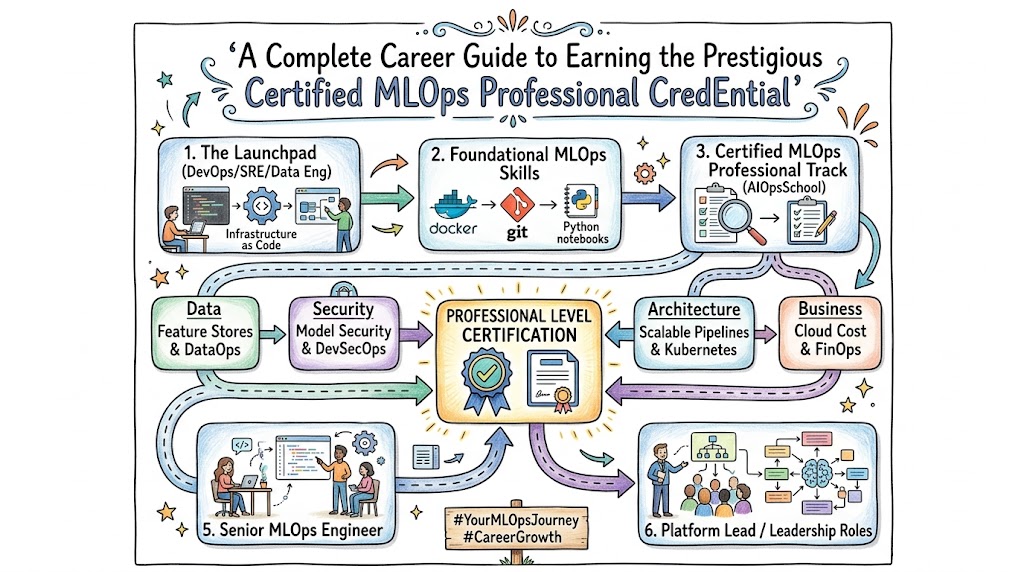
Platform teams often struggle to move experimental AI projects into stable, high-performance production settings. The Certified MLOps Professional program bridges this gap by validating the skills needed to automate and manage complex machine learning lifecycles. This comprehensive guide serves engineers and managers who want to transition from manual workflows to robust, cloud-native pipelines. By mastering these principles through AIOpsSchool, you ensure your infrastructure remains resilient while supporting the next generation of intelligent software.
Understanding the Certified MLOps Professional Framework
The Certified MLOps Professional designation represents a technical standard for engineers who specialize in the operational side of artificial intelligence. It exists because standard software deployment methods fail to address the unique challenges of data drift and model decay. This program prioritizes a production-first mindset, teaching you how to build observable and reproducible systems. Organizations increasingly rely on these frameworks to maintain governance and security within their machine learning initiatives. You learn to integrate models into standard CI/CD workflows, treating them as essential infrastructure components.
Targeted Candidates for This Career Path
Cloud architects, SREs, and data engineers gain the most from this specialized training. Experienced developers use this certification to pivot into high-demand AI roles, while junior engineers build a strong foundation in modern automation. Engineering managers also benefit by acquiring the technical vocabulary necessary to lead cross-functional data science teams. This credential holds immense value in global tech hubs, including the rapidly expanding engineering sectors across India. Anyone tasked with scaling AI workloads will find these skills essential for their daily operations.
Future-Proofing Your Career with MLOps
Enterprises now demand operationalized AI, creating a massive shortage of qualified engineers who understand the full model lifecycle. This certification offers long-term career stability because it emphasizes core principles over temporary toolsets. You stay relevant by mastering the framework for managing any model across various cloud providers. Furthermore, the return on investment remains high as companies seek to optimize their expensive GPU and TPU resources. Mastering these workflows makes you a vital asset to any organization building intelligent, data-driven applications.
Program Delivery and Structure
The official provider delivers this curriculum through a specialized course portal and hosts it on their primary website. Candidates face a rigorous assessment process that tests real-time troubleshooting and architectural design skills. The structure demands that you take ownership of the entire pipeline, from initial data ingestion to continuous monitoring. Instead of simple memorization, the program evaluates whether you can maintain a live, evolving system. This practical focus ensures that every certified professional can handle the pressure of a senior-level production environment.
Progression of Skills and Certification Levels
The program follows a logical progression through foundation, professional, and advanced levels to mirror a natural career arc. The foundation level covers basic containerization and CI/CD, while the professional track dives into complex orchestration and automated retraining. Advanced candidates focus on high-level architectural patterns and enterprise-scale security. These tiers allow you to specialize in niches like AI-focused FinOps or specialized SRE workflows. This cumulative learning approach ensures your skills grow alongside your professional responsibilities.
Certified MLOps Professional Comparison Table
| Track | Level | Ideal Candidate | Requirements | Primary Skills | Order |
| Core Systems | Foundation | Junior DevOps Engineers | Linux & Python | GitOps, CI/CD | 1 |
| Engineering | Professional | Senior SREs | Foundation Cert | Drift Detection | 2 |
| Architecture | Advanced | Solutions Architects | Professional Cert | Scaling, IaC | 3 |
| Security | Specialist | DevSecOps Leads | MLOps Core | Model Guardrails | 4 |
| Financial | Specialist | FinOps Leads | Cloud Billing | GPU Optimization | 5 |
Detailed Certification Guide
Certified MLOps Professional – Foundation Level
What it is
This level confirms your ability to integrate basic machine learning tasks into automated delivery pipelines. It proves you can navigate the essential tools required for collaborative AI development.
Who should take it
Aspiring DevOps engineers and recent graduates should start here to understand the intersection of data and operations.
Skills you’ll gain
- Containerizing applications with Docker
- Basic CI/CD for ML models
- Managing data versions
- Scripting with Python
Real-world projects you should be able to do
- Build a Docker image for an inference API
- Create a GitHub Actions pipeline for testing
- Implement basic data version control
Preparation plan
Focus on CLI basics and core definitions during the first 14 days. Spend 30 days building small local pipelines, and use a 60-day window to complete three end-to-end projects.
Common mistakes
Candidates often ignore data versioning or focus too much on model math rather than infrastructure stability.
Best next certification after this
- Same-track: Professional Level MLOps
- Cross-track: Cloud Architecture
- Leadership: Project Management
Certified MLOps Professional – Professional Level
What it is
This certification validates your expertise in designing and maintaining complex AI pipelines within production-grade cloud environments.
Who should take it
Senior DevOps engineers with at least two years of experience should pursue this to lead organizational AI initiatives.
Skills you’ll gain
- Kubernetes orchestration
- Advanced model monitoring
- Continuous Training (CT)
- Feature store management
Real-world projects you should be able to do
- Manage a multi-node cluster for model serving
- Set up automated drift alerts
- Design a full CT pipeline
Preparation plan
Dedicate 14 days to mastering orchestration tools. Use 30 days to build a Kubernetes home lab, and spend 60 days optimizing a live deployment.
Common mistakes
Over-engineering pipelines or failing to secure environment variables often leads to exam failure.
Best next certification after this
- Same-track: Advanced Level MLOps
- Cross-track: CKA (Kubernetes)
- Leadership: Engineering Management
Selecting Your Learning Specialization
DevOps Path
Engineers on this path apply traditional CI/CD rigor to machine learning artifacts. You learn to treat datasets and model weights as code, ensuring they undergo strict testing before reaching users. This specialization suits those who want to guarantee the reliability of AI-driven features. You also master Infrastructure as Code to provide reproducible environments for data science teams.
DevSecOps Path
The DevSecOps track prioritizes the integrity of the machine learning supply chain. You implement automated scanning for vulnerabilities and protect against data poisoning or unauthorized model access. This path is essential for engineers working in highly regulated fields like banking or healthcare. You ensure that innovation never compromises the security or privacy of the underlying data.
SRE Path
Reliability engineers focus on maintaining high availability for inference services through SLOs and error budgets. You learn to manage the scaling challenges unique to GPU-accelerated workloads while implementing deep observability. This path bridges the gap between infrastructure stability and the volatility of live AI models. It ensures that traffic spikes never crash your intelligent services.
AIOps Path
This path teaches you how to use machine learning to optimize traditional IT operations. You build systems that predict outages and automate incident responses across the entire infrastructure stack. This meta-approach uses AI to manage the very servers that host it. Professionals in this track become experts at finding patterns in massive streams of log data.
MLOps Path
The MLOps path represents the core journey of delivering models from research labs to end consumers. You cover every stage of the process, including feature engineering, deployment, and continuous retraining. This track appeals to those who want to sit at the center of the AI revolution. You balance the creative needs of data scientists with the rigid constraints of production operations.
DataOps Path
DataOps specialists focus on the quality and reliability of the data feeding the AI engine. You build automated testing for data pipelines and manage complex warehouses to ensure data lineage remains clear. Without strong DataOps, even the best MLOps strategy will fail. You ensure that the “fuel” for your models remains clean and consistent.
FinOps Path
The FinOps track addresses the massive costs associated with modern AI infrastructure. You learn to monitor cloud spend in real-time and optimize the use of expensive compute resources. This path is vital for keeping AI projects financially sustainable within an enterprise. You reconcile high-performance engineering needs with strict budgetary accountability.
Career Mapping: Roles and Certifications
| Professional Role | Recommended Certification Path |
| DevOps Engineer | Foundation + Professional MLOps |
| SRE | Professional MLOps + SRE Specialist |
| Platform Engineer | Advanced MLOps + Infrastructure |
| Cloud Engineer | Foundation + Cloud Architecture |
| Security Engineer | MLOps Security + DevSecOps |
| Data Engineer | DataOps + Foundation MLOps |
| FinOps Practitioner | FinOps for AI + Professional |
| Engineering Manager | Foundation + Leadership Track |
Continuing Your Education
Same Track Progression
Deepen your technical expertise by pursuing advanced architectural certifications after finishing the MLOps track. These credentials focus on high-performance computing and the distributed systems required for training large-scale models. Remaining a specialist ensures you stay at the forefront of infrastructure problem-solving.
Cross-Track Expansion
Broaden your marketability by exploring the security or data engineering domains. Adding a certification in data privacy makes you a versatile asset for global companies handling sensitive user information. This expansion allows you to lead cross-departmental projects with a holistic view of the technology stack.
Leadership & Management Track
Transition into management by focusing on agile methodologies and organizational strategy. Learn to translate complex technical metrics into business value for executive stakeholders. This path prepares you to lead teams and set the long-term vision for technical departments.
Training & Certification Support Providers
DevOpsSchool
This organization provides extensive training modules focused on the practical application of automation tools. Their curriculum stays current with the latest trends in the DevOps and CI/CD landscape.
Cotocus
Specializing in cloud-native technologies, this provider offers deep dives into orchestration and containerization. Their instructors bring years of industry experience to every training session.
Scmgalaxy
This community-focused platform offers a wide range of resources for configuration management and supply chain security. Their tutorials help engineers master open-source tools within the MLOps ecosystem.
BestDevOps
This provider designs career-oriented programs that help engineers secure high-paying roles in the cloud industry. They offer a structured path from entry-level basics to advanced engineering.
devsecopsschool.com
This site leads the way in teaching engineers how to bake security into their deployment pipelines. They offer specialized courses on compliance as code and automated vulnerability scanning.
sreschool.com
Reliability experts turn to this provider for training on incident management and service level objectives. Their curriculum provides the technical depth needed to manage massive, high-availability systems.
aiopsschool.com
This platform focuses exclusively on the intersection of AI and operations. They provide the most comprehensive training for engineers looking to master MLOps and AIOps.
dataopsschool.com
Data professionals use this site to learn about building resilient pipelines and ensuring high data quality. Their courses are vital for anyone supporting large-scale machine learning models.
finopsschool.com
This provider bridges the gap between engineering and finance by teaching cloud cost optimization. They help teams scale their AI infrastructure without exceeding their budgets.
Frequently Asked Questions
- How hard is the Certified MLOps Professional exam?
The exam presents a moderate challenge because it tests both operational skills and machine learning concepts. You must demonstrate practical ability in a lab environment. - Which prerequisites should I complete first?
You need basic knowledge of Python and Linux. We strongly recommend earning the foundation certification before attempting the professional level. - What is the typical preparation time?
Most candidates spend 30 to 60 days studying. This timeframe allows you to balance theoretical reading with hands-on practice. - Will this certification increase my salary?
Yes, MLOps specialists currently command some of the highest salaries in the tech industry due to their rare skill set. - Do I need a DevOps background to succeed?
While not mandatory, understanding DevOps makes the MLOps journey much easier since the two fields share many core principles. - Does the exam involve coding?
Yes, you will likely need to write scripts and configuration files during the practical portions of the exam. - Is the curriculum tied to one cloud provider?
No, the program focuses on cloud-agnostic principles that you can apply to AWS, Azure, or Google Cloud. - When do I need to renew the certification?
You should plan to recertify every two to three years to stay updated with the latest AI technologies. - Can managers take this course?
Engineering managers find the foundation level incredibly helpful for managing technical roadmaps and hiring the right talent. - Where is this credential recognized?
Major tech companies across the globe, including those in India and the US, recognize this as a valid measure of engineering skill. - Are study groups available?
Most providers host Slack or Discord communities where you can ask questions and study with peers. - What is the first step I should take?
Start with a foundation-level course and build a simple local pipeline to get comfortable with the workflow.
Specific FAQs on Certified MLOps Professional
- Which tools will I learn to use?
You will gain hands-on experience with Kubernetes, Docker, Kubeflow, and various CI/CD and monitoring platforms. - How does this differ from a data science degree?
Data science focuses on building models; this certification focuses on the infrastructure and automation required to run them reliably. - Is the exam available remotely?
Yes, you can take proctored exams online from your home or office. - Does the course cover cloud costs?
Yes, the professional and advanced levels include specific modules on optimizing GPU and compute spending. - Do I need a math degree?
No, you only need to understand the high-level logic of how models function within a system. - What happens if I fail the exam?
Most providers offer retake options and provide feedback on which areas you need to improve. - Is there corporate training for teams?
Yes, many organizations offer bulk training packages for entire engineering departments. - Can I skip the foundation level?
You can, but we advise against it unless you already have significant professional experience in MLOps.
Final Thoughts: Is Certified MLOps Professional Worth It?
Selecting a specialization requires a serious commitment of your time and resources. The industry is rapidly shifting toward AI-driven products, making the ability to manage these systems a critical skill for the future. This program offers a clear, structured path to transform from a generalist into a high-value specialist. It focuses on the practical techniques that keep production environments running smoothly and efficiently. If you want to future-proof your career in the cloud era, this certification provides the most direct route to success.