Introduction
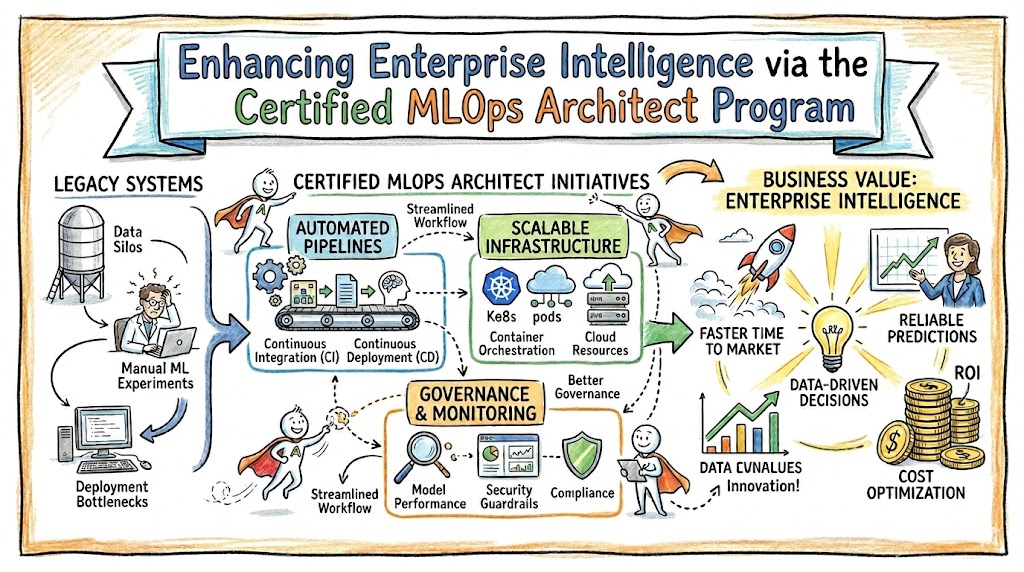
Modern engineering teams now prioritize professionals who seamlessly bridge the gap between machine learning development and operational reliability. This comprehensive guide breaks down the Certified MLOps Architect program, a vital credential for anyone mastering AIOpsSchool methodologies. As global enterprises move away from experimental AI toward scalable production systems, architects need structured knowledge to manage complex cloud-native environments. This article assists engineers in determining how this specific certification path fuels long-term career growth and technical authority.
What is the Certified MLOps Architect?
The Certified MLOps Architect designation validates a practitioner’s ability to govern the entire machine learning lifecycle within modern cloud ecosystems. It creates a standard for integrating continuous delivery and deployment specifically for data-heavy workloads. Unlike programs that focus on theory, this certification prioritizes the construction of resilient pipelines that manage data versioning and automated retraining. It mirrors current engineering trends by integrating model code, infrastructure, and data into a single, unified production workflow.
Who Should Pursue Certified MLOps Architect?
DevOps engineers, SREs, and platform architects who support data science teams gain the most from this specialized track. Data specialists who want to automate their daily tasks and developers migrating toward AI infrastructure will find the curriculum indispensable. Engineering leaders also benefit from the high-level overview of how MLOps acceleration shortens the time-to-market for AI-driven products. Professionals across India and the global tech sector use these skills to solve universal challenges in enterprise automation.
Why Certified MLOps Architect is Valuable Beyond Today
Organizations desperately need experts who can move models out of laboratory settings and into live environments. This certification offers career longevity because it emphasizes fundamental architectural patterns rather than fleeting software versions. As the enterprise world adopts artificial intelligence at scale, the management of model drift and cloud costs becomes a permanent requirement. Choosing this path ensures an engineer remains a critical asset even as the underlying technology stack evolves.
Certified MLOps Architect Certification Overview
Candidates access the program through the official platform, which provides a consistent and high-quality learning experience. The assessment strategy uses multiple levels to test both theoretical grasp and hands-on laboratory implementation. The structure guides learners from basic automation concepts to the design of complex, distributed systems. Earning this credential signals that an engineer possesses the technical depth to lead an organization’s MLOps transition.
Certified MLOps Architect Certification Tracks & Levels
The certification features foundation, professional, and advanced tiers to match various stages of a technical career. The foundation level provides the essential vocabulary and pipeline concepts for those entering the field. Professional and advanced levels offer specialized training in areas like high-scale orchestration and security compliance. These levels allow practitioners to build a modular skill set that expands as they accept greater organizational responsibilities.
Complete Certified MLOps Architect Certification Table
| Track | Level | Who it’s for | Prerequisites | Skills Covered | Recommended Order |
| Core | Associate | Junior Devs/Managers | Python Basics | ML Basics, Docker | 1 |
| Operations | Professional | SREs/DevOps | Cloud Fundamentals | CI/CD, Monitoring | 2 |
| Data Ops | Professional | Data Engineers | SQL/Data Pipelines | Feature Stores, ETL | 2 |
| Security | Advanced | Security Engineers | Professional Level | Compliance, Auditing | 3 |
| Enterprise | Expert | Principal Architects | Senior Experience | System Design, Drift | 4 |
Detailed Guide for Each Certified MLOps Architect Certification
Certified MLOps Architect – Foundation
What it is This introductory credential confirms a learner’s understanding of how DevOps and Machine Learning intersect. It ensures that the candidate can distinguish between the requirements of data-driven code and traditional software.
Who should take it Entry-level developers or IT professionals looking to pivot into AI infrastructure find this the perfect starting point.
Skills you’ll gain
- Mastery of the ML Lifecycle stages
- Implementation of basic Data Versioning
- Construction of simple Automated Pipelines
- Deployment of basic Models
Real-world projects you should be able to do
- Configure a GitHub Actions pipeline for a simple ML model.
- Track data changes using open-source versioning tools.
Preparation plan
- 7–14 days: Memorize the official study guide and core terminology.
- 30 days: Execute basic automation labs focused on pipeline flow.
- 60 days: Study container basics and fundamental cloud service models.
Common mistakes
- Focusing entirely on code while neglecting the data layer.
- Skipping the study of basic Linux terminal operations.
Best next certification after this
- Same-track option: Certified MLOps Architect – Professional
- Cross-track option: Cloud Platform Associate
- Leadership option: Technical Team Lead Foundation
Certified MLOps Architect – Professional
What it is The professional level validates the ability to engineer end-to-end MLOps platforms from scratch. It prioritizes the creation of reliable systems that function under heavy production loads.
Who should take it Mid-level DevOps engineers and SREs who manage live workloads on a daily basis should pursue this.
Skills you’ll gain
- Advanced Kubernetes management for ML clusters
- Design of Model Monitoring and Alerting systems
- Construction of Feature Store architectures
- Management of Automated Retraining loops
Real-world projects you should be able to do
- Deploy a high-scale inference service using KServe.
- Build a drift detection dashboard that alerts teams to model decay.
Preparation plan
- 7–14 days: Study advanced networking and orchestration logic.
- 30 days: Develop a complete Continuous Training (CT) pipeline.
- 60 days: Troubleshoot complex failures in a simulated production lab.
Common mistakes
- Creating overly complex solutions for small model requirements.
- Forgetting to integrate security protocols within the deployment pipeline.
Best next certification after this
- Same-track option: Certified MLOps Architect – Advanced
- Cross-track option: DevSecOps Professional
- Leadership option: Principal Engineer Certification
Choose Your Learning Path
DevOps Path
Engineers following this path apply their CI/CD expertise to the unique artifacts of machine learning. They learn to manage models as deployable software units that require rigorous automated testing. This track prioritizes infrastructure as code to ensure that ML environments remain stable and predictable. Experts here focus on reducing friction between development teams and production environments.
DevSecOps Path
The security track focuses on protecting the entire software supply chain for machine learning models. Practitioners learn to scan models for hidden vulnerabilities and secure sensitive training data. They establish automated guardrails that prevent unauthorized access or data leakage. This path remains essential for engineers working in highly regulated sectors like banking.
SRE Path
Site Reliability Engineers specialize in the performance and uptime of machine learning services. They monitor latency, GPU resource consumption, and the overall health of inference clusters. Their work ensures that AI applications remain responsive even under peak user demand. This path suits those who enjoy solving complex scaling and reliability problems.
AIOps Path
This specialty involves using machine learning models to improve the efficiency of IT operations. Professionals build systems that analyze logs and metrics to predict system outages before they occur. It creates a loop where MLOps manages the very tools that optimize the infrastructure. This track appeals to innovators who want to redefine how companies manage their technology stacks.
MLOps Path
The dedicated MLOps track focuses entirely on the bridge between data science and operational systems. These specialists manage feature stores and model registries to ensure every model has a clear audit trail. They provide the tools that allow data scientists to iterate and deploy experiments rapidly. This role sits at the heart of any AI-first organization.
DataOps Path
DataOps experts ensure that high-quality data flows smoothly into machine learning models. They build automated cleaning and transformation pipelines that verify data integrity at every step. By optimizing data delivery, they significantly increase the speed of the entire ML development cycle. This path attracts those with strong backgrounds in data engineering and database management.
FinOps Path
The FinOps specialty addresses the rising costs of training and running advanced AI models. Engineers learn to right-size GPU instances and use spot instances to reduce cloud bills. They provide the financial visibility needed to prove the ROI of machine learning projects to stakeholders. This role has become vital as companies seek to control their growing AI infrastructure budgets.
Role → Recommended Certified MLOps Architect Certifications
| Role | Recommended Certifications |
|---|---|
| DevOps Engineer | Certified MLOps Architect (Foundation + Professional) |
| SRE | Certified MLOps Architect (Professional) + SRE Professional |
| Platform Engineer | Certified MLOps Architect (Advanced) |
| Cloud Engineer | Certified MLOps Architect (Foundation) + Cloud Architect |
| Security Engineer | Certified MLOps Architect (Professional) + DevSecOps |
| Data Engineer | Certified MLOps Architect (Foundation) + DataOps Specialist |
| FinOps Practitioner | Certified MLOps Architect (Foundation) + FinOps Associate |
| Engineering Manager | Certified MLOps Architect (Foundation) + Leadership Track |
Export to Sheets
Next Certifications to Take After Certified MLOps Architect
Same Track Progression
After finishing the advanced level, engineers often pursue deep mastery of specific cloud-native frameworks. This stage involves solving the most complex architectural challenges, such as distributed training across thousands of nodes. Staying on this track marks a professional as a top-tier expert in the MLOps field.
Cross-Track Expansion
Gaining expertise in DevSecOps or DataOps provides a more holistic view of the technical landscape. An architect who understands security, data quality, and model deployment offers immense value to any organization. This expansion fosters better collaboration and leads to the design of more resilient systems.
Leadership & Management Track
Engineers aiming for executive roles should transition toward technical management certifications. This shift moves the focus from “how to build” toward “how to lead” and strategic planning. These credentials help experts bridge the gap between technical excellence and significant business impact.
Training & Certification Support Providers for Certified MLOps Architect
DevOpsSchool This organization provides extensive training for those mastering the intersection of development and operations. Their curriculum covers essential tools and methodologies required for modern software delivery cycles. Students practice in real-world labs to bridge the gap between theory and application. It remains a top choice for beginners in the automation space.
Cotocus This provider focuses on high-end technology implementations and specialized consulting services. They offer deep-dive sessions into container orchestration and cloud-native architecture patterns. The practical approach ensures that learners can deploy production-ready systems immediately after training. They support both individual career growth and large-scale corporate transformations.
Scmgalaxy As a community-focused platform, this site serves as a massive knowledge hub for configuration management. They provide a wealth of tutorials and articles that help engineers stay current with industry trends. The focus on supply chain management makes their training particularly relevant for modern security needs. It attracts professionals who value a mix of community insights and structured learning.
BestDevOps This provider offers elite training designed to produce world-class DevOps specialists. Their programs challenge students to master the most complex automation workflows in the industry. The curriculum changes frequently to stay ahead of the fast-paced cloud-native market. It suits experienced engineers who want to reach the absolute peak of their profession.
devsecopsschool.com This institution focuses entirely on integrating security protocols within the DevOps lifecycle. They teach practitioners how to automate security checks and maintain compliance throughout the development process. Their courses cover everything from static code analysis to secure infrastructure management. As security threats evolve, this training becomes indispensable for modern engineering teams.
sreschool.com This platform teaches the discipline of Site Reliability Engineering to ensure system uptime and performance. The training focuses on error budgets, observability, and automated incident response. Students learn how to apply strict engineering principles to traditional operations problems. It serves as the primary destination for those managing high-availability production workloads.
aiopsschool.com This leader in AI operations training prepares professionals for a future driven by machine learning. They offer specialized tracks that focus on scaling and managing AI workloads with extreme efficiency. Industry veterans build the curriculum to address the real-world challenges of model deployment. It provides the most direct path for dominating the MLOps market.
dataopsschool.com This school focuses on DataOps, teaching engineers to manage data with the same rigor as source code. Their programs emphasize automated data testing and the reduction of cycle times for data analytics. This training helps data engineers bring DevOps efficiency to their daily pipelines. It bridges the gap between raw data and reliable machine learning models.
finopsschool.com This provider addresses the financial complexities of modern cloud infrastructure. They teach engineers and managers how to align technical spending with overall business objectives. The curriculum covers cost allocation, right-sizing, and the cultural changes required for FinOps success. It is an essential resource for anyone managing the budget of a cloud-native organization.
Frequently Asked Questions (General)
- How hard is the Certified MLOps Architect test?
The exam presents a significant challenge because it requires expertise in both automation and machine learning. Candidates succeed by combining theoretical study with practical lab experience. - What is the typical study duration for this credential?
Most technical professionals spend 30 to 60 days preparing for the assessment. This includes time for reading guides and completing hands-on projects. - Does the foundation level have any strict prerequisites?
No formal certificates are needed, but you should understand basic Python and Linux operations before starting. - What kind of ROI does this certification offer?
Certified architects often access higher-paying roles and lead high-impact AI projects at major tech firms. It proves your worth in a specialized and growing sector. - Do companies globally recognize this certification?
Yes, the program follows international best practices that apply to any major cloud provider or enterprise environment. - Can I bypass the foundation exam if I already know DevOps?
While possible, the foundation level introduces specific ML concepts that differ significantly from standard DevOps practices. - How often must I renew my certification?
Practitioners typically recertify every two to three years to ensure their skills match the latest industry tools. - Are specific tools like Jenkins or Terraform included?
The curriculum focuses on architectural patterns, but labs use these popular tools to demonstrate real-world implementation. - Is there a network for certified professionals?
Yes, graduates gain entry into exclusive forums for networking and sharing job leads with other experts. - How does this differ from data science training?
Data science focuses on building models, while this certification focuses on the infrastructure required to run those models. - Do I take the exam online or at a center?
The exams are proctored online to maintain the highest level of integrity and verify the identity of the candidate. - Can my entire team take this training together?
Most providers offer corporate packages and workshops designed to upskill entire engineering departments simultaneously.
FAQs on Certified MLOps Architect
- How does an MLOps Architect differ from a standard DevOps Engineer?
An MLOps architect manages specific challenges like model drift and data versioning that traditional DevOps roles do not cover. - Does a manager need coding skills to benefit from this?
The foundation level provides the strategic knowledge managers need to oversee AI teams and make sound infrastructure investments. - Which skills are central to the professional level?
The professional tier emphasizes Kubernetes orchestration, automated model retraining, and advanced monitoring for live AI services. - Why should I choose AIOpsSchool for this training?
It provides the most specialized curriculum focused purely on the intersection of AI and operational engineering. - Is the training restricted to a specific cloud provider?
No, the architectural principles apply universally across AWS, Azure, Google Cloud, and private data centers. - Does the program help with “black box” AI issues?
The curriculum teaches observability and explainability, allowing architects to monitor model decisions in real-time. - Do advanced levels cover cloud cost management?
Yes, architects learn to optimize expensive GPU resources and align AI spending with business value. - What are the long-term career prospects for architects?
You can advance into roles like Principal Architect, Lead MLOps Engineer, or Head of Infrastructure.
Final Thoughts: Is Certified MLOps Architect Worth It?
Companies today face massive hurdles when moving machine learning models into reliable production. Earning the Certified MLOps Architect credential places you at the forefront of solving these enterprise-level problems. This journey involves more than just mastering new software; it requires a fundamental shift in how you manage the lifecycle of data and models.
For individual engineers, this path provides a distinct advantage in a competitive and evolving job market. For businesses, employing certified architects ensures that AI investments yield scalable and stable results. If you want to merge the best of cloud-native engineering with the future of AI, this certification serves as a practical and powerful investment. It equips you with the authority to lead teams and build the systems that will drive the next generation of technology.