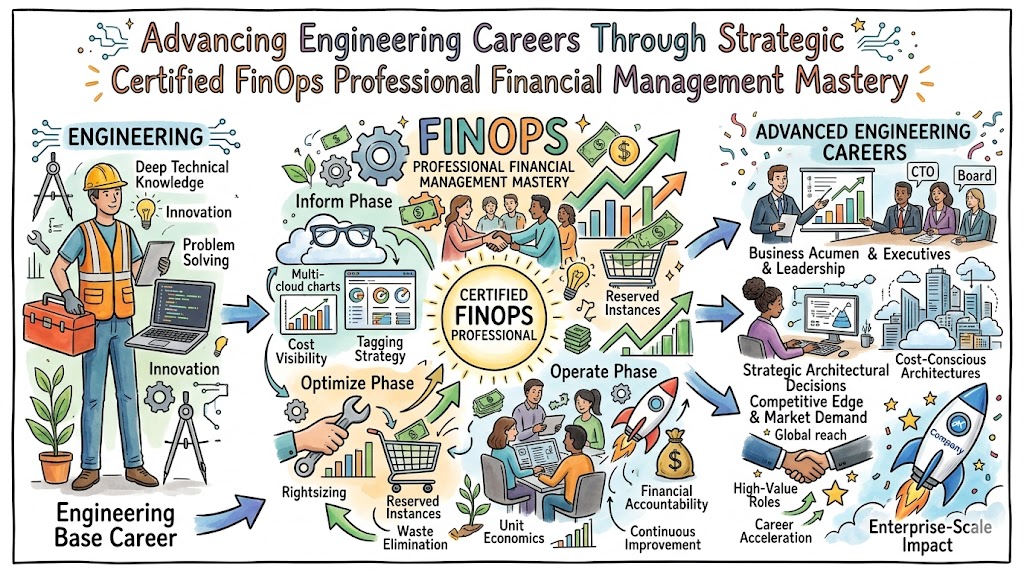
The cloud financial management landscape has shifted from basic cost reporting to a complex discipline requiring deep engineering integration. This guide for the Certified FinOps Professional serves as a roadmap for cloud architects, platform engineers, and financial managers aiming to bridge the gap between variable cloud spending and business value. Navigating this certification through FinOpsSchool ensures that practitioners can move beyond simple alerts to implementing automated governance and unit economics within their organizations. By following this path, professionals gain the technical and analytical rigor necessary to lead high-impact cloud cost optimization initiatives in modern enterprise environments.
What is the Certified FinOps Professional?
The Certified FinOps Professional represents the highest standard of excellence for individuals dedicated to the discipline of cloud financial management. It exists to validate a practitioner’s ability to not only understand the FinOps framework but to apply it across complex, multi-cloud enterprise ecosystems. This certification emphasizes real-world application, focusing on how to drive cultural change and technical accountability rather than just memorizing cloud provider billing consoles.
It aligns perfectly with modern engineering workflows by treating cost as a primary non-functional requirement, similar to performance or security. In a production-focused environment, this means moving from reactive cost-cutting to proactive value engineering. The certification proves you can navigate the intersection of finance, engineering, and business leadership to ensure cloud investments deliver maximum return.
Who Should Pursue Certified FinOps Professional?
This certification is designed for a diverse range of professionals who touch the cloud lifecycle, particularly those in SRE, DevOps, and Platform Engineering roles. Engineers who want to understand the fiscal impact of their architectural decisions will find immense value in this curriculum. It is equally critical for financial analysts and IT procurement specialists who need to speak the language of engineering to manage variable spend effectively.
Beyond technical roles, engineering managers and CTOs should pursue this path to build sustainable, cost-aware cultures within their departments. In the context of both the Indian market and the global tech landscape, the demand for professionals who can curb cloud sprawl is soaring. Whether you are a beginner looking to specialize or a veteran manager seeking to optimize millions in spend, this credential provides the necessary framework.
Why Certified FinOps Professional is Valuable and Beyond
The longevity of this certification is rooted in the permanent shift toward cloud-native architectures and the inherent complexity of consumption-based pricing models. As enterprises move past initial cloud migration and into the optimization phase, the ability to manage unit economics becomes a competitive advantage. This discipline helps professionals stay relevant even as specific cloud tools change, as the underlying principles of accountability and optimization remain constant.
Furthermore, enterprise adoption of FinOps is no longer optional but a fiscal necessity for survival in a volatile economy. Investing time in this certification offers a significant career return, as it positions you as a strategic partner to the business rather than just a cost center. It bridges the communication gap between the boardroom and the data center, making you an indispensable asset in any modern organization.
Certified FinOps Professional Certification Overview
The program utilizes a comprehensive assessment approach that tests both theoretical knowledge and practical scenario-based problem-solving. The structure is built around the core phases of the FinOps journey: Inform, Optimize, and Operate, ensuring a well-rounded mastery of the domain. Participants own their learning journey through a series of modules that cover cost allocation, budgeting, forecasting, and real-time decision-making.
The professional level specifically demands a deeper understanding of how to implement these strategies at scale across various business units. It is structured to provide practitioners with the tools to build a FinOps center of excellence within their respective companies. This certification ensures that you possess the technical depth required to manage large-scale cloud budgets effectively while fostering a culture of financial accountability.
Certified FinOps Professional Certification Tracks & Levels
The certification ecosystem begins with the Foundation level, which establishes a common language and understanding of the fundamental building blocks of cloud finance. This is intended for those new to the discipline or stakeholders who need a high-level overview of the framework. It ensures that everyone from the developer to the accountant is aligned on basic terminology and objectives.
Progression leads to the Professional level, which focuses on advanced implementation, complex reporting, and driving organizational change. Beyond this, specialization tracks allow professionals to align their FinOps expertise with specific technical domains like DevOps or SRE. These levels ensure that as your career progresses from execution to strategy, your certification reflects your ability to handle increasingly complex financial and technical challenges.
Complete Certified FinOps Professional Certification Table
| Track | Level | Who it’s for | Prerequisites | Skills Covered | Recommended Order |
| Core FinOps | Foundation | Beginners, Finance, Managers | Basic Cloud Knowledge | Terminology, Lifecycle, Personas | 1 |
| Engineering | Professional | SREs, DevOps, Architects | Cloud Certifications | Automation, Rightsizing, Tagging | 2 |
| Strategy | Advanced | FinOps Leads, CTOs | Professional Level | Governance, Unit Economics, Culture | 3 |
| Multi-Cloud | Specialization | Cloud Economists | Foundation Level | Billing Parity, Tooling, SaaS | 2 |
Detailed Guide for Each Certified FinOps Professional Certification
Certified FinOps Professional – Foundation
What it is
This certification validates a baseline understanding of the FinOps principles and the three phases of the lifecycle. It ensures practitioners can contribute to cost-saving discussions and understand cloud billing basics.
Who should take it
It is ideal for junior cloud engineers, finance professionals, procurement officers, and business analysts who are new to cloud financial management.
Skills you’ll gain
- Understanding the 6 FinOps principles.
- Identifying different FinOps personas and their motivations.
- Navigating the Inform, Optimize, and Operate phases.
- Basic cloud cost allocation and visibility.
Real-world projects you should be able to do
- Create a basic cloud spend dashboard for a specific team.
- Implement a standardized tagging policy across a small environment.
- Identify immediate low-hanging fruit for cost savings, like unattached disks.
Preparation plan
- 7-14 Days: Review official glossary and core principles.
- 30 Days: Complete foundational coursework and practice exams.
- 60 Days: Participate in community forums and apply basics to a trial cloud account.
Common mistakes
- Ignoring the cultural aspect and focusing only on the math.
- Confusing FinOps with traditional IT accounting.
Best next certification after this
- Same-track: Certified FinOps Professional.
- Cross-track: Cloud Practitioner (AWS/Azure/GCP).
- Leadership: FinOps Practitioner.
Certified FinOps Professional – Professional
What it is
This validates the ability to implement and manage a FinOps practice at scale within an organization. It covers advanced metrics, commitment management, and automated remediation.
Who should take it
Senior engineers, cloud architects, and dedicated FinOps practitioners who lead cost management initiatives for large-scale enterprises.
Skills you’ll gain
- Designing advanced cost allocation models and showback/chargeback.
- Managing Reserved Instances and Savings Plans at scale.
- Developing automated workflows for resource rightsizing.
- Calculating and reporting on unit economics.
Real-world projects you should be able to do
- Build an automated stop-start schedule for non-production environments.
- Lead a cross-functional workshop to align engineering and finance on KPIs.
- Negotiate and manage enterprise-level commitment discounts with cloud providers.
Preparation plan
- 7-14 Days: Deep dive into complex billing datasets and API exports.
- 30 Days: Study advanced case studies on enterprise-scale FinOps.
- 60 Days: Conduct a mock audit of a multi-cloud environment for optimization.
Common mistakes
- Focusing too much on tools and not enough on process.
- Failing to account for shared costs in multi-tenant clusters.
Best next certification after this
- Same-track: FinOps Advanced Specialization.
- Cross-track: Senior SRE or DevOps Engineer.
- Leadership: ITIL 4 or PMP.
Choose Your Learning Path
DevOps Path
The DevOps path focuses on integrating cost visibility directly into the CI/CD pipeline and developer workflows. It emphasizes shift-left cost management, where developers see the financial impact of their code changes before deployment. This path is essential for teams looking to automate cost governance without slowing down the release cycle.
DevSecOps Path
In this track, professionals learn to balance the triad of security, performance, and cost. It involves implementing guardrails that prevent expensive security misconfigurations and ensuring that compliance does not lead to unnecessary over-provisioning. The goal is to build secure, cost-effective environments by default.
SRE Path
The SRE path views cost through the lens of reliability and error budgets. It explores how to optimize for cost while maintaining strict service level objectives. SREs learn to use FinOps data to make informed decisions about redundancy, scaling, and infrastructure resilience.
AIOps Path
This path focuses on using artificial intelligence to predict spending patterns and detect anomalies in real-time. It involves building models that can automatically adjust resources based on predicted load to minimize waste. Professionals here merge data science with cloud economics to drive efficiency.
MLOps Path
MLOps specialists focus on the unique financial challenges of machine learning, such as expensive GPU training and high data egress costs. This path teaches how to manage the lifecycle of models in a way that remains budget-conscious. It ensures that the innovation of AI does not result in uncontrollable cloud debt.
DataOps Path
DataOps focuses on the financial management of large-scale data pipelines, warehouses, and lakes. It involves optimizing storage tiers and query performance to reduce the high costs associated with big data. Professionals learn to apply FinOps principles to data engineering and analytics platforms.
FinOps Path
The pure FinOps path is dedicated to building the organizational framework and cultural transformation needed for cloud success. It focuses on the strategic alignment of finance, business, and engineering teams. This is the path for those who want to lead the FinOps practice at an executive or program level.
Role → Recommended Certified FinOps Professional Certifications
| Role | Recommended Certifications |
| DevOps Engineer | Certified FinOps Professional Foundation, Professional |
| SRE | Certified FinOps Professional, SRE Specialization |
| Platform Engineer | Certified FinOps Professional, Infrastructure track |
| Cloud Engineer | Certified FinOps Professional Foundation, Multi-Cloud |
| Security Engineer | Certified FinOps Professional, DevSecOps Specialization |
| Data Engineer | Certified FinOps Professional, DataOps track |
| FinOps Practitioner | Certified FinOps Professional (All Levels) |
| Engineering Manager | Certified FinOps Professional Foundation, Leadership track |
Next Certifications to Take After Certified FinOps Professional
Same Track Progression
Deep specialization within the FinOps domain involves moving into advanced architectural roles where cost is the primary design constraint. You might pursue specialized certifications in specific cloud provider billing mechanisms or advanced data visualization for financial reporting. This path solidifies your status as a subject matter expert who can handle the most complex financial optimizations.
Cross-Track Expansion
Broadening your skills into SRE or Security allows you to understand how cost optimization interacts with other critical system attributes. For example, learning SRE principles helps you understand the cost of high availability versus standard availability. This makes you a more versatile architect who can make holistic trade-offs that benefit the entire business.
Leadership & Management Track
Transitioning to leadership involves moving from executing FinOps tasks to building and leading FinOps teams. Certifications in project management or executive leadership can complement your technical financial skills. This allows you to drive the cultural shift at the highest levels of the organization, turning FinOps from a project into a permanent business function.
Training & Certification Support Providers for Certified FinOps Professional
DevOpsSchool
This provider offers extensive resources for professionals looking to integrate financial management into their DevOps pipelines. They focus on practical, hands-on labs that simulate real-world cloud billing scenarios and optimization challenges. Their curriculum is designed to help engineers transition into cost-aware practitioners through intensive bootcamp-style training and expert mentorship.
Cotocus
This organization provides specialized consulting and training services focused on modern cloud-native technologies and FinOps methodologies. They emphasize the importance of automation in cloud cost management and provide tools to help teams achieve better visibility into their spending. Their trainers are industry veterans who bring deep practical experience to the classroom environment.
Scmgalaxy
This community-driven platform offers a wealth of tutorials and guides for software configuration management and cloud finance. It serves as a valuable knowledge hub for practitioners looking to stay updated on the latest tools and best practices in the FinOps space. They provide a collaborative environment where professionals can share insights and solve complex infrastructure problems.
BestDevOps
Focused on providing high-quality training for the next generation of cloud leaders, this provider offers targeted courses on cost optimization and cloud governance. They focus on the strategic aspects of DevOps, ensuring that participants understand how to align their technical efforts with broader business goals. Their training modules are highly interactive and career-oriented.
devsecopsschool.com
This portal specializes in the intersection of security and development, with a growing emphasis on financial security and cost guardrails. They offer training that helps professionals build secure, compliant, and cost-effective cloud environments. Their courses are essential for those looking to master the financial implications of security decisions in the cloud.
sreschool.com
Focusing on reliability engineering, this provider teaches how to manage costs while maintaining high system availability. They offer deep dives into how FinOps principles can be applied to capacity planning and performance engineering. Their training is crucial for SREs who want to take ownership of the financial efficiency of their platforms.
aiopsschool.com
This provider is at the forefront of the shift toward automated, AI-driven operations and financial management. They offer courses on using machine learning to predict cloud spend and automate cost-saving measures. Their curriculum is perfect for tech-forward professionals looking to leverage data science for operational excellence.
dataopsschool.com
This organization focuses on the unique challenges of managing financial efficiency within large-scale data environments. They provide specialized training on optimizing the costs of data ingestion, processing, and storage. Their courses are tailored for data engineers and architects who need to manage massive cloud data budgets.
finopsschool.com
As a primary source for FinOps education, this site provides comprehensive certification programs and resources for all levels of practitioners. They offer a structured learning path that covers everything from foundational concepts to advanced enterprise strategies. Their platform is the central hub for those seeking to become certified professionals in the field.
Frequently Asked Questions (General)
1. How difficult is the professional certification?
The professional level is significantly more challenging than the foundation as it requires deep analytical skills and practical experience.
2. What are the prerequisites for the exam?
While not always mandatory, having a foundational certification and at least one year of cloud experience is highly recommended.
3. How much time does it take to prepare?
Most candidates spend between 30 to 60 days preparing, depending on their existing familiarity with cloud billing and finance.
4. Is there a high ROI for this certification?
Yes, as companies face rising cloud costs, professionals with these skills often command higher salaries and more strategic roles.
5. In what order should I take the certifications?
It is best to start with the Foundation to align on terminology before moving to the Professional and Specialization levels.
6. Does this certification cover AWS, Azure, and GCP?
Yes, the principles are cloud-agnostic and applicable across all major public and private cloud providers and services.
7. How long is the certification valid?
Typically, these certifications are valid for two or three years, after which renewal or higher-level certification is required.
8. Can I pass the exam with just theoretical knowledge?
It is very difficult, as the professional exam relies heavily on scenario-based questions that test practical implementation and logic.
9. Are there hands-on labs involved in the training?
Yes, reputable training providers include labs where you analyze actual billing files and implement optimization scripts in real environments.
10. How does this differ from a standard Cloud Architect certification?
Architect certifications focus on how to build, while FinOps focuses on how to build cost-efficiently and prove value.
11. Is this relevant for small startups?
Absolutely, as startups need to burn as little cash as possible, making cost optimization a survival skill for their engineers.
12. Who manages the certification standards?
The standards are managed by the FinOps Foundation, a part of the Linux Foundation, ensuring industry-wide neutrality and quality.
FAQs on Certified FinOps Professional
1. What is the main focus of the Professional exam?
The exam focuses heavily on your ability to drive organizational change and manage complex, multi-cloud financial datasets at an enterprise scale.
2. Do I need to be a math expert?
While advanced math isn’t required, you must be very comfortable with data analysis, spreadsheets, and understanding variable consumption-based pricing models.
3. How does this help an SRE?
It allows SREs to treat cost as a metric like latency, enabling better decisions about resource allocation and system architecture trade-offs.
4. Can finance professionals take the Professional level?
Yes, but they will need a strong understanding of cloud infrastructure to pass the more technical, engineering-focused sections of the exam.
5. What is Unit Economics in the context of the exam?
It refers to measuring the cloud cost per business unit, such as cost per transaction or cost per active user.
6. Is automation covered in the curriculum?
Yes, the professional level emphasizes automating the Operate phase to ensure that cost savings are sustained without manual intervention.
7. Does the certification cover SaaS costs?
Yes, modern FinOps includes managing the costs of third-party SaaS tools that run alongside or on top of cloud infrastructure.
8. What is the passing score?
Passing scores can vary but usually hover around 75% for the professional level, reflecting the rigorous nature of the assessment.
Final Thoughts: Is Certified FinOps Professional Worth It?
From the perspective of a long-term career strategy, this certification is a highly valuable investment for anyone working in the cloud ecosystem. We have entered an era where growth at all costs has been replaced by sustainable, profitable growth, and cloud spend is often the largest line item after payroll. Being the person who can translate technical architecture into business value is a powerful position to hold.
This is not a trend or a temporary tool-based credential; it is a fundamental shift in how technology is managed. If you enjoy solving puzzles that involve both code and commerce, this path will provide immense professional satisfaction. It gives you a seat at the table where major business decisions are made, ensuring your technical skills are recognized for their direct impact on the bottom line.