Introduction
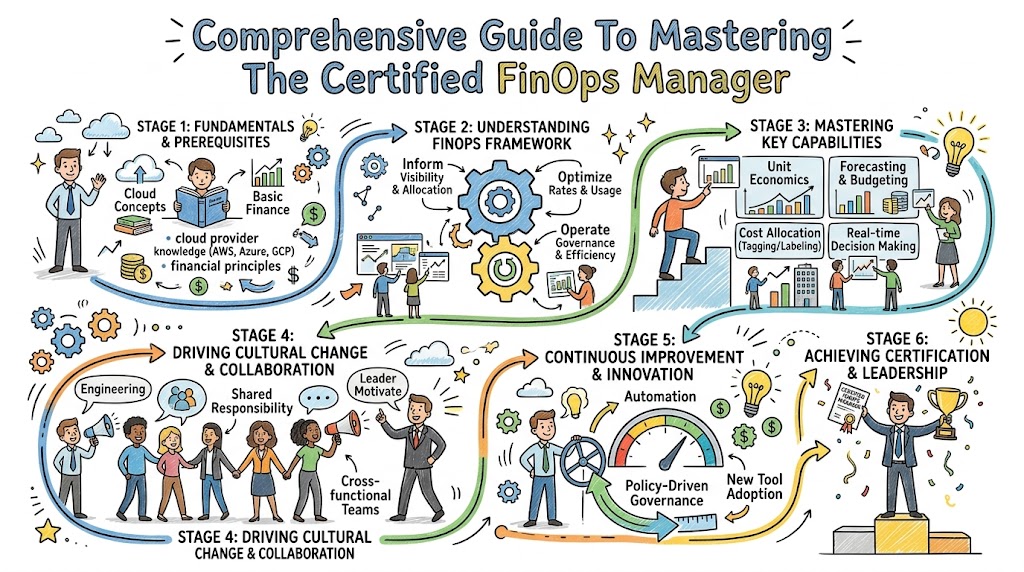
Contemporary cloud ecosystems necessitate strategic resource management and financial accountability in addition to technical deployment. This guide explores the Certified FinOps Manager program, a specialized path designed for professionals looking to bridge the gap between engineering velocity and fiscal responsibility. Whether you are navigating platform engineering or cloud-native transformations, understanding cloud financial management is essential for long-term career growth. By following the structured paths at FinOpsSchool, engineers can transition from tactical resource management to strategic leadership roles. This deep dive helps professionals evaluate the certification’s impact on their career trajectory and organizational value.
What is the Certified FinOps Manager?
The Certified FinOps Manager is a professional designation that validates an individual’s ability to govern cloud spending while maintaining high engineering standards. It focuses on the intersection of finance, business, and technology, ensuring that cloud investments deliver maximum value without hindering innovation. Unlike theoretical frameworks, this certification emphasizes real-world application, teaching practitioners how to implement visibility, optimization, and automation. It aligns perfectly with enterprise needs for scalable cloud governance and collaborative decision-making across multidisciplinary teams.
Who Should Pursue Certified FinOps Manager?
Cloud engineers and DevOps practitioners who find themselves managing rising cloud bills will benefit immensely from this certification. SREs and platform engineers who want to integrate “cost as a metric” into their observability stacks are also ideal candidates. Furthermore, engineering managers and IT financial analysts need this knowledge to foster a culture of accountability within their organizations. In the global market, including the rapidly expanding tech sector in India, this role is becoming a prerequisite for senior leadership positions in cloud-centric companies.
Why Certified FinOps Manager is Valuable and Beyond
As organizations move beyond initial cloud migration into the optimization phase, the demand for cost-aware engineering continues to soar. Tools and cloud providers may change, but the fundamental principles of financial accountability and unit economics remain constant. This certification ensures longevity in a career by providing a skill set that directly impacts an organization’s bottom line. Investing time in this domain offers a high return, as businesses prioritize professionals who can prove the ROI of their technical decisions.
Certified FinOps Manager Certification Overview
The program is delivered through the official curriculum and hosted on the specialized FinOpsSchool platform. It utilizes a comprehensive assessment approach that tests both technical proficiency in cloud billing and the soft skills required for cross-departmental collaboration. The certification is structured to move from foundational knowledge to advanced organizational ownership. It covers the full lifecycle of cloud financial management, ensuring that practitioners can handle everything from initial budget forecasting to automated cost remediation.
Certified FinOps Manager Certification Tracks & Levels
The certification structure typically begins with a foundation level that introduces core terminology and the lifecycle phases of Inform, Optimize, and Operate. As professionals progress to the professional and advanced levels, the focus shifts toward complex organizational challenges and multi-cloud governance. Specialization tracks allow practitioners to align their FinOps expertise with specific domains like DevOps or SRE. These levels are designed to mirror a professional’s growth from a contributor to a strategic architect or manager.
Complete Certified FinOps Manager Certification Table
| Track | Level | Who it’s for | Prerequisites | Skills Covered | Recommended Order |
| Core FinOps | Foundation | Beginners/Analysts | Cloud Basics | Lifecycle phases, Terminology | First |
| Engineering | Professional | DevOps/SREs | Foundation Cert | Cost Optimization, Automation | Second |
| Management | Advanced | Leaders/Directors | Professional Cert | Governance, Policy, Strategy | Third |
| Specialized | Expert | Architects | Advanced Cert | Multi-cloud, Unit Economics | Fourth |
Detailed Guide for Each Certified FinOps Manager Certification
Certified FinOps Manager – Foundation Level
What it is
This level validates a basic understanding of the cloud financial management lifecycle and the primary personas involved in the process. It serves as the entry point for anyone looking to speak the language of cloud finance.
Who should take it
It is suitable for junior cloud engineers, business analysts, and procurement specialists who are new to cloud cost management. No prior financial background is required.
Skills you’ll gain
- Understanding cloud billing models and invoices.
- Identifying the three phases: Inform, Optimize, and Operate.
- Communicating effectively between finance and engineering teams.
Real-world projects you should be able to do
- Generate a basic cloud cost report for a specific department.
- Identify orphaned resources in a development environment.
Preparation plan
- 7–14 days: Review official terminology and core lifecycle definitions.
- 30 days: Complete a foundational course and take practice exams.
- 60 days: Not required for this level unless balancing a very heavy workload.
Common mistakes
- Overcomplicating the technical aspects while ignoring the cultural shifts.
- Failing to memorize specific cloud-native cost management terms.
Best next certification after this
- Same-track option: Certified FinOps Professional.
- Cross-track option: Cloud Provider Practitioner (AWS/Azure/GCP).
- Leadership option: ITIL Foundation.
Certified FinOps Manager – Professional Level
What it is
This certification validates the ability to execute optimization strategies and build automated workflows for cost management. It bridges the gap between seeing a bill and taking technical action.
Who should take it
Experienced DevOps engineers, SREs, and cloud architects who have hands-on experience managing cloud environments and want to specialize in efficiency.
Skills you’ll gain
- Implementing tagging and labeling strategies at scale.
- Managing Reserved Instances and Savings Plans.
- Building automated alerts for budget overruns.
Real-world projects you should be able to do
- Automate the shutdown of non-production resources during off-hours.
- Implement a showback/chargeback system for a multi-tenant cluster.
Preparation plan
- 7–14 days: Focused review on specific cloud provider billing APIs.
- 30 days: Practical lab work and implementation of optimization scripts.
- 60 days: Comprehensive study of multi-cloud billing complexities.
Common mistakes
- Ignoring the impact of optimization on system performance or reliability.
- Focusing only on one cloud provider’s tools.
Best next certification after this
- Same-track option: Certified FinOps Manager – Advanced.
- Cross-track option: Certified Kubernetes Administrator.
- Leadership option: Engineering Manager Professional.
Choose Your Learning Path
DevOps Path
Integration of cost feedback loops directly into the CI/CD pipeline is the focus here. Engineers learn to treat cost as a functional requirement during the development phase. This path ensures that deployments are not just fast and secure, but also financially sustainable. It involves mastering infrastructure as code with a focus on resource efficiency.
DevSecOps Path
This path combines security governance with financial oversight to ensure that cost-saving measures do not introduce vulnerabilities. Professionals learn to audit environments for both security leaks and “cash leaks” simultaneously. It emphasizes the use of policy-as-code to enforce both security and budget guardrails. This dual-focus makes practitioners highly valuable to risk-averse enterprises.
SRE Path
Site Reliability Engineers use this path to balance the “Error Budget” with the “Financial Budget.” The focus is on maintaining system availability while minimizing the cost of redundancy and over-provisioning. It involves deep dives into observability tools to track unit economics per request or transaction. This ensures that the platform remains reliable without unnecessary expenditure.
AIOps Path
In this track, professionals learn to use machine learning models to predict cloud spending and detect anomalies. It focuses on automating the “Inform” phase of FinOps using intelligent forecasting tools. Engineers explore how to handle the massive data sets generated by cloud billing exports. This path is ideal for those working in large-scale, dynamic environments.
MLOps Path
Managing the high costs associated with GPU instances and training large models is the core of this track. It focuses on optimizing the machine learning lifecycle from data ingestion to model deployment. Practitioners learn how to manage experimental costs without stifling data science innovation. It is a critical path for organizations heavily invested in artificial intelligence.
DataOps Path
Data pipelines can be notoriously expensive due to storage and egress fees, which this path addresses directly. Professionals learn to optimize data warehouse queries and storage tiers to reduce the cost of business intelligence. It involves understanding the financial implications of data retention policies. This path ensures that data remains an asset rather than a liability.
FinOps Path
This is the pure-play path for those dedicated to the FinOps career track, moving into management and leadership. It covers the cultural transition required to make an entire organization cost-conscious. Practitioners focus on high-level strategy, executive reporting, and vendor negotiations. It is the ultimate path for those aiming to lead a FinOps Center of Excellence.
Role → Recommended Certified FinOps Manager Certifications
| Role | Recommended Certifications |
| DevOps Engineer | Certified FinOps Foundation, Professional |
| SRE | Certified FinOps Professional, SRE Specialized |
| Platform Engineer | Certified FinOps Foundation, Advanced Governance |
| Cloud Engineer | Certified FinOps Foundation, Cloud Optimization |
| Security Engineer | Certified FinOps Foundation, DevSecOps Track |
| Data Engineer | Certified FinOps Foundation, DataOps Specialist |
| FinOps Practitioner | Full Path: Foundation to Advanced |
| Engineering Manager | Certified FinOps Foundation, Leadership Track |
Next Certifications to Take After Certified FinOps Manager
Same Track Progression
Deep specialization involves moving toward specific cloud provider expert certifications. For example, mastering AWS Certified Solutions Architect Professional after FinOps provides the technical depth to execute high-level financial strategies. It ensures that the practitioner can move from identifying a cost issue to re-architecting the entire solution for maximum efficiency.
Cross-Track Expansion
Skill broadening involves looking into adjacent domains like security or platform engineering. A Certified Kubernetes Administrator (CKA) certification is an excellent follow-up, as container orchestration is a primary driver of cloud costs. This allows the professional to manage the most complex and expensive parts of modern infrastructure with precision.
Leadership & Management Track
For those transitioning to leadership, pursuing an MBA or a Senior Engineering Management certification is logical. These programs build on the financial literacy gained through FinOps to manage larger budgets and department-wide strategies. It prepares the professional for roles like Director of Infrastructure or Chief Cloud Officer.
Training & Certification Support Providers for Certified FinOps Manager
DevOpsSchool
This provider offers extensive resources and hands-on labs specifically tailored for engineering professionals. Their curriculum emphasizes the practical integration of FinOps within the DevOps lifecycle, ensuring students can apply what they learn immediately.
Cotocus
Focusing on boutique training experiences, this organization provides deep dives into cloud-native technologies. Their approach to FinOps is rooted in real-world consulting experience, offering students insights into enterprise-level challenges and solutions.
Scmgalaxy
As a community-driven platform, they offer a wealth of tutorials and articles on cost optimization and automation. It is an excellent resource for staying updated on the latest tools and best practices in the evolving FinOps landscape.
BestDevOps
This provider focuses on comprehensive career paths, helping professionals transition from generalist roles to specialized experts. Their FinOps training is designed to be accessible yet technically rigorous for working professionals.
devsecopsschool.com
They specialize in the intersection of security and operations, providing a unique lens on financial management. Their courses ensure that budget optimization is always balanced with robust security protocols.
sreschool.com
This platform focuses on reliability and performance, teaching FinOps as a core component of the SRE toolkit. Their training helps engineers understand the financial cost of downtime and over-provisioning.
aiopsschool.com
Focusing on the future of operations, this provider teaches how to use artificial intelligence to manage complex cloud costs. It is the go-to resource for engineers looking to automate their FinOps practices.
dataopsschool.com
They address the specific financial challenges of data-intensive organizations. Their training covers cost-efficient data architecture and the financial management of large-scale analytics platforms.
finopsschool.com
As the primary host for the Certified FinOps Manager program, this site provides the most direct and official learning path. It serves as a central hub for the FinOps community and official certification standards.
Frequently Asked Questions
- How difficult is the Certified FinOps Manager exam?
The difficulty is moderate, focusing more on the application of principles and cultural understanding than on complex mathematical formulas or coding. - How much time does it take to get certified?
A dedicated professional can typically prepare for and pass the foundation level within thirty days, while professional levels may require more experience. - What are the prerequisites for this certification?
There are no formal prerequisites for the foundation level, but a basic understanding of cloud computing and how billing works is highly recommended. - Is the ROI worth the cost of the certification?
Yes, as organizations increasingly look for specialists who can manage cloud waste, certified professionals often see significant salary increases and career advancement. - Should I take this before or after a cloud provider certification?
It is often best to have a basic cloud provider certification first so that you understand the resources you are attempting to optimize. - Does this certification expire?
Most certifications in this domain require renewal every two to three years to ensure practitioners are up to date with changing cloud billing models. - Is there a coding requirement for the exam?
The exam does not require deep coding skills, but understanding scripts and automation logic is vital for the professional and advanced levels. - How does this help an Engineering Manager?
It provides the financial vocabulary needed to defend budgets to the CFO while ensuring the engineering team has the resources they need. - Can I skip the foundation level?
While some programs allow it, the foundation level is crucial for mastering the specific terminology and framework used in higher levels of the program. - Are there lab-based assessments?
Higher-level certifications often include practical scenarios or case studies where you must identify optimization opportunities in a simulated environment. - How relevant is this for multi-cloud environments?
Extremely relevant, as the principles of FinOps are designed to be cloud-agnostic and applicable across AWS, Azure, GCP, and private clouds. - Is this recognized globally?
Yes, FinOps is an international standard, and this certification is recognized by major enterprises and service providers around the world.
FAQs on Certified FinOps Manager
- What specific cloud platforms does the Certified FinOps Manager cover?
The curriculum is designed to be platform-neutral, meaning the principles apply to all major providers like AWS, GCP, and Azure. It focuses on the universal logic of cloud consumption and financial management rather than specific button-clicking in a single portal.
- How does this certification differ from a standard finance degree?
Traditional finance focuses on accounting and capital expenditure, whereas this certification focuses on operational expenditure and the variable nature of cloud. It bridges the gap by teaching “Unit Economics,” which is a concept unique to scalable technology platforms.
- Will this certification help me in a job interview?
Absolutely, as it demonstrates that you possess a rare “dual-language” capability in both technology and finance. Employers look for this to ensure their technical leads are aligned with the company’s broader business and fiscal goals.
- Can non-engineers pass the Certified FinOps Manager exam?
Yes, business analysts and procurement professionals can pass the foundation level. However, the professional level requires a deeper understanding of technical architectures like containers and serverless to effectively recommend optimization strategies.
- Is automation a big part of the curriculum?
Yes, a core tenet of modern FinOps is moving away from manual spreadsheets toward automated governance. The program covers how to use policy-as-code to prevent budget overruns before they happen, which is essential for scaling.
- Does the program cover open-source FinOps tools?
The certification introduces various tools, including open-source options and native cloud provider services. This ensures that managers can select the best toolset for their specific organizational needs without being locked into a single vendor.
- What is the “Inform” phase in the FinOps lifecycle?
This is the first phase where the focus is on visibility and allocation. It ensures that every dollar spent in the cloud can be traced back to a specific team, project, or business unit through proper tagging.
- How does FinOps relate to the culture of an organization?
FinOps is as much about culture as it is about tools. The certification teaches how to break down silos between finance and engineering, fostering a environment where everyone takes responsibility for their cloud usage.
Final Thoughts: Is Certified FinOps Manager Worth It?
The transition to the cloud has made financial management an engineering problem. In this environment, a professional who understands both the “how” of deployment and the “how much” of consumption is incredibly valuable. The Certified FinOps Manager program provides a clear, structured path to gaining this expertise without the fluff found in many other certifications. It is a practical investment for anyone who wants to move into senior engineering or management roles. By focusing on real-world outcomes and cultural change, it prepares you for the actual challenges of modern enterprise cloud governance. If you want to be the person who ensures technology remains a growth engine rather than a cost center, this certification is definitely worth your time.