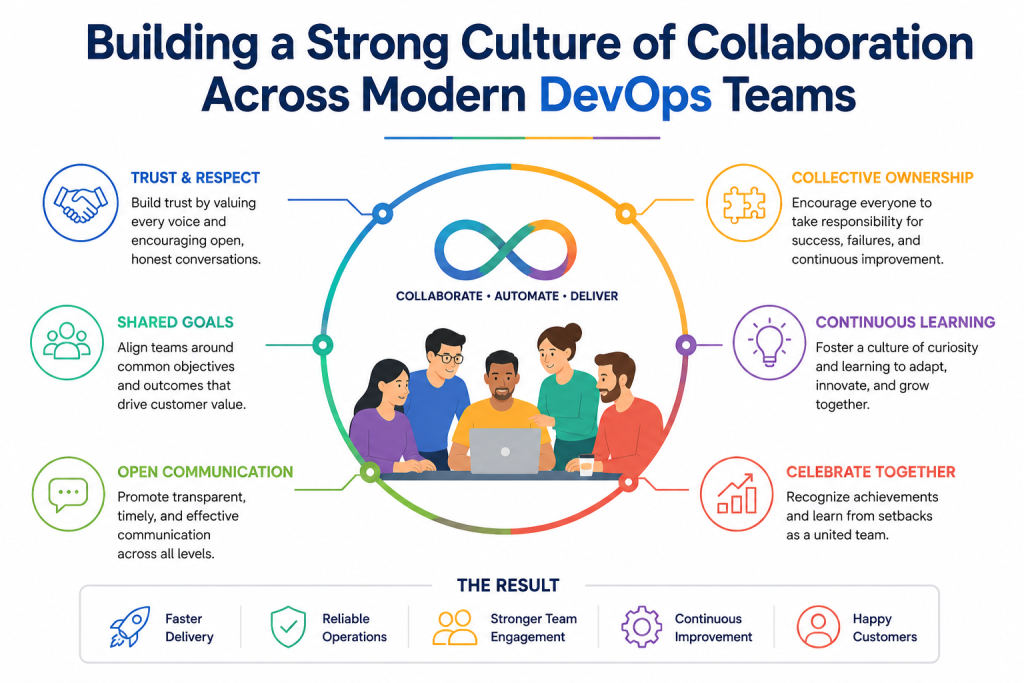
Building a culture of collaboration in DevOps teams means creating an environment where development, operations, quality assurance, security, and business teams work together toward common goals. Instead of operating in separate departments with different priorities, team members communicate openly, share responsibilities, and solve problems collectively. Collaboration forms the foundation of successful DevOps practices because modern software delivery requires continuous coordination between multiple stakeholders.
Organizations that embrace collaboration often experience faster software releases, improved service reliability, better customer satisfaction, and stronger employee engagement. Technology alone cannot create these outcomes. Teams must develop trust, transparency, accountability, and shared ownership. This cultural transformation requires leadership support, effective communication practices, and continuous learning opportunities. Many organizations seek guidance from Xopsschool to understand how collaborative DevOps cultures operate and how teams can implement practical strategies that improve operational performance while supporting long-term business growth.
Understanding Why Collaboration Matters in DevOps
DevOps emerged because traditional software development and operations teams often worked independently. Developers focused on delivering new features quickly, while operations teams concentrated on maintaining system stability. As a result, conflicting priorities frequently caused delays, misunderstandings, deployment failures, and operational inefficiencies.
A collaborative culture removes these barriers by encouraging teams to work together throughout the software lifecycle. Developers gain a deeper understanding of infrastructure requirements, while operations professionals become involved earlier in development processes. This shared perspective helps teams identify potential issues before they impact production systems.
Furthermore, collaboration creates faster feedback loops. Team members can discuss challenges openly, exchange ideas, and resolve issues before they become major problems. When everyone shares responsibility for application performance and customer satisfaction, organizations can deliver better products while reducing operational risks. Consequently, collaboration becomes a critical factor in achieving sustainable DevOps success.
Foundations of a Collaborative DevOps Culture
Every successful DevOps organization builds its culture on several foundational principles. These principles guide daily interactions, influence decision-making processes, and establish expectations for teamwork across departments.
Trust serves as the most important foundation. Team members must feel comfortable sharing concerns, admitting mistakes, and requesting assistance when needed. Without trust, individuals may hide problems or avoid difficult conversations, which can negatively impact project outcomes.
Transparency also plays a significant role. Teams should openly share project status, performance metrics, deployment schedules, and operational challenges. Transparency reduces confusion and ensures everyone understands current priorities.
Shared ownership further strengthens collaboration. Instead of assigning blame when problems occur, teams focus on identifying solutions and improving processes. This mindset encourages continuous improvement while reducing friction between departments. Together, these foundations create an environment where collaboration becomes a natural part of daily operations.
Creating Shared Goals Across Teams
One of the biggest obstacles to collaboration occurs when departments pursue different objectives. Development teams may prioritize feature delivery speed, while operations teams focus on uptime and stability. These conflicting goals often create tension and slow progress.
Organizations can address this challenge by establishing shared goals that align all teams with broader business objectives. For example, teams can focus on deployment frequency, service availability, customer satisfaction, incident response times, and application performance metrics.
Shared goals encourage cross-functional cooperation because success depends on collective effort rather than individual departmental achievements. Team members begin viewing challenges from a broader perspective and recognize how their actions affect other stakeholders.
Additionally, shared goals improve accountability. Everyone understands their role in achieving organizational objectives, which creates stronger alignment and motivates teams to support one another. As a result, collaboration becomes embedded within daily workflows rather than treated as an optional activity.
Improving Communication Between Teams
Effective communication forms the backbone of collaborative DevOps environments. Without clear communication channels, misunderstandings can quickly lead to delays, deployment failures, and operational disruptions.
Organizations should encourage regular communication through daily standups, planning sessions, retrospectives, incident reviews, and knowledge-sharing meetings. These interactions help teams stay aligned while providing opportunities to discuss challenges and progress.
Documentation also contributes significantly to communication effectiveness. Teams should maintain accurate records of infrastructure configurations, deployment procedures, troubleshooting guides, and operational policies. Well-documented processes reduce dependency on individual knowledge holders and support smoother collaboration.
Furthermore, communication should extend beyond technical topics. Team members should understand business priorities, customer expectations, and organizational goals. This broader awareness helps teams make better decisions and fosters stronger collaboration across departments.
Encouraging Cross-Functional Team Structures
Traditional organizational structures often separate development, operations, security, and testing functions into independent departments. Although specialization provides expertise, excessive separation can create silos that hinder collaboration.
Cross-functional teams address this issue by bringing together professionals with diverse skills and responsibilities. These teams work collectively on projects from initial planning through production deployment and ongoing support.
Cross-functional structures improve collaboration because team members interact regularly, share knowledge, and gain exposure to different perspectives. Developers learn operational considerations, while operations engineers understand development challenges.
Moreover, cross-functional teams accelerate decision-making. Since required expertise exists within the same group, teams can resolve issues quickly without waiting for approvals from multiple departments. Consequently, organizations achieve greater agility while strengthening collaborative relationships throughout the software delivery lifecycle.
Key Operational Concepts You Must Know
Understanding key operational concepts helps DevOps teams collaborate more effectively and maintain reliable systems. These concepts provide the framework for managing modern infrastructure and software delivery processes.
Automation represents one of the most important operational principles. By automating repetitive tasks such as deployments, testing, monitoring, and configuration management, teams reduce errors while improving consistency. Automation also frees team members to focus on higher-value activities.
Observability provides visibility into application behavior and system performance. Teams use metrics, logs, traces, and monitoring tools to understand system health and diagnose issues efficiently.
Incident management establishes structured processes for responding to operational disruptions. Effective incident management promotes coordination between teams and minimizes service interruptions.
Continuous integration and continuous delivery support rapid software deployment through automated testing and release pipelines. These practices enable teams to deliver updates frequently while maintaining quality and stability.
Capacity planning, disaster recovery, and security management further contribute to operational excellence. Together, these concepts create a strong foundation for collaborative and reliable DevOps operations.
Platform Implementation vs. Culture — What’s the Real Difference?
Many organizations invest heavily in DevOps tools and platforms while overlooking cultural transformation. Although technology plays an important role, tools alone cannot create effective collaboration.
Platform implementation focuses on technical capabilities. This includes automation tools, monitoring solutions, cloud infrastructure, deployment pipelines, and configuration management systems. These technologies help teams improve efficiency and streamline operational processes.
Culture, however, focuses on human behavior. It influences how people communicate, share knowledge, solve problems, and support one another. A collaborative culture encourages trust, transparency, accountability, and continuous learning.
Organizations sometimes assume that adopting modern tools automatically creates DevOps success. However, teams may continue operating in silos despite advanced technology investments. Conversely, organizations with strong collaborative cultures often achieve impressive results even when using relatively simple tools.
The most successful DevOps transformations balance both elements. Technology provides operational capabilities, while culture ensures teams use those capabilities effectively. Together, they create sustainable improvements in performance, reliability, and innovation.
Building Trust Through Shared Responsibility
Trust develops when team members consistently demonstrate reliability, accountability, and mutual support. In collaborative DevOps environments, trust grows through shared responsibility rather than isolated ownership.
Organizations should encourage teams to participate collectively in planning, deployment, monitoring, and incident response activities. Shared responsibility helps individuals understand the challenges faced by colleagues and promotes empathy across departments.
Blameless postmortems represent another valuable practice. When incidents occur, teams focus on learning and improvement rather than assigning fault. This approach encourages open discussions and helps identify root causes more effectively.
Leaders also influence trust development by modeling transparency and supporting constructive feedback. When employees feel psychologically safe, they contribute ideas more freely and engage more actively in collaborative efforts. Over time, these behaviors strengthen team relationships and improve overall performance.
Real-World Use Cases of Modern Operations
Modern operations practices support collaboration across a wide range of industries and business environments. Organizations use these approaches to improve service delivery, increase reliability, and respond quickly to changing customer needs.
E-commerce companies rely on collaborative DevOps teams to manage high-traffic applications during major sales events. Developers, operations engineers, and security specialists coordinate closely to maintain performance and availability.
Financial institutions use DevOps practices to accelerate software releases while meeting strict compliance requirements. Cross-functional teams collaborate on testing, monitoring, and risk management activities.
Healthcare organizations depend on collaborative operations teams to ensure continuous access to critical applications and patient information systems. Reliable infrastructure and rapid incident response support essential healthcare services.
Software-as-a-service providers leverage DevOps collaboration to deploy new features frequently while maintaining service stability. Continuous monitoring and automated deployment pipelines enable rapid innovation without compromising reliability.
These examples demonstrate how collaborative cultures support operational success across diverse industries and technical environments.
Knowledge Sharing and Continuous Learning
Collaborative DevOps cultures prioritize continuous learning because technology, business requirements, and operational challenges evolve constantly. Teams must continuously expand their knowledge to remain effective.
Organizations can support learning through technical workshops, internal training programs, mentorship initiatives, and collaborative problem-solving sessions. These activities encourage knowledge exchange while strengthening relationships between team members.
Documentation also supports continuous learning. Teams should capture lessons learned, operational procedures, troubleshooting techniques, and best practices. Accessible knowledge repositories help new employees become productive more quickly and reduce dependency on individual experts.
Additionally, teams should regularly review operational incidents, project outcomes, and performance metrics. These reviews provide valuable opportunities to identify improvement areas and share insights across departments. Continuous learning ultimately enhances collaboration by creating a more informed and capable workforce.
Common Mistakes in Operations Engineering
Many organizations encounter challenges during DevOps transformations because they overlook important cultural and operational factors. Recognizing these common mistakes can help teams avoid unnecessary setbacks.
One frequent mistake involves focusing exclusively on tools while neglecting cultural change. Organizations may invest heavily in automation platforms but fail to improve communication and collaboration practices.
Another mistake involves maintaining departmental silos. When teams operate independently, knowledge sharing decreases and coordination becomes more difficult.
Poor documentation also creates operational risks. Without clear procedures and knowledge resources, teams struggle to resolve issues efficiently and onboard new employees effectively.
Insufficient monitoring represents another common challenge. Limited visibility makes it difficult to identify performance issues before customers experience disruptions.
Finally, organizations sometimes underestimate the importance of leadership support. Successful collaboration requires leaders who actively promote teamwork, transparency, and continuous improvement throughout the organization.
How to Become an Operations Expert — Career Roadmap
Building expertise in modern operations requires a combination of technical skills, practical experience, and collaborative abilities. Professionals who follow a structured learning path can develop strong operational capabilities while supporting DevOps initiatives.
Step 1: Learn Core Technical Foundations
Begin by developing knowledge in operating systems, networking, cloud computing, databases, and scripting languages. These fundamentals provide the technical foundation required for operational success.
Step 2: Master Automation Technologies
Learn automation tools, infrastructure management platforms, deployment pipelines, and configuration management practices. Automation remains a critical component of modern operations engineering.
Step 3: Develop Monitoring and Observability Skills
Gain experience with monitoring systems, logging platforms, tracing solutions, and performance analysis techniques. Observability helps teams maintain reliable services and troubleshoot issues efficiently.
Step 4: Understand Security Principles
Security knowledge is essential for protecting applications, infrastructure, and customer data. Learn identity management, vulnerability assessment, compliance requirements, and security automation practices.
Step 5: Build Collaboration and Leadership Skills
Technical expertise alone is not sufficient. Operations professionals must communicate effectively, collaborate across teams, mentor colleagues, and contribute to organizational improvement efforts.
Recommended Skill Areas
- Linux administration
- Cloud infrastructure
- Container technologies
- Continuous integration and delivery
- Monitoring and observability
- Automation frameworks
- Incident management
- Security operations
- Performance optimization
- Team leadership
Professionals who combine these skills with practical experience can build rewarding careers in modern operations environments.
FAQ Section
What is collaboration in DevOps?
Collaboration in DevOps refers to development, operations, testing, security, and business teams working together toward shared objectives throughout the software lifecycle.
Why is collaboration important for DevOps success?
Collaboration improves communication, reduces operational silos, accelerates software delivery, enhances reliability, and supports continuous improvement across teams.
How can organizations improve DevOps collaboration?
Organizations can improve collaboration by establishing shared goals, encouraging cross-functional teams, promoting transparency, supporting knowledge sharing, and implementing effective communication practices.
What role does leadership play in collaborative cultures?
Leadership helps create trust, encourages accountability, removes organizational barriers, supports learning initiatives, and models collaborative behaviors throughout the organization.
Can DevOps succeed without cultural transformation?
Technology can improve operational efficiency, but long-term DevOps success requires cultural changes that promote collaboration, trust, shared ownership, and continuous improvement.
What skills support collaborative DevOps environments?
Communication, problem-solving, automation, monitoring, security awareness, teamwork, leadership, and continuous learning all contribute to successful collaboration.
Final Summary
Building a culture of collaboration in DevOps teams requires much more than implementing modern tools and automation platforms. Successful organizations create environments where trust, transparency, shared ownership, and continuous learning become part of everyday operations. Teams communicate openly, align around common objectives, and work together to solve challenges throughout the software delivery lifecycle.
Strong collaboration improves deployment speed, operational reliability, customer satisfaction, and employee engagement. Furthermore, organizations that invest in cross-functional teamwork develop greater agility and resilience when responding to changing business requirements. By understanding key operational concepts, avoiding common engineering mistakes, embracing modern operational practices, and following a structured career development path, both organizations and professionals can achieve lasting success in the evolving world of DevOps and operations engineering.