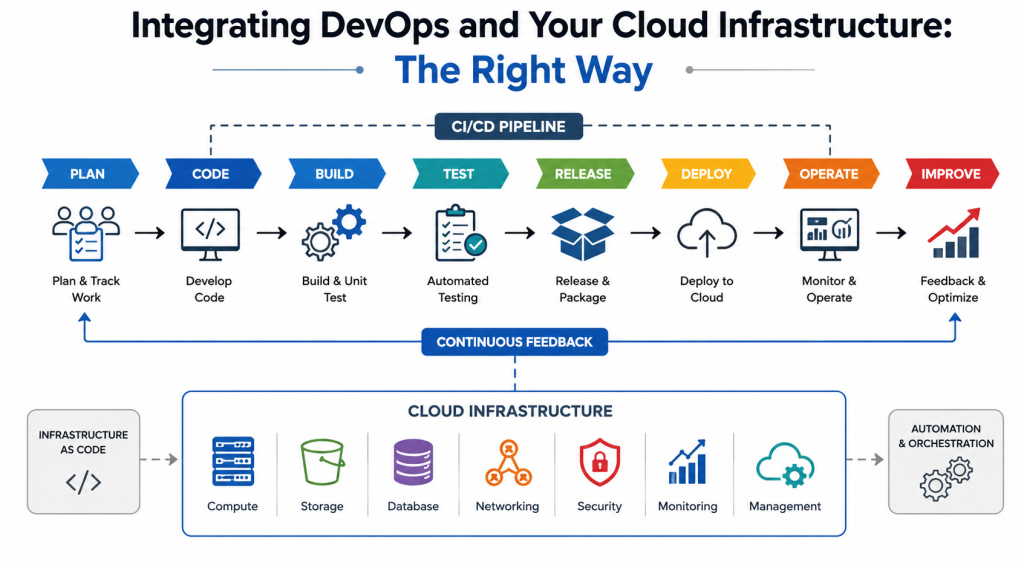
Cloud infrastructure has transformed the way organizations build, deploy, and manage applications. Companies no longer need to invest heavily in physical servers because cloud platforms provide scalable, flexible, and on-demand computing resources. At the same time, DevOps has emerged as a powerful operational approach that brings development and operations teams together to improve software delivery speed, reliability, and quality.
When organizations combine DevOps with cloud infrastructure, they create an environment where automation, collaboration, scalability, and continuous improvement work together. This integration helps teams release software faster, reduce operational risks, improve infrastructure management, and maintain consistent service quality.
Many businesses move workloads to the cloud but fail to realize the full benefits because they continue using traditional operational practices. To achieve maximum value, organizations must align cloud services with DevOps principles such as Infrastructure as Code, Continuous Integration, Continuous Delivery, monitoring, automation, and collaboration.
For professionals and organizations seeking structured learning and practical implementation guidance, Xopsschool provides educational resources focused on modern operations, cloud technologies, automation, DevOps practices, and infrastructure management.
Understanding DevOps and Cloud Infrastructure Integration
DevOps and cloud computing naturally complement each other. Cloud platforms provide programmable infrastructure, while DevOps promotes automation and rapid delivery. Together, they create an ecosystem where teams can build, test, deploy, monitor, and scale applications efficiently.
Traditional infrastructure management often involved lengthy procurement processes, manual server configuration, and siloed teams. Developers wrote code, operations teams managed infrastructure, and communication gaps frequently caused deployment failures. Cloud environments eliminate many of these limitations by offering self-service resources and automated provisioning capabilities.
DevOps takes advantage of these cloud capabilities by introducing repeatable deployment pipelines, infrastructure automation, monitoring systems, and collaborative workflows. As a result, teams can deploy changes more frequently while maintaining stability and security.
Organizations that successfully integrate DevOps with cloud infrastructure typically experience shorter release cycles, faster incident resolution, improved resource utilization, and better customer satisfaction. Furthermore, automation reduces repetitive manual work, allowing engineers to focus on innovation and strategic improvements rather than routine maintenance tasks.
Why Cloud Infrastructure Needs DevOps Practices
Cloud environments can become complex very quickly. Organizations often manage hundreds of virtual machines, containers, databases, networking components, storage services, and security policies. Without proper operational processes, this complexity can lead to configuration drift, deployment failures, and increased operational costs.
DevOps introduces structure and consistency into cloud operations. Teams can automate infrastructure provisioning, standardize deployment procedures, and continuously validate system performance. This approach significantly reduces human error and increases operational reliability.
Additionally, cloud platforms support rapid scaling. Applications may experience sudden traffic increases that require immediate resource allocation. DevOps automation enables systems to respond automatically to changing demand without requiring manual intervention.
Another major benefit involves visibility. DevOps emphasizes monitoring and observability, allowing organizations to understand application behavior, infrastructure health, and customer experience in real time. This visibility helps teams identify problems early and resolve them before users are affected.
As cloud adoption continues to expand across industries, DevOps becomes an essential operational capability rather than an optional improvement.
Core Components of DevOps Integration in Cloud Environments
Successful integration requires several interconnected components working together.
Infrastructure as Code
Infrastructure as Code allows teams to define cloud resources using code rather than manual configuration. Engineers can version, review, test, and deploy infrastructure changes just like application code.
This approach improves consistency across environments and reduces configuration errors. It also enables rapid infrastructure provisioning, making it easier to support development, testing, and production workloads.
Infrastructure definitions become reusable assets that simplify scaling and disaster recovery planning. Organizations gain better control over cloud resources while maintaining operational consistency.
Continuous Integration
Continuous Integration focuses on automatically validating code changes whenever developers commit updates. Automated builds, testing procedures, and quality checks help identify issues early in the development lifecycle.
Cloud-based CI systems provide scalable build environments capable of handling multiple projects simultaneously. Teams receive rapid feedback, allowing them to address defects before they reach production environments.
Continuous Integration improves software quality while reducing deployment risks. It also encourages developers to commit smaller, more manageable changes.
Continuous Delivery and Deployment
Continuous Delivery extends automation by preparing validated code for deployment. Continuous Deployment goes one step further by automatically releasing approved changes to production.
Cloud infrastructure supports these practices by enabling automated environment creation, deployment orchestration, and rollback mechanisms. Teams can release updates frequently while maintaining service reliability.
This capability allows organizations to respond quickly to customer feedback, market changes, and business requirements.
Monitoring and Observability
Monitoring provides visibility into infrastructure performance, application behavior, and system health. Observability expands this capability by helping teams understand why issues occur.
Cloud-native monitoring tools collect metrics, logs, traces, and events from distributed systems. Teams can detect anomalies, troubleshoot incidents, and optimize performance more effectively.
Strong observability practices improve reliability and support proactive operational management.
Key Operational Concepts You Must Know
Understanding operational fundamentals is essential for successful DevOps and cloud integration. These concepts form the foundation of modern infrastructure management.
Automation First Mindset
Automation should be the default approach whenever repetitive tasks exist. Manual processes introduce inconsistency, consume valuable time, and increase operational risk.
Teams should automate provisioning, deployment, testing, monitoring, backups, and incident response activities whenever possible. Automation improves reliability while enabling faster service delivery.
An automation-first culture encourages continuous improvement and operational efficiency throughout the organization.
Immutable Infrastructure
Immutable infrastructure means replacing systems rather than modifying them after deployment. Instead of manually updating servers, teams create new versions and replace existing instances.
This approach reduces configuration drift and ensures consistent environments across development, testing, and production systems.
Immutable infrastructure also simplifies rollback procedures because teams can quickly revert to previously validated versions.
Configuration Management
Configuration management ensures systems maintain desired states over time. Cloud environments often contain numerous resources that require consistent configuration.
Standardized configuration practices improve security, compliance, and operational reliability. Teams can track changes, enforce policies, and maintain predictable infrastructure behavior.
Effective configuration management reduces operational complexity and improves governance.
Site Reliability Principles
Reliability remains a critical operational objective. Site reliability principles focus on balancing innovation speed with service stability.
Teams establish service objectives, measure performance indicators, and continuously improve system resilience. Reliability engineering practices help organizations maintain high service availability while supporting rapid delivery.
This balance enables sustainable operational growth.
Feedback Loops
Continuous feedback drives operational improvement. Teams collect insights from monitoring systems, customer interactions, incident reviews, and performance metrics.
These feedback loops enable informed decision-making and continuous optimization. Organizations can identify inefficiencies, address recurring issues, and improve service quality over time.
Strong feedback mechanisms support long-term operational maturity.
Building a Cloud-Native DevOps Strategy
Organizations should approach integration strategically rather than implementing isolated tools.
A cloud-native DevOps strategy begins with business objectives. Teams must understand organizational goals, customer expectations, compliance requirements, and operational constraints. Technology choices should support these objectives rather than driving them.
Next, organizations should standardize infrastructure provisioning processes. Infrastructure templates, deployment pipelines, and configuration standards create consistency across environments.
Security integration must also occur early in the process. Security controls should become automated components within development and deployment workflows rather than separate manual checkpoints.
Monitoring, logging, and observability systems should provide comprehensive visibility across applications and infrastructure. Teams need actionable insights that support proactive operations and rapid incident response.
Finally, organizations should continuously evaluate performance metrics and operational outcomes to identify improvement opportunities.
Platform Implementation vs. Culture — What’s the Real Difference?
Many organizations believe DevOps transformation is primarily about technology. In reality, culture often determines success more than tools or platforms.
| Platform Implementation | Culture Transformation |
|---|---|
| Focuses on tools | Focuses on people |
| Automates workflows | Improves collaboration |
| Standardizes processes | Changes behaviors |
| Deploys technology | Builds trust |
| Creates pipelines | Encourages ownership |
| Enables efficiency | Drives continuous improvement |
Platform implementation involves selecting cloud services, deployment tools, automation frameworks, monitoring platforms, and infrastructure management solutions. These technologies provide the technical foundation required for DevOps practices.
However, culture transformation addresses how teams work together. Development, operations, security, quality assurance, and business stakeholders must share responsibilities and objectives.
Without cultural alignment, organizations may implement advanced automation while retaining communication barriers and conflicting priorities. As a result, expected benefits often fail to materialize.
Successful DevOps integration combines both elements. Technology provides capabilities, while culture enables teams to use those capabilities effectively. Organizations that invest in collaboration, learning, accountability, and continuous improvement typically achieve stronger operational outcomes.
Security Integration Within Cloud DevOps
Security must become an integral part of DevOps workflows rather than a separate process.
Modern cloud environments face constant security challenges including misconfigurations, unauthorized access, vulnerabilities, and compliance requirements. Traditional security reviews often slow delivery and create bottlenecks.
DevOps addresses this challenge through security automation. Security testing, vulnerability scanning, policy validation, and compliance checks become embedded within development pipelines.
Infrastructure definitions can enforce security standards automatically. Monitoring systems continuously evaluate configurations and identify potential risks.
This integrated approach improves both security posture and delivery speed. Teams can detect and resolve issues earlier while maintaining operational agility.
Organizations often refer to this model as shifting security left because security considerations move earlier in the development lifecycle.
Optimizing Cloud Resources Through DevOps Practices
Cloud environments offer flexibility, but uncontrolled resource growth can increase operational costs.
DevOps practices help organizations manage cloud spending more effectively. Infrastructure automation enables consistent resource provisioning and decommissioning. Teams can eliminate unused resources and optimize workloads based on actual demand.
Monitoring systems provide visibility into utilization patterns, helping organizations identify inefficiencies. Automated scaling ensures resources expand and contract according to workload requirements.
Cost management becomes an ongoing operational process rather than an occasional review activity. Teams gain better visibility into spending while maintaining service performance.
Resource optimization contributes to both financial efficiency and operational sustainability.
Real-World Use Cases of Modern Operations
Modern organizations apply DevOps and cloud integration across numerous operational scenarios.
Large-Scale E-Commerce Platforms
E-commerce companies often experience significant traffic fluctuations during promotions and seasonal events. DevOps automation enables dynamic scaling, ensuring applications remain available during demand spikes.
Continuous deployment pipelines support rapid feature releases while monitoring systems provide visibility into customer experiences. Teams can respond quickly to issues and maintain service quality.
This combination improves reliability, revenue generation, and customer satisfaction.
Financial Service Applications
Financial organizations require high reliability, security, and compliance standards. Cloud-based DevOps practices support automated testing, deployment validation, and infrastructure consistency.
Monitoring systems detect performance anomalies while automated recovery mechanisms minimize service disruptions.
These capabilities help organizations maintain trust and regulatory compliance.
Healthcare Technology Platforms
Healthcare applications manage sensitive information and critical services. DevOps automation improves deployment consistency and operational visibility.
Infrastructure as Code simplifies environment management while security controls support compliance requirements. Teams can deliver updates safely without compromising service availability.
Operational reliability directly supports patient care and organizational performance.
Software-as-a-Service Businesses
SaaS providers continuously release enhancements and new features. DevOps practices enable rapid iteration while maintaining platform stability.
Automated deployment pipelines, observability systems, and scalable cloud infrastructure support growth and innovation.
Organizations can deliver customer value faster while maintaining operational excellence.
Enterprise Digital Transformation
Large enterprises often modernize legacy systems using cloud technologies and DevOps practices. Automated infrastructure management reduces operational complexity while improving agility.
Cross-functional teams collaborate more effectively, accelerating modernization efforts and business transformation initiatives.
These improvements create long-term competitive advantages.
Common Mistakes in Operations Engineering
Many organizations encounter avoidable challenges during cloud and DevOps adoption.
Focusing Only on Tools
Purchasing advanced tools does not automatically create operational excellence. Teams sometimes expect technology alone to solve organizational challenges.
Without process improvements and cultural alignment, tool investments often produce limited results.
Organizations should balance technology adoption with collaboration, training, and operational maturity initiatives.
Ignoring Monitoring Early
Some teams prioritize deployment automation while delaying monitoring implementation. This approach creates visibility gaps that complicate troubleshooting and incident response.
Monitoring should accompany infrastructure and application deployment from the beginning.
Comprehensive observability improves operational confidence and reliability.
Over-Automating Too Quickly
Automation provides significant benefits, but excessive automation without proper understanding can introduce new risks.
Teams should first understand processes thoroughly before automating them. Gradual implementation allows organizations to validate outcomes and reduce unintended consequences.
Balanced automation supports sustainable operational growth.
Poor Documentation Practices
Cloud environments evolve rapidly. Without accurate documentation, knowledge becomes fragmented and operational risks increase.
Teams should document architectures, workflows, policies, and operational procedures consistently.
Strong documentation supports onboarding, troubleshooting, and long-term maintainability.
Neglecting Security Responsibilities
Security cannot remain an afterthought. Misconfigured cloud resources represent one of the most common causes of security incidents.
Organizations should integrate security controls into operational workflows and continuously validate configurations.
Proactive security practices reduce risk and improve resilience.
How to Become an Operations Expert — Career Roadmap
Operations engineering offers diverse and rewarding career opportunities. Professionals interested in this field should focus on both technical and operational competencies.
Step 1: Learn Operating Systems and Networking
A strong foundation begins with understanding operating systems, networking concepts, and system administration principles.
These skills help professionals understand how infrastructure components interact and support applications.
Foundational knowledge remains valuable regardless of technology changes.
Step 2: Master Cloud Platforms
Cloud expertise has become essential for modern operations roles.
Professionals should understand:
- Cloud architecture principles
- Compute services
- Storage systems
- Networking services
- Identity management
- Security controls
- Cost optimization
Hands-on experience strengthens theoretical understanding.
Step 3: Learn Automation Technologies
Automation skills significantly improve operational efficiency.
Focus areas include:
- Scripting
- Configuration management
- Infrastructure as Code
- Deployment automation
- Workflow orchestration
Automation expertise increases productivity and operational consistency.
Step 4: Develop Monitoring Expertise
Monitoring and observability capabilities help professionals maintain reliable systems.
Learn how to collect, analyze, and interpret metrics, logs, traces, and performance data.
Strong monitoring skills improve troubleshooting effectiveness.
Step 5: Understand DevOps Practices
DevOps knowledge enables professionals to support modern software delivery processes.
Key competencies include:
- Continuous Integration
- Continuous Delivery
- Pipeline development
- Collaboration practices
- Release management
- Reliability engineering
These capabilities improve career flexibility and advancement opportunities.
Step 6: Strengthen Soft Skills
Technical expertise alone is insufficient.
Operations professionals should develop:
- Communication skills
- Problem-solving abilities
- Leadership capabilities
- Incident management skills
- Collaboration techniques
Strong interpersonal skills improve team effectiveness and career growth.
Step 7: Pursue Continuous Learning
Technology evolves continuously. Successful professionals maintain learning habits through practical experimentation, community participation, and ongoing skill development.
Continuous learning supports long-term relevance and professional advancement.
FAQ Section
What does DevOps integration with cloud infrastructure mean?
It means combining DevOps practices such as automation, collaboration, monitoring, and continuous delivery with cloud-based infrastructure to improve efficiency, scalability, and reliability.
Why is Infrastructure as Code important?
Infrastructure as Code enables consistent, repeatable, and automated infrastructure provisioning while reducing manual configuration errors.
Can small organizations benefit from DevOps?
Yes.
Small organizations often gain significant advantages because automation reduces operational overhead and accelerates software delivery.
Does DevOps replace operations teams?
No.
DevOps enhances operations capabilities by improving collaboration and automation rather than eliminating operational responsibilities.
How does cloud computing support DevOps?
Cloud platforms provide scalable, programmable infrastructure that enables automation, rapid provisioning, and continuous deployment practices.
What skills are most valuable for operations engineers?
Cloud computing, automation, scripting, monitoring, networking, security, troubleshooting, and communication skills are highly valuable.
Is monitoring necessary in a DevOps environment?
Yes.
Monitoring provides visibility into application performance, infrastructure health, and operational reliability.
How does DevOps improve security?
DevOps integrates security controls into development and deployment workflows, enabling earlier detection and remediation of vulnerabilities.
Can DevOps reduce cloud costs?
Yes.
Automation, resource optimization, monitoring, and scaling strategies help organizations improve cloud cost efficiency.
How long does it take to become proficient in operations engineering?
The timeline varies.
Consistent hands-on practice, cloud experience, automation knowledge, and operational exposure significantly accelerate learning.
Final Summary
Integrating DevOps with cloud infrastructure creates a powerful operational model that combines automation, scalability, reliability, collaboration, and continuous improvement. Cloud platforms provide flexible and programmable resources, while DevOps introduces structured processes that accelerate software delivery and infrastructure management.
Organizations that successfully implement this integration benefit from faster deployments, improved service reliability, stronger security, better resource utilization, and enhanced operational visibility. However, technology alone is not enough. Long-term success requires a balance between platform implementation and cultural transformation.
By understanding Infrastructure as Code, automation, observability, reliability engineering, security integration, and continuous feedback loops, teams can build resilient cloud environments capable of supporting modern business demands. At the same time, professionals who develop expertise in cloud technologies, automation, monitoring, and DevOps practices position themselves for valuable career opportunities in modern operations engineering.