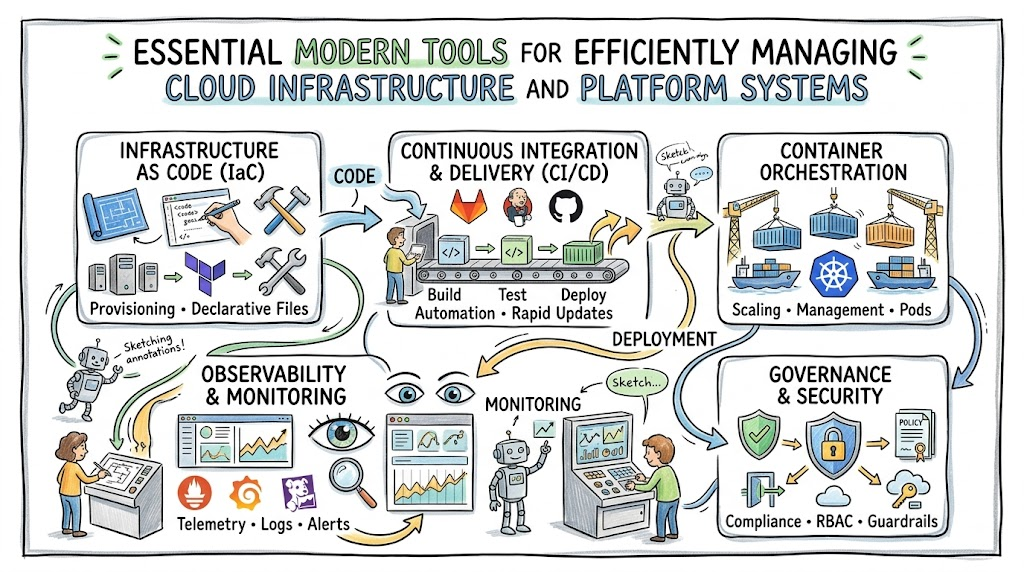
Managing modern cloud infrastructure requires a well-structured ecosystem of automation, observability, and orchestration tools. As systems expand across multi-cloud environments and hybrid platforms, manual administration quickly becomes impractical and error-prone. Modern operations rely heavily on automated provisioning, declarative configuration management, and real-time observability to ensure reliability and speed. By implementing the right toolchain, organizations can scale resources effortlessly, enforce security compliance, and minimize operational downtime.
Adopting these strategic platforms allows engineering teams to shift their focus from firefighting daily operational failures to delivering high-value product features. To build internal expertise and navigate this complex tooling ecosystem, organizations frequently turn to industry training resources like Xopsschool. Mastering these platforms empowers your infrastructure teams to maintain continuous delivery, optimize cloud expenses, and secure distributed workloads seamlessly.
Infrastructure as Code and Declarative Provisioning
Modern infrastructure management relies on Infrastructure as Code (IaC) to eliminate manual configuration drift and streamline resource delivery. Declarative tools enable engineers to define networks, compute clusters, and storage buckets using clean configuration files stored in version control. Consequently, infrastructure changes follow the exact same rigorous review and testing workflows as application code.
By utilizing platforms like Terraform or OpenTofu alongside provider-native templates, teams gain reproducible, consistent environments across multi-cloud footprints. Whenever updates occur, these tools automatically calculate execution plans to highlight changes before applying them to live environments. This automated process minimizes human error, improves auditability, and dramatically reduces deployment cycle times.
Container Orchestration and Cluster Automation
Running microservices at scale requires container orchestration platforms that automate scheduling, self-healing, and networking. Kubernetes has become the standard platform for orchestrating containerized workloads across public clouds and on-premises data centers. It dynamically allocates compute capacity, manages service discovery, and automatically balances traffic across healthy application instances.
Furthermore, management layers like Red Hat OpenShift and SUSE Rancher simplify the deployment and maintenance of enterprise-grade Kubernetes clusters. These platforms provide built-in security profiles, centralized cluster registries, and automated rolling update capabilities. As a result, engineering teams can operate thousands of individual containers with minimal administrative overhead.
Centralized Configuration and State Management
Maintaining operational consistency across a massive fleet of servers demands automated configuration management tools. Platforms such as Ansible, Puppet, and Chef allow operators to enforce desired system states across heterogeneous environments without writing repetitive manual scripts. Because tools like Ansible operate agentlessly over standard secure shell connections, rollout friction remains exceptionally low.
In addition to basic configuration, modern teams utilize these platforms to streamline OS patching, user management, and regulatory compliance checks. Whenever a configuration drift occurs on a target host, the automation engine corrects the discrepancy instantly. This predictable state management guarantees that staging, development, and production environments remain perfectly synchronized.
Cloud Observability and Telemetry Analysis
Operating distributed cloud applications without real-time observability is like flying an aircraft through dense fog without radar. Full-stack observability platforms like Datadog, Dynatrace, and New Relic aggregate metrics, distributed traces, and log data into unified visualization dashboards. These platforms continuously analyze system behavior to identify performance regressions and resource bottlenecks before they impact end users.
Moreover, modern observability platforms incorporate automated anomaly detection to correlate events across complex microservice dependencies. Rather than digging through fragmented server logs, on-call engineers receive enriched alerts with direct diagnostic context. This comprehensive visibility drastically reduces the mean time to resolution and ensures continuous service availability.
Key Operational Concepts You Must Know
GitOps and Continuous Deployment Pipelines
GitOps represents an operational framework that uses Git repositories as the single source of truth for all infrastructure definitions. Whenever an engineer merges a pull request, automated deployment agents continuously reconcile the live infrastructure state with the repository. This approach provides an immutable audit log, facilitates instant rollbacks, and prevents unauthorized manual modifications directly inside cloud environments.
Additionally, integrating GitOps engines like ArgoCD or Flux directly into continuous deployment pipelines accelerates software release velocity. Developers can deploy complex application updates simply by committing configuration changes to a branch. This declarative workflow empowers development teams while maintaining tight operational governance.
Policy as Code and Automated Governance
Managing cloud resources safely requires automated guardrails that prevent misconfigurations before they reach production environments. Policy-as-code frameworks allow security and compliance teams to codify regulatory requirements into machine-readable policies. Tools like Open Policy Agent systematically scan infrastructure templates to block insecure networking rules or exposed database instances.
Furthermore, these automated validation checks run seamlessly within pre-commit hooks and pull request pipelines. If a configuration violates internal security standards, the continuous integration pipeline fails immediately with actionable feedback. This proactive enforcement ensures that your systems remain continuously compliant without slowing down engineering momentum.
Platform Implementation vs. Culture — What’s the Real Difference?
| Operational Dimension | Platform Implementation Focus | Cultural Alignment Focus |
|---|---|---|
| Primary Goal | Deploying orchestration engines, provisioning pipelines, and monitoring tools. | Cultivating collaborative ownership, continuous learning, and blameless communication. |
| Daily Activity | Writing declarative code templates, configuring agents, and tuning dashboards. | Conducting blameless retrospectives, sharing knowledge, and eliminating organizational silos. |
| Measurement Criteria | Infrastructure deployment frequency, platform uptime, and resource utilization. | Inter-team trust, proactive problem-solving, and cross-functional operational ownership. |
| Organizational Impact | Establishes the technical baseline and automated capabilities for rapid scaling. | Ensures the long-term sustainability and effectiveness of platform investments. |
Deploying advanced infrastructure tools without addressing team dynamics inevitably leads to operational friction and underutilized platforms. If teams continue working in isolated silos, automated tools will only accelerate the creation of fragmented, uncoordinated resources. Therefore, successful cloud transformations require pairing modern platform adoption with an empathetic engineering culture that encourages experimentation and shared responsibility.
Real-World Use Cases of Modern Operations
Automated Disaster Recovery and Failover
Consider an enterprise that hosts critical customer-facing services across multiple geographical cloud regions. In a traditional infrastructure model, failing over during a regional outage required hours of high-stress manual intervention and DNS reconfiguration. With declarative infrastructure and automated orchestration, the platform detects regional degradation automatically and routes traffic to healthy standby clusters.
[Regional Outage Detected] -> [Health Checks Fail] -> [Traffic Rerouted via Global Load Balancer] -> [Standby Clusters Scale Up]
Because the entire infrastructure topology is maintained as code, the system can automatically recreate missing compute instances on demand. This rapid, automated failover protects critical revenue streams and guarantees business continuity during major service disruptions.
Continuous Dynamic Autoscaling
High-growth digital applications often experience unpredictable traffic surges that strain traditional static server setups. Modern cloud management platforms leverage dynamic horizontal pod autoscaling to adjust capacity in direct response to incoming demand. When queue lengths or CPU utilization spikes, the orchestration engine provisions additional application pods and worker nodes within seconds.
- Metric Monitoring: Telemetry agents detect an incoming surge in user transaction requests.
- Capacity Trigger: The orchestrator automatically signals the infrastructure layer to scale worker nodes.
- Pod Scheduling: New application containers deploy immediately across newly allocated compute resources.
- Scale Down: Resources terminate gracefully once traffic returns to normal baselines to minimize costs.
This dynamic elasticity guarantees high application performance during peak periods while preventing wasteful spending during off-peak hours.
Common Mistakes in Operations Engineering
Uncontrolled Cloud Sprawl and Orphaned Resources
A frequent operational pitfall in enterprise cloud environments is the rapid accumulation of unmanaged, abandoned resources. Developers frequently provision test virtual machines, unattached storage volumes, and isolated database instances, only to forget them once testing concludes. This uncontrolled sprawl inflates monthly infrastructure invoices and creates unmonitored security vulnerabilities across your cloud accounts.
To combat resource sprawl, teams must enforce strict resource tagging policies and automated cleanup lifecycles. Implementing continuous cost governance tools helps identify unutilized assets and notifies resource owners automatically. Regularly auditing your cloud inventory ensures optimal expenditure and reduces the potential attack surface.
Neglecting State File Security in Infrastructure as Code
Another critical error is failing to secure and version Infrastructure as Code state files properly. State files frequently contain sensitive information, including plaintext connection strings, access tokens, and administrative credentials. Storing these files in unsecured or unencrypted storage buckets exposes your entire infrastructure topology to potential compromise.
[Insecure State Storage] -> [Credential Exposure] -> [Unauthorized Infrastructure Alterations]
To eliminate this vulnerability, teams must store state files in encrypted, remote object storage with strict access controls and state-locking mechanisms. Additionally, separating production and non-production state environments prevents accidental resource destruction during routine infrastructure updates.
How to Become an Operations Expert — Career Roadmap
Mastering Core Infrastructure and Automation Concepts
Aspiring cloud infrastructure professionals must start by mastering fundamental networking protocols, Linux administration, and storage architectures. Understanding subnetting, DNS resolution, and kernel process management provides the essential troubleshooting foundation for distributed systems. Once you understand the core mechanics of compute environments, prioritize learning modern automation languages like Python and Go.
Role-Based Skills and Mastery Matrix
- Associate Cloud Administrator:
- Master foundational cloud provider services, standard identity access management, and Linux server maintenance.
- Learn declarative infrastructure syntax to provision basic virtual machines, storage, and networking components.
- Build foundational skills in container management using Docker and basic container runtime engines.
- Senior Platform Engineer:
- Design and maintain resilient multi-cluster Kubernetes environments across diverse infrastructure footprints.
- Build automated continuous integration and continuous deployment pipelines using modern GitOps frameworks.
- Implement enterprise observability solutions with automated alerting and centralized distributed tracing.
- Principal Infrastructure Architect:
- Define enterprise-wide cloud governance, automated security guardrails, and FinOps cost optimization strategies.
- Align technical infrastructure roadmaps with core business initiatives and long-term organizational scaling goals.
- Mentor engineering teams and establish collaborative platform engineering practices across all technical departments.
FAQ Section
- What is the difference between Infrastructure as Code and Configuration Management?Infrastructure as Code focuses on provisioning and modifying cloud resources like virtual networks, storage, and compute instances. In contrast, configuration management specializes in configuring operating systems, installing software packages, and maintaining system state inside those provisioned instances.
- Why is Kubernetes considered an industry standard for cloud infrastructure management?Kubernetes provides a standardized, vendor-neutral API for deploying, scaling, and managing containerized applications across any cloud environment. Its rich ecosystem, self-healing architecture, and vibrant open-source community make it the most versatile platform for running microservices.
- How does GitOps enhance security and stability in production environments?GitOps requires all infrastructure and application changes to pass through version-controlled pull requests, ensuring complete auditability and peer reviews. Furthermore, automated reconciliation agents continuously overwrite unauthorized manual changes to maintain environment consistency.
- What are the most critical metrics to monitor for healthy cloud infrastructure?Engineers should track resource utilization metrics such as CPU and memory usage alongside application latency, error rates, and network throughput. Tracking these four golden signals provides immediate insight into both infrastructure performance and user experience.
- How can organizations effectively balance cloud automation with cost control?Teams can manage cloud expenditures by pairing automated infrastructure provisioning with dynamic autoscaling and automated resource scheduling. Implementing FinOps cost visibility tools allows teams to track spending by department and eliminate idle infrastructure promptly.
Final Summary
Managing modern cloud infrastructure effectively demands a balanced approach that combines declarative provisioning, container orchestration, and continuous observability. By leveraging automated toolchains, engineering organizations eliminate repetitive manual tasks and drastically reduce operational failure rates. Furthermore, implementing robust governance frameworks and policy-as-code ensures that rapid deployment cycles do not compromise security or compliance standards.
Ultimately, successful infrastructure management relies on combining powerful technical platforms with a collaborative, forward-thinking engineering culture. Investing in continuous professional development and fostering cross-functional alignment empowers teams to navigate complex multi-cloud ecosystems with confidence. As your platform evolves, adopting these modern operational practices ensures your systems remain scalable, cost-efficient, and resilient against unexpected disruptions.