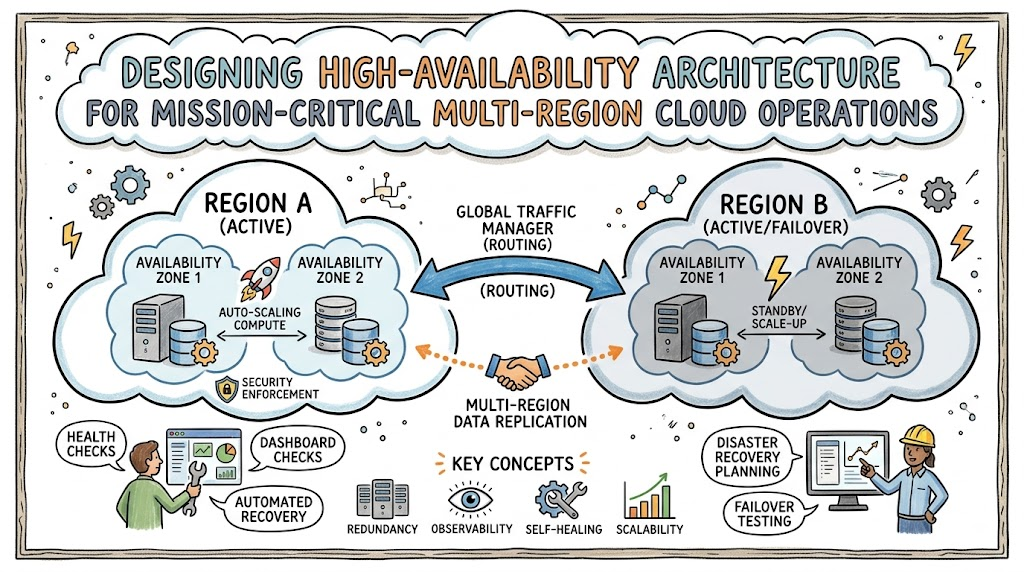
Modern cloud infrastructure demands resilient architectures capable of surviving localized hardware crashes, data center outages, and unexpected regional disruptions. Consequently, organizations must transition away from legacy, single-instance deployments toward distributed, self-healing cloud ecosystems. Achieving true high availability requires deep redundancy, automated failover pipelines, active traffic routing, and real-time observability across all computational layers. By embedding these operational best practices into your deployment lifecycles, your team can maintain continuous uptime and deliver seamless user experiences.
When building modern high-availability infrastructure, engineering teams often seek structured guidance, operational frameworks, and advanced training platforms such as Xopsschool. Mastering these architectural patterns allows operations engineers to safeguard critical business transactions and eliminate single points of failure across complex environments. Ultimately, high availability is not a one-time product purchase; rather, it is a continuous engineering discipline that combines intelligent automation, scalable infrastructure, and robust operational readiness.
Architectural Redundancy Across Availability Zones
To establish continuous service uptime, engineering teams must implement compute and data redundancy across physically isolated availability zones. For that reason, deploying instances across multiple distinct data centers ensures that a localized power or network failure will not take down your entire production workload. Whenever traffic spikes or a hardware node deteriorates, automated load balancers must immediately route incoming requests away from unhealthy nodes to properly functioning instances. Building resilience directly into the network layer eliminates single points of failure before outages can degrade user experiences.
Moreover, true architectural redundancy requires synchronized data storage that replicates state continuously across separated geographic boundaries. You can accomplish this by configuring distributed database clusters that support automated primary-replica failovers and continuous transaction logging. Instead of relying on manual interventions during outages, your orchestration platform should automatically detect unresponsive database nodes and elevate healthy replicas within seconds. By distributing both compute workloads and persistent data layers, your infrastructure maintains complete operational continuity during localized disasters.
Key Operational Concepts You Must Know
Automated Health Checks and Intelligent Traffic Management
Modern distributed systems require sophisticated health-checking mechanisms to verify that services are not merely reachable, but genuinely operational. Therefore, you must implement deep application health endpoints that assess database connectivity, cache accessibility, and internal queue health before accepting incoming traffic. Whenever an endpoint begins returning elevated error rates or degraded response times, your intelligent traffic controllers should immediately throttle requests or reroute connections elsewhere. This granular visibility prevents cascading service failures from bringing down your entire ecosystem.
Furthermore, static DNS-based routing is rarely sufficient for handling real-time infrastructure degradation in high-throughput environments. Teams need dynamic global server load balancing combined with anycast routing to direct end users toward the closest, healthiest cluster dynamically. By analyzing real-time network latency and endpoint telemetry, your routing layer can gracefully shed load and isolate faulty microservices without human intervention. This automated traffic management guarantees that regional performance hiccups remain completely unnoticed by your global customer base.
Self-Healing Compute Clusters and Elastic Scaling
Relying on human operators to manually provision extra virtual instances during sudden traffic surges inevitably leads to degraded performance and downtime. Because of this limitation, high-availability architectures rely heavily on auto-scaling groups and container orchestration platforms to maintain desired operational capacity. Consequently, whenever compute utilization crosses predefined thresholds, your orchestration engine immediately schedules additional worker nodes to absorb the extra computational demand. This automated elasticity prevents resource exhaustion and keeps response latencies within acceptable service-level agreements.
In addition to scaling up during demand spikes, modern cloud clusters must actively monitor the underlying health of individual container pods and virtual nodes. If an application process crashes or becomes unresponsive, the container runtime automatically kills the unhealthy container and launches a pristine replacement instance elsewhere. This continuous reconciliation loop ensures that your operational baseline stays intact despite inevitable underlying hardware degradation. Embracing self-healing systems frees your engineering teams from constant firefighting and guarantees uninterrupted application delivery.
Platform Implementation vs. Culture — What’s the Real Difference?
| Operational Aspect | Platform Implementation Focus | Cultural Alignment Focus |
|---|---|---|
| Primary Objective | Deploying auto-scaling groups, multi-region balancers, and distributed data stores. | Fostering a blameless culture centered around chaos engineering and resilience testing. |
| Core Execution | Writing declarative infrastructure templates, health check probes, and failover scripts. | Conducting game days, running incident retrospectives, and training on-call rotations. |
| Success Metric | Uptime percentages, mean time to detect anomalies, and automated recovery latency. | Team psychological safety, post-mortem clarity, and proactive vulnerability discovery. |
| Long-Term Impact | Provides the technical mechanisms required to reroute traffic and scale compute nodes. | Empowers engineers to build inherently fault-tolerant applications without fear of failure. |
Selecting reliable multi-region cloud services is undeniably vital, yet technology alone cannot build high availability without proper cultural practices. If you deploy a fault-tolerant multi-cloud architecture but fail to regularly test your disaster recovery plans, an outage will still result in chaos. Therefore, organizations must couple technical safeguards with structured operational exercises like chaos experiments and scheduled game days. When teams actively practice responding to simulated failures, they build the organizational resilience needed to handle real production disasters smoothly.
Real-World Use Cases of Modern Operations
Active-Active Multi-Region Database Synchronization
Consider a high-frequency financial platform that requires round-the-clock availability for critical payments without any risk of data inconsistency. In a traditional active-passive deployment, failover to a secondary region requires manual database promotion, resulting in several minutes of costly operational downtime. However, adopting a multi-region active-active database deployment allows transactions to write directly to the nearest regional database node while data streams replicate asynchronously across global clusters. The system continuously reconciles write conflicts through distributed consensus algorithms without interrupting service.
[User Request] -> [Global Traffic Router] -> [Healthy Regional Cluster] -> [Active-Active Data Replication]
Because both regions remain active simultaneously, the complete failure of an entire cloud region results in zero downtime for end users. The global traffic manager simply redirects incoming requests to the surviving region within a few milliseconds. Meanwhile, automated replication queues buffer pending data transactions until the degraded region fully recovers. This architecture ensures uninterrupted service delivery, protects critical revenue streams, and maintains complete compliance with strict enterprise availability mandates.
Zero-Downtime Deployment Strategies with Canary Releases
Another essential use case involves updating microservice applications in production without disrupting active user sessions or risking sudden system-wide failures. When an engineering team releases new features, the continuous delivery pipeline provisions a parallel canary deployment that receives a tiny fraction of total production traffic. The automated monitoring system immediately analyzes real-time error rates, CPU consumption, and latency metrics from the canary instances against the stable baseline version. If the system detects any performance regression, the deployment pipeline rolls back instantly and automatically.
- Canary Provisioning: The pipeline deploys the new application version to a small, isolated cluster.
- Traffic Splitting: The service mesh routes five percent of live user traffic to the canary instance.
- Automated Telemetry: Monitoring tools evaluate error budgets and latency baselines continuously.
- Progressive Promotion: The pipeline increases traffic incrementally until total deployment completes smoothly.
By isolating software rollouts behind automated canary gates, you prevent bad code updates from impacting your entire customer base. This rigorous verification model gives development teams the confidence to deploy frequent software updates while maintaining rock-solid system stability.
Common Mistakes in Operations Engineering
Inadequate Disaster Recovery Testing and Documentation
One of the most dangerous oversights in modern cloud architecture is assuming that disaster recovery systems will function properly without regular validation. When organizations only test failover processes on paper, unexpected configuration drifts, expired security certificates, and broken scripts inevitably surface during real emergencies. As a result, what should have been a seamless five-minute recovery turns into hours of frantic troubleshooting. To avoid this catastrophe, you must regularly execute scheduled chaos engineering experiments and disaster recovery drills in staging and production environments.
Furthermore, operational runbooks and disaster recovery documentation must remain living documents that receive continuous updates alongside infrastructure modifications. If an on-call engineer needs to follow outdated recovery guides during a massive network outage, precious recovery time gets wasted on trial and error. Teams must automate disaster recovery testing through scripted game days that deliberately inject network latency and kill compute instances. Regularly exercising your failover systems ensures that your platform mechanics and human operators remain completely prepared for sudden crises.
Neglecting Shared Dependencies and Hidden Single Points of Failure
Engineering teams frequently build redundant multi-tier applications, yet inadvertently tie all components to a single centralized dependency, such as an un-replicated authorization service. When that single central dependency experiences a degraded state, the entire distributed application collapses regardless of how many redundant compute instances exist. This architectural flaw, known as a hidden single point of failure, undermines the entire investment made in high-availability cloud infrastructure. To resolve this, you must conduct deep dependency mapping to identify and decouple tightly bound microservices.
[Redundant Frontend] -> [Redundant Compute] -> [Single Shared Auth DB] -> [Catastrophic System Outage]
Additionally, organizations must implement robust caching layers and circuit breaker patterns to allow graceful service degradation whenever external APIs experience outages. If a downstream service becomes unreachable, the circuit breaker trips immediately to prevent cascading thread exhaustion across upstream applications. Removing shared hard dependencies and designing asynchronous failbacks protects your primary application workflows from sudden cascading collapse.
How to Become an Operations Expert — Career Roadmap
Mastering Distributed Systems and Cloud Architecture
To build a rewarding career as a high-availability cloud architect, you must develop a thorough understanding of distributed systems theory and network protocols. You need to understand the trade-offs of the CAP theorem, distributed consensus mechanisms, and how DNS propagation behaves across global networks. Once you master these fundamental concepts, focus your energy on learning container orchestration platforms, service mesh technologies, and declarative infrastructure automation tools. Being able to architect self-healing systems that span multiple cloud providers is a crucial skill for modern operations leaders.
Role-Based Skills and Mastery Matrix
- Junior Operations Engineer:
- Master foundational Linux administration, network diagnostics, and scripting for basic automation tasks.
- Learn how to configure basic load balancers, manage cloud compute instances, and read distributed metrics.
- Understand standard continuous deployment pipelines and container deployment workflows inside Kubernetes clusters.
- Senior High-Availability Specialist:
- Design multi-region active-active architectures and implement complex policy-driven automated scaling policies.
- Architect resilient service mesh topologies that handle traffic shaping, circuit breaking, and canary deployments.
- Lead incident response rotations, conduct blameless post-mortems, and build automated chaos engineering scenarios.
- Principal Cloud Architect:
- Define organizational resilience standards, disaster recovery strategies, and multi-cloud architectural frameworks.
- Collaborate with executive stakeholders to translate uptime requirements into cost-effective infrastructure designs.
- Mentor engineering organizations in building fault-tolerant software and establishing cultures of continuous operational excellence.
FAQ Section
- What is the difference between high availability and disaster recovery in cloud operations?High availability focuses on keeping your application continuously operational during component failures without manual intervention, while disaster recovery outlines the strategic processes used to restore complete operational functionality after a catastrophic, wide-scale outage.
- How does an active-active architecture differ from an active-passive setup during regional failovers?An active-active architecture serves live user traffic across multiple regions simultaneously, offering near-instantaneous automated failover, whereas an active-passive setup maintains an idle standby environment that requires traffic rerouting and service initialization during unexpected outages.
- Why are circuit breakers essential for maintaining system stability in distributed microservices?Circuit breakers prevent failing downstream services from exhausting compute threads in upstream callers by immediately returning fallback responses, which isolates localized errors and stops system-wide cascading failures across your infrastructure.
- How can organizations balance infrastructure costs while designing multi-region high-availability systems?Organizations should strategically identify mission-critical services that genuinely require multi-region active-active redundancy, while placing non-critical internal workloads in single-region multi-zone environments to balance operational resilience against cloud expenses.
- What role does chaos engineering play in validating cloud high-availability architectures?Chaos engineering deliberately injects controlled failures, such as server terminations or network latency, directly into running systems to proactively identify architectural weaknesses before they cause unpredicted outages in live production.
Final Summary
Achieving high availability across modern cloud platforms requires a comprehensive strategy that unites distributed architecture, intelligent automation, and proactive operational discipline. By deploying workloads across redundant availability zones, configuring dynamic load balancers, and establishing self-healing compute clusters, organizations eliminate single points of failure. Automated canary deployments and circuit breakers ensure that software updates and dependent outages never compromise system uptime.
Ultimately, technological solutions must be supported by an engineering culture that embraces continuous testing and chaos experiments. Investing in specialized training and modern operational frameworks equips your engineering teams with the expertise required to design, deploy, and maintain fault-tolerant systems. When you build resilience into every layer of your infrastructure, high availability shifts from an elusive goal into a reliable foundation for business growth.