Imagine a sudden operational bottleneck crashing a major financial transaction network during peak market hours. Consequently, millions of users lose access instantly, which triggers massive revenue losses and damages corporate reputation. Traditional infrastructure teams usually struggle to isolate the root cause because they operate in isolated data silos.
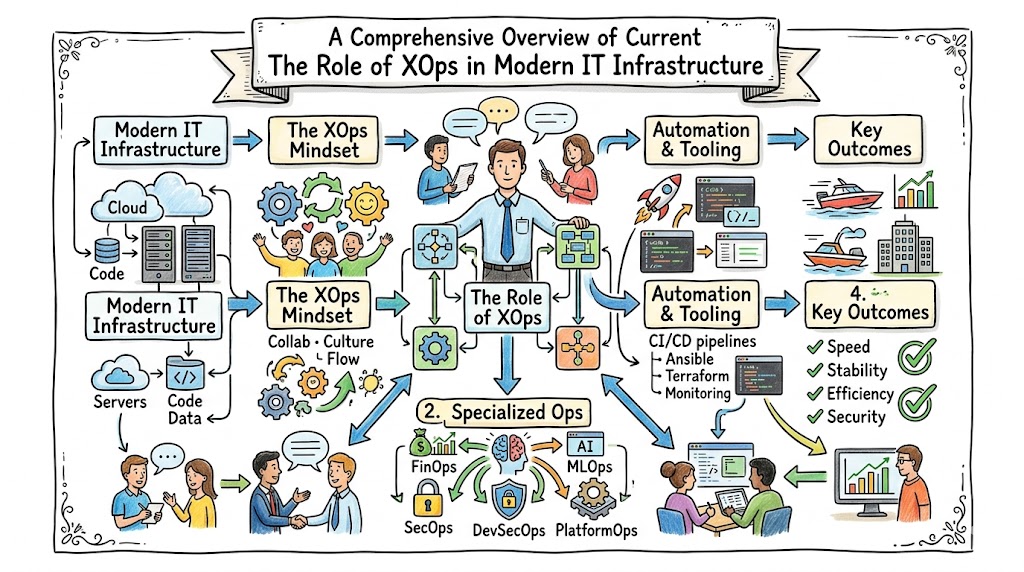
Fortunately, the emergence of the role of XOps in modern IT infrastructure changes this dynamic entirely by unifying diverse operations. This methodology integrates data, machine learning, and platform practices to build highly resilient digital ecosystems.
This comprehensive guide covers the foundational principles, real-world deployment strategies, and critical metrics required to master distributed systems. If you want to accelerate your career and build elite systems, you can explore the premium industry programs at Xopsschool.
The Origin of Systems Infrastructure
The Early Industrial Bottlenecks
Historically, traditional IT departments operated under rigid corporate structures where software developers and system administrators rarely communicated. As a result of this deep operational divide, software updates frequently failed when entering production environments.
Furthermore, manual server provisioning slowed down business agility significantly. Teams spent days configuring hardware, which created massive deployment bottlenecks.
Ultimately, these isolated environments caused frequent outages, prolonged resolution times, and heightened organizational frustration.
Moving Toward Unified Workflow Automation
Subsequently, the rise of virtualization and cloud environments forced a massive shift toward automated processes. Engineers realized that manual infrastructure management could no longer match rapid application development cycles.
Therefore, organizations began breaking down traditional team silos to build unified workflow automation pipelines. By treating infrastructure as code, teams successfully merged development practices with core system operations.
This critical transformation enabled continuous integration, which drastically reduced deployment errors while boosting release velocity.
Global Expansion Across Commercial Ecosystems
Eventually, this highly automated operational framework spread across large-scale tech enterprises worldwide. Global businesses discovered that standard automation practices needed to expand into specialized domains.
Consequently, specialized variants like MLOps, FinOps, and DevSecOps began emerging to handle unique corporate challenges. Modern infrastructure now requires a holistic combination of these diverse operational methodologies.
Today, this interconnected ecosystem ensures that security, cost efficiency, and data intelligence remain integrated throughout the delivery lifecycle.
Defining Strategic Operations Management
The Core Operational Structure
The underlying architecture of modern systems management relies on continuous feedback loops and automated data pipelines. Specifically, data flows smoothly from application monitoring agents directly into centralized analytical platforms.
Then, intelligent correlation engines process these incoming system signals to detect early performance degradation. This structural setup ensures that telemetry insights guide engineering decisions rather than guesswork.
Consequently, organizations maintain a clear, real-time view of their entire global infrastructure footprint.
[System Telemetry] ──> [Centralized Analytics] ──> [Correlation Engines] ──> [Automated Remediation]
Daily Tasks of Systems Coordinators
On any given day, system specialists execute a wide variety of engineering and analytical tasks. For instance, they write automated scripts to replace repetitive manual server configurations.
Additionally, they review system performance metrics to optimize cloud resource consumption. They also run proactive simulations to verify that disaster recovery protocols function correctly under pressure.
Finally, these experts collaborate closely with product developers to design highly resilient software delivery pipelines.
Localized Control vs. Broad System Architecture
To understand the full operational landscape, engineers must balance specific components against wide system architecture. Localized control focuses intensely on optimizing individual microservices or single database instances.
Conversely, broad system architecture manages the entire interconnected network of distributed applications. While micro-optimizations improve local speed, broad system design ensures long-term global resilience.
Therefore, successful teams learn to master both viewpoints to maintain optimal system health.
The Efficiency Mindset
Transitioning to this modern framework requires a profound cultural shift toward long-term system stability. Instead of simply fixing broken servers, engineers focus on building self-healing software architectures.
This mindset values proactive error prevention over reactive incident firefighting. Thus, teams dedicate substantial time to engineering sustainable solutions that eliminate systemic weaknesses permanently.
Ultimately, this cultural transformation builds a highly stable environment that supports rapid corporate innovation.
The 7 Core Principles of The Role of XOps in Modern IT Infrastructure
1. Embracing Risk and Managing Variability
Modern engineering principles explicitly acknowledge that software components will inevitably fail at some point. Therefore, teams stop chasing impossible uptime metrics and focus instead on managing acceptable risks.
By defining clear operational boundaries, organizations accept minor faults to accelerate feature delivery. This strategic approach allows businesses to innovate quickly without jeopardizing core system stability.
2. Establishing Service Level Objectives (SLOs)
Setting clear, quantifiable targets ensures that engineering teams stay aligned on performance expectations. Specifically, these objectives define the exact level of reliability your users actually need.
By tracking these metrics closely, businesses create an objective framework for operational decision-making. Consequently, teams can confidently decide when to push new features or freeze deployments.
3. Eliminating Toil and Manual Processes
Repetitive, manual operational tasks regularly drain engineering time and reduce overall organizational velocity. Because of this issue, modern frameworks prioritize identifying and systematically eliminating manual toil.
Engineers use automated software tools to handle routine maintenance, user provisioning, and standard configurations. As a result, valuable human talent can focus entirely on high-impact architectural improvements.
4. Monitoring & Observability Across the Pipeline
Comprehensive visibility across the entire deployment environment is essential for preventing major system outages. Modern telemetry practices combine logs, metrics, and distributed traces into a single view.
This deep observability allows engineers to track requests as they move across complex microservices. Consequently, teams quickly isolate performance bottlenecks before they impact end users.
5. Automation Over Manual Coordination
Scaling modern IT operations efficiently requires a profound reliance on software-driven automation solutions. Instead of manually coordinating complex multi-stage deployments, teams use intelligent orchestration tools.
These automated engines handle rollbacks, scaling events, and security validation independently. Therefore, organizations minimize human error while maintaining consistent infrastructure states across environments.
6. Release Engineering and Deployment Stability
Safe and predictable application delivery forms the bedrock of modern infrastructure management. Engineers design automated canary releases and blue-green deployments to minimize production risks.
These advanced strategies isolate new code variations, allowing safe testing against live user traffic. If anomalies surface, automated rollback mechanisms instantly restore the previous stable system state.
7. Simplicity in Network Architecture
Complex infrastructure designs naturally increase the overall failure surface of modern enterprise systems. Hence, operations engineers continually advocate for clean, minimal, and highly uniform architectural patterns.
By removing unnecessary software layers and redundant configurations, troubleshooting becomes significantly easier. This dedication to simplicity keeps systems understandable, maintainable, and remarkably resilient over time.
Key Operational Concepts You Must Know
SLA vs. SLO vs. SLI — Explained Simply
Understanding the distinct differences between operational agreements, objectives, and indicators is vital for tracking success.
- Service Level Agreement (SLA): The formal commitment made directly to external customers, including financial penalties if broken.
- Service Level Objective (SLO): The internal target metric that teams aim for to keep customers satisfied.
- Service Level Indicator (SLI): The precise, real-time measurement showing how well a specific system is performing.
Error Budgets — The Game Changer for Operational Risk
An error budget represents the exact amount of system downtime an organization is willing to tolerate. For example, if your internal target requires a specific level of performance, the remaining margin is your budget.
When your error budget is full, developers can rapidly ship innovative new features to production. However, if unexpected outages consume this entire budget, teams must immediately halt new releases.
During this freeze, engineers focus exclusively on improving system reliability and patching architectural vulnerabilities.
Toil — The Silent Productivity Killer in Infrastructure
Toil defines the specific manual, repetitive operational tasks that lack long-term engineering value. For clarity, the following table compares typical toll tasks against strategic engineering work:
| Characteristics of System Toil | Characteristics of Strategic Engineering |
| Manual and highly repetitive | Automated and scalable |
| Lacks long-term architectural value | Builds long-term systemic value |
| Scales linearly with system growth | Reduces future operational overhead |
| Focuses entirely on immediate fixes | Addresses underlying root causes |
To eliminate this productivity drain, teams must carefully calculate hours spent on manual work. Once identified, engineers develop automated software scripts to execute these tasks seamlessly without human intervention.
Incident Management & Postmortems
When severe infrastructure outages occur, modern organizations initiate structured, blameless postmortem processes. Instead of punishing individual engineers for human mistakes, teams focus on identifying systemic flaws.
Engineers conduct thorough root cause analyses to uncover why the system allowed the failure to happen. The final document details explicit remediation actions designed to prevent identical outages in the future.
This open, transparent approach turns frustrating operational failures into valuable learning opportunities for everyone.
Capacity Planning
Proactive capacity planning ensures that large-scale infrastructure stays ahead of growing consumer demand. Engineers analyze historical usage trends to forecast future compute, storage, and networking requirements.
By understanding these patterns, businesses avoid sudden performance degradation during major traffic spikes. Additionally, automated cloud scaling protocols help optimize infrastructure costs during low-demand periods.
The Four Golden Signals of Pipeline Performance
To maintain deep visibility into distributed systems, engineers track four foundational telemetry metrics:
| Metric Name | Focus Area | Measurement Detail |
| Latency | Speed | The time it takes to service a specific request |
| Traffic | Demand | The total volume of concurrent requests on the system |
| Errors | Failure | The rate of requests that fail explicitly or implicitly |
| Saturation | Capacity | The total fraction of system resources currently utilized |
Monitoring these four golden signals enables operations teams to diagnose underlying system strain quickly.
Platform Implementation vs. Culture — What’s the Real Difference?
The Philosophy Difference
While some professionals treat infrastructure paradigms purely as a cultural mindset, others view them as a set of technical tools. The cultural perspective focuses on breaking down organizational barriers, sharing responsibilities, and embracing risk.
Conversely, the platform perspective delivers concrete internal developer portals and automated infrastructure patterns. Culture builds the collaborative environment, whereas platform implementation provides the physical machinery to execute the vision.
Roles & Responsibilities Compared
- Cultural Framework Champions: Foster open communication, facilitate postmortems, and eliminate organizational silos across teams.
- Platform Engineers: Build automated delivery pipelines, manage Kubernetes clusters, and maintain shared infrastructure components.
- Operations Specialists: Monitor systemic health, define error budgets, and resolve complex distributed infrastructure incidents.
Can You Have Both Disciplines?
Modern enterprises do not have to choose between cultural alignment and advanced platform engineering. In fact, these two operational philosophies complement each other perfectly within a mature IT organization.
A strong collaborative culture encourages developers to use shared internal platform tools responsibly. Meanwhile, robust automated platforms make it significantly easier for teams to uphold rigorous operational standards.
Which One Should Your Team Adopt?
Choosing the right starting point depends heavily on your current company size and engineering maturity. Small startups should prioritize building a collaborative, shared-responsibility culture before investing heavily in custom tooling.
In contrast, large enterprises with hundreds of developers require dedicated platform teams to manage massive scale. Evaluate your biggest operational bottlenecks carefully to determine where to focus your engineering resources.
Real-World Use Cases of Modern Operations
How Tech Leaders Use Operational Metrics
Top-tier enterprise software organizations track billions of daily telemetry points to maintain optimal system performance. By using advanced visualization platforms, these businesses spot micro-trends before they turn into major outages.
Furthermore, data-driven operational metrics allow leadership to make informed investments in core infrastructure upgrades. This analytical approach removes emotion from system management, ensuring that resources go where they are needed most.
Chaos Engineering Approaches to Resilient Systems
Elite cloud engineering teams intentionally inject controlled failures into production environments to uncover hidden architectural weaknesses. For instance, automated tools randomly terminate virtual servers or introduce artificial network latency.
These chaos experiments verify that automated self-healing systems react correctly under real-world duress. By breaking things on purpose during working hours, teams confidently prevent catastrophic outages in the middle of the night.
Handling Reliability at Massive Scale
Global hyper-scale platforms utilize distributed microservice architectures to process millions of concurrent transactions smoothly. To survive this immense volume, engineers deploy advanced traffic-routing patterns and global load balancers.
They also implement strict rate-limiting protocols to protect fragile downstream backend databases from sudden traffic spikes. These combined strategies ensure that localized system failures never cascade across the entire international infrastructure.
High-Availability in Fintech Operations
Financial technology platforms operate under strict regulatory mandates that demand zero tolerance for transaction downtime. Therefore, operations engineers build multi-region Active-Active infrastructure configurations that replicate data instantly.
If an entire cloud data center loses power, automated failover systems reroute traffic seamlessly in milliseconds. This extreme level of redundancy guarantees continuous payment processing while maintaining absolute data integrity.
Scaled-Down but Essential Systems for Startups
Early-stage technology companies do not need to build massive, overly complex multi-region architectures immediately. Instead, small teams apply core operational principles by utilizing managed cloud services and lightweight automation pipelines.
By defining simple SLOs and automating basic deployment steps, startups protect their velocity while maintaining system stability. This lean approach provides a solid foundation for scaling infrastructure smoothly as the user base grows.
Common Mistakes in Operations Engineering
Mistake 1 — Confusing System Management with Just Being On-Call
Many organizations mistakenly believe they have adopted modern infrastructure practices simply by handing engineers an alert pager. However, true operational excellence focuses on proactive software engineering rather than constant reactive firefighting.
If your team spends all their time answering pages, they cannot build scalable, automated solutions. True specialists must have dedicated time to write code that prevents incidents from recurring.
Mistake 2 — Setting Unrealistic SLOs
Enthusiastic business leaders frequently demand perfect uptime metrics without understanding the associated architectural costs. Demanding flawless performance stalls feature releases completely because developers must avoid all operational risks.
Furthermore, chasing unrealistic uptime goals burns out engineering teams and inflates cloud infrastructure expenses unnecessarily. Smart organizations set reasonable reliability targets that align with actual customer satisfaction thresholds.
Mistake 3 — Ignoring Toil Until It’s Too Late
Neglecting repetitive manual tasks allows operational debt to accumulate rapidly within an expanding technology organization. As the infrastructure grows, manual user onboarding and server patching consume the team’s entire weekly capacity.
Consequently, critical engineering velocity slows down to a crawl, and morale drops significantly. Teams must systematically identify and automate away toil before it completely overwhelms their engineering resources.
Mistake 4 — Skipping Blameless Postmortems
When a major system failure occurs, pointing fingers at individual developers destroys engineering collaboration. Punishing human errors causes team members to hide infrastructure flaws and minimize transparent technical discussions.
By skipping blameless postmortems, organizations lose the opportunity to fix deep, underlying systemic vulnerabilities. Embracing a blameless culture ensures that teams collaborate openly to make the environment safer for everyone.
Mistake 5 — Monitoring Without Actionable Alerts
Configuring monitoring systems to trigger loud notifications for minor, non-critical events creates massive alert fatigue. Engineers quickly become desensitized to constant notifications, which leads them to ignore critical system warnings.
Every alert sent to a human responder must require immediate, well-defined technical action. If a system anomaly does not need urgent human intervention, it should be logged silently or automated away.
Mistake 6 — Not Involving Operational Engineers in the Design Phase
Software development teams frequently design complex system architectures without consulting operational specialists during the initial planning stages. As a consequence, code arrives in production with severe scaling limitations and poor observability.
Fixing these deep architectural flaws after deployment is significantly more expensive than addressing them early. Involving operations experts from day one ensures that systems are built for long-term production reliability.
Essential Infrastructure Tools & Technologies
Monitoring & Observability
Maintaining deep visibility into complex, highly distributed environments requires robust telemetry collection tools. Industry standard platforms process massive volumes of system metrics and logs concurrently.
These comprehensive observability suites allow engineering teams to build detailed real-time dashboards and spot performance anomalies instantly.
- Prometheus: An open-source time-series database optimized for scraping high-dimensional metric data.
- Grafana: A visualization engine that turns complex telemetry data into beautiful, actionable operational dashboards.
- Datadog: A unified SaaS monitoring platform that provides deep full-stack observability across cloud environments.
- New Relic: An application performance monitoring tool designed to trace requests and isolate code bottlenecks.
Incident Management
When critical infrastructure outages happen, teams need organized communication platforms to coordinate rapid responses. These specialized modern tools route urgent alerts to the correct on-call engineers instantly.
They also manage escalation paths and track incident resolution timelines automatically to streamline operations.
- PagerDuty: An automated incident response platform that integrates with monitoring tools to alert on-call teams.
CI/CD & Release Engineering
Automating the software delivery pipeline ensures that infrastructure changes and application updates roll out safely. These advanced automation engines run automated tests, validate security compliance, and manage production deployments.
- Jenkins: A highly customizable open-source automation server used to build custom continuous integration pipelines.
- Argo CD: A declarative GitOps continuous delivery tool designed specifically for native Kubernetes applications.
- Spinnaker: A multi-cloud continuous delivery platform built for executing reliable, large-scale application deployments.
Chaos Engineering
Building highly resilient systems requires specialized tools that intentionally inject controlled failures into live environments. These automated frameworks help engineers discover hidden software vulnerabilities safely before they cause unexpected customer outages.
- Chaos Monkey: A resilient testing tool that randomly terminates production server instances to verify self-healing capabilities.
SLO Management
Tracking customer satisfaction thresholds requires dedicated software solutions that measure reliability against agreed targets. These innovative platforms calculate error budgets continuously, helping teams balance feature velocity with infrastructure safety.
- Nobl9: An enterprise SLO platform that integrates with existing data sources to track reliability metrics.
How to Become an Operations Expert — Career Roadmap
Skills Every Specialist Must Have
Starting a career in modern systems management requires a strong foundation in core technical disciplines. First, you must master the command line and feel comfortable navigating complex server environments using terminal commands.
Next, learn at least one major scripting language to automate repetitive administrative tasks efficiently. Finally, gain a deep understanding of cloud networking concepts, containerization, and modern infrastructure-as-code principles.
The Professional Learning Path
The educational journey progresses systematically from managing individual local servers to designing massive global architectures. Begin by mastering basic operating system concepts, file permissions, and simple network configuration protocols.
After that, transition into learning container orchestration tools to manage distributed application deployments. Ultimately, you will learn to design complex, multi-region cloud architectures that feature automated self-healing mechanisms.
Certifications Worth Pursuing
Validating your technical infrastructure expertise requires obtaining industry-recognized professional credentials. Earning these certifications demonstrates your dedication to mastering complex cloud environments to potential employers.
Focus on securing certifications from major public cloud providers and open-source container orchestration foundations. These structured credentials provide a clear path for advancing your technical career rapidly.
Educational Resources with Xopsschool
To accelerate your professional development, you need access to structured, hands-on learning materials. Enrolling in specialized industry programs provides the deep practical experience required to master modern infrastructure management.
Experienced mentors guide you through real-world labs, cloud architecture simulations, and advanced automation scripting workshops. Exploring these comprehensive educational resources equips you with the skills needed to thrive as an elite systems expert.
The Future of Systems Management
AI and Automation in System Optimization
The integration of machine learning algorithms is completely revolutionizing how enterprises manage large-scale cloud infrastructure. Automated systems now analyze massive streams of telemetry data to predict impending hardware failures before they occur.
Furthermore, intelligent software-driven engines automatically adjust resource allocations to optimize application performance dynamically. This shift reduces the need for human intervention, allowing operations teams to focus entirely on strategic architecture.
Platform Engineering — The Evolution of Infrastructure
Internal platform engineering is rapidly emerging as the preferred method for delivering scalable developer infrastructure. Instead of configuring custom environments manually, engineers build standardized, automated self-service internal developer portals.
This approach allows software developers to provision secure, compliant infrastructure templates independently with a single click. Consequently, organizations eliminate delivery bottlenecks while maintaining strict security controls across the entire enterprise ecosystem.
Management in Cloud-Native & Kubernetes Environments
As organizations migrate heavily toward containerized applications, managing vast microservice networks becomes increasingly complex. Modern infrastructure specialists must master advanced service meshes, dynamic ingress routing, and automated cluster scaling mechanisms.
These advanced tools ensure that thousands of interconnected containers communicate securely while utilizing underlying compute resources efficiently. Overcoming these orchestration challenges is vital for maintaining high availability across public cloud platforms.
Operational Skills That Will Matter Most
The next generation of infrastructure experts must expand their technical skill sets beyond traditional system monitoring. Professionals need to develop deep expertise in financial cloud cost optimization and advanced data observability tracing.
Additionally, understanding data privacy regulations and security-first infrastructure automation will become standard engineering requirements. Cultivating these advanced interdisciplinary skills ensures that you remain highly valuable in an evolving corporate landscape.
FAQ Section
- What are the foundational technical skills required to start a career in modern infrastructure operations?Aspiring specialists must master terminal commands, discover how to write automation scripts, and understand fundamental cloud networking principles thoroughly.
- How do error budgets balance the competing priorities of software developers and operations teams?Error budgets provide an objective, data-driven boundary that allows rapid innovation when full but halts releases to focus on stability when depleted.
- What is the typical salary trajectory for an experienced systems engineer entering the XOps domain?Professionals transitioning into advanced operational roles see substantial salary growth, with senior infrastructure architects earning premium compensation globally.
- Why is a blameless postmortem culture critical for improving long-term corporate infrastructure reliability?Removing personal blame encourages engineering teams to document failures transparently, which allows the organization to identify and fix deep systemic flaws permanently.
- How does platform engineering differ from traditional system administration duties in an enterprise setting?System administrators configure individual servers manually, whereas platform engineers write scalable software to deliver automated self-service infrastructure portals for developers.
- What role does chaos engineering play in validating the resilience of multi-region cloud deployments?Chaos engineering intentionally injects controlled infrastructure failures into live environments to prove that automated self-healing protocols function correctly under duress.
Final Summary
Maintaining optimal system health in modern IT infrastructure requires a dedicated commitment to automated observability, shared operational metrics, and proactive software engineering. By embracing risk intelligently and systematically eliminating manual toil, organizations build highly resilient digital ecosystems that scale effortlessly.
As automated platform engineering and machine learning optimization continue to reshape the corporate landscape, mastering these integrated operational methodologies becomes essential for long-term technical success. Embracing a comprehensive performance framework empowers modern enterprises to deploy software safely while maintaining absolute systemic stability.