Introduction
Accelerating software delivery separates market innovators from struggling organizations in our fast-moving digital economy. Brittle deployment scripts and frequent production downtime erode customer confidence and stall product momentum. Many technology leaders mistakenly believe that purchasing new enterprise software licenses will automatically resolve deep operational friction. Sustainable velocity requires businesses to transform team culture, automate routine operational chores, and enforce uncompromising platform standards.
Specialized advisors empower growing companies to construct resilient, automated application platforms. Establishing unified delivery workflows empowers software squads to compress release cycles from several weeks into single minutes while strengthening system performance.
What Does DevOps Actually Help a Business Do?
Technology organizations unify product developers and system operations teams to form an uninterrupted feedback loop. Breaking down historic department silos lets software engineers ship high-value features rapidly without endangering service stability. Automated build checks, standardized integration tests, and continuous delivery pipelines replace error-prone manual deployments.
Consequently, engineering leaders observe a steep drop in production defects and operational disruptions. Companies launch digital experiments much faster, enabling product owners to test market hypotheses directly against real customer metrics. Furthermore, automated compliance verifiers guarantee that company infrastructure satisfies security benchmarks without hindering feature delivery.
Why Are So Many Businesses Moving Toward DevOps?
Aggressive competitors challenge established firms daily by deploying continuous software improvements. Outdated operational approaches that depend on fragmented handoffs and lengthy approvals cannot survive modern market pressures. Research data demonstrates that high-performing software organizations encounter substantially fewer deployment defects and restore impaired systems dramatically faster than lagging competitors.
| Operational Capability | Traditional Siloed Delivery | Modern Automated Delivery |
|---|---|---|
| Deployment Cadence | Teams release monthly or quarterly | Engineers deploy updates several times daily |
| Change Failure Rate | Surpasses 25% of all production pushes | Remains under 5% across releases |
| Recovery Time (MTTR) | Requires hours or days of manual triage | Completes within minutes using rollbacks |
Therefore, adopting automated development practices represents an essential business strategy rather than a discretionary technical upgrade.
Where Can DevOps Consulting Make a Difference?
Overhauling corporate delivery workflows introduces complex architectural puzzles that can overwhelm internal teams. Seasoned DevOps Consulting Services inject deep technical insight, steering in-house squads through intricate cloud transitions. Dedicated technical mentors pinpoint bottlenecks across existing delivery pipelines, strip away redundant approval gates, and build robust deployment workflows.
During one major project, an enterprise payments provider slashed release cycle times from seven weeks down to forty minutes after introducing container templates and automated pipelines alongside external advisors.
What Are Managed DevOps Services and Who Needs Them?
Product engineers face severe burnout when leadership forces them to balance writing product features with maintaining servers day and night. Comprehensive Managed DevOps Services relieve this pressure by supervising live infrastructure, running routine cluster updates, maintaining delivery pipelines, and triaging production alerts.
- Early-Stage Tech Startups: Stand up mature cloud foundations swiftly without recruiting expensive dedicated platform staff.
- Mid-Sized Product Companies: Free application programmers to dedicate their attention to core revenue-generating features.
- Global Cloud Enterprises: Enforce uniform governance and consistent patching across hundreds of separate operational environments.
Offloading routine operational upkeep enables technical managers to stabilize infrastructure costs while preserving team energy.
How Does Cloud Computing Change the Way Teams Build Software?
Programmable cloud infrastructure replaces the tedious hardware provisioning cycles that once characterized on-premises facilities. Instead of submitting infrastructure request tickets, programmers spin up entire virtual data centers within seconds through declarative automation templates. Elastic computing resources allow software platforms to absorb immense traffic surges gracefully and spin down during idle hours to prevent unnecessary spending.
Moreover, modern cloud ecosystems facilitate decoupled microservices architectures that let independent squads release discrete services on their own schedules. Harnessing programmable cloud resources shifts infrastructure from an obstructive capital cost into a powerful agility engine.
When Should You Consider Cloud Consulting Services?
Adopting complex cloud architectures without disciplined technical oversight triggers ballooning invoices, over-permissioned security roles, and fragile architectures. Strategic Cloud Consulting Services guide business leaders as they build secure environments across Amazon Web Services, Microsoft Azure, and Google Cloud Platform. Experienced advisors establish immutable baseline configurations, set up centralized financial reporting, and configure strict access policies.
Seasoned platform architects frequently warn that expanding into the cloud without architectural discipline simply accelerates technical debt accumulation. Enlisting specialized cloud consultants guarantees that engineering organizations build resilient, cost-effective infrastructure from the start.
What Should You Know Before Moving Applications to the Cloud?
Moving legacy monolithic software into cloud instances without thoughtful refactoring inflates ongoing hosting costs and yields disappointing performance. Technology leaders must evaluate and categorize legacy portfolios using proven migration strategies: Rehost, Refactor, Replatform, or Retain.
- Audit Workload Dependencies: Map complex backend connections and shared databases before planning production cutovers.
- Architect Secure Networks: Establish private cloud subnets, dedicated interconnects, and centralized routing tables.
- Project Cloud Budgets: Calculate active data egress fees, storage retention expenses, and compute hours accurately.
Leveraging focused Cloud Migration Services ensures that core business applications transition seamlessly to the cloud without costly system downtime.
Why Is Kubernetes Becoming Important for Modern Applications?
Containers bundle application code with runtime dependencies, ensuring that software executes identically across developer laptops and live production servers. Managing thousands of distributed application containers by hand, however, invites operational disaster. Kubernetes resolves this container sprawl by orchestrating workload schedules, self-healing unhealthy instances, routing ingress traffic, and optimizing hardware consumption across compute fleets.
Because of this robust automation, Kubernetes operates as the universal management layer for distributed cloud environments. Software groups launch resilient applications that quickly recover from crashes and absorb sudden traffic spikes across active containers.
When Can Kubernetes Consulting Services Be Useful?
Running production-grade Kubernetes clusters demands deep familiarity with container network plugins, ingress controllers, persistent storage drivers, and access protocols. Knowledgeable Kubernetes Consulting Services assist engineering departments in deploying, securing, and tuning platforms like Amazon EKS, Azure AKS, and Google Cloud GKE.
Specialists help teams configure automated pod scaling, introduce service meshes, and implement zero-trust network boundaries. Partnering with container specialists helps teams avoid painful production outages and lets engineers consume container infrastructure without wrestling with complex cluster internals.
How Does DevSecOps Bring Security Into Everyday Development?
Old security practices functioned as an adversarial bottleneck at the end of the release cycle, sparking panic fixes and delayed launches. In contrast, modern DevSecOps Consulting Services inject security controls directly into routine coding activities. Automated scanners evaluate code bases, third-party libraries, and container configurations the moment a developer submits a pull request.
Moving security analysis into earlier development phases allows engineers to remediate flaws while the code context remains fresh in their minds. Thus, weaving automated checks directly into deployment pipelines shields enterprise systems while keeping development moving quickly.
Why Is Automation So Important for DevSecOps?
Manual compliance reviews cannot match the pace of top-tier engineering organizations that push software updates continuously. Human reviews create severe backlogs, tempting software squads to bypass security gates to satisfy launch deadlines. Automated vulnerability scanners remove this friction by checking application code, open-source libraries, and server configurations against real-time threat registries.
Static analysis engines inspect infrastructure templates before technicians ever provision live resources. Relying on automated policy engines enables organizations to enforce compliance baselines continuously without subjecting developers to tedious manual audits.
What Is SRE and Why Does Reliability Matter?
Site Reliability Engineering treats operations as an engineering problem that software solutions can resolve. Incorporating SRE Consulting Services redirects engineering teams away from unrealistic uptime goals toward mathematically grounded Service Level Indicators (SLIs) and Service Level Objectives (SLOs).
Product teams manage error budgets to strike a healthy balance between rapid feature releases and continuous system availability. When an outage consumes the allocated error budget, developers pause risky updates and focus on hardening system foundations. Embracing SRE principles safeguards digital user experiences, enhances brand loyalty, and protects corporate revenue.
How Can Better Observability Help Your Engineering Team?
Simple server uptime monitors cannot provide meaningful visibility into distributed modern microservices. Engineering teams require unified telemetry platforms that synthesize distributed execution traces, application logs, and system metrics inside a central interface. Deep observability enables platform engineers to pinpoint intermittent database delays and network timeouts across sprawling clusters.
Consequently, operations teams reduce mean time to resolution during critical production incidents. Developers track requests through complex microservice topologies effortlessly, fixing latent bugs before isolated glitches disrupt user workflows.
What Is Platform Engineering and Why Are Teams Adopting It?
Modern distributed cloud environments impose immense cognitive strain on application engineers. Developers squander valuable hours writing infrastructure declarations and troubleshooting broken delivery pipelines instead of creating business value. Strategic Platform Engineering Consulting Services solve this challenge by building Internal Developer Platforms (IDPs).
Platform engineering teams treat their internal tooling as an intuitive product that empowers internal software engineers. Giving developers self-service access to cloud environments reduces context switching, ensures operational consistency, and boosts overall engineering throughput.
What Are Golden Paths and How Do They Help Developers?
Golden paths provide supported, thoroughly documented templates that allow software engineers to deploy new application services safely and independently. Instead of designing continuous delivery workflows from scratch, developers choose curated starter templates loaded with pre-configured security guardrails, test runners, and deployment routines.
- Effortless Team Onboarding: Software developers provision production-ready microservices in minutes through clear self-service portals.
- Standardized Infrastructure Blueprints: Service manifests adopt company-wide security standards, monitoring agents, and logging configurations by default.
- Preserved Engineering Autonomy: Teams retain the freedom to customize configurations for unusual edge cases while standard paths remain the easiest choice.
Curated workflows relieve developers from repetitive infrastructure plumbing while guaranteeing consistent operational standards across the whole enterprise.
How Can Corporate DevOps Training Strengthen Internal Teams?
Purchasing modern developer platforms fails to yield business results when technical personnel lack the skills to operate them effectively. Structured Corporate DevOps Training eliminates knowledge deficits across developer, operations, and security departments.
Practical training programs build hands-on mastery in declarative infrastructure code, pipeline scripting, container orchestration, and reliability concepts. Furthermore, shared learning builds common communication habits across disparate departments, removing old organizational barriers. Upskilling existing engineers boosts workplace retention and creates a resilient engineering culture that drives technical innovation.
How Do DevOps, Cloud, Kubernetes, and SRE Work Together?
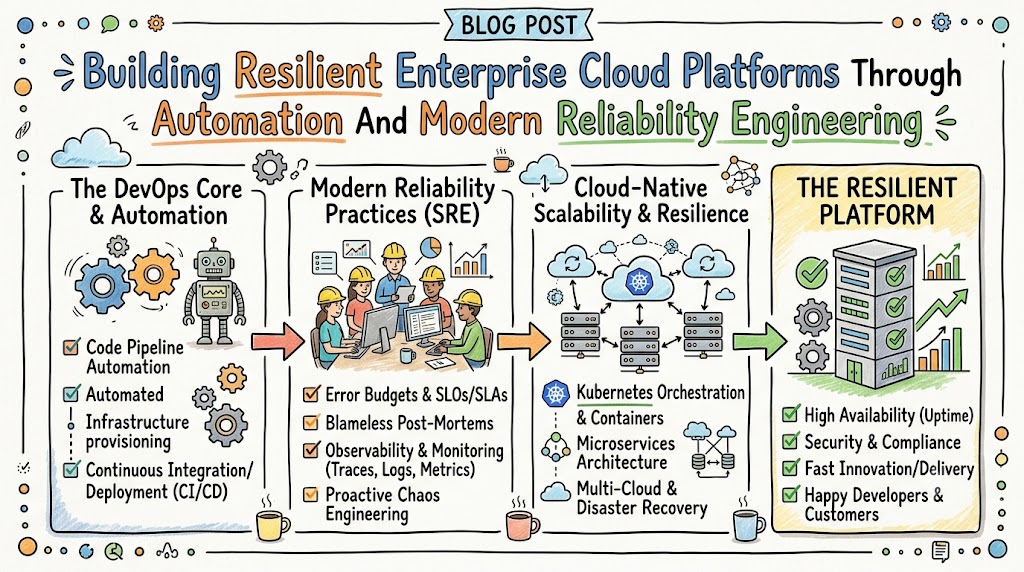
Modern software engineering triumphs when organizations harmonize complementary practices into an integrated platform vision. Elastic cloud environments supply on-demand computing capacity, which Kubernetes organizes into robust container clusters. DevOps pipelines deliver automated code changes to these container clusters smoothly. Concurrently, SRE frameworks maintain system uptime through proactive monitoring and automated failovers.
Combined, these operational disciplines form a resilient launchpad for enterprise growth. Organizations that master these interconnected disciplines consistently outperform their industry rivals in deployment velocity, platform resilience, and overall product quality.
What Problems Can Slow Down a DevOps Transformation?
Cultural inertia and entrenched operational silos present the most difficult roadblocks to successful organizational transformation. Departmental managers often defend territory, while application developers may treat security reviews as frustrating barriers. Uncontrolled tool adoption also creates friction when independent teams implement incompatible software without central technical alignment.
Furthermore, launching an operational reorganization without sustained executive sponsorship leaves engineering teams without the time needed to fix technical debt. Overcoming these hurdles requires empathetic leadership, transparent communication, and steady incremental achievements that prove tangible business value to executive stakeholders.
How Can You Tell Whether Your DevOps Strategy Is Working?
Measuring the genuine return on engineering investments demands objective, data-driven telemetry. The DORA metric system provides a clear, reliable standard for evaluating release velocity and operational resilience:
| DORA Operational Metric | Low-Performing Delivery Baseline | Elite Engineering Capability |
|---|---|---|
| Deployment Frequency | Pushes updates less than once a month | Deploys updates multiple times each day |
| Lead Time for Changes | Spans more than one month from code commit | Finishes in less than sixty minutes end-to-end |
| Change Failure Rate | Fails on 20% to 30% of changes | Sustains low failure rates (0% to 15%) |
| Mean Time to Restore (MTTR) | Requires days to fix live incidents | Restores broken services within minutes |
Monitoring these primary indicators exposes delivery friction clearly, enabling technology executives to guide engineering investments with precision.
What Does a Practical DevOps Roadmap Look Like?
Attaining lasting engineering transformation demands an incremental platform strategy rather than an abrupt, risky overhaul. Technology leaders must craft rollout initiatives that eliminate immediate operational headaches while methodically building foundational technical capabilities.
- Phase One (Foundations): Unify source version control, centralize artifact repositories, and implement automated build and test pipelines.
- Phase Two (Infrastructure as Code): Provision server environments using declarative templates, eliminating manual infrastructure changes.
- Phase Three (Containerization): Package application services into containers and run them on managed Kubernetes clusters to achieve consistent behavior.
- Phase Four (Reliability & Security): Embed vulnerability analyzers into delivery pipelines, define service level objectives, and launch unified telemetry dashboards.
- Phase Five (Developer Platforms): Build an internal developer platform with clear golden paths that let engineers deploy microservices independently.
Executing an incremental delivery roadmap guarantees continuous progress, controls delivery risk, and maintains high engineering velocity throughout the journey.
How Can Cotocus Support Your Modern Engineering Journey?
Modernizing enterprise delivery systems demands seasoned technical leadership, battle-tested architectural frameworks, and reliable operational support. Organizations that require immediate engineering capacity rely on DevOps Outsourcing Services from Cotocus to embed top-tier DevOps, Kubernetes, and reliability specialists directly into their delivery squads.
Whether your organization requires focused DevOps Consulting Services, end-to-end cloud migrations, or targeted Corporate DevOps Training, Cotocus supplies experienced engineers who align technical tasks directly with core commercial goals. Our specialists collaborate with your internal teams to design dependable release pipelines, build resilient cloud environments, and cultivate an exceptional engineering culture.
Frequently Asked Questions
1. What primary technical solutions does Cotocus deliver to enterprise clients?
Cotocus provides strategic engineering services, including DevOps consulting, continuous managed cloud operations, Kubernetes deployment, DevSecOps pipeline automation, SRE enablement, and corporate technology upskilling.
2. How do Managed DevOps Services support internal development teams?
Managed operations assume full ownership of platform monitoring, routine cloud upgrades, and pipeline maintenance, allowing internal developers to concentrate on creating customer-facing product features.
3. Does Cotocus guide organizations through complex cloud migrations?
Cotocus designs and completes enterprise-scale cloud migrations, shifting mission-critical applications and data stores onto AWS, Microsoft Azure, or Google Cloud Platform without disrupting operations.
4. How do Cotocus engineers embed automated security checks into release pipelines?
Engineers integrate automated code analyzers, container scanners, secret detectors, and policy checkers directly into the continuous integration flow to catch defects before code reaches production.
5. Which specific container environments does Cotocus support?
Cotocus deploys, secures, and oversees container platforms across leading distributions, such as Amazon EKS, Azure AKS, Google Cloud GKE, and on-premises enterprise Kubernetes clusters.
6. How do SRE consulting engagements enhance enterprise reliability?
SRE practitioners establish Service Level Objectives, configure centralized telemetry dashboards, and build automated incident response mechanisms to minimize downtime and speed up recovery times.
7. Can businesses outsource engineering capacity through Cotocus?
Cotocus offers flexible staff augmentation, supplying experienced DevOps, cloud architecture, and platform engineers who integrate directly into your internal teams to hit delivery goals.
8. What key technical competencies do corporate training workshops cover?
Training curriculums provide practical, hands-on instruction in CI/CD pipeline automation, cloud infrastructure, container orchestration, DevSecOps principles, and site reliability methods.
9. How do internal developer platforms enhance developer velocity?
Internal developer platforms provide standardized self-service environments using curated golden paths, eliminating infrastructure bottlenecks and freeing programmers from mundane operational work.
10. How can technology leaders start an engagement with Cotocus?
Leadership teams can schedule an initial discovery session with Cotocus platform architects to review current delivery pipelines, assess cloud architecture, and draft a practical modernization roadmap.
Final Thoughts
Reaching peak operational efficiency across modern cloud systems demands disciplined engineering practices and steady execution. Merely adopting modern container tools or migrating workloads into the cloud will not automatically resolve delivery bottlenecks or prevent platform outages. Real development speed emerges when organizations construct integrated deployment pipelines, automated security guardrails, and self-service internal developer platforms.
Focusing on pipeline automation, introducing modern platform engineering concepts, and continually upskilling engineering teams establishes a durable competitive advantage. Teaming up with experienced platform practitioners accelerates this technical journey, ensuring that your organization deploys resilient software updates quickly and securely.