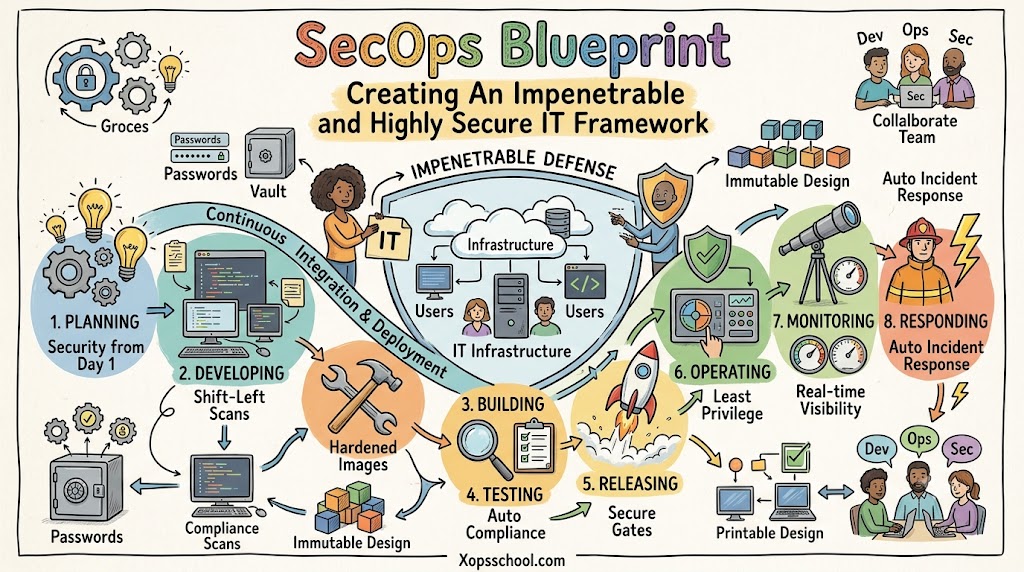
SecOps represents the seamless integration of security methodologies into traditional IT operations. Consequently, organizations no longer treat protection as an afterthought or a final checkpoint before deployment. Teams now bake defensive protocols directly into every layer of their technological architecture from day one. You can master these advanced paradigms through elite technical education by visiting Xopsschool, which bridges the gap between infrastructure deployment and proactive threat mitigation. Therefore, this modern approach ensures that your networks remain resilient against evolving digital hazards while maintaining rapid deployment speeds.
The ultimate objective centers on breaking down the historical silos that separated system administrators from risk management professionals. When these two units operate independently, major communication gaps inevitably emerge, leaving critical vulnerabilities completely exposed. SecOps unifies these workflows under a single operational umbrella, fostering shared responsibility for systemic health. As a result, engineers can deploy updates smoothly without accidentally introducing misconfigurations that hackers could easily exploit. Ultimately, this foundational alignment transforms security from a restrictive roadblock into a powerful business accelerator.
Understanding the Core Architecture of SecOps
Building a resilient infrastructure requires a deep understanding of how security weaves into daily operational pipelines. Traditional setups usually ran tests at the very end of development, which caused massive delays and frustration. Conversely, SecOps infuses continuous compliance and automated testing directly into the deployment pipeline, catching flaws instantly. This proactive stance ensures that every virtual machine, container, and cloud resource adheres strictly to compliance policies before entering production.
Furthermore, this framework relies heavily on real-time visibility across the entire corporate technology ecosystem. Engineers can track unauthorized changes or suspicious behavior immediately by utilizing comprehensive monitoring tools and unified logging systems. This immediate insight allows teams to isolate compromised nodes before lateral movement occurs across the network. Thus, continuous observability forms the bedrock of a modern, self-defending architecture.
The Role of Automation in Infrastructure Protection
Automation serves as the primary engine driving modern defensive infrastructure operations. Manually auditing configurations or applying patches across thousands of servers is completely inefficient and introduces human error. Automated scripts can scan systems constantly, deploying updates and fixing standard compliance drifts without human intervention.
Consequently, your engineering team saves valuable time while reducing the window of exposure for newly discovered vulnerabilities. Automation also ensures that every single environment conforms exactly to standardized, hardened configurations every time.
Shifting Security to the Left Side of Operations
Shifting left means integrating diagnostic tests and risk assessments into the earliest stages of infrastructure design. When engineers write infrastructure code, automated scanners evaluate those blueprints immediately for design flaws.
Therefore, you can fix weak network rules or exposed access credentials long before any physical resources are provisioned. This strategy dramatically lowers remediation costs and prevents flawed designs from reaching live environments.
Key Operational Concepts You Must Know
To successfully run a secure infrastructure, engineers must master several non-negotiable operational concepts. First, the principle of least privilege ensures that users and applications only possess the precise access required for their functions. Therefore, if an account suffers a breach, the attacker cannot access the rest of the enterprise network.
Second, continuous configuration management guarantees that all servers maintain an identical, pre-approved security posture over time. Tools scan for deviations from this baseline and automatically rewrite unauthorized changes back to the safe standard. Finally, immutable infrastructure dictates that running servers are never modified directly; instead, you replace them entirely with fresh, updated instances.
| Concept | Primary Operational Objective | Core Strategic Benefit |
|---|---|---|
| Least Privilege | Limit user permissions strictly to necessary operational tasks | Drastically minimizes internal blast radius during an active breach |
| Baseline Hardening | Disable unused ports, services, and default protocols systematically | Shrinks the overall attack surface available to external threats |
| Immutable Design | Replace running infrastructure completely instead of patching it live | Eliminates configuration drift and cleans hidden malware persistence |
| Continuous Auditing | Run automated compliance scans across all active resources hourly | Identifies security deviations before attackers discover them |
Platform Implementation vs. Culture — What’s the Real Difference?
Many organizations mistakenly believe that purchasing expensive software instantly solves all their infrastructure security challenges. However, implementing a platform merely provides the mechanical tools, whereas culture dictates how effectively your team uses those tools daily. If your staff views security as a chore or an external imposition, they will consistently find clever workarounds to bypass restrictions. True cultural integration ensures that every engineer inherently considers defensive principles while designing every single line of code.
[Tool Adoption Only] ──> Broken Processes ──> Unpatched Gaps ──> Vulnerabilities
[Cultural Alignment]  ──> Shared Ownership ──> Proactive Defense ──> Resilient Network
- Shared Metric Accountability: Security teams and operations teams must share identical performance goals, matching uptime metrics with vulnerability remediation speeds.
- Blameless Post-Mortems: When an incident occurs, focus entirely on fixing the systemic flaw rather than punishing the individual engineer who made the mistake.
- Security Champions: Embed dedicated operational advocates within standard engineering teams to provide immediate compliance guidance during active design phases.
Real-World Use Cases of Modern Operations
A major financial services enterprise recently struggled with manual compliance checks, which slowed their infrastructure deployments to a crawl. By adopting automated compliance verification, they integrated policy testing into their central deployment pipeline. As a result, the company cut its release validation timeline from weeks to minutes while blocking unauthorized network configurations.
Another compelling case involves a global e-commerce platform facing massive credential stuffing attacks during high-traffic seasonal events. They implemented real-time automated traffic shaping and rate-limiting rules across their edge infrastructure. Consequently, the automated system blocked millions of malicious requests instantly, ensuring zero downtime for legitimate shoppers.
- Automated Incident Response: An infrastructure node detects an active malware signature, isolates itself from the local subnet automatically, and provisions a clean replacement instance within seconds.
- Dynamic Secrets Rotation: Application databases rotate their access credentials every hour via automated systems, rendering stolen keys useless to hackers very quickly.
- Centralized Log Aggregation: Millions of disparate system events feed into a central engine that correlates patterns to expose advanced persistent threats instantly.
Common Mistakes in Operations Engineering
The most frequent blunder in operations engineering centers on ignoring minor alert notifications due to sheer system volume. When monitoring platforms generate thousands of low-priority warnings daily, engineers develop severe alert fatigue and eventually ignore everything. Consequently, a critical, high-severity breach notification can easily slip through unnoticed amidst the digital noise. Teams must tune their alerting systems meticulously to ensure that only actionable, critical events trigger direct human intervention.
High Alert Volume ──> Alert Fatigue ──> Ignored Notifications ──> Catastrophic Breach
Another widespread mistake involves hardcoding sensitive passwords, API keys, and cryptographic certificates directly into infrastructure source repositories. This practice exposes vital credentials to anyone who gains access to the codebase, leading to catastrophic system-wide compromises. Organizations must store sensitive data exclusively inside dedicated, encrypted vault systems that inject credentials securely at runtime.
How to Become an Operations Expert — Career Roadmap
Transitioning into an elite infrastructure specialist requires a structured learning path combining technical depth with architectural wisdom. You should begin by mastering Linux system administration fundamentals and foundational networking protocols, such as DNS, routing, and TCP/IP. Next, pivot toward learning infrastructure as code methodologies to manage hardware setups programmatically using software development principles.
1
Master Core Systems Administration
Phase 1
1.Master Core Systems Administration:Phase 1.
Gain deep proficiency in Linux environments, terminal manipulation, bash scripting, and fundamental system permissions protocols.
2
Learn Infrastructure as Code
Phase 2
2.Learn Infrastructure as Code:Phase 2.
Understand how to define complex computing environments programmatically using declarative configuration files and template tools.
3
Integrate Automation Pipelines
Phase 3
3.Integrate Automation Pipelines:Phase 3.
Build continuous integration and deployment channels that embed automated security scanning scripts directly into the code path.
4
Adopt Advanced Monitoring and Observability
Phase 4
4.Adopt Advanced Monitoring and Observability:Phase 4.
Implement distributed tracing, centralized log management analytics, and automated alerting thresholds to maintain complete network visibility.
FAQ Section
- What is the primary difference between DevOps and SecOps?
DevOps focuses heavily on accelerating the speed of software delivery and optimizing infrastructure deployment workflows. SecOps intentionally infuses security protocols directly into those exact deployment operations, ensuring that speed never compromises structural safety.
- How does infrastructure as code improve network security?
Infrastructure as code allows teams to audit and scan system configurations before they are deployed into live environments. It eliminates manual errors, prevents undocumented ad-hoc changes, and maintains an immutable history of every infrastructure modification.
- What is alert fatigue and how do you prevent it?
Alert fatigue occurs when engineers become desensitized to monitoring notifications because their systems constantly generate non-critical warnings. You prevent it by setting strict filtering thresholds and ensuring that only urgent, actionable issues notify a human operator.
- Why is shifting left considered a cost-effective strategy?
Fixing a structural vulnerability during the design phase costs significantly less than remediating a live breach on a production server. Shifting left identifies bugs early, saving substantial development time, legal fees, and reputational damage.
- Can small startups implement these frameworks effectively?
Yes, startups can leverage cloud-native managed services to automate security configurations without needing massive dedicated operational engineering teams. Implementing these habits early prevents complex architectural technical debt as the business expands.
- How often should configuration baselines be audited?
Configuration baselines must be monitored continuously using automated tools that track changes in real time. Any unauthorized variation should trigger automatic remediation or alert the operations response team immediately.
Final Summary
Building a secure IT infrastructure demands a complete paradigm shift from reactive firefighting to proactive, automated defense systems. By unifying security and operations, organizations can maintain rapid deployment schedules while building an impenetrable digital perimeter. Automation eliminates human error, immutable architectures wipe away persistence, and a strong engineering culture ensures long-term operational resilience. Ultimately, prioritizing these integrated workflows protects your vital corporate data, maintains client trust, and fuels sustainable business growth.