Introduction
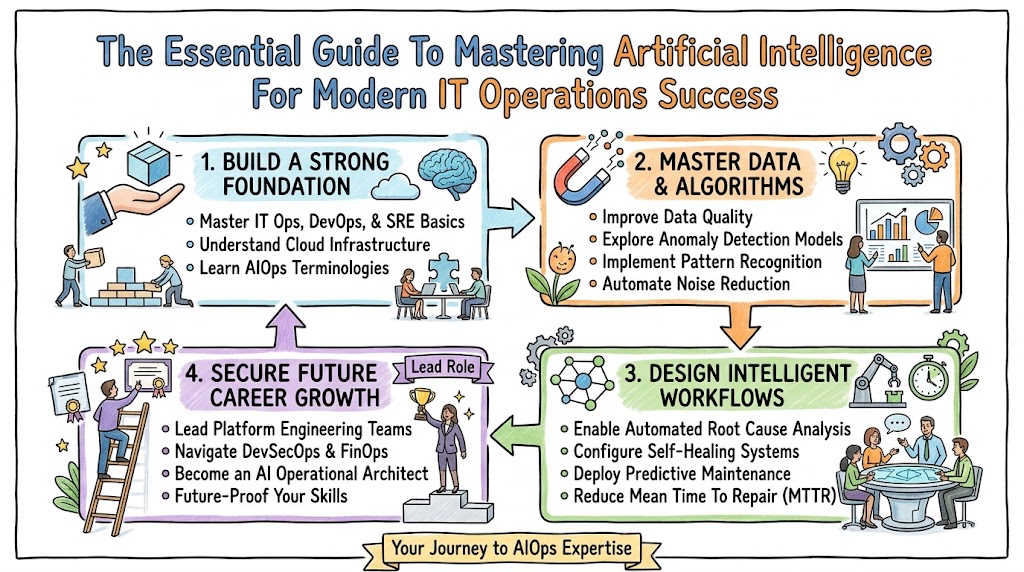
Engineers today face a massive influx of telemetry data that traditional manual monitoring simply cannot handle efficiently. This AIOps Foundation Certification guide offers a clear path for professionals who want to lead the shift toward autonomous, self-healing infrastructure. By mastering these intelligent frameworks, you position yourself at the forefront of the platform engineering movement. Navigating the curriculum at AIOpsSchool empowers you to make informed career moves that align with the rapid evolution of cloud-native ecosystems and automated site reliability.
What is the AIOps Foundation Certification?
The AIOps Foundation Certification establishes a high standard for professionals aiming to integrate machine learning into standard IT workflows. It exists to transform how teams handle massive datasets by moving beyond simple threshold-based alerts to predictive analytics. This program prioritizes practical application in production environments rather than just theoretical data science. It directly supports modern enterprise needs by enabling engineers to build systems that anticipate failures and optimize resource allocation automatically.
Who Should Pursue AIOps Foundation Certification?
Cloud architects and SREs seeking to reduce operational toil will find immense value in this specialized training program. Security analysts and data engineers also benefit by learning how to apply algorithmic patterns to threat detection and pipeline management. Even technical managers and beginners find this certification useful for understanding the strategic impact of AI on digital transformation. This credential carries significant weight in both the Indian tech sector and the broader global market for high-level engineering roles.
Why AIOps Foundation Certification is Valuable and Beyond
Enterprises are rapidly adopting AI-driven operations because human teams cannot scale at the same rate as modern cloud infrastructure. This certification ensures your skills remain relevant even as specific software tools change, because it teaches the underlying logic of algorithmic automation. Professionals holding this credential often secure lead positions in platform engineering due to their ability to manage complex data ecosystems. Investing in this knowledge yields a long-term career advantage by making you an architect of the autonomous future.
AIOps Foundation Certification Overview
Candidates access the official training through the course portal which remains hosted on the Website. The program utilizes a rigorous assessment model to verify your expertise in noise reduction, incident correlation, and root cause analysis. It provides a clear, practical structure that guides you from basic terminology to the deployment of complex AIOps workflows. Earning this certification proves you can effectively bridge the gap between traditional DevOps practices and advanced artificial intelligence.
AIOps Foundation Certification Tracks & Levels
The curriculum starts with a foundation level to build a solid base in operational AI terminology and data requirements. As you move into professional and advanced tracks, the focus shifts toward specialized implementation in areas like FinOps and DevSecOps. These levels align perfectly with a standard career progression from junior engineer to principal architect or technical lead. Each stage challenges you to apply machine learning to solve increasingly difficult infrastructure and availability problems.
Complete AIOps Foundation Certification Table
| Track | Level | Who it’s for | Prerequisites | Skills Covered | Recommended Order |
| Core Ops | Foundation | New AIOps Engineers | IT Fundamentals | Pattern Recognition | First |
| Engineering | Professional | SREs & DevOps Leads | Foundation Cert | Event Correlation | Second |
| Architecture | Advanced | Principal Architects | 5+ Years Experience | AI Strategy | Third |
| Specialized | Expert | Data & Ops Leaders | Professional Cert | Model Lifecycle | Final |
Detailed Guide for Each AIOps Foundation Certification
AIOps Foundation Certification – Foundation Level
What it is
This certification confirms your ability to identify where machine learning can improve traditional IT operations. It validates your grasp of the core pillars required to build an intelligent monitoring ecosystem.
Who should take it
DevOps practitioners, system administrators, and technical managers should start here to gain a functional understanding of AI in the data center.
Skills you’ll gain
- Identify key data sources for operational analytics.
- Differentiate between standard automation and AI-driven insights.
- Map out basic AIOps implementation strategies.
- Master noise reduction techniques for alert management.
Real-world projects you should be able to do
- Design a telemetry collection plan for a distributed application.
- Analyze a log stream to identify recurring failure patterns.
- Build a business case for automated incident response.
Preparation plan
- 7–14 days: Study the primary definitions and the five stages of AIOps maturity.
- 30 days: Review real-world case studies focused on predictive maintenance.
- 60 days: Complete hands-on labs involving data ingestion and basic correlation.
Common mistakes
- Assuming that AIOps replaces the need for basic DevOps discipline.
- Ignoring the quality and cleanliness of the data feeding the models.
- Overcomplicating the initial implementation with too many variables.
Best next certification after this
- Same-track option: AIOps Professional Certification.
- Cross-track option: SRE Practitioner Certification.
- Leadership option: Technical Program Manager – AI.
Choose Your Learning Path
DevOps Path
The DevOps path focuses on using AI to enhance the CI/CD pipeline and predict deployment risks before they reach production. You will learn how to automate rollbacks and optimize build cycles using historical performance data. This track empowers engineers to create self-correcting delivery systems that maintain high velocity without sacrificing stability.
DevSecOps Path
This track integrates AI into the security lifecycle to automate threat hunting and identify anomalous user behavior in real-time. You will study how to use machine learning to patch vulnerabilities and respond to attacks faster than manual intervention allows. It represents the next level of proactive defense for cloud-native environments.
SRE Path
The SRE path applies AIOps principles to maintain service level objectives and reduce manual troubleshooting through predictive modeling. You will learn how to forecast capacity needs and automate the resolution of common infrastructure failures. This path is essential for managing the high availability of modern, global-scale applications.
AIOps Path
Dedicated specifically to the operations specialist, this path dives deep into the algorithms that power autonomous systems. You will focus on root cause analysis and the orchestration of complex AI workflows across diverse technology stacks. It prepares you to be the primary architect of a company’s AIOps strategy.
MLOps Path
Engineers on the MLOps path focus on the infrastructure required to deploy, monitor, and retrain the models used in AIOps. You will master model versioning and data drift detection to ensure that the AI remains accurate as the environment changes. This path bridges the gap between data science and production engineering.
DataOps Path
The DataOps path ensures that the information feeding the AI models is accurate, timely, and secure across the entire organization. You will build robust data pipelines that handle real-time streaming and large-scale storage requirements. This is a foundational track for any successful AI-driven operational strategy.
FinOps Path
This path uses AI to bring financial accountability to the cloud by predicting spend patterns and automating cost-saving measures. You will learn to identify wasted resources and right-size infrastructure based on intelligent forecasting. It aligns technical operations with business profitability and budgetary goals.
Role → Recommended AIOps Foundation Certification
| Role | Recommended Certifications |
| DevOps Engineer | AIOps Foundation, MLOps Professional |
| SRE | AIOps Foundation, SRE Advanced |
| Platform Engineer | AIOps Foundation, DataOps Specialist |
| Cloud Engineer | AIOps Foundation, FinOps Practitioner |
| Security Engineer | AIOps Foundation, DevSecOps Expert |
| Data Engineer | AIOps Foundation, DataOps Professional |
| FinOps Practitioner | AIOps Foundation, FinOps Specialist |
| Engineering Manager | AIOps Foundation, AI Strategy |
Next Certifications to Take After AIOps Foundation Certification
Same Track Progression
Deepening your expertise through the Professional and Expert levels of the AIOps track allows you to lead enterprise-wide automation initiatives. These advanced certifications focus on complex model design and the strategic integration of AI across multiple business units. This path cements your status as a high-level specialist in the field.
Cross-Track Expansion
Broadening your skillset by earning SRE or FinOps certifications makes you a more versatile architect in a cloud-native world. Combining AI knowledge with operational reliability principles ensures you can handle the full spectrum of modern infrastructure challenges. This approach is ideal for those who want to solve high-impact, multi-disciplinary problems.
Leadership & Management Track
Transitioning into leadership roles requires certifications that focus on the ROI and ethical governance of artificial intelligence. These programs prepare you to manage technical teams and align AI capabilities with long-term business objectives. This track is perfect for senior engineers moving into director or VP-level positions.
Training & Certification Support Providers for AIOps Foundation Certification
DevOpsSchool
This organization provides deep-dive technical training and a community of experts for those pursuing modern engineering excellence. They offer hands-on labs that reflect the latest production environments.
Cotocus
A leader in technical consulting and training, they help enterprises and individuals adopt cloud-native technologies effectively. Their courses emphasize practical skills that apply directly to real-world infrastructure challenges.
Scmgalaxy
This portal offers a massive library of tutorials and certification support for professionals in configuration management and automation. They focus on the practical “how-to” aspects of software delivery.
BestDevOps
Engineers visit this site for curated tool comparisons and clear career roadmaps in the DevOps and SRE space. It serves as a reliable guide for choosing the most impactful certifications.
devsecopsschool.com
This school focuses on securing the modern software supply chain through specialized DevSecOps training and certification tracks. They provide the tools needed to integrate security into every stage of the lifecycle.
sreschool.com
Professionals looking to master site reliability engineering principles find the most relevant and up-to-date training here. Their programs align with the industry’s highest standards for system availability.
aiopsschool.com
As the primary provider for AIOps education, this site offers the most comprehensive tracks for mastering operational artificial intelligence. They turn traditional operators into future-ready AI architects.
dataopsschool.com
This institution teaches engineers how to manage the complex data pipelines required to fuel modern AI and analytics platforms. They emphasize data quality and reliability as core operational requirements.
finopsschool.com
This school empowers professionals to master the financial side of the cloud through intelligent cost management and forecasting. Their training helps align technical spend with business value.
Frequently Asked Questions (General)
- Does the foundation exam require prior AI experience?
No, the exam introduces basic AI concepts specifically for those coming from a traditional IT background.
- How much study time should I plan for?
Most candidates succeed by dedicating about five to ten hours a week for two months.
- What are the main benefits for an SRE?
It provides the tools to automate root cause analysis and reduce the time spent on manual incident response.
- Can I take the exam from home?
Yes, the certification body offers proctored online exams that you can schedule at your convenience.
- How long does the certification stay valid?
The certification generally requires renewal every two years to ensure you remain current with evolving AI technologies.
- Is coding a major part of the foundation test?
The foundation level focuses on logic and methodology rather than writing complex machine learning code.
- Does it help with career advancement in India?
Yes, many top-tier tech companies in India actively seek engineers with verified AIOps skills for their platform teams.
- Are there any labs in the training?
Yes, most reputable providers include hands-on labs to demonstrate how AI models interact with real system data.
- How does this differ from a Data Science cert?
This certification focuses on applying AI to infrastructure and operations rather than general mathematical modeling.
- Will this help me manage cloud costs?
Yes, the curriculum includes modules on using predictive analytics to optimize cloud resource usage and spending.
11. What is the pass mark for the exam?
While it varies, most exams require a score of 70% or higher to demonstrate mastery of the material.
12. Are there group discounts for teams?
Many training providers offer corporate packages for organizations looking to upskill their entire engineering department.
FAQs on AIOps Foundation Certification
1. Which machine learning models does the course emphasize?
The course focuses on regression, clustering, and decision trees specifically applied to time-series telemetry and log data.
2. Does it cover open-source AIOps tools?
Yes, the training explores popular open-source frameworks for data ingestion and automated alerting pipelines.
3. How does the cert handle security data?
It teaches you how to feed security logs into AI engines to detect anomalies and potential breaches automatically.
4. Can I apply these skills to on-premise data centers?
Yes, the principles of AIOps work effectively across cloud, hybrid, and traditional on-premise environments.
5. Does the exam include performance-based questions?
The foundation exam usually features multiple-choice questions that test your ability to apply AIOps logic to specific scenarios.
6. Will I learn about automated remediation?
Yes, a key part of the curriculum involves designing workflows that automatically fix common system issues without human intervention.
7. Is data ethics part of the certification?
The program covers the ethical implications of automated decision-making and the importance of transparent AI in operations.
8. How does this certification support FinOps?
It provides the analytical foundation needed to use AI for deep cost forecasting and automated budget governance.
Final Thoughts: Is AIOps Foundation Certification Worth It?
Senior mentors in the industry recognize that the era of manual monitoring is quickly coming to an end. Pursuing this certification represents a smart, proactive move that secures your place in the next generation of infrastructure management. It moves you beyond the role of a “firefighter” and into the role of an architect who builds resilient, self-sustaining systems. If you want to future-proof your career and stay ahead of the automation curve, I highly recommend starting this journey today.