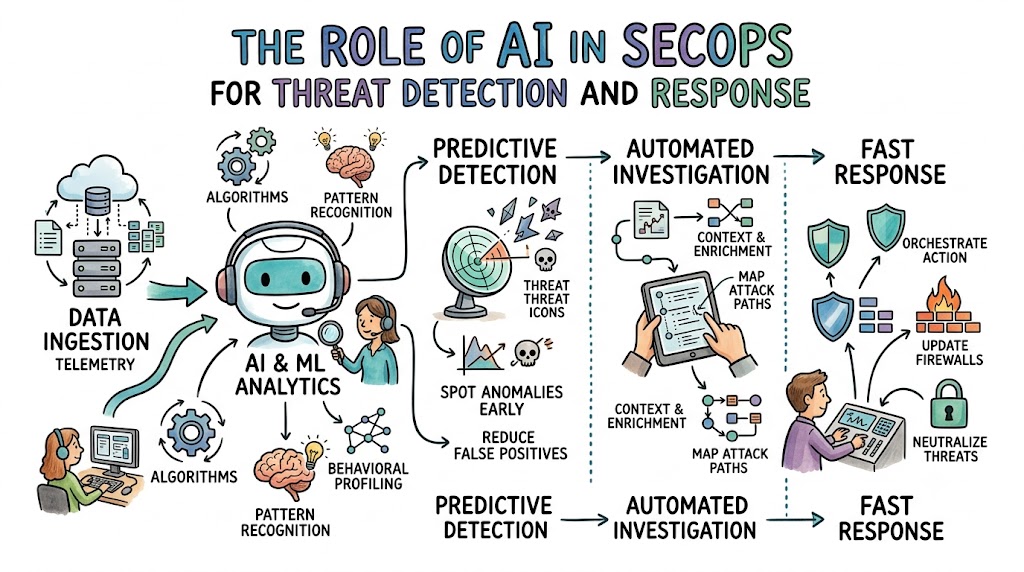
The modern threat landscape is evolving at a pace that manual human monitoring can no longer match. Security operations, or SecOps, faces an overwhelming deluge of daily alerts, complex multi-stage attacks, and sophisticated exploits designed to bypass traditional signature-based defenses. To counter these challenges, organizations are increasingly embedding artificial intelligence (AI) and machine learning (ML) models directly into their defense frameworks. By analyzing massive streams of telemetry in real-time, AI acts as a force multiplier that allows operations teams to detect anomalies, automate investigation workflows, and neutralize active threats with unprecedented speed.
When organizations integrate advanced intelligence into their defensive posture, they shift from a purely reactive stance to an intelligent, predictive defense model. To navigate this technical shift and build forward-thinking engineering teams, organizations leverage modern training platforms like Xopsschool to master cloud-native security automation. Introducing AI into your infrastructure workflows doesn’t replace the human analyst; instead, it eliminates repetitive low-level data sorting, allowing your operations engineers to focus their expertise on strategic threat hunting and complex incident architecture.
Core Pillars of Collaborative Security Operations
Building a modern security operations ecosystem requires a tight integration of people, automated platforms, and continuous telemetry pipelines. For that reason, organizations must establish deep, end-to-end visibility across their hybrid and multi-cloud footprints to capture security events as they happen. Traditional security silos, where developers build applications without considering how operational teams will defend them, inevitably lead to catastrophic visibility gaps. A collaborative SecOps paradigm ensures that every deployment pipeline automatically provisions logging configurations, security agents, and behavioral monitoring hooks directly alongside application code.
Furthermore, true collaborative operations rely heavily on establishing shared accountability across your entire engineering department. This alignment is maintained by tracking unified operational metrics, such as the mean time to detect an anomaly and the mean time to contain a breach. When security telemetry is integrated seamlessly into standard operational dashboards, engineers can instantly see how infrastructure changes impact the overall risk profile. This continuous feedback loop ensures that security ceases to be a final, bureaucratic roadblock and instead becomes an organic, automated characteristic of your daily release cycle.
Key Operational Concepts You Must Know
Continuous Telemetry and Distributed Observability
Modern enterprise systems generate terabytes of security logs, network packets, and application traces every hour, making comprehensive observability an absolute prerequisite for threat detection. Therefore, you must implement unified logging pipelines that aggregate structured data from cloud providers, container runpoints, identity systems, and endpoint agents. Whenever a microservice interacts with an external dependency, the underlying system must trace the execution path to map normal runtime behaviors accurately. This deep, granular telemetry provides the rich datasets that machine learning algorithms require to distinguish between standard operations and malicious activity.
Moreover, relying on superficial perimeter metrics or basic system health checks is entirely insufficient in a world governed by distributed cloud architectures. SecOps teams must observe deep internal state transitions, API payload patterns, and encrypted cross-cluster communications to identify advanced persistent threats. By organizing this massive influx of telemetry into a centralized, high-performance data lake, you provide your analytics engines with the raw material needed to run advanced behavioral correlations. This constant visibility ensures that your operational engineers are never left guessing when a critical system component begins to exhibit abnormal execution characteristics.
Automated Infrastructure Guardrails
Managing infrastructure manually or reviewing compliance states on an intermittent basis introduces unacceptable windows of vulnerability into your production environments. Consequently, modern SecOps groups rely on automated infrastructure guardrails that express your organization’s security policies completely as executable code. Whenever an engineering team updates an infrastructure template, automated validation engines instantly inspect the file for open access control lists, unencrypted databases, or non-compliant routing paths. This proactive validation ensures that misconfigured resources are automatically blocked from ever being instantiated within your environment.
In addition to pre-deployment policy checks, your automated guardrails must continuously monitor live production clusters for runtime configuration drift. If a malicious actor or an unauthorized administrator manually alters a production security group configuration, the compliance engine must instantly trigger a self-healing routine. The automated system reconciles the live resource back to its version-controlled, cryptographically signed configuration state within seconds. Implementing these rigid automated boundaries prevents small security oversights from lingering long enough to be discovered and exploited by external threat actors.
Platform Implementation vs. Culture — What’s the Real Difference?
| Operational Aspect | Platform Implementation Focus | Cultural Alignment Focus |
|---|---|---|
| Primary Objective | Deploying AI-driven SIEM platforms, SOAR engines, and automated endpoint protection agents. | Fostering a blameless, security-first mindset across engineering, product, and operations teams. |
| Core Execution | Writing correlation rules, configuring webhook triggers, and engineering data parsing pipelines. | Conducting cross-functional threat modeling workshops and rewarding proactive vulnerability reporting. |
| Success Metric | Data ingestion throughput, alert reduction percentages, and automated play execution speed. | Broad organizational transparency, high psychological safety, and minimal finger-pointing during incidents. |
| Long-Term Impact | Equips the enterprise with the technical processing power needed to scale threat analysis operations. | Sustains a resilient posture by ensuring human operators understand, trust, and properly maintain the automated tools. |
Deploying sophisticated artificial intelligence platforms provides immense technical processing capability, yet technology cannot overcome an organizational culture rooted in fear and siloed communication. If an AI engine flags a critical architectural vulnerability, but developers feel pressured by management to prioritize feature shipping over security remediation, the system ultimately fails. Therefore, enterprise leaders must dedicate equal effort toward cultivating an engineering culture that actively values security transparently and encourages collaborative problem-solving. When a breach occurs, the immediate response must focus entirely on dissecting system weaknesses and upgrading automated models rather than assigning individual blame.
Real-World Use Cases of Modern Operations
Rapid Automated Incident Mitigation
Imagine an enterprise cloud environment where an advanced machine learning model detects an anomalous credential stuffing attempt targeting an internal API gateway. In an un-automated, legacy environment, the security center would generate an alert that sits in a queue until a human analyst manually reviews the logs hours later. Conversely, a mature, AI-powered SecOps pipeline utilizes automated orchestration playbooks that spring into action the millisecond an anomaly score crosses an established threshold. The system dynamically updates web application firewall policies, revokes the compromised access tokens, and routes traffic through an isolated inspection sandbox.
Because the automated platform acts with lightning speed, the brute-force attack is neutralized before the threat actor can exfiltrate sensitive customer databases or establish persistence. Meanwhile, the AI system compiles all relevant forensic data, maps the attack trajectory against public threat frameworks, and logs a comprehensive ticket for human review. This instant, automated mitigation minimizes potential financial liability, protects your brand equity, and allows your human engineering specialists to devote their energy to root-cause defense enhancements.
Securing the Automated Deployment Pipeline
Another powerful application of modern SecOps involves leveraging machine learning algorithms to guard the continuous integration and continuous deployment pipeline against supply chain compromises. When developers commit a software update, an intelligent scanner reads the source code alongside its external open-source library dependencies. The engine does not simply match library version numbers against static lists of known flaws; instead, it uses semantic analysis to detect malicious patterns, such as unexpected network calls hidden inside minor dependencies. If a suspicious code pattern or an unapproved structural mutation is discovered, the pipeline automatically locks down.
- Code Event: A developer commits code changes to the organization’s central git repository.
- Semantic Scanning: An intelligent engine analyzes the structural semantics of the code to find hidden logic flaws.
- Dependency Inspection: Machine learning models evaluate the behavior and reputation of third-party open-source components.
- Automated Rejection: The deployment pipeline drops the build automatically if any step violates your internal compliance baseline.
By integrating intelligent validation checks directly into the heart of your delivery pipeline, you ensure that defective or poisoned code never makes its way to production servers. This automated gatekeeping gives your executive team absolute confidence that every software artifact running in production is inherently secure.
Common Mistakes in Operations Engineering
Excessive Alerting and Alert Fatigue
A pervasive and damaging mistake made by engineering teams is configuring their security analytics platforms with overly broad, non-contextual alert triggers. When every minor configuration variation or transient network fluctuation fires a critical notification to your on-call engineers, response quality rapidly deteriorates. Human analysts subjected to this relentless wave of digital noise quickly develop alert fatigue, causing them to downplay notifications or miss genuine, high-severity attacks entirely. To solve this problem, you must leverage AI to correlate disparate, low-priority events into unified, context-rich incident stories before notifying human operators.
Furthermore, every alert sent to an engineering team must arrive equipped with deep, machine-generated context, clear impact analysis, and specific remediation guidelines. If an on-call engineer has to manually log into multiple disparate consoles just to understand why a specific notification was triggered, your incident response process is fundamentally broken. Teams must implement a rigorous review process to continuously prune outmoded alert definitions that no longer deliver clear operational value. Maintaining a highly clean, validated monitoring stream preserves the focus and sharpness of your engineering staff when defending against real threats.
Mismanaging Credentials and Static Secrets
Allowing static credentials, long-lived API keys, and cryptographic passwords to be hardcoded within software repositories remains one of the primary entry points for modern infrastructure compromises. When engineering groups rely on static secrets, the likelihood of accidental exposure via public code repositories or insecure internal communication channels scales exponentially. To neutralize this danger, modern security operations mandate the migration to central, highly secure secret managers that leverage dynamic, short-lived authentication mechanisms. Applications must programmatically request temporary credentials that expire automatically after a specified number of minutes or operations.
[Application Instance] -> [Requests Dynamic Secret via IAM] -> [Secrets Vault Validates Policy] -> [Issues Short-Lived Token]
Additionally, organizations must enforce granular, least-privilege access control models so that an application component can only access the exact resources required for its immediate function. You must also implement continuous, automated secret scanning across your entire version control history to catch and revoke exposed keys instantly. Eliminating static secrets from your ecosystem drastically reduces your blast radius and removes one of the easiest vulnerabilities that malicious actors exploit to move laterally across enterprise networks.
How to Become an Operations Expert — Career Roadmap
Mastering Foundational Systems and Cloud Automation
To build an impactful career in the intersection of artificial intelligence and security operations, you must first construct a rock-solid foundation in classic systems engineering. You need to understand intimately how Linux kernels handle system calls, how virtual memory management operates, and how low-level network protocols route traffic across complex topologies. Once you possess a comprehensive grasp of these underlying systems, shift your learning trajectory toward mastering infrastructure-as-code automation frameworks and modern programming languages. The ability to programmatically control, modify, and defend massive distributed systems is the core skill that separates elite platform engineers from traditional administrators.
Role-Based Skills and Mastery Matrix
- Junior SecOps Engineer:
- Focus intensely on mastering Linux operating system administration, basic scripting languages, and core cloud provider networking architectures.
- Learn how to read distributed application logs, interpret basic threat alerts, and manage standard CI/CD pipeline automation components.
- Understand the fundamental mechanics of container isolation, Docker security practices, and git-based source control management workflows.
- Senior Security Operations Specialist:
- Master advanced infrastructure-as-code patterns, write complex policy-as-code rules, and engineer automated threat remediation scripts.
- Architect unified, enterprise-wide logging pipelines that aggregate, clean, and enrich telemetry from multi-cloud systems in real-time.
- Lead complex incident investigation efforts and configure machine learning models to reduce false-positive alert distributions.
- Principal Infrastructure Architect:
- Define the overarching long-term technical strategy for security automation, data observability platform engineering, and enterprise compliance.
- Collaborate directly with executive leadership to align infrastructure technology investments with global risk mitigation frameworks.
- Act as an internal mentor across all engineering teams, instilling an organizational culture that prioritizes continuous, automated security evolution.
FAQ Section
- How exactly does artificial intelligence help reduce false-positive alerts within busy SecOps teams?Traditional security platforms rely on rigid, static rules that trigger alerts whenever a pre-defined threshold is crossed, often resulting in massive amounts of noise. AI reduces false positives by learning the unique baseline behaviors of your specific infrastructure, allowing it to contextualize anomalies and dismiss harmless operational spikes automatically.
- Can small engineering organizations utilize AI-driven SecOps without a massive capital budget?Yes, small teams can easily adopt AI capabilities by leveraging managed, cloud-native security services provided by their existing infrastructure vendors. Most major cloud platforms now offer integrated, machine-learning-powered threat detection tools that can be activated with minimal configuration and pay-as-you-go pricing models.
- Does the introduction of AI-powered threat detection mean that human security analysts are becoming obsolete?Absolutely not. AI excels at processing vast datasets, identifying hidden patterns, and automating repetitive tasks at machine speeds, but it completely lacks human intuition, contextual reasoning, and strategic thinking. The technology is designed to empower human analysts, freeing them from data sorting so they can tackle high-level architectural defense.
- What are the risks associated with threat actors utilizing AI to attack enterprise infrastructure platforms?Threat actors are actively leveraging AI to craft highly targeted phishing campaigns, automate the discovery of software vulnerabilities, and generate polymorphic malware that changes its signature to evade detection. This reality makes it crucial for defensive teams to adopt AI tools simply to maintain parity with modern attackers.
- How can teams ensure that their AI security models do not suffer from data bias or configuration drift over time?Engineering teams must treat security models like any other critical software asset by continuously monitoring their output accuracy and retraining them with updated telemetry data. Regularly auditing model decisions against real-world incident outcomes ensures the system adapts accurately as your infrastructure evolves.
Final Summary
Integrating artificial intelligence into your security operations framework represents a critical evolutionary leap for protecting modern, high-velocity infrastructure. By automating the heavy lifting of data ingestion, pattern correlation, and incident mitigation, AI empowers your engineering teams to outpace sophisticated threat actors. However, achieving maximum efficacy requires a balanced combination of intelligent software platforms, robust infrastructure guardrails, and an open, collaborative engineering culture.
Ultimately, technology is only as strong as the human operators who design, guide, and maintain it across your organizational ecosystem. Investing in continuous education and leveraging deep technical training programs will ensure your teams possess the advanced skills required to operate these intelligent platforms effectively. As you systematically eliminate operational silos and embed AI-driven automation into your workflows, security ceases to be an expensive bottleneck and becomes a foundational pillar of structural resilience.