Introduction
In today’s complex cloud-native environments, traditional monitoring often falls short of maintaining high availability. Consequently, engineers are turning toward the Certified AIOps Engineer program to master the integration of artificial intelligence within operational workflows. This guide serves professionals in DevOps, SRE, and platform engineering who want to move beyond manual intervention. By pursuing this path at AIOpsSchool, you will learn to leverage machine learning for predictive maintenance and automated incident response. Ultimately, this resource helps you navigate the evolving landscape of intelligent automation to make informed career decisions and stay ahead of enterprise demands.
What is the Certified AIOps Engineer?
The Certified AIOps Engineer represents a paradigm shift from reactive to proactive IT operations. It exists because modern infrastructure generates a volume of telemetry data that exceeds human processing capabilities. Therefore, this program focuses on real-world, production-focused applications of machine learning rather than just abstract theory. It aligns perfectly with modern engineering workflows by teaching engineers how to build self-healing systems. Since businesses now demand near-zero downtime, this certification validates your ability to manage high-scale environments using data-driven intelligence.
Who Should Pursue Certified AIOps Engineer?
Systems engineers and SREs who manage large-scale distributed systems will find this certification particularly beneficial. Cloud professionals and data engineers also gain significant value, as it bridges the gap between infrastructure management and data science. While beginners can enter the foundation levels, experienced architects use it to refine their automation strategies. In both the Indian market and the global tech sector, there is a massive surge in demand for talent that can reduce “noise” in monitoring. Engineering managers also pursue this to better lead teams through digital transformation initiatives.
Why Certified AIOps Engineer is Valuable and Beyond
The longevity of this certification stems from the permanent shift toward autonomous infrastructure. As organizations adopt multi-cloud strategies, the complexity requires AI to maintain stability and performance. Pursuing this path ensures that your skills remain relevant even as specific CI/CD or cloud tools change over time. Furthermore, the return on time investment is substantial because it positions you as a high-value specialist in a niche field. Enterprises are actively seeking engineers who can lower operational costs through intelligent automation and reduced mean time to repair.
Certified AIOps Engineer Certification Overview
The program is delivered via the official portal at Certified AIOps Engineer and is hosted on aiopsschool.com. It follows a structured approach that moves from foundational concepts to advanced architectural implementation. Candidates undergo rigorous assessments that focus on practical problem-solving rather than rote memorization. The ownership of the program ensures that the curriculum stays updated with the latest industry trends in machine learning and observability. By following this structure, professionals can systematically build their expertise in building intelligent operations.
Certified AIOps Engineer Certification Tracks & Levels
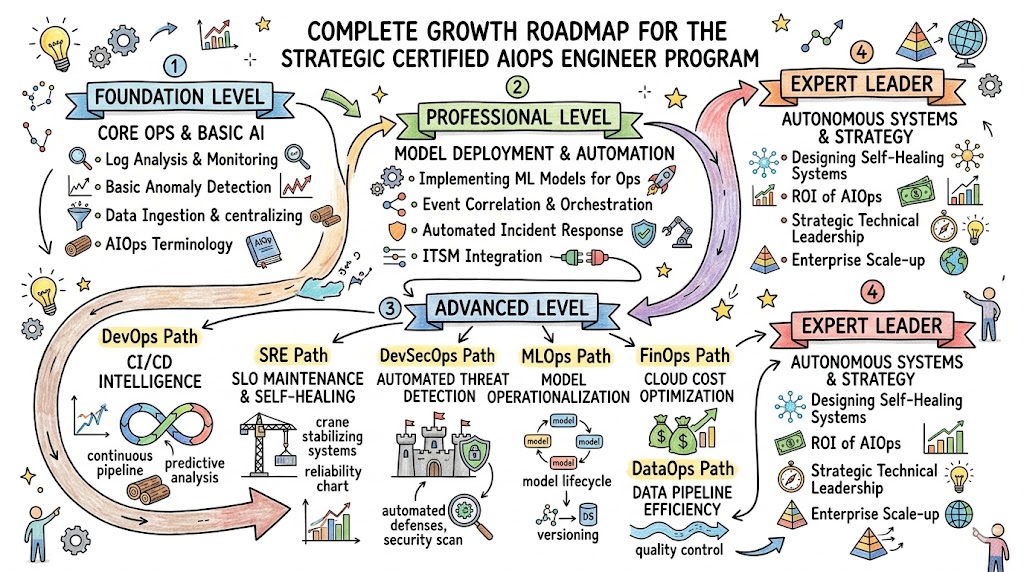
The certification is divided into three distinct levels: Foundation, Professional, and Advanced. The Foundation level introduces the core principles of data ingestion and basic pattern recognition for junior roles. Moving up, the Professional level focuses on integrating AI models into existing SRE and DevOps pipelines for mid-career experts. Finally, the Advanced level prepares leaders to design entire AIOps frameworks for large enterprises. These tracks allow for a natural career progression, ensuring that every professional finds a starting point relevant to their current experience.
Complete Certified AIOps Engineer Certification Table
| Track | Level | Who it’s for | Prerequisites | Skills Covered | Recommended Order |
| Core Operations | Foundation | Junior Engineers | Basic Linux & Cloud | Data Ingestion, Alerting | 1 |
| Engineering | Professional | SREs / DevOps | Python, Monitoring | ML Modeling, Automation | 2 |
| Architecture | Advanced | Architects / Leads | Professional Cert | Strategic Design, Scaling | 3 |
| Specialized | Expert | Data Ops / MLOps | Advanced Math | Deep Learning, Analytics | 4 |
Detailed Guide for Each Certified AIOps Engineer Certification
Certified AIOps Engineer – Foundation
What it is
This level validates a candidate’s understanding of the basic components of artificial intelligence in IT operations. It confirms you can identify where AI fits into the standard DevOps lifecycle.
Who should take it
It is suitable for entry-level cloud engineers and students who want to enter the automation field. It also serves as a great starting point for managers needing a conceptual overview.
Skills you’ll gain
- Understanding telemetry data types.
- Basic anomaly detection concepts.
- Familiarity with AIOps terminology.
- Knowledge of incident management workflows.
Real-world projects you should be able to do
- Configure basic data collectors for a web application.
- Identify patterns in historical log data.
- Set up automated alerts based on static thresholds.
Preparation plan
- 7-14 days: Review official documentation and core terminology.
- 30 days: Complete the foundation labs and practice assessments.
- 60 days: Not typically required for this level unless new to IT.
Common mistakes
- Skipping the basics of statistics.
- Ignoring the importance of clean data.
Best next certification after this
- Same-track: Professional AIOps Engineer.
- Cross-track: Foundation SRE.
- Leadership: ITIL Foundation.
Certified AIOps Engineer – Professional
What it is
This certification validates the ability to implement and manage AIOps tools in a live production environment. It focuses on the integration of machine learning models with existing monitoring stacks.
Who should take it
Mid-level DevOps engineers and SREs who are responsible for maintaining system uptime should pursue this. It requires a solid grasp of scripting and infrastructure.
Skills you’ll gain
- Building predictive scaling models.
- Implementing automated root cause analysis.
- Managing event correlation engines.
- Developing custom AI scripts for operations.
Real-world projects you should be able to do
- Deploy an automated incident suppression system.
- Build a dashboard that predicts disk failure before it happens.
- Integrate ML-based anomaly detection into a CI/CD pipeline.
Preparation plan
- 7-14 days: Focus on advanced Python scripting and API integrations.
- 30 days: Build three lab projects involving real-world datasets.
- 60 days: Perform deep-dive study on specific ML algorithms used in Ops.
Common mistakes
- Over-complicating models for simple tasks.
- Neglecting the security of the AI pipeline.
Best next certification after this
- Same-track: Advanced AIOps Architect.
- Cross-track: MLOps Professional.
- Leadership: Engineering Manager Track.
Choose Your Learning Path
DevOps Path
In this path, you focus on integrating intelligence into the continuous integration and delivery cycles. You will learn to use AI to analyze build failures and predict deployment risks before they reach production. This reduces the burden on developers and speeds up the release cycle significantly. By automating the feedback loop, you create a more resilient software delivery engine.
DevSecOps Path
Security professionals use AIOps to detect sophisticated threats that traditional rule-based systems might miss. This path emphasizes the use of AI for behavioral analysis and automated threat hunting. You will focus on identifying anomalies in user behavior and network traffic in real-time. Consequently, this helps in mitigating breaches before they cause significant damage to the organization.
SRE Path
Site Reliability Engineers use AIOps to maintain strict Service Level Objectives with minimal manual toil. This path focuses heavily on automated incident response and proactive system tuning. You will learn to build “self-healing” systems that can resolve common issues without human intervention. This allows SRE teams to focus on high-value engineering tasks rather than repetitive firefighting.
AIOps Path
The dedicated AIOps path is for those who want to specialize exclusively in the science of intelligent operations. You will dive deep into data engineering, model training, and the lifecycle of operational AI. This involves managing large data lakes and ensuring the accuracy of predictive models. It is the most technical path, requiring a strong balance of operations and data science.
MLOps Path
This path focuses on the operational side of machine learning itself, ensuring models are deployed and monitored correctly. While AIOps uses AI to help Ops, MLOps uses Ops to help AI. You will learn about model versioning, feature stores, and automated retraining pipelines. This is essential for companies that rely on AI as a core part of their product offering.
DataOps Path
DataOps focuses on improving the quality and reducing the cycle time of data analytics. Within this path, you use AI to monitor data pipelines and ensure data integrity across the enterprise. You will learn to automate data testing and deployment to provide reliable insights to stakeholders. This ensures that the AI models used in other paths are fed with high-quality information.
FinOps Path
The FinOps path utilizes AI to predict and optimize cloud spending across multi-cloud environments. You will learn to identify wasted resources and suggest rightsizing opportunities using machine learning algorithms. This helps organizations balance performance with cost-efficiency effectively. By automating cost governance, you ensure that cloud budgets are respected without manual oversight.
Role → Recommended Certified AIOps Engineer Certifications
| Role | Recommended Certifications |
| DevOps Engineer | Professional AIOps Engineer |
| SRE | Professional AIOps Engineer + SRE Specialist |
| Platform Engineer | Advanced AIOps Architect |
| Cloud Engineer | Foundation AIOps + Cloud Specialist |
| Security Engineer | DevSecOps AIOps Specialist |
| Data Engineer | DataOps Specialist |
| FinOps Practitioner | FinOps AIOps Specialist |
| Engineering Manager | Foundation AIOps + Leadership Track |
Next Certifications to Take After Certified AIOps Engineer
Same Track Progression
Once you master the professional level, the logical step is to move into architectural roles. This involves designing the entire data strategy for an organization’s operations department. You will focus on cross-team collaboration and selecting the right toolsets for global scale. Deep specialization ensures you remain the primary authority on autonomous systems within your company.
Cross-Track Expansion
Broadening your skills into related fields like MLOps or DevSecOps creates a well-rounded professional profile. Understanding how security and machine learning delivery intersect with AIOps makes you a versatile asset. This expansion allows you to lead multi-disciplinary teams that handle complex, modern stacks. It also provides a safety net as the industry shifts toward more integrated “XOps” roles.
Leadership & Management Track
For those looking to move away from hands-on coding, the leadership track focuses on ROI and strategy. You will learn how to build a business case for AI adoption and manage the cultural shift required for automation. This path prepares you for Director of Operations or CTO roles. It emphasizes people management and strategic planning over technical implementation.
Training & Certification Support Providers for Certified AIOps Engineer
DevOpsSchool
DevOpsSchool provides comprehensive training programs that cover the entire lifecycle of modern software delivery and infrastructure management. Their instructors focus on hands-on labs and real-world scenarios to ensure students gain practical expertise.
Cotocus
Cotocus specializes in high-end technical consulting and specialized training for enterprise-level automation and cloud-native technologies. They help professionals bridge the skill gap through intensive bootcamps and personalized mentoring sessions.
Scmgalaxy
Scmgalaxy offers a vast repository of community knowledge, tutorials, and certification guides for configuration management and DevOps tools. Their platform serves as a central hub for engineers looking to stay updated with industry best practices.
BestDevOps
BestDevOps focuses on delivering high-quality educational content and certification paths designed for the modern cloud architect. They prioritize career-oriented learning that aligns directly with current job market requirements.
devsecopsschool.com
devsecopsschool.com is dedicated to the integration of security into the DevOps process, providing specialized tracks for security-minded engineers. Their curriculum emphasizes automated compliance and proactive threat management in cloud environments.
sreschool.com
sreschool.com provides targeted training for Site Reliability Engineers, focusing on availability, scalability, and incident response. Their programs are designed to help engineers reduce toil and improve system reliability through advanced engineering.
aiopsschool.com
aiopsschool.com serves as the primary authority for AIOps education, offering certifications that blend data science with IT operations. They provide the frameworks necessary for building intelligent, self-healing infrastructure.
dataopsschool.com
dataopsschool.com focuses on the emerging field of DataOps, teaching professionals how to manage data pipelines with the same rigor as code. Their training covers data quality, integration, and automated delivery.
finopsschool.com
finopsschool.com addresses the financial side of cloud computing, offering certifications in cloud cost management and optimization. They help professionals align technical decisions with business value and budget constraints.
Frequently Asked Questions
- Is the Certified AIOps Engineer exam difficult for beginners?
The foundation level is designed to be accessible, but the professional and advanced levels require significant hands-on experience with Linux and scripting.
- How much time does it take to prepare for the certification?
Most professionals spend between 30 to 60 days preparing, depending on their existing familiarity with machine learning and operations.
- Are there any prerequisites for the Professional level?
Yes, you should have a basic understanding of Python and at least one year of experience in a DevOps or SRE role.
- What is the return on investment for this certification?
Graduates often see a significant increase in salary and job opportunities, as AIOps is currently one of the highest-paying niches in tech.
- Do I need to be a data scientist to pass?
No, you do not need a degree in data science, but you must understand how to apply ML models to operational data.
- Should I take the SRE certification before AIOps?
While not mandatory, having an SRE background provides an excellent foundation for the problems AIOps aims to solve.
- Is the exam proctored online?
Yes, the certification exams are typically proctored online, allowing you to take them from anywhere in the world.
- How long is the certification valid?
The certification is usually valid for two years, after which you may need to recertify to prove your knowledge of updated tools.
- Does this certification cover specific tools like Splunk or ELK?
It focuses on the underlying principles and workflows, though popular tools are often used in the practical lab portions.
- Can a manager benefit from this technical certification?
Managers benefit from the Foundation level, which provides the vocabulary and strategic understanding needed to lead technical teams.
- Are there lab-based questions in the exam?
Yes, the professional levels include scenario-based questions that test your ability to solve real production issues.
- Is there a community for certified professionals?
Yes, AIOpsSchool maintains a private community where certified engineers can network and share advanced automation strategies.
FAQs on Certified AIOps Engineer
- How does AIOps differ from standard monitoring in this course?
Standard monitoring focuses on “what” is happening, while AIOps teaches you to use algorithms to understand “why” and “what next.”
- Which programming languages are most important for this track?
Python is the primary language used, though a basic understanding of Go and Bash is also very helpful for implementation.
- Does the certification cover multi-cloud environments?
Yes, the curriculum is designed to be cloud-agnostic, covering AWS, Azure, and Google Cloud Platform integration strategies.
- Will I learn about generative AI for operations?
The course covers the application of LLMs and generative models for automating documentation and generating incident post-mortems.
- Is there a focus on open-source tools?
The program emphasizes open-source frameworks like Prometheus, Grafana, and various Python ML libraries to ensure broad applicability.
- How does this certification help with career progression?
It moves you from a generalist role into a specialist position, often leading to “Lead Engineer” or “Architect” titles.
- Are real-world datasets used during the training?
Yes, you will work with anonymized production logs and metrics to practice identifying real-system anomalies.
- Can I transition from a Data Science role to AIOps?
Absolutely, data scientists find this a great way to apply their skills to the stable and high-demand field of IT operations.
Final Thoughts: Is Certified AIOps Engineer Worth It?
If you are looking to future-proof your career, the Certified AIOps Engineer is one of the most strategic investments you can make. The industry is moving away from manual “button-clicking” and toward intelligent, autonomous systems that can think for themselves. By obtaining this certification, you demonstrate that you possess the rare blend of operational experience and data-driven insight. It is not just about a title; it is about having the actual capability to manage the next generation of enterprise infrastructure. I highly recommend this path for any engineer who wants to lead rather than just follow the trends of modern technology.