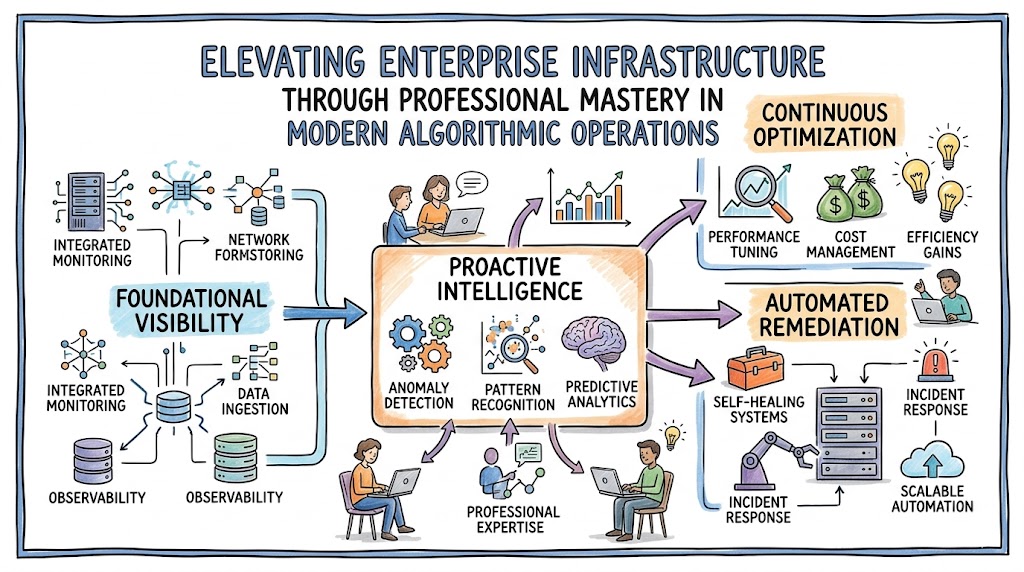
AIOps represents the future of scalable infrastructure management, where machine learning automates the heavy lifting of system monitoring. This comprehensive guide details the Certified AIOps Engineer program at AIOpsSchool, a curriculum designed specifically for professionals eager to master predictive maintenance. By exploring this certification, SREs and DevOps practitioners can move beyond basic alerting into the realm of self-healing systems. We provide this roadmap to help you navigate the specialized training required to lead intelligent automation initiatives within your organization.
What is the Certified AIOps Engineer?
Industry leaders created this designation to validate an engineer’s ability to integrate artificial intelligence into standard operational workflows. It shifts the focus from manual dashboard monitoring to the creation of autonomous systems that identify and resolve incidents before they impact users. The program emphasizes the practical application of data science within production environments, ensuring that learners can handle the massive telemetry streams generated by modern cloud-native applications. Ultimately, this certification proves a candidate can manage high-cardinality data to maintain enterprise-grade uptime.
Who Should Pursue Certified AIOps Engineer?
Platform engineers, cloud architects, and security specialists seeking to reduce operational noise will find this path highly rewarding. While the course targets those already familiar with CI/CD and container orchestration, it also serves as a critical bridge for data engineers moving into the infrastructure space. Managers who oversee large-scale digital transformations also benefit by gaining the technical depth needed to steer their teams toward autonomous operations. Globally, especially within India’s tech hubs, companies prioritize candidates who demonstrate these specialized skills to manage their growing cloud footprints.
Why Certified AIOps Engineer is Valuable and Beyond
The modern enterprise demands faster delivery and higher reliability, a combination that traditional human-led operations can no longer sustain. Earning this credential secures your place at the forefront of the next technological wave, where AI manages the complexity that humans find overwhelming. Professionals who master these concepts enjoy significant career longevity because they solve the most expensive problem in IT: unplanned downtime. Furthermore, this training provides a massive return on investment by teaching you how to optimize resources and reduce cloud spend through intelligent forecasting.
Certified AIOps Engineer Certification Overview
Candidates access the official program through the Certified AIOps Engineer portal, which is hosted directly on AIOpsSchool. The curriculum utilizes a hands-on methodology where students must demonstrate proficiency in real-world scenarios rather than just passing theoretical quizzes. Each module focuses on a specific aspect of the AIOps lifecycle, from data ingestion to automated remediation and post-incident analysis. This structured approach ensures that every certified professional possesses a consistent, high-level skill set recognized by top-tier global employers.
Certified AIOps Engineer Certification Tracks & Levels
The certification framework follows a logical progression from foundational concepts to expert-level architecture. At the base level, engineers learn the core math and logic behind anomaly detection and event correlation. As they move into professional and advanced tracks, they specialize in niche areas like predictive scaling, automated security response, or financial operations. This tiered system allows professionals to build their expertise incrementally, matching their learning pace to their career goals and daily responsibilities.
Complete Certified AIOps Engineer Certification Table
| Track | Level | Who it’s for | Prerequisites | Skills Covered | Recommended Order |
| Operations | Foundation | Junior DevOps | Linux Basics | Data Preprocessing | 1st |
| Reliability | Professional | Senior SREs | Python, Metrics | Anomaly Detection | 2nd |
| Architecture | Advanced | Tech Leads | Foundation | System Orchestration | 3rd |
| FinOps | Specialist | Cloud Analysts | Math Basics | Cost Prediction | Optional |
Detailed Guide for Each Certified AIOps Engineer Certification
Certified AIOps Engineer – Foundation Level
What it is
This level introduces the essential building blocks of intelligent operations. It confirms that the holder understands how to move from traditional reactive monitoring to an observability-first mindset using basic ML.
Who should take it
System administrators and junior DevOps engineers should start here to transition into the world of automation. It provides the necessary context for anyone working with modern telemetry data.
Skills you’ll gain
- Building data pipelines for operational metrics.
- Understanding supervised vs. unsupervised learning for IT.
- Basic event deduplication strategies.
Real-world projects you should be able to do
- Construct a monitoring dashboard that highlights abnormal traffic patterns.
- Automate the filtering of redundant alerts in a staging environment.
Preparation plan
- 7-14 Days: Learn the vocabulary of AIOps and basic metric collection.
- 30 Days: Practice configuring standard observability tools with AI plugins.
- 60 Days: Complete lab exercises focused on basic root cause identification.
Common mistakes
- Skipping the fundamentals of data cleaning before trying to run models.
- Over-relying on tool defaults without understanding the underlying logic.
Best next certification after this
- Same-track option: Professional Certified AIOps Engineer.
- Cross-track option: SRE Foundation.
- Leadership option: Team Lead (Ops).
Certified AIOps Engineer – Professional Level
What it is
The professional level validates an engineer’s capacity to build complex, self-healing workflows. It requires a deep understanding of how to link AI models to active remediation scripts in production.
Who should take it
Senior SREs and automation engineers who want to lead the design of autonomous platforms. This track is for those who are responsible for the overall reliability of distributed systems.
Skills you’ll gain
- Developing custom anomaly detection models.
- Implementing NLP for log analysis and incident categorization.
- Scripting automated incident responses.
Real-world projects you should be able to do
- Create a self-healing script that restarts services based on predictive memory usage.
- Deploy a multi-cloud correlation engine that tracks cross-service failures.
Preparation plan
- 7-14 Days: Review advanced Python libraries like Scikit-learn and Pandas.
- 30 Days: Implement test models against historical outage data.
- 60 Days: Design and document a full AIOps implementation strategy.
Common mistakes
- Failing to account for “false positives” in automated remediation.
- Designing models that are too complex for the team to maintain.
Best next certification after this
- Same-track option: Advanced AIOps Architect.
- Cross-track option: Certified MLOps Professional.
- Leadership option: Director of Platform Engineering.
Choose Your Learning Path
DevOps Path
Engineers following this path prioritize speed and safety within the software delivery pipeline. They use AIOps to identify risky deployments and automate the rollback process based on real-time performance telemetry. This ensures that the development team maintains high velocity without sacrificing the stability of the production environment.
DevSecOps Path
This track focuses on the intersection of security and intelligent automation. Professionals learn to use machine learning to detect zero-day threats and unusual user behavior that traditional firewalls might miss. By integrating AI into the security stack, they ensure continuous compliance and rapid response to potential breaches.
SRE Path
The SRE path emphasizes high availability and the management of service levels through data-driven decisions. Engineers learn to use predictive analytics to anticipate capacity needs and prevent outages before they happen. This role bridges the gap between infrastructure management and high-level system reliability engineering.
AIOps Path
This specific track dives deep into the algorithmic side of operations management. It focuses on the specific tools and methodologies needed to build a truly autonomous infrastructure layer. Engineers here become experts in the niche technologies that power the “brain” of the modern data center.
MLOps Path
Focusing on the lifecycle of the models themselves, this path ensures that machine learning assets remain healthy and accurate. Engineers implement version control, automated testing, and monitoring for ML models to prevent drift and performance degradation. It is a critical role for teams that rely on proprietary algorithms.
DataOps Path
Reliable AIOps depends on high-quality data, and this path teaches you how to build the pipelines that provide it. Professionals learn to orchestrate data flows and ensure the integrity of the information fed into operational models. It is the essential foundation for any successful AI-driven strategy.
FinOps Path
This specialization uses machine learning to conquer the complexity of cloud billing and resource allocation. Engineers learn to predict future spending patterns and automatically downsize underutilized resources to maximize profitability. This path ensures that the organization gets the most value out of its cloud investment.
Role → Recommended Certified AIOps Engineer Certifications
| Role | Recommended Certifications |
| DevOps Engineer | Foundation + Professional (DevOps) |
| SRE | Professional + Advanced (SRE) |
| Platform Engineer | Professional (AIOps) |
| Cloud Engineer | Foundation + Professional (Cloud) |
| Security Engineer | Professional (DevSecOps) |
| Data Engineer | Professional (DataOps) |
| FinOps Practitioner | Specialist (FinOps) |
| Engineering Manager | Foundation + Strategic Leadership |
Next Certifications to Take After Certified AIOps Engineer
Same Track Progression
Deepening your expertise involves moving toward architectural roles where you design the entire automation framework for an enterprise. This requires a shift from implementing specific models to creating long-term strategies for autonomous scaling and global infrastructure management.
Cross-Track Expansion
Broadening your skill set into areas like MLOps or FinOps makes you a much more versatile asset to any engineering organization. Understanding how AI impacts different domains allows you to solve complex, cross-departmental problems that others cannot.
Leadership & Management Track
Transitioning into leadership roles allows you to use your technical background to guide entire departments. You will focus on building high-performance teams and translating the technical benefits of AIOps into business outcomes that executives understand and support.
Training & Certification Support Providers for Certified AIOps Engineer
DevOpsSchool
This provider leads the market with comprehensive training modules that cater to the needs of modern IT professionals. They offer intensive, project-based learning that ensures every student leaves with a portfolio of work they can show to employers.
Cotocus
Focusing on high-end technical training, this organization helps teams master the complexities of cloud-native systems. They provide customized training programs that align perfectly with the specific operational challenges of large enterprises.
Scmgalaxy
This site functions as a massive community knowledge base, offering a deep library of resources on configuration management and automation. It is the perfect starting point for engineers who prefer self-paced learning supported by a robust community.
BestDevOps
Specializing in career transformation, this platform offers curated tracks that guide engineers from basic administration to advanced automation. They simplify complex topics like AI and machine learning, making them accessible to a wide audience.
devsecopsschool.com
This is the premier destination for professionals looking to secure their pipelines with intelligent automation. They provide deep-dive courses that focus on the critical intersection of security, development, and operations.
sreschool.com
Dedicated to the principles of site reliability, this provider teaches engineers how to maintain massive systems with minimal effort. Their curriculum incorporates the latest AIOps trends as a fundamental part of the modern SRE toolkit.
aiopsschool.com
As the official host for the Certified AIOps Engineer credentials, this site provides the most direct and thorough training available. They offer specialized tracks that ensure every engineer finds the specific knowledge they need for their role.
dataopsschool.com
This platform focuses on the vital data pipelines that power every intelligent system. They teach engineers how to manage the flow and quality of operational data, ensuring that AIOps models remain accurate and reliable.
finopsschool.com
Engineers who want to master the economic side of the cloud turn to this provider for specialized training. They offer courses on using AI to predict and control cloud costs, a skill that is increasingly valuable to modern businesses.
Frequently Asked Questions (General)
- How tough is the Certified AIOps Engineer examination?
The exam tests both your conceptual understanding and your ability to apply AI to real operational problems, making it a moderately difficult challenge. - What time commitment does the course require?
Most students spend about 5 to 10 hours per week over a period of two to three months to fully master the material. - Do I need a background in data science?
No, the course teaches you the specific machine learning concepts you need for IT operations, though basic math skills are helpful. - Is the certification recognized by global employers?
Yes, companies worldwide value the Certified AIOps Engineer credential because it proves a high level of practical, hands-on skill. - How do I renew my certification?
You must undergo a brief recertification process every two years to prove that your skills remain current with the latest industry trends. - Are there any live instructor-led sessions?
Many of the training providers offer live webinars and Q&A sessions to support students as they work through the curriculum. - Does the exam focus on specific vendor tools?
The exam prioritizes the logic and principles of AIOps, though you will use popular open-source and commercial tools during the labs. - What kind of salary increase can I expect?
Professionals with AIOps skills often command significantly higher salaries due to the scarcity of talent in this specialized field. - Can I take the exam in multiple languages?
Currently, the primary language for the exam is English, though support for other languages is expanding as the program grows. - Is there a prerequisite for the Professional level?
We strongly recommend completing the Foundation level first to ensure you have the necessary background for the more advanced topics. - Do I get a digital badge for my profile?
Yes, upon passing, you receive a verified digital badge that you can display on your LinkedIn profile and resume. - What happens if I fail the exam on the first try?
Most providers offer a retake policy that allows you to review the material and try again after a short waiting period.
FAQs on Certified AIOps Engineer
- How does this program handle the “black box” nature of AI?
We teach you how to build explainable models so you can always understand why an automated decision was made. - Will AIOps eventually replace human SREs?
No, AI replaces the tedious, repetitive tasks, allowing human engineers to focus on higher-level system design and innovation. - What is the most difficult part of the curriculum?
Many students find the transition from rule-based alerting to probabilistic, ML-based detection to be the most significant mental shift. - Does the course include training on Large Language Models?
The advanced tracks include modules on using LLMs to assist with log summarization and automated incident documentation. - How often does the curriculum change?
We update the course materials twice a year to ensure they reflect the latest advancements in AI and infrastructure management. - Can I use my own cloud account for the labs?
While we provide lab environments, you can also apply the principles in your own sandbox to further solidify your learning. - Is there a focus on ethical AI and bias?
Yes, we include modules on ensuring that your operational AI does not introduce bias or unintended consequences into your system. - What kind of laptop do I need for the course?
Any modern computer with a stable internet connection will work, as most of the heavy lifting happens in cloud-based lab environments.
Final Thoughts
Gaining mastery in algorithmic operations positions you as a critical asset in an increasingly automated world. By choosing the right certification track, you transform your daily routine from fire-fighting to strategic innovation. This guide highlights the best paths for growth, ensuring that your investment in learning leads to real-world career advancement. Take the first step today by exploring the foundational courses and joining a community of professionals dedicated to the future of infrastructure. Your journey toward becoming an elite automation expert begins with the commitment to master these intelligent systems.