INTRODUCTION
Navigating the complexities of international relocation requires precision, and utilizing a PR Points Calculator serves as the foundational step for any aspiring migrant. Consequently, many candidates face significant hurdles when attempting to quantify their professional and personal attributes against rigid governmental standards. This guide illuminates the intricate pathways available to skilled professionals by breaking down the specific metrics that determine success. Furthermore, understanding the nuances of these calculations empowers individuals to make informed decisions regarding their future residency. Therefore, this roadmap provides a comprehensive analysis of human capital factors, regional influences, and strategic optimizations designed to elevate your profile. Eventually, you will possess the clarity needed to transform a complex set of criteria into a manageable and actionable plan.
What Is a PR Points Calculator?
A PR Points Calculator functions as a sophisticated diagnostic tool that translates personal history into a numerical value for immigration authorities. Essentially, this system prioritizes candidates who demonstrate the highest potential for economic contribution and seamless integration into the local labor market. Because the landscape of global migration remains highly competitive, these calculators offer a standardized method for ranking applicants fairly. Moreover, the logic behind the system ensures that only the most qualified individuals receive invitations to apply for permanent residency. Hence, users must treat this tool as a vital simulation of the actual assessment conducted by immigration officers. By providing immediate feedback on one’s standing, it identifies critical gaps that require attention before a formal submission occurs.
- The Core Purpose of PR Points Calculator:
- This tool serves as an objective filtering mechanism that streamlines the selection process for government agencies while reducing administrative backlogs significantly.
- It provides applicants with a transparent benchmark, allowing them to compare their current qualifications against the minimum thresholds required for various visa subclasses.
- How the PR Points Calculator System Works:
- The algorithm assigns specific weightings to variables such as age, language ability, and work history, culminating in a total aggregate score.
- Regular updates to the underlying software ensure that the calculation reflects the most recent legislative changes and shifting economic priorities of the host nation.
- Eligibility Standards vs. Selection Criteria:
- Eligibility standards represent the absolute minimum legal requirements for entry, such as health clearances and character checks, which do not always grant points.
- Selection criteria involve the competitive point-based attributes where higher scores directly increase the probability of receiving an Invitation to Apply (ITA).
PR Points Calculator Components: The Building Blocks
The architectural integrity of a migration profile rests upon several key human capital components that define a candidate’s long-term viability. Specifically, these building blocks prioritize youth, expertise, and communication skills to ensure that new residents can thrive in a modern economy. Consequently, the points system heavily favors individuals within a specific age bracket who possess specialized academic credentials. Additionally, language proficiency acts as a critical multiplier, as it determines an individual’s ability to navigate professional environments effectively. Furthermore, verified work experience reinforces the validity of an applicant’s skillset, proving they can meet industry demands immediately upon arrival. Therefore, analyzing these components individually allows for a more granular understanding of where a score can be fortified through targeted efforts.
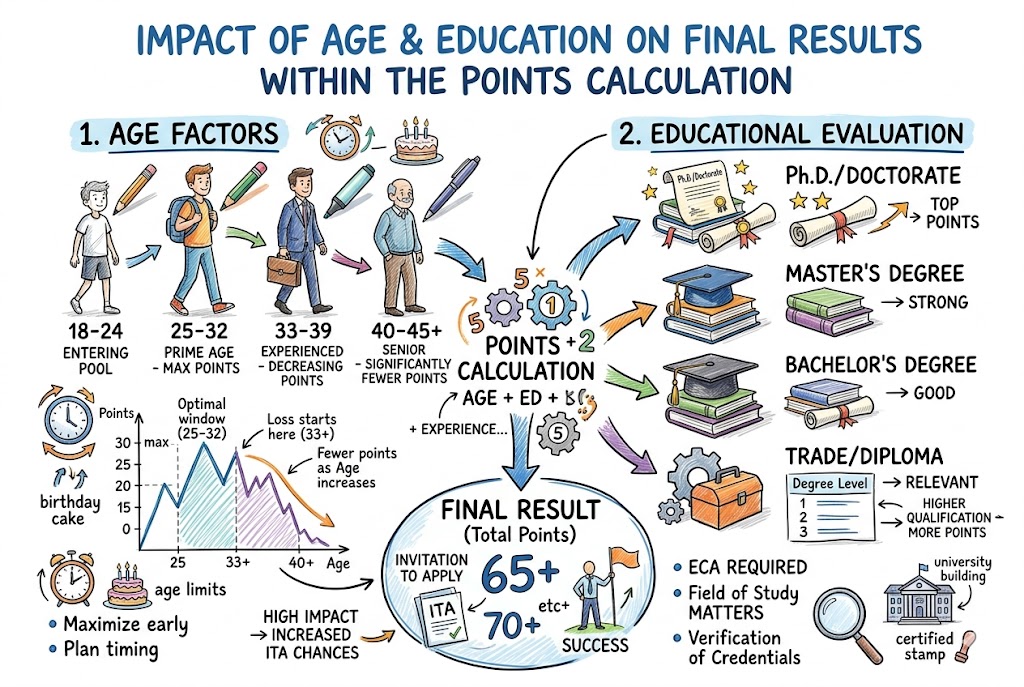
- Age Factors in PR Points Calculator:
- The system typically awards the maximum points to individuals in their mid-twenties to early thirties, as this demographic offers the longest potential working life.
- Point allocations gradually decrease as applicants move toward their late thirties and forties, reflecting a shorter remaining contribution period to the national pension and tax systems.
- Educational Evaluation for PR Points Calculator:
- Degrees obtained from recognized international institutions undergo rigorous scrutiny to ensure they meet the equivalent standards of the host country’s educational framework.
- Higher-level qualifications, such as Doctorates or Master’s degrees in specialized fields, yield significantly more points than basic diplomas or vocational certificates.
- Language Proficiency Standards:
- Achieving “Superior” or “Proficient” results in standardized tests like IELTS or PTE can provide a massive boost, often making the difference between success and failure.
- Test results must remain valid at the time of the invitation, necessitating careful timing to ensure the scores do not expire during the processing period.
- Professional Experience Verification:
- Relevant work history must align strictly with the nominated occupation list to qualify for points, requiring detailed reference letters and pay records.
- Experience gained in the host country often carries a higher point value compared to overseas experience due to the immediate relevance of local industry knowledge.
International Pathways for PR Points Calculator
Exploring the various international pathways reveals that different visa subclasses cater to diverse professional backgrounds and regional needs. Specifically, independent skilled visas allow for maximum flexibility, whereas state-sponsored streams provide a vital lifeline for those who fall slightly short of the required points. Because different regions have unique labor shortages, they often lower certain thresholds to attract specific talents to their local industries. Moreover, these subclasses serve as distinct categories that influence how the calculator processes your data. Therefore, understanding the distinction between a permanent independent visa and a provisional regional visa remains crucial for a successful strategy. Furthermore, these pathways often lead to the same end goal of permanent residency but require different commitment levels regarding where you live and work.
- Key Categories and Classes:
- The Skilled Independent stream relies solely on the applicant’s personal attributes without requiring a sponsor, making it the most competitive yet flexible option.
- State or Territory Nominated subclasses provide additional points in exchange for a commitment to live and work in a specific jurisdiction for a set period.
- Comparative Results Summary:
- Independent pathways usually require a much higher points ceiling due to the massive volume of global applicants competing for limited spots.
- Regional pathways offer a lower points entry barrier but necessitate thorough research into the specific economic demands of smaller, less populated provinces.
Advanced Regional Requirements for PR Points Calculator
Regional requirements introduce a layer of complexity that often benefits candidates willing to move outside of major metropolitan hubs. Specifically, many governments utilize points-based incentives to encourage migration into areas experiencing significant population decline or skill shortages. Consequently, bonus points for regional study or state nomination can bridge the gap for applicants who are otherwise stuck at a lower score. Furthermore, these incentives reflect a strategic effort to balance the national economy by distributing talent more evenly across the country. Additionally, regional sponsorship often involves a streamlined processing timeline, which serves as an additional advantage for those in a hurry. Therefore, investigating regional opportunities often reveals hidden paths to residency that the standard independent assessment might overlook.
- Regional Study Bonuses:
- Completing a degree or diploma at a campus located in a designated regional area can unlock vital bonus points that are unavailable to city-based students.
- This requirement usually stipulates a minimum residency period within the region during the course of study to ensure genuine community integration.
- Sponsorship Weights:
- A formal nomination from a state government provides a significant numerical increase to the total score, often totaling five to fifteen additional points.
- Each state maintains its own “In-Demand” list, meaning applicants must tailor their profiles to meet the specific vocational needs of that particular region.
The Global Landscape of PR Points Calculator
The global landscape of migration has shifted toward these quantitative models because they offer a data-driven approach to border management. Specifically, countries like Australia, Canada, and New Zealand have refined these systems over decades to maintain high living standards and economic growth. Consequently, while the core logic remains similar across borders, the specific weightings for certain professions can vary wildly depending on local market trends. Moreover, comparing these frameworks allows applicants to identify which country offers the best “return on investment” for their specific skill set. Furthermore, understanding the international context helps in managing expectations regarding processing times and the competitive nature of the global talent pool. Therefore, a broad perspective on the global points landscape ensures that you are applying in a market where your skills are most valued.
- Major Global Frameworks:
- Leading migration nations utilize Expression of Interest (EOI) systems to manage the flow of applicants, ensuring that only the top-ranked candidates move forward.
- These frameworks are increasingly incorporating “Human Capital” scores which prioritize the adaptability and long-term potential of the migrant over immediate job offers.
- Key International Differences:
- Some countries place a heavier emphasis on an existing job offer, while others focus purely on the points generated by academic and professional history.
- The frequency of selection rounds varies between nations, with some conducting monthly draws and others operating on a more fluid, demand-based schedule.
Benefits of Utilizing a PR Points Calculator
Utilizing a calculator provides immediate clarity, which is perhaps the most significant benefit during an inherently stressful and expensive process. Specifically, it allows for meticulous planning by highlighting exactly which areas of a profile need the most improvement. Consequently, instead of guessing their chances, applicants can invest their resources into retaking language exams or gaining additional years of experience. Furthermore, this proactive approach saves thousands of dollars in application fees that might otherwise be wasted on an ineligible submission. Additionally, the tool acts as a reality check, ensuring that expectations remain aligned with the current legislative environment. Therefore, the strategic use of a calculator transforms the migration journey from a gamble into a calculated professional move.
- Planning Accuracy:
- Users can simulate different scenarios, such as the impact of gaining a new certification or reaching a higher age bracket, to plan their submission timing perfectly.
- Accurate calculations prevent the submission of “weak” profiles that are unlikely to receive an invitation, thereby preserving the applicant’s record and resources.
- Strategic Resource Allocation:
- By identifying that a higher language score provides more points than an additional year of work, applicants can prioritize study over extra overtime.
- The tool helps in deciding whether to pursue a state nomination or wait for an independent invitation based on the calculated point gap.
Educational Credential Assessment (ECA) Standards
The Educational Credential Assessment (ECA) serves as a mandatory gatekeeper to ensure that international qualifications match local academic standards. Specifically, without a valid ECA, the points claimed for a degree are often considered null and void by immigration authorities. Consequently, this process involves a thorough verification of transcripts, institution status, and the duration of the program. Moreover, different assessing bodies handle specific professions, such as engineering, nursing, or information technology. Furthermore, the table below illustrates how different levels of education typically translate into points across most standard calculators. Therefore, securing an ECA early in the process is essential for providing a factual basis for your points claim.
| Education Level | Typical Point Value | Duration Equivalent |
|---|---|---|
| PhD / Doctorate | 20 Points | 3-5 Years Post-Grad |
| Master’s Degree | 15 Points | 1-2 Years Post-Grad |
| Bachelor’s Degree | 15 Points | 3-4 Years Undergraduate |
| Advanced Diploma | 10 Points | 2-3 Years Vocational |
| Trade Certificate | 10 Points | Varies by Industry |
Export to Sheets
- Verification Protocols:
- Assessing authorities verify the accreditation of the awarding university to prevent the use of degrees from unverified or “diploma mill” institutions.
- The assessment specifically looks at whether the course content aligns with the duties of the nominated occupation chosen by the applicant.
Step-by-Step Guide to Mastering PR Points Calculator
Mastering the calculation process requires a systematic approach to ensure that no point is left unclaimed and every claim is backed by evidence. Specifically, the first step involves a cold assessment of your current standing without any “aspirational” data. Consequently, once you have a baseline, you must begin the rigorous process of document collection to verify every month of work and every academic credit. Furthermore, checking the latest market demand lists is vital, as a profession that was in demand last month might be removed today. Moreover, the final calculation should be a conservative estimate to account for any potential discrepancies during the official government audit. Therefore, following a structured sequence prevents the common pitfalls of over-enthusiasm and clerical errors.
- Gathering Necessary Documents:
- Collect all employment contracts, tax returns, and official transcripts before attempting a final calculation to ensure the data entered is 100% accurate.
- Obtain a preliminary language test result or use a practice exam score to provide a realistic baseline for the English proficiency section.
- Practicing Core Assessments:
- Engaging with professional skills assessment bodies early allows you to understand if your job title truly matches the required tasks of the occupation.
- Regularly testing your language skills under exam conditions ensures that the points you claim in the calculator are actually achievable in reality.
- Checking Market Demand Lists:
- Frequently monitor the “Occupations in Demand” lists released by various states, as these directly influence your eligibility for certain point-boosting pathways.
- Verify that your specific ANZSCO or NOC code is currently open for invitations to avoid calculating points for a closed pathway.
- Calculating the Final Result:
- Input the verified data into the calculator, paying close attention to the exact dates of employment to avoid “rounding up” errors that lead to rejection.
- Review the final tally against the recent historical “cut-off” scores for your occupation to gauge the actual likelihood of an invitation.
Strategies to Optimize Your PR Points Calculator Score
Optimizing a score requires a proactive mindset and a willingness to invest in self-improvement to outshine the global competition. Specifically, many applicants find success by targeting the “low-hanging fruit,” such as improving their language test results from a “Competent” to a “Superior” level. Consequently, this single change can often add twenty points to a profile, which is equivalent to several years of work experience. Furthermore, seeking a partner’s skills assessment or language proficiency can also contribute valuable bonus points to a joint application. Moreover, pursuing a professional year or specialized certification can provide the edge needed in a crowded field. Therefore, optimization is not about inflating your credentials but about strategically enhancing your profile to meet the system’s preferences.
- The Performance Enhancement Strategy:
- Investing in high-quality language coaching can lead to a score boost that provides more points than any other single factor in the system.
- Ensuring that your partner also completes a skills assessment can add five to ten points, which often serves as the deciding factor for an invitation.
- Bonus Qualification Advantages:
- Acquiring a NAATI certification for translation or interpretation in a community language can provide a unique five-point bonus that many other candidates miss.
- Completing a “Professional Year” program in fields like Accounting or IT provides both local experience points and a direct pathway to industry networking.
- Regional Nomination Opportunities:
- Researching smaller states with niche requirements can lead to a nomination that adds substantial points to your total, making the independent threshold irrelevant.
- Maintaining a flexible attitude toward your initial place of residence can significantly shorten the time it takes to secure a permanent visa.
Common Mistakes in the PR Points Calculator Process
Avoiding common mistakes is just as important as gaining new points, as a single inaccuracy can lead to a multi-year ban for providing misleading information. Specifically, many applicants mistakenly count work experience that occurred before they were considered “fully qualified” by the assessing authority. Consequently, this leads to an overestimation of points that is quickly dismantled during the formal visa processing stage. Furthermore, relying on expired documents or old language test results is a frequent error that results in immediate disqualification. Moreover, misunderstanding the “age-out” rules can be devastating if an applicant turns a year older while their application is still in the queue. Therefore, meticulous attention to detail and a conservative approach to point claims are the best defenses against failure.
- Overestimating Attributes:
- Claiming points for “skilled” employment before the date the assessing body deems you qualified is a leading cause of visa refusals and “over-claiming” flags.
- Assuming that a job title alone guarantees points without checking the specific task descriptions in the official dictionary of occupations can lead to total rejection.
- Expired Documentation Risks:
- Failing to notice that a language test or a skills assessment has a limited validity period can result in an invalid Expression of Interest.
- Submitting documents that are not properly translated or certified according to the specific standards of the immigration department can cause massive delays.
Real-Life Case Scenarios Using PR Points Calculator
Analyzing real-life scenarios helps visualize how different profiles navigate the points landscape to achieve their residency goals. Specifically, an early-career professional might rely heavily on their high language scores and recent local education to offset their lack of work experience. Consequently, they often find success through regional pathways that value their long-term potential. Furthermore, an experienced professional with a decade of overseas work might struggle with the age bracket but excel in the “Years of Experience” category. Moreover, specialized experts in “Critically Endangered” skill sectors may receive invitations even with a lower total score due to the extreme demand for their niche talents. Therefore, these scenarios demonstrate that there is no “one size fits all” approach to the points system.
- The Early Career Scenario:
- A 25-year-old graduate with a Master’s degree from a local university focuses on achieving a perfect score in English to compensate for having only one year of work history.
- They successfully secure a state nomination by moving to a regional area, gaining the final points needed for a provisional residency visa.
- The Experienced Professional Scenario:
- A 38-year-old Senior Engineer with twelve years of experience relies on their high-level expertise and a partner’s skills assessment to maintain a competitive edge.
- Despite losing points for age, their maximum points for work history and educational qualifications allow them to meet the independent visa threshold.
- The Specialized Hero Scenario:
- An IT specialist working in a high-demand field like Cybersecurity finds that they are invited at a lower point score because the government is prioritizing their specific industry.
- This individual uses the calculator to ensure they maintain the minimum baseline while focusing their energy on securing a job offer that accelerates their nomination.
Frequently Asked Questions (FAQs)
- How often should I update my profile in the PR Points Calculator?You should update your profile immediately whenever you gain a new qualification, reach a new age bracket, or receive updated language test results.
- Can I claim points for work experience gained during my studies?Generally, most systems only count work experience that is post-qualification and meets a minimum number of hours per week to be considered “skilled.”
- What happens if I turn a year older after submitting my Expression of Interest?The system automatically updates your score based on your date of birth, which might reduce your total points and affect your ranking in the pool.
- Is a job offer mandatory to get points in the calculator?While a job offer is not always mandatory for independent visas, it can provide significant bonus points or be a requirement for certain state-sponsored pathways.
- Does the PR Points Calculator guarantee a visa approval?No, the calculator is a self-assessment tool; the official determination is made by immigration officers after a thorough audit of your supporting evidence.
- How long are language test results valid for the points calculation?Most immigration authorities accept language test results for up to three years, but you must check the specific rules for your chosen visa subclass.
- Can I combine points from two different occupations?No, you must nominate a single occupation and only claim work experience and qualifications that are relevant to that specific professional code.
- Are the points for a Master’s degree higher than a Bachelor’s degree?In many systems, both degrees receive the same number of points, though a Master’s might be required to pass the skills assessment for certain professions.
- What is the “pass mark” for a PR Points Calculator?The pass mark varies depending on the visa type and the current level of competition, but most independent visas require a minimum of 65 points.
- Do I get points for my spouse’s education?Yes, if your spouse meets specific language and skills assessment requirements, they can contribute additional points to your total aggregate score.
FINAL THOUGHT
Successfully navigating the PR Points Calculator requires a blend of meticulous honesty and strategic foresight. Because the migration landscape is constantly evolving, maintaining a flexible and proactive approach to your profile is essential for long-term success. Furthermore, this tool should be viewed as a compass that guides your professional development and educational choices toward a viable residency outcome. By understanding the weight of each component—from age and language to regional incentives—you can build a profile that stands out in a competitive global market. Moreover, the effort spent in accurately documenting your journey today will prevent significant challenges during the formal application process tomorrow. Eventually, your dedication to detail and commitment to improvement will bridge the gap between your current location and your future home. Therefore, take the first step with confidence, stay informed about policy shifts, and remain persistent in your pursuit of international opportunities. You possess the capability to master this system and unlock the door to a vibrant new chapter of your life.