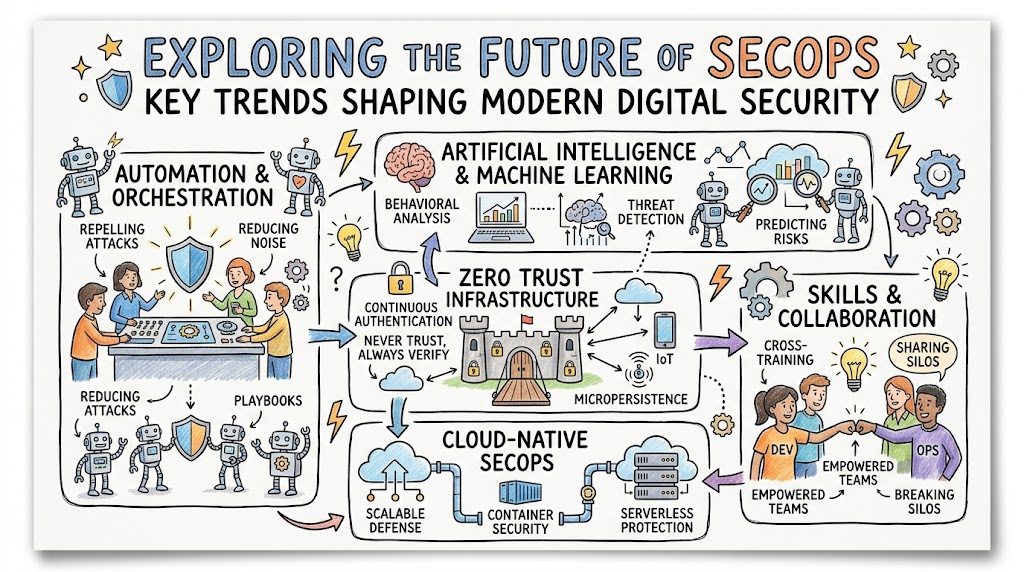
Security operations continue to transform at an unprecedented rate, shifting from reactive defense mechanisms toward intelligent, automated, and proactive posture management. Organizations across the globe recognize that operational speed without embedded continuous protection creates severe vulnerabilities. As infrastructure expands across multi-cloud environments, distributed microservices, and edge devices, traditional boundary defenses can no longer protect sensitive assets. SecOps unifies developers, system engineers, and security specialists into a single collaborative force that embeds continuous guardrails into every deployment pipeline.
To navigate this changing landscape successfully, engineering teams must adopt advanced telemetry, real-time threat detection, and unified governance platforms. Professional guidance and specialized skill development through platforms like Xopsschool allow teams to build resilient operational ecosystems. Modern security operations ensure that security becomes an automated, continuous enabler rather than an annoying operational bottleneck. By weaving security into daily engineering workflows, organizations stay ahead of emerging threats while maintaining exceptional system reliability.
Unveiling the Next Era of Modern Security Operations
The modern digital ecosystem demands a fundamentally new approach to operational safety and system resilience. Historically, security teams operated in isolated silos, performing periodic manual audits that frequently delayed product launches and created friction with development teams. Today, high-velocity delivery models require continuous oversight, where every single line of code and infrastructure configuration undergoes continuous validation. Consequently, modern security operations rely on deep automation, behavioral analytics, and real-time monitoring to safeguard enterprise ecosystems.
As cyber threats become increasingly sophisticated, autonomous attacks and automated exploit kits easily bypass static, perimeter-based security controls. Modern operational security addresses this by embedding active sensors across network endpoints, cloud environments, and deployment pipelines. Furthermore, integrating artificial intelligence and advanced machine learning into detection engines enables systems to spot unusual behavioral patterns instantly. This proactive stance ensures that potential security breaches are identified and contained long before they can impact production environments.
In addition to advanced detection mechanisms, the ongoing convergence of security operations with platform engineering is redefining organizational structures. Platform teams now build secure internal platforms that provide developers with self-service capabilities backed by pre-approved compliance templates. As a result, developers can build and deploy applications independently without accidentally exposing sensitive cloud resources. This collaborative model transforms security from an obstructive checkpoint into an invisible, continuous safety net that scales naturally with organizational growth.
Key Operational Concepts You Must Know
Autonomous Threat Detection and Agentic Incident Response
Modern enterprise environments generate immense volumes of event telemetry every single second, quickly overwhelming traditional monitoring tools. To manage this massive data stream, next-generation operational platforms utilize agentic intelligence to perform automated investigation and response. Consequently, automated agents can analyze complex event correlations, cross-reference threat intelligence feeds, and execute containment playbooks within milliseconds. This automated triage eliminates manual overhead, allowing human engineers to focus their expertise on high-priority strategic decisions.
[System Telemetry Stream] -> [Agentic Detection Engine] -> [Contextual Enrichment] -> [Automated Playbook Trigger]
Furthermore, autonomous response engines actively mitigate security threats without requiring manual human intervention at every step. For example, if an internal workload exhibits unusual outbound network activity, the automated system can instantly quarantine the affected container instance. Simultaneously, the platform revokes compromised dynamic credentials and notifies on-call responders with comprehensive forensic details. This rapid containment drastically reduces the mean time to remediate, keeping organizational assets fully protected around the clock.
Policy-as-Code and Automated Governance Pipelines
Enforcing regulatory compliance and security policies manually across thousands of cloud resources is practically impossible in modern IT environments. Therefore, engineering teams utilize policy-as-code frameworks to express compliance rules directly as version-controlled code. By embedding policy evaluation engines into continuous integration pipelines, every proposed configuration change undergoes immediate validation before deployment. As a result, non-compliant resource configurations are automatically rejected, preventing security misconfigurations from reaching live production environments.
Moreover, policy-as-code extends well beyond pre-deployment pipeline checks into continuous runtime governance. Policy engines constantly inspect live cloud environments to detect unauthorized configuration drift or accidental security modifications. Whenever live resources diverge from declared compliance states, automated remediation workflows immediately restore the secure baseline. This continuous reconciliation loop ensures that regulatory compliance is maintained dynamically without imposing heavy administrative workloads on engineering teams.
Platform Implementation vs. Culture — What’s the Real Difference?
| Operational Aspect | Platform Implementation Focus | Cultural Alignment Focus |
|---|---|---|
| Core Strategy | Deploying automated security scanners, log aggregators, and secret vaults. | Establishing shared accountability, blameless post-mortems, and continuous learning. |
| Daily Operations | Configuring Webhooks, writing automation scripts, and tuning alerting rules. | Breaking down team silos, holding cross-functional reviews, and fostering trust. |
| Success Metrics | Tool adoption rate, deployment pipeline speed, and automated fix frequency. | Reduced inter-team friction, proactive issue reporting, and strong team morale. |
| Long-Term Impact | Builds technical infrastructure required to detect and stop system attacks. | Sustains operational security practices as tools evolve and team structures change. |
Deploying powerful enterprise platforms is essential, yet relying purely on technical solutions without addressing team culture leads to failure. When organizations buy expensive security tools without fostering open communication, engineers often view security procedures as restrictive obstacles. Consequently, leadership must actively promote a supportive culture that values transparency and views security misconfigurations as learning opportunities. When developers feel comfortable reporting accidental exposure risks immediately, overall system safety improves exponentially.
In addition, true cultural alignment requires integrating security goals directly into the day-to-day objectives of software delivery teams. Security metrics should never exist in isolation; instead, they must sit right alongside performance and reliability metrics. When operations, development, and security teams share common objectives, they naturally collaborate to build resilient, high-performing systems. Ultimately, a strong security culture ensures that technical platforms are fully utilized and continuously refined over time.
Real-World Use Cases of Modern Operations
Automated Remediation in Multi-Cloud Environments
Consider a enterprise operating across diverse public cloud platforms that encounters a sudden data exposure event. An automated system detects an unencrypted storage bucket created with public read permissions in a remote cloud region. Rather than relying on human operators to manually identify and fix the issue, the automated platform acts instantly. The system revokes public access rights, enables native encryption at rest, and updates network firewall policies within seconds of detection.
[Public Access Flagged] -> [Automated Policy Engine] -> [Permissions Revoked] -> [Encryption Enabled Automatically]
Because this automated remediation occurs within seconds, malicious actors have zero opportunity to discover or extract sensitive corporate data. Meanwhile, the platform generates detailed audit logs and notifies the responsible development team with clear guidance on avoiding similar configuration mistakes. This real-time response model protects enterprise assets across complex, multi-cloud environments while maintaining complete operational visibility.
Zero-Trust Continuous Identity Verification
Another powerful real-world scenario involves implementing zero-trust identity architectures across distributed application networks. In traditional architectures, once an entity gains initial access to an internal network, it enjoys broad access privileges across adjacent systems. Modern operations eliminate this dangerous implicit trust by requiring continuous identity verification for every single service request. Microservice communications must present short-lived, cryptographically signed identity tokens before access is granted.
- Request Initiation: The client service generates a signed request containing short-lived identity claims.
- Contextual Evaluation: The security gateway inspects user location, device health, and active session risk.
- Dynamic Authorization: Access is granted strictly for the requested resource and revoked immediately upon task completion.
- Continuous Monitoring: System behavior is analyzed continuously for unexpected lateral movement attempts.
By enforcing strict contextual authorization at every layer, organizations effectively neutralize lateral attack paths across their network infrastructure. If an attacker manages to compromise a single service, automated boundary controls isolate the breach instantly. This granular containment protects critical databases and internal services from unauthorized access, ensuring business continuity during security incidents.
Common Mistakes in Operations Engineering
Mismanaging Alert Thresholds and Ignoring Alert Fatigue
A frequent mistake in operations engineering is configuring broad, overly sensitive alert parameters for non-critical systems. When communication channels are constantly flooded with routine operational notifications, engineers quickly develop alert fatigue. Consequently, critical security warnings get lost in the overwhelming noise, leading to delayed response times during major incidents. To prevent this, engineering teams must carefully calibrate alert rules so that notifications trigger only when immediate human action is required.
Furthermore, every notification generated by monitoring systems must provide clear, actionable context and relevant troubleshooting guides. If on-call responders must spend valuable time deciphering obscure error codes, their incident response efficiency drops significantly. Teams should schedule regular audits to archive obsolete monitoring rules and adjust alerting baselines based on historical performance data. Maintaining a focused alerting environment keeps engineering teams vigilant, responsive, and ready for critical threats.
Relying on Static Credentials and Manual Key Rotation
Hardcoding static API keys, database passwords, and cryptographic secrets directly into source code repositories remains a massive security risk. Static credentials frequently leak into public code repositories or linger in outdated configuration files long after employees leave. Modern operations require the elimination of static credentials in favor of centralized secret management solutions that issue short-lived, dynamically generated tokens. Applications must authenticate against secure secret managers at runtime to receive transient access credentials automatically.
[Application Instance] -> [Requests Runtime Secret] -> [Secret Manager Validates] -> [Issues Short-Lived Token]
Additionally, automated rotation schedules must be configured for all database credentials and third-party API integration keys. By rotating secrets continuously in the background, organizations ensure that leaked credentials become useless almost immediately. Implementing dynamic secret management drastically reduces the enterprise attack surface and prevents unauthorized credential misuse across distributed systems.
How to Become an Operations Expert — Career Roadmap
Mastering Core Infrastructure and Cloud Automation
To build a successful career in modern security operations, engineers must build a solid foundation in operating systems, networking, and software development. Understanding core networking protocols, system kernel interactions, and cloud virtualization is essential for diagnosing complex security anomalies. Once foundational knowledge is established, engineers should focus heavily on mastering infrastructure-as-code frameworks and automation scripting languages. The ability to programmatically build, manage, and secure cloud environments is a fundamental requirement for platform engineers.
Role-Based Skills and Mastery Matrix
- Associate Security Operations Specialist:
- Gain deep proficiency in Linux system administration, foundational networking, and basic Shell/Python scripting.
- Learn to configure centralized logging platforms and build custom visualization dashboards for monitoring telemetry.
- Understand modern containerization concepts, basic Kubernetes architecture, and version control workflows using Git.
- Senior Security Operations Engineer:
- Design advanced infrastructure-as-code templates integrated with automated policy-as-code validation engines.
- Architect scalable log aggregation pipelines capable of processing terabytes of security events in real time.
- Develop automated incident response playbooks using modern SOAR platforms to streamline threat mitigation.
- Principal Infrastructure Security Architect:
- Define enterprise-wide strategy for zero-trust architecture, multi-cloud governance, and security automation.
- Align technical infrastructure investments with overarching business risk strategies and regulatory requirements.
- Mentor cross-functional engineering teams, foster a culture of shared security accountability, and drive platform evolution.
FAQ Section
- What is the main difference between traditional security operations and modern cloud-native SecOps?Traditional security operations relied heavily on manual audits, perimeter firewalls, and reactive incident responses after breaches occurred. In contrast, modern cloud-native SecOps integrates automated security guardrails, policy-as-code, and continuous real-time telemetry directly into automated deployment pipelines.
- How can organizations effectively reduce alert fatigue among on-call engineering teams?Organizations can combat alert fatigue by systematically auditing monitoring rules, tuning notification thresholds, and suppressing non-actionable alerts. Additionally, implementing automated triage platforms ensures that human engineers are alerted only when immediate, high-priority intervention is strictly necessary.
- Why is policy-as-code critical for managing multi-cloud compliance and governance?Policy-as-code allows organizations to define compliance rules as version-controlled code, ensuring consistent enforcement across all cloud providers. This approach prevents misconfigurations before deployment and continuously reconciles runtime configuration drift without requiring manual compliance checks.
- How does zero-trust architecture enhance overall security posture in distributed environments?Zero-trust architecture removes implicit trust from internal networks by requiring explicit, continuous identity verification for every user and workload request. This approach limits lateral movement, contains potential breaches, and ensures that dynamic access permissions are strictly restricted to verified entities.
- What steps should small engineering teams take to adopt automated security guardrails quickly?Small teams should start by embedding open-source static security scanners directly into their existing continuous integration pipelines. Focusing first on automated secret detection and basic vulnerability scanning yields immediate safety improvements without overwhelming existing operational capacity.
Final Summary
Embracing the future of security operations requires combining automated platform engineering, intelligent threat detection, and an inclusive organizational culture. By replacing manual audits with automated policy enforcement, continuous telemetry, and dynamic secret management, organizations can safely accelerate software delivery. Security becomes an empowering asset that enhances overall resilience rather than an operational bottleneck.
Ultimately, achieving operational excellence depends on empowering engineers with modern skills, strong collaboration habits, and continuous learning opportunities. Investing in robust training programs and fostering cross-functional accountability ensures that teams adapt smoothly to emerging threats. As digital ecosystems become more complex, proactive security operations will remain the cornerstone of resilient, scalable modern enterprise infrastructure.