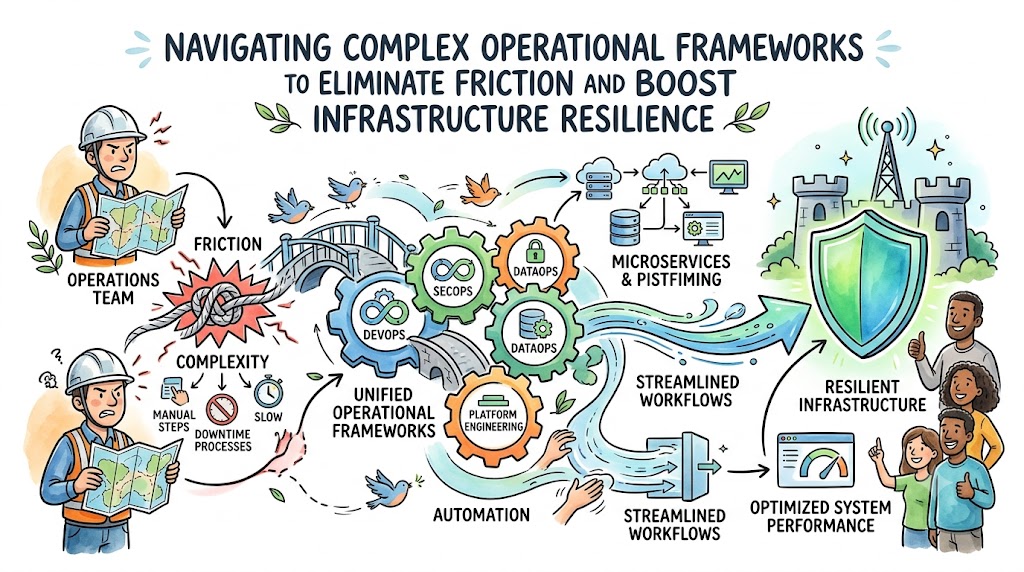
Imagine a sudden, massive system disruption hitting your primary application during peak traffic hours, leaving your engineering team scrambling in the dark. This operational bottleneck happens because modern distributed systems grow too complex for traditional management methodologies to handle safely. Therefore, tech organizations desperately need unified operations, or XOps, to maintain stability while deploying software at a global scale.
XOps represents the comprehensive integration of various operational disciplines—including DevOps, SecOps, DataOps, and MLOps—into a single, cohesive framework. This practice breaks down organizational silos, aligns cross-functional engineering teams, and ensures consistent automation across every layer of the technology stack. Consequently, this deep-dive guide covers the critical friction points within modern infrastructure environments, foundational management architectures, and proven engineering methodologies to achieve continuous uptime. To successfully master these complex environments, professionals can explore industry-aligned training programs and interactive learning pathways provided by Xopsschool, which equips teams with the precise technical skills required to conquer modern systemic challenges.
The Origin of Systems Infrastructure
The Early Industrial Bottlenecks
Traditional software operations relied heavily on isolated engineering teams working in separate silos, which created massive friction during deployments. Developers focused entirely on writing code and shipping features quickly, while operations teams prioritized baseline system stability above all else. Because these groups rarely communicated effectively, code handoffs frequently triggered unexpected performance failures and extended downtime.
Furthermore, manual infrastructure provisioning made replicating staging environments in production setups nearly impossible. When configuration drift inevitably occurred, engineers spent days troubleshooting environmental discrepancies instead of building value. This recurring operational friction severely limited business agility and exposed the fundamental flaws of legacy infrastructure management.
Moving Toward Unified Workflow Automation
As application architectures evolved from monolithic codebases to distributed microservices, manual system coordination became completely unsustainable. Organizations quickly realized they needed a unified approach that merged development pipelines with operational security and infrastructure management. This realization triggered the broad adoption of programmable infrastructure and automated continuous integration workflows.
By treating infrastructure as code, teams eliminated manual configuration errors and stabilized delivery processes across entire enterprises. Consequently, operations shifted from a reactive firefighting model to a proactive, software-driven engineering discipline. This cultural evolution laid the groundwork for modern, automated system governance frameworks.
Global Expansion Across Commercial Ecosystems
Following the initial success of automated infrastructure, these collaborative operational practices rapidly expanded across global commercial ecosystems. High-growth tech enterprises discovered that scaling digital services required standardizing automated deployment loops across every department. As a result, specialized disciplines like DataOps, SecOps, and GitOps emerged to address specific pipeline requirements.
Today, large-scale corporations utilize these unified frameworks to manage thousands of microservices simultaneously across hybrid cloud environments. This widespread expansion proves that cross-functional operational alignment is no longer a luxury, but a core business necessity. Companies that embrace these automated workflows consistently outperform competitors in both deployment velocity and system reliability.
Defining Strategic Operations Management
The Core Operational Structure
The foundational architecture of modern operations management relies on continuous feedback loops between automated monitoring tools and deployment pipelines. Data flows systematically from live application environments back into development cycles, allowing teams to isolate vulnerabilities before they impact users. This interconnected flow ensures that infrastructure automatically adapts to changing software requirements and fluctuating traffic patterns.
| Component | Primary Function | Business Impact |
| Telemetry Pipeline | Continuous metric collection | Eliminates system blind spots |
| Automation Engine | Infrastructure provisioning | Reduces manual human errors |
Daily Tasks of Systems Coordinators
Systems coordinators spend their days designing resilient deployment pipelines, analyzing performance metrics, and systematically engineering away operational friction. Instead of manually fixing repetitive infrastructure bugs, these specialists write automated scripts to handle cluster auto-scaling and self-healing tasks. They also collaborate closely with product developers to review architectural blueprints and ensure new features meet strict reliability guidelines.
Additionally, coordinators conduct regular game-day exercises to test how infrastructure handles simulated network partitions and cloud provider outages. By proactively hunting for hidden architectural weak points, they protect production environments from unexpected real-world disasters. Their ultimate goal centers on building highly resilient software delivery systems that require minimal human intervention.
Localized Control vs. Broad System Architecture
Managing modern infrastructure requires balancing localized control over individual microservices with a comprehensive view of broad system architecture. While individual development teams need the autonomy to configure localized components, uncoordinated changes can destabilize dependencies across the network. Therefore, operations engineers must establish global governance boundaries while still allowing teams to innovate independently within their containers.
Achieving this balance requires building centralized platform interfaces that enforce corporate security standards automatically while offering self-service flexibility. When teams utilize standardized infrastructure templates, they eliminate configuration variations that cause multi-system failures. This strategic approach protects the wider ecosystem without bottlenecking engineering velocity.
The Efficiency Mindset
Transitioning to a modern operational framework requires an organizational cultural shift that prioritizes long-term systemic stability over temporary quick fixes. Engineers must adopt an efficiency mindset, viewing every recurring manual error as a software bug that requires an automated solution. This philosophy discourages temporary patches, encouraging teams to invest time into discovering the absolute root causes of infrastructure anomalies.
Moreover, this cultural shift redefines failure as a valuable learning opportunity rather than a reason to assign personal blame. When organizations reward transparency and deep systemic analysis, engineers collaborate openly to improve infrastructure resilience. Over time, this continuous focus on stability builds a highly sustainable production environment capable of supporting rapid growth.
The 7 Core Principles of Key Challenges in XOps and How to Overcome Them
1. Embracing Risk and Managing Variability
Modern engineering principles explicitly acknowledge that achieving absolute 100% system uptime is mathematically unfeasible and commercially counterproductive. Attempting to eliminate every minor operational risk stalls product innovation, increases infrastructure expenditures, and frustrates development teams. Therefore, operations specialists focus on defining an acceptable level of systemic risk that balances rapid feature delivery with baseline application availability.
By intentionally managing this variability, organizations can confidently deploy experimental code updates without fearing minor service disruptions. This pragmatic approach shifts the engineering objective from pursuing impossible perfection to maintaining controlled, resilient operations. Consequently, teams can innovate rapidly while protecting the core user experience.
2. Establishing Service Level Objectives (SLOs)
To manage systemic risk effectively, engineering teams must define precise, data-driven targets known as Service Level Objectives. These internal performance metrics align technical performance directly with user satisfaction by measuring indicators like api responsiveness and successful request percentages. When teams establish clear objectives, they create an objective framework for making balanced operational decisions.
These metrics remove emotional guesswork from engineering roadmaps, providing clear data on when to prioritize stability over new features. If performance drops below the agreed objective, teams temporarily pause feature rollouts to focus exclusively on fixing underlying infrastructure issues. This disciplined approach keeps engineering efforts aligned with actual customer expectations.
3. Eliminating Toil and Manual Processes
Toil represents repetitive, manual operational tasks that scale linearly with infrastructure growth and provide no enduring long-term value. Examples include manually restarting stuck servers, running routine database cleanup scripts, or clicking through user creation dashboards. If left unaddressed, mounting toil completely drains engineering morale, causes burnout, and blocks strategic architectural improvements.
Modern operations departments combat this hidden productivity killer by dedicating fixed engineering hours to writing automated remediation scripts. When teams treat repetitive operational friction as a software engineering problem, they systematically build self-healing infrastructure. Eliminating toil allows highly skilled engineers to focus on high-impact scalability designs.
4. Monitoring & Observability Across the Pipeline
Comprehensive visibility across the entire deployment pipeline is absolutely essential for diagnosing complex, intermittent errors in distributed cloud environments. Traditional monitoring merely alerts teams when a specific server crashes, whereas modern observability allows engineers to understand why a system is behaving erratically. This deep insight requires gathering detailed metrics, structured application logs, and distributed request traces from every infrastructure layer.
[User Request] ➔ [API Gateway] ➔ [Microservices] ➔ [Database Cluster]
       │               │                │                 │
       └───────────────┴────────μ-Services Traces────────┘
When teams correlate this telemetry data in real time, they immediately isolate hidden architectural bottlenecks and performance degradation trends. This continuous visibility ensures that engineers detect and remediate anomalies long before they impact end-users. Strong observability forms the cornerstone of proactive system defense.
5. Automation Over Manual Coordination
Scaling modern, global enterprise infrastructure without increasing headcount exponentially requires replacing manual coordination with software-driven automation. This principle dictates that every deployment step, security check, and environment provisioning task must execute via automated code loops. By removing human touchpoints from daily operations, organizations significantly reduce the risk of manual configuration mistakes.
Furthermore, automated workflows ensure that infrastructure deployments remain completely consistent across development, staging, and production clusters. When an outage occurs, automated scripts can instantly spin up fresh, identical infrastructure components to replace damaged ones. This programmatic scaling strategy allows lean engineering teams to manage massive cloud footprints effortlessly.
6. Release Engineering and Deployment Stability
Release engineering focuses on building reliable, repeatable, and completely safe strategies for delivering application updates to production clusters. This discipline utilizes automated testing engines, canary deployments, and progressive traffic routing to minimize blast radiuses during updates. By gradually shifting small percentages of user traffic to new code versions, engineers validate stability in real-world environments safely.
If the canary version exhibits any elevated error rates or performance regressions, automated rollback scripts instantly restore the previous stable build. This continuous, controlled delivery model reduces the anxiety typically associated with software deployments. Consequently, organizations can ship code multiple times a day while maintaining optimal systemic uptime.
7. Simplicity in Network Architecture
As systems expand, engineers frequently introduce unnecessary architectural complexity by stacking redundant software layers and custom configurations. However, complex environments increase failure surfaces, making troubleshooting and root cause isolation incredibly difficult during active outages. Therefore, modern operations principles strictly emphasize maintaining the utmost simplicity in network layouts and infrastructure designs.
[Complex Mesh: Too many intersections] ➔ [Simplified Pipeline: Straight line flow]
Teams achieve this vital simplicity by using minimalist container configurations, standardizing data transfer protocols, and eliminating unused legacy microservices. Keeping infrastructure designs clean and straightforward makes system behaviors highly predictable and easy to reason about. Ultimately, simple systems are significantly cheaper to maintain, faster to scale, and far easier to defend against failures.
Key Operational Concepts You Must Know
SLA vs. SLO vs. SLI — Explained Simply
Understanding the distinct differences between service metrics is vital for managing corporate infrastructure expectations and driving engineering priorities.
- Service Level Agreement (SLA): This represents the formal, legally binding contract commitments made directly to external clients regarding service uptime and performance parameters. Failing to meet these contractual obligations triggers costly financial penalties, subscription credits, or legal repercussions.
- Service Level Objective (SLO): This serves as the strict internal target threshold that engineering teams strive to maintain to prevent SLA violations. It acts as an early warning buffer, positioned higher than the legal contract to trigger internal alerts before clients experience visible issues.
- Service Level Indicator (SLI): This is the precise, real-time quantitative measurement of service performance at any given moment, such as request success percentages. Comparing current indicators against internal objectives provides immediate insight into overall infrastructure health.
| Metric Type | Primary Target | Consequences of Failure |
| SLA | Legal Customers | Financial penalties and legal credits |
| SLO | Engineering Teams | Internal deployment pauses and engineering shifts |
| SLI | Monitoring Tools | Automated alerting and incident triggering |
Error Budgets — The Game Changer for Operational Risk
An error budget represents the total allowable amount of system downtime or performance degradation allocated to an application within a specific timeframe. For example, if an internal objective mandates a 99.9% success rate for a service, the corresponding error budget allows for a 0.1% failure rate. This mathematical budget acts as a dynamic control mechanism that effectively balances feature innovation velocity against baseline system stability.
When a development team maintains a clean, surplus error budget, they can aggressively push risky feature updates and architectural experiments to production. Conversely, if unexpected outages consume the budget completely, the team must halt feature releases and focus entirely on infrastructure remediation. This objective system resolves historical conflicts between speed-driven developers and stability-minded operations teams.
Toil — The Silent Productivity Killer in Infrastructure
Toil encompasses administrative, repetitive tasks that require manual human effort, lack enduring tactical value, and scale linearly as services expand. Left unchecked, manual toil creates massive operational friction, delays crucial architectural updates, and drives talented engineers toward burnout. Organizations must systematically measure toil levels and commit to engineering these manual processes out of the ecosystem entirely.
[Manual Tasks Accumulating] ➔ [Operational Friction Increases] ➔ [Engineering Velocity Halts]
To eliminate toil, teams calculate the exact hours spent on manual operations and identify patterns ripe for software-driven automation. Engineers then write declarative configuration scripts and deploy automated workflows to handle these tasks programmatically. Keeping manual toil consistently below fifty percent of a team’s total workload preserves critical time for high-impact scalability engineering.
Incident Management & Postmortems
When severe system outages inevitably occur, organizations must execute structured incident management frameworks to restore service as quickly as possible. This process involves appointing a clear incident commander, establishing isolated communication channels, and systematically isolating failing application dependencies. Once the production environment stabilizes, teams shift focus toward conducting a comprehensive, blameless postmortem analysis.
A blameless culture assumes that engineers operate with good intentions based on the information available to them at the time. Therefore, postmortems focus on identifying systemic flaws, architectural vulnerabilities, and monitoring blind spots rather than punishing human errors. This transparent approach allows teams to implement permanent code fixes that prevent identical failures from recurring.
Capacity Planning
Capacity planning is the proactive practice of forecasting future resource requirements to ensure infrastructure can handle user demand peaks smoothly. This discipline requires analyzing historical traffic trends, organic business growth data, and seasonal usage spikes to predict resource exhaustion. Failing to plan capacity accurately leads to severe resource starvation, application slowness, and unexpected cloud expenditure overruns.
Modern operations teams utilize automated load-testing suites to simulate massive user traffic surges against staging environments. These tests reveal exactly how database connections, memory buffers, and network switches behave under extreme pressure. Armed with this data, engineers confidently scale cloud resources ahead of time, ensuring uninterrupted service during major corporate marketing events.
The Four Golden Signals of Pipeline Performance
To maintain deep visibility into complex infrastructure health, engineers monitor the four golden signals of pipeline performance.
- Latency: This measures the precise time it takes for a system to process a specific request and return a response to the user.
- Traffic: This quantifies the overall demand being placed on the infrastructure, measured in requests per second or concurrent network connections.
- Errors: This tracks the total rate of requests that fail explicitly, return internal server errors, or violate timeout thresholds.
- Saturation: This evaluates the overall fraction of system resources that are completely full, highlighting memory, disk, and processing limitations.
Platform Implementation vs. Culture — What’s the Real Difference?
The Philosophy Difference
While platform implementation focuses on deploying specific software tools, building a collaborative culture requires changing how engineering teams think and behave. Technical tools enable automated workflows, but they cannot fix broken communication patterns or misaligned corporate incentives. Therefore, organizations must address cultural barriers and technical tooling concurrently to achieve true operational excellence.
A healthy culture encourages developers to take shared responsibility for production stability, while motivating operations engineers to support rapid software delivery. Tools simply serve as the mechanisms that allow these collaborative philosophies to manifest in daily workflows. Without a supportive culture, even the most advanced technical platforms will fail to deliver lasting business value.
Roles & Responsibilities Compared
Understanding how day-to-day duties differ between engineering functions helps organizations build highly effective technical teams.
- Platform Engineers: Focus heavily on designing, building, and maintaining internal self-service developer platforms and underlying cloud infrastructure. Their primary goal centers on reducing cognitive load for developers by delivering standardized, automated toolchains.
- Site Reliability Engineers: Concentrate on monitoring production stability, defining service objectives, and managing incident response workflows. They write software to optimize system availability, analyze application regressions, and systematically eliminate manual toil.
- DevOps Specialists: Work primarily as organizational facilitators who bridge communication gaps between product development squads and traditional infrastructure teams. They design automated continuous delivery pipelines and champion cross-functional collaboration throughout the software lifecycle.
Can You Have Both Disciplines?
Modern enterprise organizations routinely employ multiple operational disciplines simultaneously to manage massive, multi-faceted technology portfolios. For instance, platform engineering squads build the foundational internal infrastructure clouds that developers use to write and ship software. Meanwhile, dedicated reliability engineers monitor those active production environments to ensure they meet corporate uptime requirements.
These separate engineering disciplines complement each other perfectly, creating a highly efficient ecosystem for continuous software delivery. Platform teams eliminate operational friction for developers, while reliability teams protect the business against critical system outages. Coexisting harmoniously, these frameworks help enterprises scale without sacrificing stability or velocity.
Which One Should Your Team Adopt?
Choosing the right operational framework depends heavily on your current organizational size, technical maturity, and core engineering challenges. Early-stage startups dealing with simple applications should focus on basic continuous integration setups without over-engineering complex platform layers. Smaller teams require generalist engineers who can fluidly handle both feature development and basic infrastructure provisioning.
Conversely, large enterprises managing hundreds of microservices require dedicated platform and reliability teams to control mounting system complexity. If your developers waste hours configuring cloud resources, invest in platform engineering to build self-service infrastructure portals. If your main issue centers on frequent, catastrophic production outages, prioritize site reliability engineering to protect your systems.
Real-World Use Cases of Modern Operations
How Tech Leaders Use Operational Metrics
Global technology enterprises process billions of digital events daily by feeding real-time telemetry metrics into centralized analysis dashboards. These organizations utilize sophisticated statistical anomalies detection algorithms to flag subtle performance drops before they trigger customer complaints. For example, if an application server exhibits an unusual latency spike after an update, traffic routers automatically isolate it.
This data-driven approach removes subjectivity from infrastructure management, allowing teams to make rapid operational adjustments based on live telemetry. Engineers track long-term performance trends to optimize cluster utilization and reduce unnecessary cloud resource expenditures. Relying on concrete metrics enables modern tech leaders to run highly cost-effective, dependable digital platforms.
Chaos Engineering Approaches to Resilient Systems
To guarantee infrastructure resilience under extreme stress, modern engineering departments utilize chaos engineering to intentionally inject failures into production setups. Teams run specialized automation tools that randomly terminate compute containers, introduce network delays, or disable entire cloud availability zones. By proactively forcing systems to fail in a controlled manner, engineers uncover hidden architectural weaknesses safely.
These real-world stress tests validate whether self-healing automation engines and traffic failovers function correctly during actual emergencies. Chaos engineering shifts an organization from a defensive, reactive posture to a confident state of continuous operational readiness. Discovering vulnerabilities during regular business hours prevents catastrophic system collapses during critical high-traffic events.
Handling Reliability at Massive Scale
Global streaming platforms and e-commerce giants maintain continuous availability by decoupling microservice dependencies and utilizing advanced caching layers. When a backend database experiences a severe slowdown, the front-end application degrades gracefully rather than crashing completely. Users can still browse content cached at the edge while the system safely queues checkout transactions in resilient message streams.
Additionally, these platforms implement automated circuit breakers that instantly cut off traffic to failing downstream services before they overwhelm the network. This isolated containment strategy prevents localized component failures from cascading into massive, sitewide infrastructure outages. Operating at massive scale requires assuming that every individual component will eventually fail, and designing systems to survive those failures.
High-Availability in Fintech Operations
Financial technology and transaction processing platforms operate under zero-tolerance mandates for data loss, security breaches, and application downtime. These environments utilize multi-region, active-active database architectures that replicate financial transaction data synchronously across distant geographic locations. If a major natural disaster takes down an entire primary data center, secondary facilities take over workloads instantly without dropping a single packet.
Fintech operations teams also enforce rigorous automated compliance and security scans directly into their continuous integration pipelines. Every code change undergoes exhaustive validation against strict regulatory frameworks before gaining access to production ledger environments. This combination of synchronous redundancy and automated compliance checks protects consumer financial data while ensuring non-stop service availability.
Scaled-Down but Essential Systems for Startups
Early-stage startups do not need to replicate the incredibly massive, multi-region infrastructure architectures utilized by global tech giants. Instead, small teams apply core operational principles efficiently by leveraging managed cloud services and serverless computing platforms. By outsourcing basic infrastructure management to public cloud providers, startups can focus their limited engineering resources on building core product features.
However, even small teams must implement automated deployment pipelines, basic log aggregation, and clear service objectives from day one. Establishing clean infrastructure templates early prevents the accumulation of crippling technical debt that slows down future corporate growth. Applying lightweight automation allows startups to remain highly agile while maintaining a stable foundation for scaling up later.
Common Mistakes in Operations Engineering
Mistake 1 — Confusing System Management with Just Being On-Call
A frequent corporate error involves treating operational engineers as a reactive, 24/7 firefighting squad dedicated solely to answering emergency pages. When specialists spend all their time manually responding to repetitive alerts, they have no room left to fix systemic architectural bugs. This short-sighted approach traps organizations in a perpetual cycle of system failures and severe engineering burnout.
True operations engineering centers on proactive software development aimed at building self-healing systems that eliminate the need for manual intervention. Teams must be given dedicated time to write automation scripts that remediate common infrastructure failures programmatically. If a system alert does not require immediate engineering software modifications, it should not trigger a wake-up page.
Mistake 2 — Setting Unrealistic SLOs
Many organizations mistakenly demand perfect 100% uptime for their applications, believing that higher targets always translate to happier customers. However, chasing unrealistic reliability goals drastically increases infrastructure costs and slows down feature deployment loops to a crawl. Developers waste valuable engineering cycles over-engineering systems for edge cases that regular users will never actually encounter.
Because every additional digit of availability requires exponential financial investment, teams must align objectives directly with actual user tolerances. A mobile business application rarely requires the same extreme uptime parameters as a life-support medical tracking device or financial ledger. Setting balanced, data-driven objectives allows organizations to maintain an optimal velocity of product innovation safely.
Mistake 3 — Ignoring Toil Until It’s Too Late
When engineering teams continuously prioritize short-term feature delivery over infrastructure maintenance, they quietly accumulate massive amounts of operational toil. Manual database adjustments, manual configuration updates, and repetitive user access setups eventually consume a team’s entire daily schedule. Consequently, engineers find themselves completely blocked from working on the scalability upgrades required to support corporate expansion.
[Toil Ignored] ➔ [Engineers Bogged Down] ➔ [Scalability Halts] ➔ [System Outages Surge]
Ignoring this operational friction leads directly to systemic instability, missing project deadlines, and widespread employee dissatisfaction. Organizations must treat toil as an active threat, monitoring its growth and enforcing strict automation mandates when it crosses acceptable boundaries. Keeping manual workloads minimal is essential for sustaining long-term engineering velocity.
Mistake 4 — Skipping Blameless Postmortems
When a severe production outage occurs, a toxic organizational culture often seeks to identify and punish the specific individual who made the mistake. This punitive reaction forces engineers to hide technical errors, obscure systemic root causes, and avoid volunteering for critical on-call shifts. Without transparent communication regarding infrastructure failures, the organization remains doomed to repeat the exact same operational disasters.
[Blame Culture] ➔ [Engineers Hide Errors] ➔ [Root Causes Unfixed] ➔ [Identical Outages Repeat]
Skipping deep, blameless postmortem analyses prevents teams from discovering the underlying architectural gaps that permitted the human error to impact production. Resilient companies completely detach personal blame from system postmortems, focusing exclusively on strengthening automated defenses and monitoring networks. True systemic safety is built on open collaboration, shared learning, and continuous architectural improvement.
Mistake 5 — Monitoring Without Actionable Alerts
Inexperienced operations teams frequently configure their monitoring platforms to send loud, urgent notifications for every single minor server fluctuation. This undisciplined approach leads directly to severe alert fatigue, causing exhausted engineers to ignore notifications entirely during their shifts. When a genuinely critical infrastructure failure occurs, the vital warning signal gets completely lost in a sea of non-actionable noise.
Every alert that routes to an on-call engineer must point to a clear, actionable system issue requiring immediate human intervention. If an automated script can resolve a minor disk space shortage or restart a stuck process, the system should handle it quietly without paging a human. Cleaning up monitoring notifications protects engineering focus and ensures rapid response times when severe disasters strike.
Mistake 6 — Not Involving Operational Engineers in the Design Phase
Software development organizations often make the mistake of excluding operations specialists from initial application architecture and design discussions. Developers design complex software packages without considering how those applications will be deployed, scaled, or monitored in live clusters. When this unvalidated code finally reaches production, operations teams inherit unstable systems that are incredibly difficult to maintain.
Bringing operational input into the design phase from day one ensures that new features inherently support logging, tracing, and smooth horizontal scaling. Infrastructure engineers help identify potential network bottlenecks and data storage limitations before a single line of code is written. This proactive collaboration drastically reduces delivery friction and builds a highly resilient application ecosystem.
Essential Infrastructure Tools & Technologies
Monitoring & Observability
Maintaining comprehensive visibility into distributed microservices requires a sophisticated suite of specialized telemetry collection and analysis tools. Engineers utilize Prometheus to scrape real-time time-series performance metrics from containerized applications and cloud infrastructure components. These metrics are then fed directly into Grafana to build interactive dashboards that visualize system health trends clearly.
For deep enterprise tracing and commercial log management, teams deploy platforms like Datadog and New Relic across their application clusters. These observability tools allow developers to trace individual user requests as they travel across complex, multi-service networks. Having access to clear telemetry data ensures that teams detect and isolate performance anomalies long before they impact users.
Incident Management
When critical infrastructure failures occur, organizations rely on centralized incident response platforms to coordinate engineering teams and streamline remediation. PagerDuty acts as a vital router, ingesting alerts from monitoring tools and instantly paging the appropriate on-call engineer based on rotating schedules. This automation ensures that critical production outages receive immediate attention from the correct technical specialists.
These incident management suites also provide dedicated, secure communication rooms and automated status pages to update internal stakeholders and external clients. By centralizing incident logs and timeline data, these platforms help teams maintain organization under intense pressure. Streamlining communications minimizes confusion, shortens resolution times, and ensures a smooth transition into the postmortem phase.
CI/CD & Release Engineering
Automating the testing and deployment of software updates requires deploying robust continuous integration and continuous delivery engines. Jenkins serves as a foundational workflow automation server, executing code tests, compliance checks, and container builds whenever developers commit updates. This automated gatekeeping prevents broken application code from ever reaching staging environments.
For modern cloud-native environments, teams utilize GitOps deployment controllers like Argo CD alongside enterprise continuous delivery platforms like Spinnaker. These tools continuously sync live Kubernetes cluster configurations with declarative infrastructure manifests stored safely in Git repositories. Automated delivery engines enable organizations to deploy software updates frequently, predictably, and with zero manual friction.
Chaos Engineering
Proactively uncovering hidden architectural vulnerabilities in production networks requires deploying specialized chaos engineering tooling. Chaos Monkey, originally designed by major streaming innovators, randomly terminates active cloud instances to ensure systems handle infrastructure loss gracefully. This continuous, controlled destruction forces software architectures to adopt resilient, fault-tolerant behaviors by default.
Using these automated failure injection frameworks allows engineering teams to validate their auto-scaling policies and database failover mechanisms safely. Running chaos experiments regularly ensures that systems maintain operational readiness during unexpected, real-world cloud provider outages. Injecting controlled failure is the most effective method for building absolute confidence in infrastructure resilience.
SLO Management
Tracking real-world system performance against agreed internal thresholds requires utilizing specialized reliability management platforms. Nobl9 allows engineering departments to ingest telemetry data from multiple monitoring sources and convert it into clear, trackable service objectives. This centralized platform continuously calculates remaining error budgets, providing clear visibility into operational risk levels.
When an application’s error budget depletes at an alarming rate, these tools trigger automated alerts to adjust deployment priorities. Integrating objective management platforms into standard workflows helps companies balance feature velocity with baseline infrastructure safety. Having access to objective reliability data removes emotional friction from engineering roadmap decisions.
How to Become an Operations Expert — Career Roadmap
Skills Every Specialist Must Have
Building a successful career in modern operations requires mastering a diverse blend of software programming, systems administration, and networking concepts. Aspiring specialists must become deeply comfortable working inside Linux terminals, managing file systems, and writing shell scripts to automate repetitive tasks. They also need to master programming languages like Python or Go to build custom infrastructure tooling and automation engines.
Furthermore, professionals must develop a strong understanding of containerization technologies like Docker and orchestration platforms like Kubernetes. Understanding cloud networking protocols, security firewalls, and infrastructure as code frameworks like Terraform is equally critical. These technical capabilities form the foundational toolkit required to navigate and manage complex, modern enterprise cloud environments.
The Professional Learning Path
The journey toward becoming a senior infrastructure architect begins with mastering basic systems administration and understanding foundational web protocols. First, learn how to deploy, secure, and manually configure web servers and databases on local machines or cloud instances. Next, dive into continuous integration concepts, learning how to build automated pipelines that test and package application code seamlessly.
Once you master basic automation, focus on cloud-native orchestration by learning how to deploy and manage container clusters at scale. Study the core principles of observability, learning how to configure advanced monitoring dashboards and set up actionable alerting parameters. Finally, master high-level system architecture, financial cloud optimization, and strategic capacity planning to lead enterprise infrastructure transformations.
Certifications Worth Pursuing
Earning respected, industry-recognized credentials validates your technical expertise and significantly accelerates your career advancement within the cloud ecosystem. Aspiring professionals should pursue foundational cloud architecture certifications from major global providers like AWS, Google Cloud, or Microsoft Azure. These credentials prove you understand how to design and manage secure, scalable cloud infrastructure components effectively.
Additionally, obtaining the Certified Kubernetes Administrator (CKA) designation demonstrates deep, practical proficiency in managing complex containerized environments. Pursuing specialized site reliability engineering and DevOps certifications further highlights your mastery of automated delivery pipelines and modern reliability methodologies. These structured credentials provide a clear competitive advantage in the global technology job market.
Educational Resources with Xopsschool
Navigating the rapidly evolving landscape of modern infrastructure management requires access to structured, high-quality, and completely up-to-date educational material. Xopsschool provides an extensive portfolio of expert-led training programs, deep-dive technical bootcamps, and real-world hands-on lab environments. Their comprehensive curriculum focuses on equipping students with practical skills in Kubernetes orchestration, advanced observability toolchains, and automated release engineering.
Whether you are a software developer looking to master production operations or an IT administrator transitioning into cloud engineering, these resources bridge the gap between theory and execution. Learning from experienced industry mentors ensures you master the exact methodologies required to solve real-world infrastructure challenges. Investing in structured education is the fastest way to achieve professional mastery in the operations space.
The Future of Systems Management
AI and Automation in System Optimization
The integration of machine learning algorithms into infrastructure management platforms is fundamentally transforming how organizations maintain application availability. Next-generation AIOps systems continuously analyze massive streams of telemetry data to identify subtle behavioral anomalies before they trigger critical outages. These smart engines trace root causes across distributed services in seconds, drastically reducing mean time to resolution during incidents.
Over time, these automated systems will transition from providing intelligent alerts to executing autonomous, self-healing infrastructure adjustments. AI engines will automatically optimize cloud cluster sizes, reconfigure network routes, and patch security vulnerabilities without requiring human approval. Embracing intelligent automation allows lean engineering teams to manage increasingly complex digital architectures safely.
Platform Engineering — The Evolution of Infrastructure
Platform engineering represents a major evolutionary step in infrastructure management, focusing on building comprehensive internal developer platforms to streamline software delivery. These self-service portals package complex cloud configurations, compliance gates, and deployment tools into simple, standardized interfaces for development squads. By reducing cognitive load, platform engineering allows developers to build, test, and ship applications independently without waiting for infrastructure teams.
This strategic shift transforms traditional operations departments into internal product teams dedicated to optimizing developer velocity and systemic governance. Standardizing workflows via centralized platforms eliminates configuration drift and ensures consistent security postures across enterprise organizations. Platform engineering is quickly becoming the standard model for scaling digital product delivery efficiently.
Management in Cloud-Native & Kubernetes Environments
As organizations migrate completely to cloud-native ecosystems, managing highly dynamic, ephemeral container environments introduces unique orchestration challenges. Microservices spin up and shut down continuously across vast server fleets, making traditional static networking configurations completely obsolete. Therefore, engineers must master advanced service meshes, dynamic service discovery protocols, and automated cluster security governance frameworks.
Managing multi-cloud Kubernetes deployments requires enforcing declarative configuration management policies to prevent environmental discrepancies. Teams must also implement automated cost-management tools to optimize resource allocation across varying cloud compute nodes. Scaling cloud-native systems safely requires combining strict architectural discipline with flexible, highly automated orchestration platforms.
Operational Skills That Will Matter Most
In the coming years, the most successful infrastructure specialists will blend deep technical engineering capabilities with strong financial and analytical business acumen. As corporate cloud budgets expand, organizations will highly prize engineers who can optimize resource allocations and reduce wasteful cloud expenditures. Mastering cloud financial operations, or FinOps, will become just as critical as designing highly available application architectures.
Additionally, professionals must cultivate data literacy to analyze massive datasets generated by enterprise monitoring and observability platforms. The ability to translate abstract technical telemetry metrics into actionable business value strategies will distinguish senior leaders from generalists. Continuous adaptation, cross-functional collaboration, and an automation-first mindset will remain the ultimate traits for long-term career success.
FAQ Section
- What is the primary difference between DevOps and SRE frameworks?
DevOps represents a high-level cultural philosophy focused on breaking down organizational silos and unifying development pipelines with operations workflows. Site Reliability Engineering serves as a concrete, technical implementation of that philosophy, applying software engineering principles directly to infrastructure challenges.
- How do error budgets prevent organizational friction between teams?
Error budgets provide a mathematical, data-driven framework that balances rapid feature innovation against baseline system stability requirements. When a budget is full, developers can release risky features; when it depletes, priorities automatically shift toward fixing underlying infrastructure bugs.
- What are the most critical technical skills for a beginner in this field?
Aspiring specialists must master Linux terminal administration, shell scripting automation, basic programming languages like Python or Go, and containerization using Docker. Understanding foundational cloud networking protocols and infrastructure as code tools like Terraform is also essential for career advancement.
- Why is a blameless postmortem culture essential for systemic reliability?
A blameless culture assumes engineers act with good intentions, encouraging honest transparency and deep analysis regarding infrastructure failures. Punishing human errors causes teams to hide mistakes, whereas blameless reviews uncover the root systemic vulnerabilities that require permanent software fixes.
- What exactly constitutes toil in daily infrastructure operations?
Toil refers to manual, repetitive administrative tasks that scale linearly with infrastructure growth and lack long-term strategic value. Examples include manually restarting stuck servers or configuring user access accounts, which should be systematically engineered away using software automation.
- How does capacity planning protect businesses against unexpected financial overruns?
Capacity planning utilizes historical traffic trends and simulated load testing to forecast infrastructure resource demands accurately ahead of time. This proactive analysis ensures that organizations provision the exact cloud compute resources required, avoiding emergency over-provisioning and wasted cloud expenditures.
Final Summary
Maintaining optimal systemic health across modern, distributed software infrastructure requires a disciplined combination of automated toolchains, data-driven objectives, and a collaborative team culture. Organizations must systematically eliminate manual toil, embrace calculated risk via error budgets, and build comprehensive visibility using modern observability frameworks. By transforming traditional, reactive operations into proactive, software-driven engineering practices, companies protect their digital services against catastrophic downtime. As technologies evolve toward intelligent automation platforms and containerized multi-cloud environments, mastering these core reliability methodologies remains absolutely essential for long-term scalability. Embracing a culture of continuous improvement, architectural simplicity, and automated resilience ensures that your engineering pipelines can confidently support rapid business growth. To stay ahead of these architectural shifts and master the tools driving the industry forward, explore the specialized training programs and professional development pathways available at [Xopsschool].