
Baldrige Excellence Framework – Tutorial (about 60 minutes)
- View
The Baldrige Excellence Framework is a United States management model that helps any organisation – a factory, a hospital, a school district, a software company, a charity or a government agency – understand how well it is led and managed as a whole system, and how good its results really are. It does not tell you which methods to use; instead it asks searching questions about leadership, strategy, customers, organisational intelligence, workforce and operations, and it gives you a disciplined way to judge the maturity of your answers. After this tutorial you will be able to explain where the framework comes from, read its structure, assess a process and a set of results with its evaluation dimensions, run a first self-assessment, and explain how the framework relates to the Baldrige Award and to other models such as ISO 9001 and the EFQM Model.
Course overview
Edition and status: The current edition for business, nonprofit and government organisations is the 2026 Baldrige Excellence Framework, sold by the Foundation for the Malcolm Baldrige National Quality Award (the Baldrige Foundation), which took over framework revisions from the Baldrige Performance Excellence Program at the National Institute of Standards and Technology (NIST) under agreements announced by the U.S. Department of Commerce in December 2025; NIST and the Department of Commerce keep ultimate responsibility and oversight. It is a major revision: it introduces three Maturity Pathways (Establishing, Developing, Maturing), reduces the framework from seven categories to six by folding the former stand-alone Results category into every category, renames Category 4 to Organizational Intelligence (formerly Measurement, Analysis, and Knowledge Management), aligns the scoring rubrics with the framework and award criteria, and removes edition years from the text so it can stay current. The Education and Health Care versions were still the 2023–2024 editions on both NIST's and the Foundation's pages on the verification date. The framework is a published book, not an ISO standard, and organisations are not "certified" against it. Verified 2026-10-29.
Who it is for: managers, quality and operational-excellence professionals, engineers moving into leadership, strategy and planning staff, HR and workforce leaders, compliance and risk people, and anyone asked to take part in a Baldrige-based self-assessment or award application. It is equally useful in business, health care, education, nonprofit and government settings.
Prerequisites: none. It helps to know roughly how your own organisation sets goals and measures performance, because the framework constantly asks you to describe and evidence exactly that.
How to use this tutorial: read the seven lessons in order (about 45 minutes), study the five diagrams, then spend the remaining time on the reflection questions before you take the 25-question knowledge check. Where this tutorial describes the content of individual categories, it draws on the publicly available 2026 Baldrige Award Criteria, which are derived from the framework; the full framework book contains more detailed questions and guidance.
Learning objectives:
- You will be able to explain why the Baldrige programme was created and what "performance excellence" means in the framework's terms.
- You will be able to describe the Organizational Profile, the six categories and how results are now integrated into each of them.
- You will be able to use the process dimensions (approach, deployment, learning, integration) and the results dimensions (levels, trends, comparisons, integration) to judge evidence.
- You will be able to place an organisation on one of the three Maturity Pathways and explain what moving to the next one requires.
- You will be able to plan and run a basic self-assessment that produces prioritised strengths and opportunities for improvement.
- You will be able to explain how state and regional programmes, the Alliance for Performance Excellence and the national award relate to the framework.
- You will be able to compare the framework with ISO 9001, the EFQM Model and other improvement approaches and explain how they can work together.
Lesson 1 – Origins, purpose and scope
Why a national quality award was created
In the early 1980s many American manufacturers were losing market share to competitors, especially from Japan, whose products were often more reliable and cheaper to make. Business leaders, academics and government officials concluded that the gap was not mainly about technology; it was about management. The best foreign firms had learned to manage quality across the whole enterprise, guided by people such as W. Edwards Deming and Joseph Juran, and Japan had recognised that kind of excellence since 1951 through its Deming Prize. The United States had no equivalent national standard of what an excellently managed organisation looks like.
In response, Congress passed the Malcolm Baldrige National Quality Improvement Act of 1987. It created a national award and named it after Malcolm Baldrige, the Secretary of Commerce who had championed quality management and who died in 1987 while in office. The first awards were presented in 1988. NIST, a non-regulatory agency of the Department of Commerce, was given responsibility for running the programme, with private-sector support from what is now the Baldrige Foundation. Over time the scope widened beyond manufacturing and services: education and health care organisations became eligible in 1999, and nonprofit and government organisations later.
From award criteria to a management framework
To judge applicants fairly, the programme had to write down what it was looking for. Those written criteria – originally called the Criteria for Performance Excellence – quickly became more important than the award itself. Thousands of organisations that never applied used the criteria to assess themselves, find gaps and plan improvements. Over the years the criteria were packaged with the core values that underpin them, scoring guidelines and a glossary, and the whole package became known as the Baldrige Excellence Framework.
That history explains the framework's personality. It was designed to compare very different organisations on a common basis, so it cannot prescribe specific tools or structures. A 40-person machine shop and a 30,000-person health system must both be able to answer it. It therefore asks what you do and how well you do it, and leaves the which method question to you. NIST describes it as non-prescriptive and adaptable to any organisation.
What "performance excellence" means
The framework uses the phrase performance excellence for an integrated approach to managing an organisation that delivers ever-improving value to customers and other stakeholders, improves the organisation's overall effectiveness and capabilities, and supports both organisational and personal learning. Three ideas sit inside that phrase. First, excellence is about the whole system, not one department: a superb quality lab cannot compensate for a broken strategy process. Second, it is about value to all key stakeholders – customers, the workforce, owners or funders, partners and the communities the organisation affects. Third, it is dynamic: today's excellent approach becomes tomorrow's average one unless the organisation keeps learning.
The 2026 turning point
The framework has traditionally been revised every two years. For most of its history NIST wrote and published it. In December 2025 the Department of Commerce announced that NIST had finalised agreements moving most programme operations, starting with the 2026 award cycle, to two private-sector partners: the Baldrige Foundation, which now leads framework revisions through a Baldrige Framework National Technical Committee, and the Alliance for Performance Excellence – a network of state, regional and sector-based Baldrige programmes – which administers the award process. NIST and the Department of Commerce keep ultimate responsibility and oversight for the framework and the award.
The first product of this new arrangement is the 2026 edition. Its designers set out to make the framework simpler and easier to start with, in response to feedback that the older criteria felt overwhelming to organisations early in their journey. The Maturity Pathways, the integration of results into each category and the simplified rubrics all come from that aim. The edition also explicitly recognises artificial intelligence as a driver of decision-making and operational capability, and the 2026 award criteria ask how organisations assess AI in their strategy and prepare their workforce for it.
Scope: who can use it
Anyone can use the framework for self-assessment and improvement; no permission, licence or certificate is needed beyond buying the book (some summary material is freely available online). It is organised by sector into versions for business, nonprofit and government; education; and health care. The versions share the same architecture but use the vocabulary of each sector – for example "students" and "learning programmes" in education, "patients" and "health care services" in health care. Organisations outside the United States also use it, although the national award itself is open only to organisations that meet U.S. eligibility rules.
Lesson 2 – Key concepts and vocabulary
The framework has a precise vocabulary. Examiners use these words consistently, and misunderstanding them is the fastest way to write a weak self-assessment. The glossary in the framework defines them formally; the explanations below are in plain language.
- Performance excellence – an integrated way of managing that delivers improving value to stakeholders, improves organisational capability and supports learning (see Lesson 1).
- Organizational Profile – a short description of the organisation's environment, relationships, competitive situation and strategic challenges. It is not scored, but it sets the context against which everything else is judged.
- Category – one of the six main areas of the framework: Leadership, Strategy, Customers, Organizational Intelligence, Workforce and Operations.
- Process – the methods an organisation uses and improves to address the framework's questions; in evaluation, processes are judged on how they are designed, used, improved and connected.
- Results – the outputs and outcomes an organisation achieves, shown as data over time; judged on their level, trend, comparison and relevance.
- Key – the few things that matter most, because outcomes depend on them. The framework asks about key customers, key processes and key measures so that you focus on what matters most.
- Systematic – done in an orderly, repeatable way that uses data, so the organisation can learn from it. A heroic one-off effort by a talented manager is not systematic.
- Approach – the method used to carry out a process, and how appropriate and effective it is for the organisation's needs.
- Deployment – the extent to which an approach is actually applied across the relevant work units, locations and people.
- Learning – what the organisation discovers by evaluating, studying, experimenting and innovating, and then puts to use to refine the approach.
- Integration – how well plans, processes, data, resources, actions and results fit together and pull in the same direction towards the organisation's overall goals.
- Levels – where current performance sits on a meaningful measurement scale.
- Trends – whether results are improving, declining or holding steady, and how fast, across several consecutive periods.
- Comparisons – how results stand against relevant reference points such as competitors, industry benchmarks, best-in-class or top-quartile performers, or the organisation's own targets.
- Strategic challenges and advantages – the pressures that threaten future success and the strengths that could secure it; both shape strategy.
- Strength and opportunity for improvement (OFI) – the two kinds of feedback comment an assessment produces: something the organisation does well, and a gap that, if closed, would most improve performance.
- Maturity Pathway – in the 2026 edition, one of three stages (Establishing, Developing, Maturing) that describe how a management system grows as its processes gain clarity, discipline and integration.
- Examiner – a trained evaluator, usually a volunteer from industry, health care, education or government, who reviews applications or self-assessments and writes feedback.
Core values and concepts
Beneath the categories sit the framework's core values and concepts – beliefs and behaviours found in high-performing organisations. They are the "why" behind the questions. NIST's public description of the framework lists eleven of them: systems perspective, visionary leadership, customer-focused excellence, valuing people, agility and resilience, organisational learning, focus on success and innovation, management by fact, societal contributions, ethics and transparency, and delivering value and results. NIST lists the core values and concepts among the contents of the 2026 revision; check the current book for any changes in wording.
Three of them deserve special attention because they explain how the framework thinks:
- Systems perspective means managing all parts of the organisation as a unified whole. A decision in operations affects workforce, customers and finances; the framework expects leaders to see and manage those links.
- Management by fact means decisions are based on measurement and analysis rather than opinion or anecdote. This is why so many questions ask for data and why anecdotal answers score poorly.
- Organisational learning means improvement is built into how work is done, through evaluation cycles, sharing and innovation, rather than happening only when something breaks.
Keep these values in mind as you meet the structure in the next lesson. Almost every question in the framework is a practical test of whether one or more of these values is actually lived.
Lesson 3 – Structure of the framework
The 2026 framework has a compact architecture. The book also contains the core values, guidance on today's operating environment, the scoring rubrics and a glossary, but the part you answer has two layers: the Organizational Profile, and six categories that each contain process and results questions.
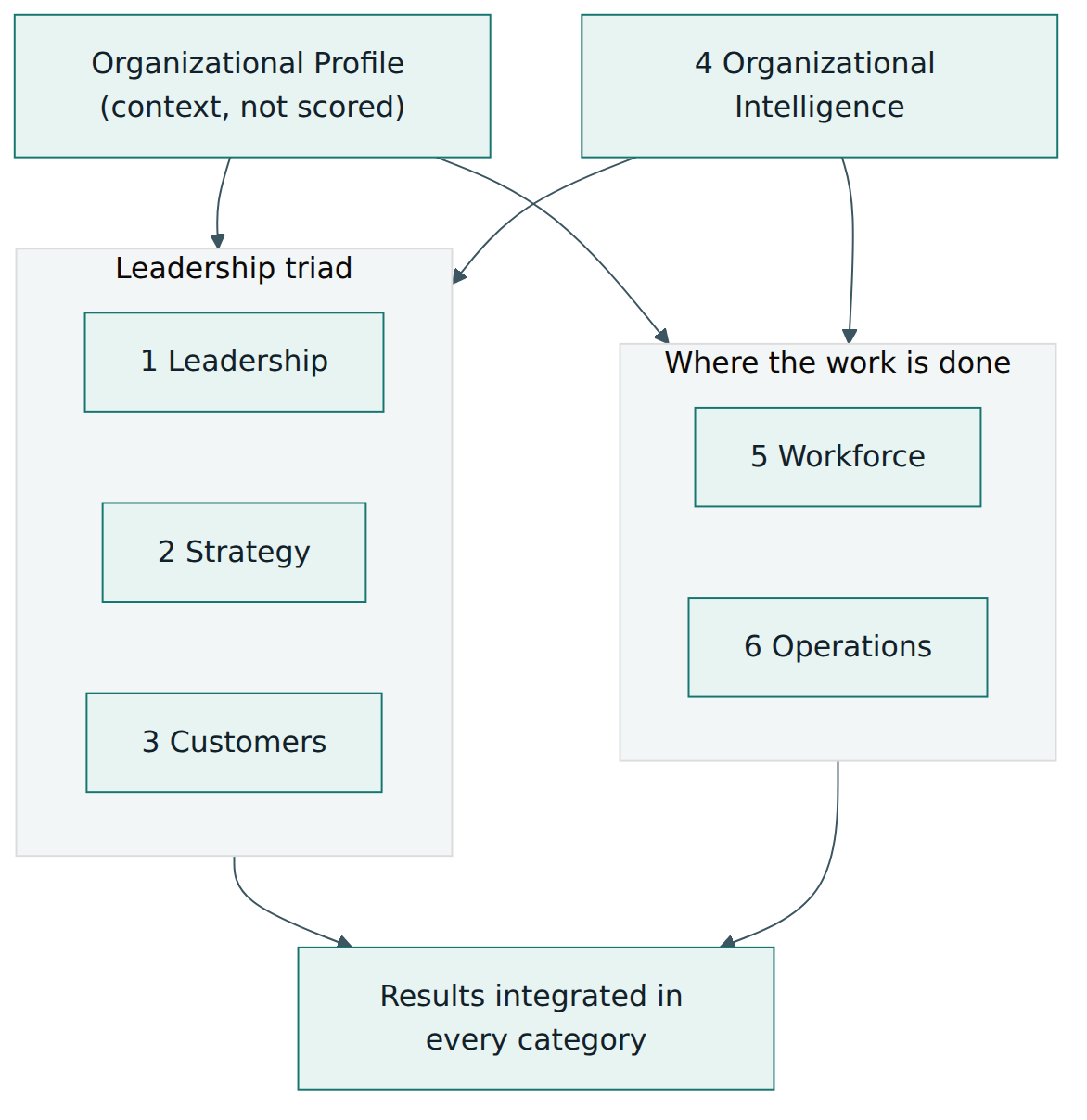
Figure 1 uses the traditional Baldrige way of grouping the categories. Leadership, Strategy and Customers form a "leadership triad" that sets direction and focus. Workforce and Operations are where the work gets done and results are produced; in earlier editions they formed a "results triad" together with the separate Results category. Organizational Intelligence is the foundation that feeds both groups with data, analysis and knowledge. In earlier editions a separate seventh category, Results, sat at the end of the chain; in 2026 each category carries the results that show whether its processes work.
The Organizational Profile
The profile is where you describe your organisation before you are evaluated. It covers your main products, services or programmes and markets; mission, vision and values; culture; workforce profile and engagement drivers; regulations, accreditations and certifications; governance; key partners and communities; customer segments and their requirements. A second part covers your situation: strategic challenges and advantages (the 2026 award criteria explicitly mention artificial intelligence as an example), strategic objectives, key financial measures, and the sources and limits of your comparative data.
The profile is not scored, but it matters enormously. Examiners use it to decide what "key" means for you. If your profile says on-time delivery to automotive customers is your top customer requirement, examiners will expect to see that measure in your customer and operations results. A profile that is vague or that contradicts later sections weakens the whole assessment. Many organisations find that simply writing an honest profile is a valuable exercise: leadership teams often discover they disagree about who their key customers are or what their main strategic challenge is.
The six categories
The descriptions below summarise, in our own words, what each category explores. They follow the public 2026 Award Criteria; the framework book phrases its questions differently and in more depth.
| Category | What it explores (processes) | Typical results asked for |
|---|---|---|
| 1 Leadership | How senior leaders set and deploy mission, vision and values; two-way communication with the workforce; creating an environment for current and future success; succession planning; responsible governance and accountability; support for key communities. | Workforce ratings of leaders' communication; outcomes of external audits and accreditations; grievances and complaints on safety and ethics; contributions to societal well-being, such as energy or waste reduction. |
| 2 Strategy | How strategic planning is conducted; how action plans are developed and deployed; how strategy is evaluated; how innovation opportunities and technological change, including AI, are assessed; how access to capital is secured. | Marketplace performance; financial viability; financial performance by unit. |
| 3 Customers | Listening to and observing customers to get actionable feedback; acquiring, engaging and retaining customers; customer support; complaint management and recovery. | Satisfaction, dissatisfaction and engagement (for example likelihood to recommend, repeat business, referrals) by key customer segment. |
| 4 Organizational Intelligence | Tracking, analysing and reviewing performance and capabilities; turning review findings into improvement and innovation priorities; deciding which innovation opportunities to pursue or stop; sharing information across the workforce and stakeholders. | In the award criteria this category has process questions only; its effect shows in the results of the others. |
| 5 Workforce | Building a culture of engagement and high performance; workforce development, learning and career progression; readiness for changing capability and capacity needs, including new technologies. | Supportive culture, satisfaction, engagement, turnover, leadership development and training results. |
| 6 Operations | Determining product and service requirements; design; managing and improving the efficiency and effectiveness of work and support processes; supply-network management; risk management, emergency preparedness and continuity; cybersecurity; safety. | Product and service performance; process efficiency and effectiveness; supply-network performance; cybersecurity effectiveness; significant safety incidents. |
Notice two patterns. First, the categories are about how the organisation works, not about departments. "Workforce" is not the HR department; it is how the whole organisation engages and develops its people, and line managers usually own much of the answer. Second, every category links processes to results. If you describe an excellent complaint-handling process in Customers, examiners will look for dissatisfaction and complaint results that show it works.
Process questions and results questions
Each category contains two kinds of question. A process question asks you to describe how you do something – "describe your key process for …". A good answer explains the method, where it is used, how it is evaluated and improved, and how it connects to other processes and to strategy. A results question asks for data – usually as charts showing several consecutive years, with comparisons. The 2026 award criteria ask for at least three to five time periods of data and comparisons with best-in-class, top-decile or top-quartile performers and competitors where available.
The framework's questions are deliberately open. You will not find a requirement such as "conduct an employee survey annually". Instead you will be asked how you determine what engages your workforce and how you know it works. That is what non-prescriptive means in practice: you can use surveys, pulse checks, focus groups or something else entirely, as long as the approach is systematic, deployed, improved and integrated.
Evaluation dimensions
The framework evaluates answers with two sets of dimensions, often remembered by their initials. Processes are judged by ADLI – Approach, Deployment, Learning, Integration. Results are judged by LeTCI – Levels, Trends, Comparisons, Integration. Figure 2 shows how they fit together.
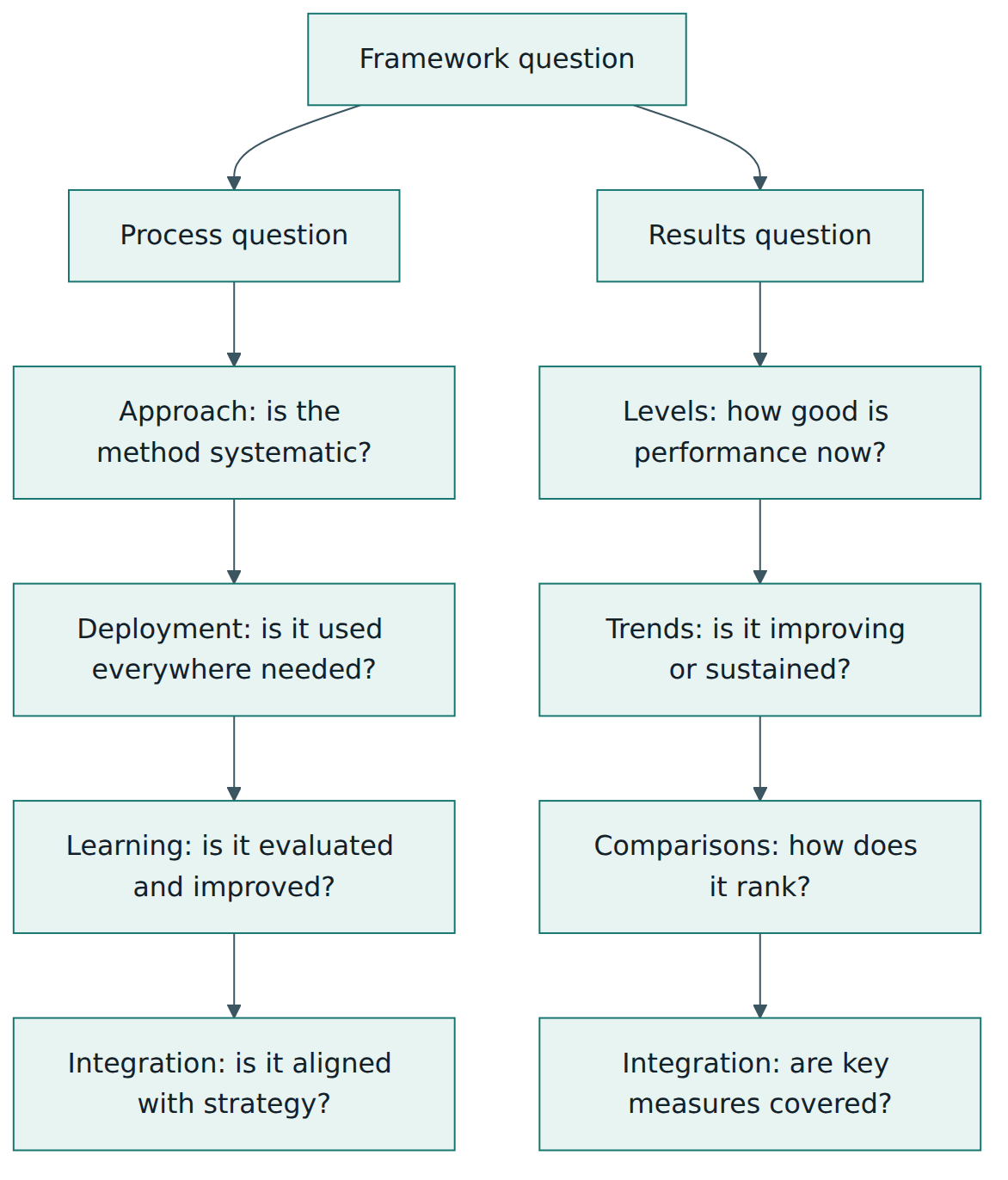
The four process dimensions build on each other. An approach that is not deployed is only a plan. A deployed approach that is never evaluated cannot improve. And a process that improves in isolation, without alignment to strategy and other processes, may optimise the wrong thing. Likewise for results: a good level means little if it is falling, a rising trend means little if competitors are far ahead, and impressive charts mean little if they are not the measures the profile said were key.
Lesson 4 – How it works in practice
The three Maturity Pathways
The biggest practical change in the 2026 edition is the introduction of Maturity Pathways. Earlier editions effectively asked every organisation to answer the full set of detailed questions, which could overwhelm a team taking its first steps. The pathways let an organisation start from where it actually is and use the framework at a depth that fits its current capability.
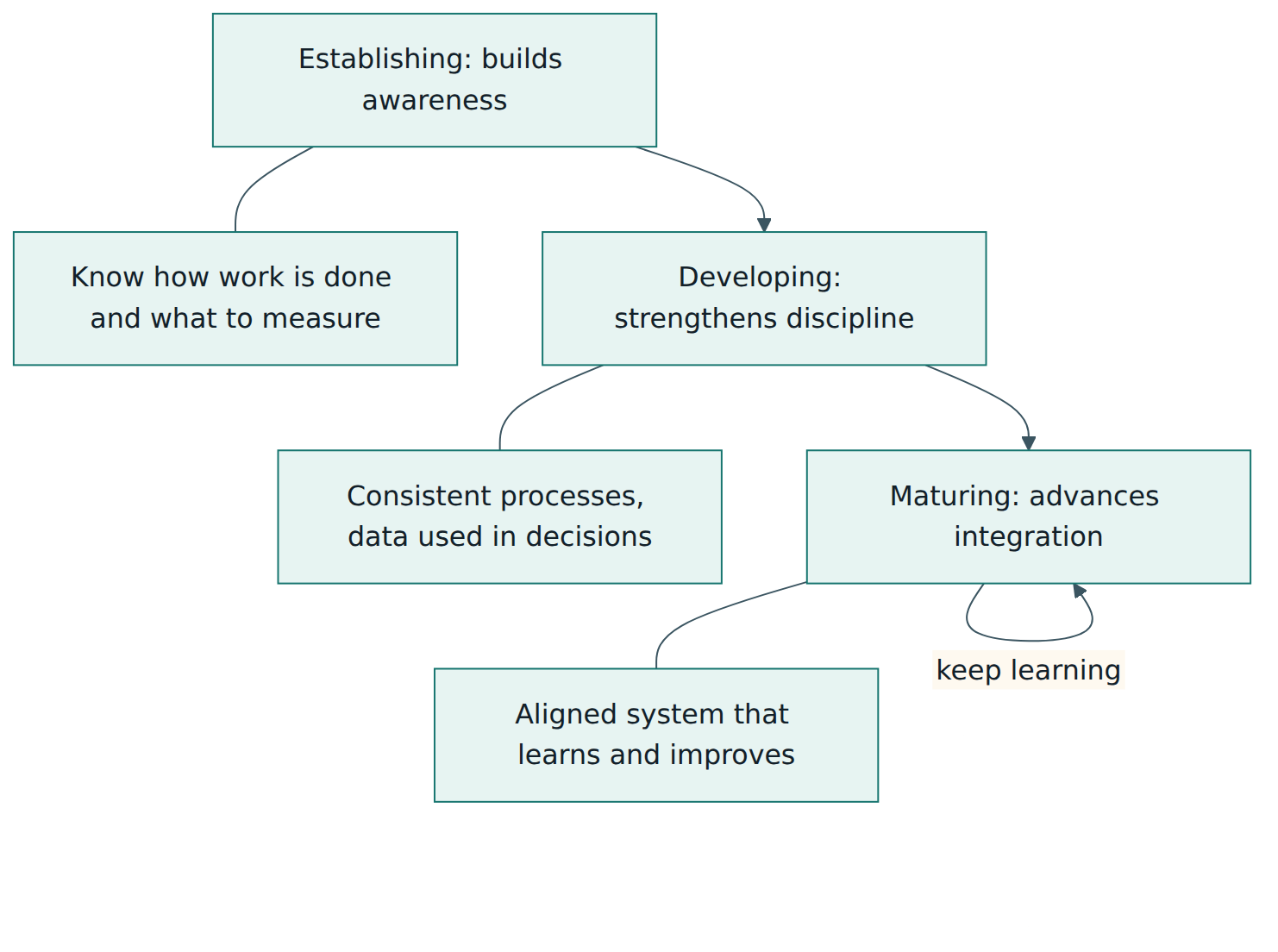
- Establishing (building awareness) – the organisation is learning how it actually operates: how work is done, what stakeholders need, which processes matter most and which results it should start measuring. Many processes depend on individuals, and results data may be thin.
- Developing (strengthening discipline) – processes become consistent, reliable and accountable, and data are used regularly to guide decisions and improvements. Evaluation cycles start to happen on a schedule rather than only after problems.
- Maturing (advancing integration) – leadership, strategy, customers, organisational intelligence, workforce, operations and results are connected into one system that learns and improves. Results are often high-performing and, in some areas, best practice compared with others.
Each pathway asks the organisation to reflect on three questions: how it currently operates, how consistent and reliable its processes are, and how effectively it uses results to drive decisions and improvement. An organisation is unlikely to sit neatly on one pathway: its operations might be Developing while its approach to innovation is still Establishing. That unevenness is useful information, because it shows where to invest.
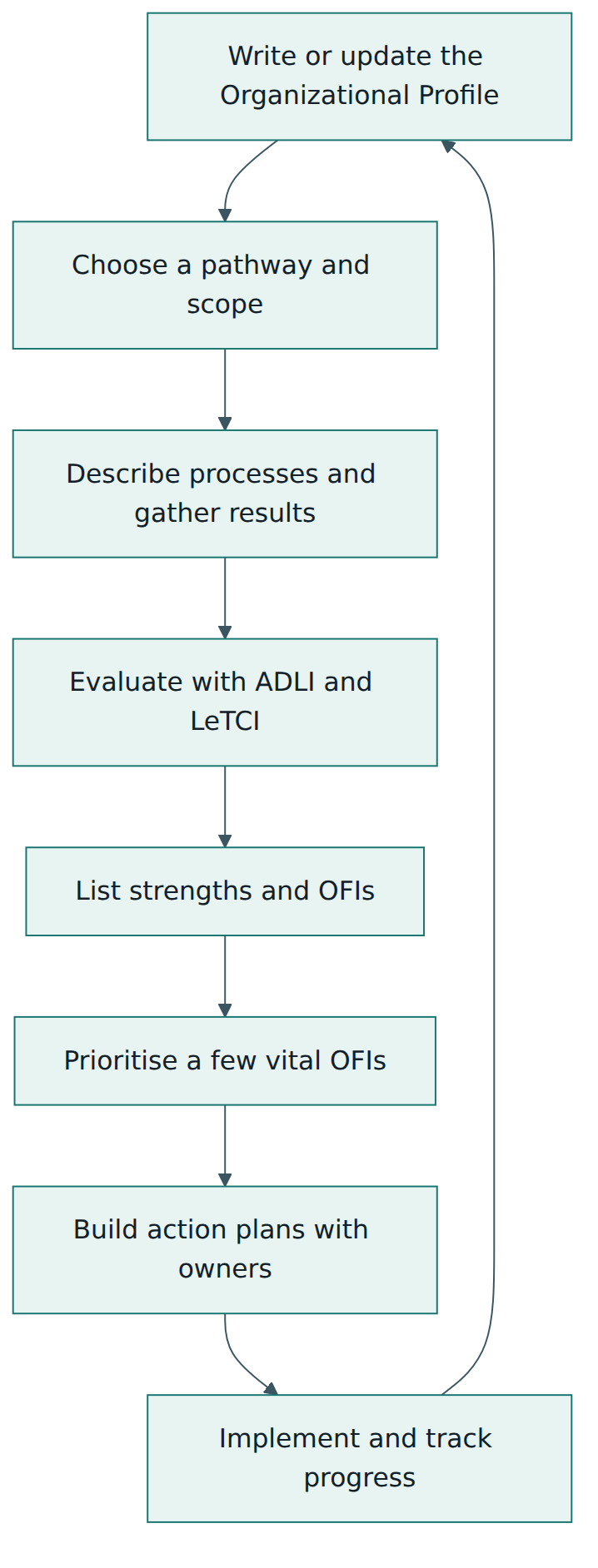
The improvement cycle
Using the framework is not a one-off project. It is a repeating cycle of describing, assessing, prioritising and improving, shown in Figure 4.
Step by step
1. Secure senior leadership commitment. The framework examines how leaders lead, so it cannot be delegated to the quality department. The senior team should sponsor the assessment, take part in it and own the resulting priorities.
2. Write the Organizational Profile. Gather the leadership team for a working session and answer the profile questions honestly. Disagreements are valuable: they reveal unclear strategy or unshared assumptions. Keep the profile short – it is context, not marketing.
3. Choose a pathway and a scope. A first-time user usually starts with the Establishing pathway and may focus on a few categories. An experienced organisation may assess all six categories against the full set of questions. Decide whether to assess the whole organisation or one division; the profile must describe whatever you choose.
4. Form category teams. Assign a small cross-functional team to each category. Include people who do the work, not only managers, because deployment can only be judged by people who see it. Train them on ADLI, LeTCI and the vocabulary in Lesson 2.
5. Describe processes and gather results. For each question, the team writes how the organisation actually does the work today – not how the policy manual says it should – and collects the relevant results with several periods of data and appropriate comparisons. Where there is no systematic process or no data, write that down: a clear gap is more useful than a polished description of something that does not exist.
6. Evaluate. Read each response the way an examiner would. For processes, ask the four ADLI questions. For results, ask the four LeTCI questions. Use the rubric levels to place each response. Write comments as strengths and OFIs, each specific enough to act on.
7. Prioritise. An assessment typically produces dozens of OFIs. Trying to fix them all exhausts people and achieves little. Leaders should choose a small number that matter most to the strategic challenges in the profile, or that underpin many other weaknesses – for example, the absence of a performance review process often weakens every category.
8. Act and track. Turn priorities into action plans with owners, resources, milestones and measures, and fold them into the normal strategic planning and review rhythm rather than running a separate "Baldrige project". Then, after a year or two, repeat the cycle and compare.
Roles and artefacts
Typical roles are an executive sponsor, a framework champion or coordinator, category teams, internal or external examiners, and the senior leadership team as decision-makers. Typical artefacts are the Organizational Profile, the category responses or self-assessment workbook, a results book of charts, the scoring and feedback summary (strengths and OFIs), and an improvement plan linked to strategic objectives. Some organisations also maintain a "systems map" that shows how leadership, planning, review and improvement processes connect, because that picture helps both employees and examiners see integration.
Different ways to start
Not every organisation begins with a full self-assessment. Common entry points include writing the profile alone; running a short questionnaire-style assessment with the senior team; training a few staff as examiners in a state or regional programme so they learn by reviewing other organisations; or applying for the entry level of recognition in a state programme to receive an external feedback report. The 2026 pathways formalise this idea that there are several sensible starting depths.
Lesson 5 – Assessment, recognition and the Baldrige Award
No certification, but external assessment
There is no Baldrige certificate in the sense of ISO 9001 certification. Nobody audits you for conformity to a list of requirements, and no auditor issues a certificate that customers can demand. Instead, the framework supports three forms of assessment: self-assessment by your own people, external assessment and feedback through a Baldrige-based state, regional or sector programme, and the national award process. The common output of all three is a feedback report of strengths and opportunities for improvement, sometimes with a score or rating.
Scoring and rubrics
Older editions used a 1,000-point scale. Points were distributed across items in the seven categories – with results carrying 450 of the 1,000 points – and each item was scored in percentage bands using scoring guidelines for processes and results. The 2026 edition aligns its scoring rubrics with the framework and the award criteria. The public 2026 Award Criteria use two simplified rubrics, one for processes and one for results, each with four levels from 1 (lowest) to 4 (highest).
In words, the process rubric runs from approaches that are only being established, deployment that is just beginning, improvements that react to problems and approaches that operate independently (level 1), up to most approaches being systematic, deployed to most work units, improved through fact-based cycles with innovation and sharing, and aligned and integrated with strategic priorities (level 4). The results rubric runs from little or no relevant data, inconsistent or adverse trends and no comparisons (level 1), up to most relevant results showing excellent performance, sustained favourable trends, better-than-average comparisons with many at top quartile or better, and coverage of the areas that matter (level 4). The words "some", "many" and "most" do much of the work: they describe how widely the strength is present.
Scores are a tool for tracking maturity and focusing improvement, not the goal. Two organisations with the same score can have very different strengths, and a score that rises because people learned to write better answers, rather than because performance improved, is worthless. Experienced users pay more attention to the comments than to the number.
State, regional and sector programmes
Most organisations meet external Baldrige assessment through programmes that belong to the Alliance for Performance Excellence. These programmes train volunteer examiners, review applications and usually offer tiered recognition, with entry-level awards for organisations that are starting out and a top-tier award for role-model performance. Each programme sets its own levels and names, so check with the programme in your state or sector. Receiving a top-tier award from an Alliance member programme is also one route into the national award.
The Malcolm Baldrige National Quality Award
The national award is the top tier of Baldrige recognition in the United States; NIST describes it as the nation's only presidential honour recognising performance excellence. Its purpose is to identify role models and to spread their practices: recipients agree to share their non-proprietary processes so others can learn from them.
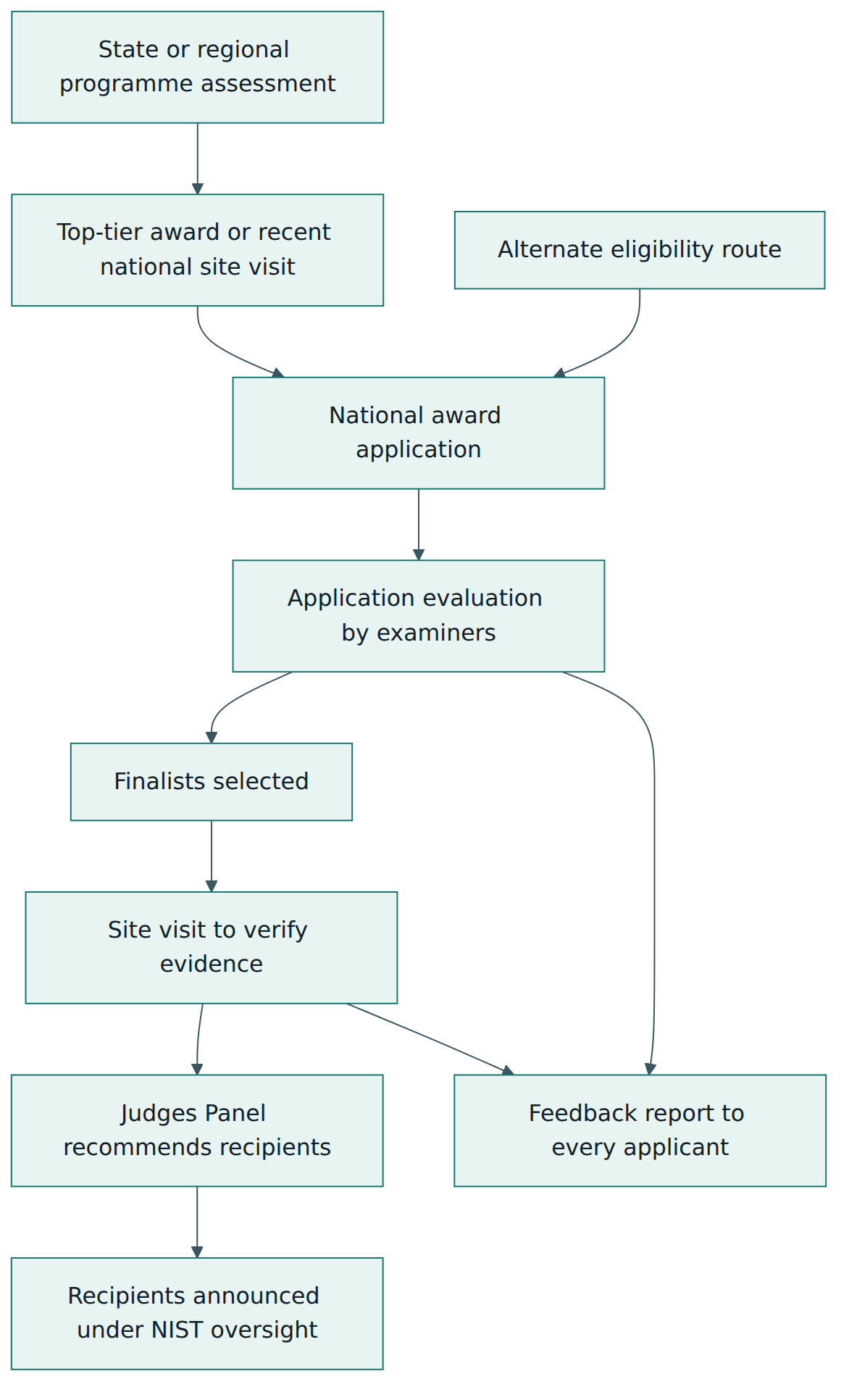
In the 2026 cycle the Alliance administers the award on behalf of NIST and the Department of Commerce. The process has two phases. In the application evaluation phase, national examiners review the written application – the Organizational Profile plus responses to results and process questions in the six categories – and form a view of the organisation's performance, giving particular weight to results because sustained results are strong evidence that processes work. Applicants that received a top-tier award from an Alliance member programme within the last four years, or a national site visit within the last two years, are granted finalist status; others are evaluated further to decide whether they earn it. In the site-visit phase, examiners verify and clarify the application through virtual and on-site engagement, and they explore which processes may be best practices. An independent Judges Panel then recommends recipients, and NIST and the Department of Commerce, which keep ultimate responsibility for the award, announce them.
The award is demanding. Applicants do not need role-model performance everywhere, but recipients usually show strong, sustained results across many areas. The application is also written within strict space limits, which forces clarity: there is no room for marketing language, only for systematic processes and evidence. Even organisations that do not win receive a detailed feedback report, which many consider the real value of applying.
Who assesses
Examiners are mostly volunteers drawn from business, health care, education, nonprofit and government organisations. They are trained in the framework and in consistent evaluation, and they work in teams: each examiner reviews independently, then the team reaches consensus on strengths, OFIs and ratings. Serving as an examiner is widely considered one of the best ways to learn the framework, because you see how other organisations answer the same questions.
Lesson 6 – Worked example: a mid-sized manufacturer
Harbor Valve Works (a fictional company) designs and assembles industrial valves. It has 480 employees in two plants, sells mainly to water utilities and to oil and gas engineering contractors, and relies on a network of foundries and machine shops. Sales have been flat for three years, a larger competitor has begun offering faster delivery, and two senior engineers are close to retirement. The new chief executive decides to use the Baldrige framework to get an honest picture of the business.
Step 1 – Leadership commitment and the profile
The chief executive and six direct reports spend two half-day sessions on the Organizational Profile. The exercise is uncomfortable. The sales director names oil and gas contractors as the key segment; the operations director believes water utilities are more important because they buy more spare parts. Nobody can say exactly how much of the market Harbor holds. The team eventually agrees on two key customer segments with different requirements (utilities value long service life and spare-parts availability; contractors value delivery speed and engineering support), lists its strategic challenges (delivery speed, loss of engineering knowledge, dependence on two foundries) and its strategic advantage (a strong reputation for durability). It also notes that comparative data are limited, because competitors are private.
Step 2 – Pathway and scope
Because Harbor has never done anything like this, it chooses the Establishing pathway and assesses all six categories, but at the lighter depth that pathway suggests. A quality engineer is appointed as framework coordinator, and six cross-functional teams of three or four people are formed, each including at least one front-line supervisor or operator.
Step 3 – What the teams find
Leadership. Leaders hold a monthly town hall, but there is no way for employees to raise questions in advance and no measure of whether communication works. The team notes a strength (regular, visible leadership presence) and an OFI (communication is one-way and unmeasured; there is no succession plan for critical engineering roles).
Strategy. A budget is produced each year, but there is no strategic plan with objectives, action plans and owners. The faster-delivery threat appears in no plan. This is the most serious OFI found.
Customers. Complaints are logged diligently at one plant but in personal emails at the other. Customer satisfaction has never been measured by segment. Strength: a well-run complaint log in plant 1. OFI: the approach is not deployed to plant 2 and there is no listening approach for contractors.
Organizational Intelligence. Each department has its own spreadsheets; no one reviews organisational performance as a whole. Engineering knowledge lives in the heads of the two retiring engineers. OFI: no systematic performance review and no knowledge-capture process.
Workforce. Turnover data exist and are good compared with local manufacturers, but there is no engagement survey and training is ad hoc. Strength: low turnover with three years of data. OFI: no systematic development or engagement approach.
Operations. Plant 1 runs a well-established lean programme with daily huddles and measured first-pass yield; plant 2 does not. Supplier quality is tracked but supplier delivery is not, even though late castings cause most late shipments. Cybersecurity relies on one contractor with no testing. Strengths: lean practice and yield results in plant 1. OFIs: deployment to plant 2, supplier delivery measurement, cybersecurity and continuity planning.
Step 4 – Evaluate with ADLI and LeTCI
Take the complaint-handling process as an illustration. Approach: plant 1 has a defined log, response times and root-cause review – reasonably systematic. Deployment: plant 2 does not use it – weak. Learning: the process has not been reviewed since it was set up – weak. Integration: complaint causes are not fed into design or supplier selection – weak. The overall picture is a sound approach at an early stage of maturity, consistent with the Establishing pathway.
Now take on-time delivery results. Levels: 82 % of orders ship on time. Trends: four years of data show a slow decline. Comparisons: the team has only the competitor's advertised lead times, which suggest Harbor is behind. Integration: delivery is clearly a key requirement for the contractor segment named in the profile, so this is exactly the right measure to show. The results tell a coherent but worrying story.
Step 5 – Prioritise
The teams produce 41 OFIs. The leadership team resists the urge to tackle them all and chooses three, each linked to a strategic challenge in the profile:
- Create a simple strategic planning process with three objectives (delivery speed, knowledge retention, supplier resilience), action plans, owners and quarterly reviews.
- Establish a monthly organisational performance review using a small set of key measures drawn from every category, including supplier on-time delivery.
- Deploy plant 1's complaint and lean practices to plant 2, using plant 1 staff as coaches.
Other OFIs, such as the engagement survey and cybersecurity testing, are recorded for the next cycle; the cybersecurity gap is given a quick interim fix because the risk is high.
Step 6 – Act, review and repeat
Eighteen months later Harbor repeats the assessment. It now has a strategic plan with quarterly reviews, a performance dashboard reviewed monthly by the senior team, and both plants on the same complaint and lean processes. On-time delivery has risen to 90 % with three quarters of improving data, and supplier delivery is now measured and discussed with suppliers. The two retiring engineers have mentored successors and recorded key design rules. The team judges that operations, customers and strategy have moved towards the Developing pathway, while workforce engagement and innovation remain at Establishing. Encouraged, Harbor applies for the entry level of recognition in its state Baldrige programme to get an external feedback report – not for the trophy, but for an independent view.
The example illustrates the framework's main lessons: the profile defines what matters; evidence beats description; deployment and learning are usually weaker than approach; a few well-chosen priorities beat a long list; and improvement shows up in results only after a cycle or two.
Lesson 7 – Relationship to other standards and frameworks
The Baldrige framework is often used alongside other models. Understanding the differences prevents two common errors: treating it as an audit standard, and assuming that a certified management system means excellence.
| Model | Owner | Main purpose | Assessment | Relationship to Baldrige |
|---|---|---|---|---|
| Baldrige Excellence Framework | Baldrige Foundation with NIST oversight | Whole-organisation performance excellence across six categories, with results integrated | Self-assessment, state and regional programmes, national award; no certification | — |
| ISO 9001 | International Organization for Standardization (ISO) | Requirements for a quality management system | Third-party certification audits for conformity | Narrower and requirement-based; a certified QMS is a strong base for Baldrige processes, especially in Operations and Customers, but certification says little about results levels or competitiveness. |
| ISO 9004 | ISO | Guidance on achieving sustained success, with a self-assessment tool | Self-assessment only; not certifiable | Closest ISO counterpart in spirit: both look beyond conformity to long-term organisational performance. |
| EFQM Model | EFQM | European excellence model built around direction, execution and results | Self-assessment, assessor-based recognition levels | Very similar purpose and logic; EFQM uses its own RADAR assessment logic where Baldrige uses ADLI and LeTCI. |
| Deming Prize | Union of Japanese Scientists and Engineers (JUSE) | Recognises total quality management practice | Examination by a prize committee | Historical inspiration for the Baldrige award; stronger emphasis on statistical quality methods. |
| Lean and Six Sigma | No single owner (methodologies) | Improve flow and reduce variation in processes | Practitioner belts and internal reviews, no organisational standard | Tools organisations often choose to improve processes that a Baldrige assessment identifies; Baldrige does not prescribe them. |
How they work together
A useful way to think about the relationships is in layers. Methods such as lean, Six Sigma, agile or design thinking are tools. Management system standards such as ISO 9001, ISO 14001, ISO 45001 or ISO/IEC 27001 define minimum disciplined systems for specific concerns and can be certified. Excellence models such as Baldrige and EFQM ask how well the entire organisation is led, how well its systems are integrated and how good its results are compared with the best. An organisation can hold several ISO certificates and still have no coherent strategy or weak results – the Baldrige framework would expose that. Conversely, a Baldrige assessment may reveal that a disciplined management system is missing, and an ISO standard may be the quickest way to build one.
Many health care organisations, schools and manufacturers combine Baldrige with sector-specific requirements, such as accreditation standards, using Baldrige as the overall management system and the sector requirements as content within it. In Baldrige terms, a certification or accreditation is something you report in the Organizational Profile and whose audit outcomes may appear as leadership and governance results.
Baldrige outside the United States
The U.S. award inspired many national and regional quality and excellence awards around the world, several of them modelled directly on its criteria. Organisations outside the U.S. can buy and use the framework for self-assessment, but national award eligibility is limited to organisations that meet U.S. eligibility rules; elsewhere, the EFQM Model or a national excellence award is often the more natural route to external recognition.
Common pitfalls and best practices
Common pitfalls
- Chasing the award or the score. Organisations that treat Baldrige as a trophy hunt learn to write impressive answers rather than to improve. Scores rise while performance stays flat.
- Delegating it to the quality department. Leadership, strategy and governance are central categories; if senior leaders do not take part, the assessment is incomplete and the improvements stall.
- Describing intentions instead of reality. Copying the policy manual into the response hides the real gaps. Examiners, and the organisation itself, need an honest description of how work is actually done.
- Anecdotes instead of systematic evidence. A story about one excellent customer rescue is not evidence of a customer process. Without data, deployment and learning cycles, responses stay at the lowest rubric level.
- Results without context. Charts with a single data point, no comparisons or measures that the profile never called key tell examiners very little.
- Trying to fix every OFI. A list of forty improvement projects overwhelms people and produces little; focus is a core skill.
- Treating it as a one-off project. The value comes from repeated cycles; a single assessment that ends in a binder on a shelf wastes the effort.
- Ignoring the profile. A vague or inconsistent Organizational Profile undermines every judgement about what is "key".
Best practices
- Start with the profile and the right pathway. An honest profile and a realistic starting depth make the first cycle achievable and useful.
- Involve people who do the work. Cross-functional teams with front-line members see deployment and integration that managers miss.
- Train internal examiners. Volunteering as an examiner in a state or regional programme builds skill and brings back ideas from other organisations.
- Build a small set of key measures with history and comparisons. Start collecting several years of data now; trends cannot be created later.
- Link priorities to strategy. Feed the chosen OFIs into the strategic planning process so they get owners, resources and reviews.
- Use a regular review rhythm. A monthly or quarterly organisational performance review turns management by fact into a habit.
- Share and spread what works. Deploying a strong practice from one unit to others is often the fastest gain available.
- Seek external feedback periodically. A state or regional programme assessment counters the blind spots of self-assessment.
Summary and key takeaways
- The Baldrige Excellence Framework grew out of the 1987 U.S. national quality award and is now a non-prescriptive model for managing any organisation as a whole system.
- The 2026 edition, from the Baldrige Foundation with NIST oversight, has an Organizational Profile and six categories – Leadership, Strategy, Customers, Organizational Intelligence, Workforce and Operations – with results integrated into each.
- The profile is not scored but defines what is key for your organisation, and every later judgement depends on it.
- Processes are evaluated on approach, deployment, learning and integration; results on levels, trends, comparisons and integration.
- Three Maturity Pathways – Establishing, Developing, Maturing – let organisations start where they are and grow from awareness to discipline to integration.
- Self-assessment is a repeating cycle: profile, assess, list strengths and OFIs, prioritise a few, act, review and repeat.
- There is no certification; external feedback comes from Alliance state, regional and sector programmes and from the national award, whose recipients are recommended by an independent panel of judges.
- Baldrige complements ISO management system standards and improvement methods: they build disciplined systems and tools, while Baldrige asks how well the whole organisation performs.
Reflection questions
- If your leadership team wrote an Organizational Profile tomorrow, where do you expect the strongest disagreement, and what would that disagreement tell you?
- Choose one process you know well. Describe it using approach, deployment, learning and integration. Which dimension is weakest, and why?
- Pick one measure your organisation reports regularly. What would you need to add to make its levels, trends and comparisons convincing to an examiner?
- Which Maturity Pathway best describes your organisation overall, and which category is the clearest exception? What would move that category one pathway forward?
- Your organisation already holds ISO 9001 certification. What would a Baldrige assessment be likely to find that the certification audits have not, and how would you use both together?
Further reading and official sources
- Baldrige Excellence Framework – publications and editions – NIST Baldrige Performance Excellence Program
- About the Baldrige Excellence Framework – NIST
- 2026 Baldrige Framework Key Changes – Baldrige Foundation
- Baldrige Maturity Pathways – Baldrige Foundation
- 2026 Baldrige Award Criteria – Alliance for Performance Excellence
- Core Values and Concepts – NIST
- The EFQM Model – EFQM
Original tutorial by xOps School (DevOpsSchool Private Limited), written from public sources about Baldrige Excellence Framework. Not affiliated with or endorsed by the standard's owner; standard names are trademarks of their owners. Buy the official standard from its publisher for the authoritative text.