
BPMM – Tutorial (about 60 minutes)
- View
The Business Process Maturity Model (BPMM) is a staged improvement roadmap, published by the Object Management Group (OMG), that helps an organisation move its business processes from improvised, hero-driven work to consistent, measured and continuously improving operations. It is used by operations managers, process improvement and quality teams, enterprise architects, sourcing managers and appraisal teams in banks, insurers, service providers, manufacturers and internal shared-service units. After this tutorial you will be able to explain how the model is built, what each of its five maturity levels changes in an organisation, how an improvement programme and an appraisal against the model work, and where BPMM fits next to CMMI, ISO 9001, BPMN and other frameworks.
Course overview
Edition and status: The current and only formal edition is BPMM version 1.0, an OMG specification (document number formal/08-06-01) adopted and published in June 2008. It replaced a pre-formal Beta 2 release, and the OMG specification catalogue still lists version 1.0 as the formal version with no newer revision announced. The authors were Charles Weber and Bill Curtis (then of Borland Software, which had acquired TeraQuest Metrics) and Tony Gardiner of Nedbank. The specification can be downloaded free of charge from the OMG website under OMG's usual licence terms. Be aware that the model has not been revised since 2008 and that, as of the verification date, we could find no public OMG register of BPMM lead appraisers or appraisal results, so today it is used mainly as a reference model for internal improvement, self-assessment and supplier evaluation rather than as a certification scheme. Note also that the acronym "BPMM" is used loosely for several other business process maturity models; this course teaches the OMG model. Verified 2026-10-29 against the OMG specification page (version 1.0, document status formal, publication date June 2008, supersedes Beta 2) and the version 1.0 document.
Who it is for: operations and service managers, process owners, business analysts, quality and compliance staff, enterprise architects, sourcing and vendor managers, and anyone who has been asked to "assess our process maturity" before a large system rollout or outsourcing deal and wants to know what a serious maturity model actually expects.
Prerequisites: none. It helps if you have seen a workflow in which different teams do the same task in different ways, because the model was written to fix exactly that kind of situation.
How to use this tutorial: read the seven lessons in order (about 45 minutes), study the four diagrams, then spend the remaining time on the reflection questions before taking the 25-question knowledge check.
Learning objectives:
- You will be able to explain why BPMM was created, where it came from and what kinds of work it covers.
- You will be able to use the core vocabulary correctly: work unit, workgroup, product and service offering, standard and defined process, institutionalization and process capability.
- You will be able to describe the architecture of the model: maturity levels, the 30 process areas, specific and institutionalization goals, practices and process area threads.
- You will be able to describe what changes in an organisation at each of the five maturity levels and why the levels must be climbed in order.
- You will be able to compare the four appraisal types and explain how goal ratings roll up into a maturity level.
- You will be able to plan a realistic BPMM-based improvement programme and avoid the most common mistakes.
- You will be able to relate BPMM to CMMI, ISO 9001, ISO/IEC 33001-series process assessment, BPMN and process-audit models such as PEMM.
Lesson 1 – Origins, purpose and scope
The problem BPMM set out to solve
In the early 2000s many large organisations spent heavily on enterprise applications such as core banking, claims, billing and resource planning systems, and a worrying number of these projects were cancelled or delivered little value. Post-mortems often found that the technology was not the real culprit. The software was being installed into an organisation whose business processes were inconsistent, poorly understood and performed differently in every branch or department. A system that automates a chaotic process tends to produce faster chaos.
The BPMM authors named several gaps that managers faced at that time. There was no widely accepted way to judge how mature a set of business workflows was, and therefore no way to estimate the risk those workflows posed to a big IT rollout. There was little help in checking whether the process models drawn by analysts matched how the work was really done. Mergers and organic growth had left many companies with several ways of doing the same job, which made system requirements complicated. Buyers of outsourced services had no trusted yardstick for checking a supplier's claims about its processes. And executives wanted a path towards agility and lower operating cost that would not collapse at the first sign of pressure. BPMM was offered as an open standard to address these needs.
Where the model comes from
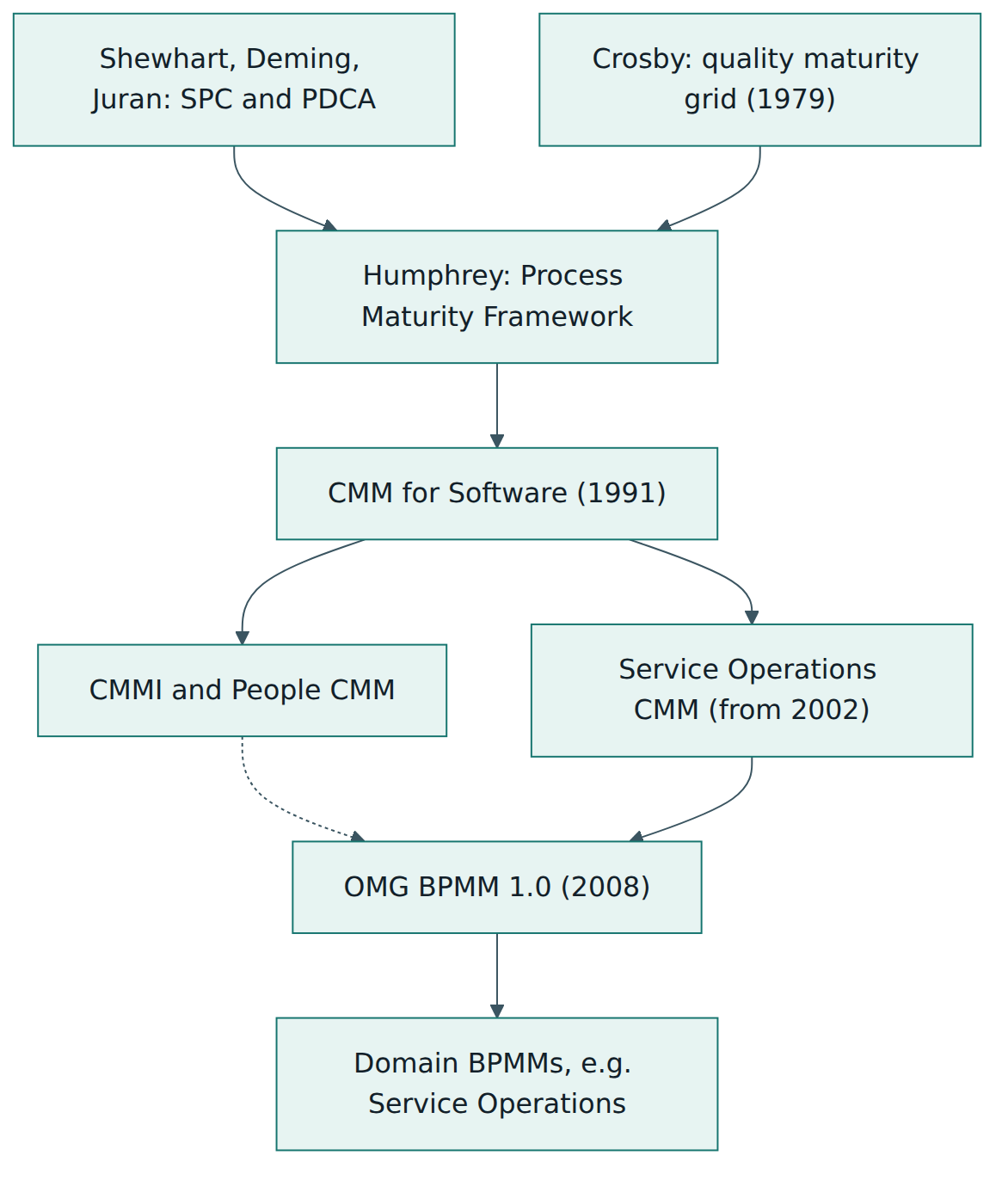
BPMM belongs to a family of maturity models whose roots go back to the quality movement. Walter Shewhart introduced statistical control of production in the 1920s and 1930s, and W. Edwards Deming and Joseph Juran turned those ideas into a management philosophy built around customer requirements, measurement and continual improvement. Philip Crosby, in his 1979 book Quality is Free, described a maturity grid through which a company's quality management passes in stages. Watts Humphrey and colleagues at IBM adapted this staged idea to software, and Humphrey then took it to the Software Engineering Institute (SEI) at Carnegie Mellon University, where it became the Process Maturity Framework and, from 1991, the Capability Maturity Model (CMM) for Software. The same architecture was later reused for CMMI and for the People CMM, which applies maturity thinking to workforce practices.
Those models worked well for development projects, but many organisations noticed that software development was only a small part of their operations. A bank, an insurer or a retailer spends most of its effort running products and services day after day. In April 2002 the consultancy TeraQuest Metrics began working with the South African bank Nedbank on a Service Operations CMM. As the model was tried in several companies, the authors realised that its practices applied to the whole life of almost any product or service: conceiving it, preparing it, deploying it, operating it and supporting it until retirement. They generalised the Service Operations CMM into BPMM. Borland Software acquired TeraQuest in January 2005, so the specification carries a Borland copyright, and the OMG adopted and published version 1.0 in June 2008. Several of the authors had also co-authored the CMM for Software, CMMI and the People CMM, which is why the family resemblance is so strong.
Scope: what BPMM covers
BPMM describes the essential practices for developing, preparing, deploying, operating and supporting a product and service offering, from understanding customer needs and justifying the offering in business terms, through daily operations and support, to withdrawal. The authors point out that even internal functions fit this pattern. A finance department produces products (reports, forms, data) and services (budget support, analysis) for internal customers; human resources provides hiring, development and appraisal services. So the model can be applied to customer-facing operations and to internal shared services alike.
An important difference from CMMI is the shape of the work. CMMI grew up around projects: bounded efforts with a start, an end and a team. Business processes are usually transactional workflows that cross organisational boundaries and repeat thousands of times: an account opening passes from a branch to a back office to a compliance check and back again. BPMM therefore talks about work units and end-to-end offerings rather than projects, although a project is treated as a special, temporary kind of work unit.
What the model is for
The specification describes four main uses. The most common is guiding a business process improvement programme: the model tells you which improvements to make first and which can wait. Second, it can be used to assess the risk that weak processes pose to an enterprise application before deployment, so that process fixes can be made in time. Third, buyers can use it to evaluate the process capability of suppliers during source selection and to track agreed improvements during the contract. Fourth, it supports benchmarking an organisation's process maturity against others. Throughout this tutorial keep in mind that BPMM states what a mature organisation does, never how it must do it; organisations choose their own methods.
Lesson 2 – Key concepts and vocabulary
BPMM uses a precise vocabulary, and many misunderstandings come from reading its terms in their everyday sense. The definitions below are paraphrased; the specification's own glossary is much longer.
- Process – a set of related activities, methods and practices that turn inputs into products and services. BPMM assumes that the quality of what an organisation delivers is largely decided by the quality of the processes used to produce and support it.
- Process capability – the range of results you can expect if you follow a process. It looks forward and is what lets you predict the outcome of the next piece of work.
- Process performance – the results actually achieved by performing a process. Capability is about expected results, performance about achieved results.
- Process maturity – how far processes are explicitly defined, managed, measured, controlled and effective, and how consistently they are applied across the organisation.
- Maturity level – one of five evolutionary plateaus (Initial, Managed, Standardized, Predictable, Innovating). Each level stabilises a critical set of practices and forms the base for the next.
- Institutionalization – building the infrastructure and culture that make a way of working the normal way of doing business, so that it survives pressure, reorganisations and the departure of the people who designed it.
- Work unit – a group of people managed as one organisational unit, whose manager is accountable for accepting requirements, making commitments, obtaining resources, assigning responsibility and tracking performance. A project is a temporary work unit.
- Workgroup – people who work closely on highly interdependent tasks to reach shared objectives. A workgroup may be a whole work unit, a support group, or a team drawn from several units, and membership can change over time.
- Product and service offering – a complete, related set of products and services that the organisation provides, managed end to end. At level 3 the focus of the model shifts from individual work units to offerings.
- Standard process – an organisation-wide description of how a type of work is done, synthesised from the best practices found in its work units, written at a level that suits many different work efforts.
- Tailoring guidelines – rules that say how a standard process may be adapted for a particular piece of work and what must not be changed.
- Defined process – the complete operational process a work unit, workgroup or project actually follows, produced by tailoring the standard process. It typically states entry criteria, inputs, procedures, activities, verification steps, outputs and exit criteria.
- Process area – a cluster of related practices that, performed together, achieve a set of goals important for one aspect of capability, such as planning work or managing suppliers.
- Specific goal and specific practice – the goals and practices that are unique to one process area and describe what it must achieve and the activities that typically achieve it.
- Institutionalization goal and practices – one goal and five practices that are identical in every process area and make its specific practices stick.
- Process area thread – a line of concern (for example, organisational support) that links process areas at different levels and shows how practices at one level grow into richer practices higher up.
- Domain BPMM – a version of the model specialised for one field, such as service operations or marketing, built from the common core plus domain process areas.
- Assignable-cause variation – unusual variation in a process result that has an identifiable, specific cause, as opposed to the normal random variation of a stable process. Telling the two apart is central to level 4.
Immature versus mature organisations
The model contrasts two kinds of organisation. In an immature one, practitioners and managers improvise processes as they go, and even documented procedures are ignored when deadlines loom. Managers spend their days fire-fighting. Commitments on cost, schedule and service levels are missed because they were not based on realistic estimates, and when time runs short, quality checks and reviews are the first things dropped. There is no objective data for judging quality or solving problems, and customers discover the quality of a product or service only when they receive it.
In a mature organisation the processes are documented, usable, communicated to existing and new staff, and actually followed, because people understand their value and the infrastructure to support them exists. Roles are clear. Estimates are based on historical performance and are usually met. Improvements are piloted, evaluated for cost and benefit, and then rolled out in a controlled way, with broad involvement of the workforce. Problems are analysed with data, and managers understand the effects of the options they choose. BPMM is a map for getting from the first picture to the second.
Lesson 3 – Structure of the model
The architectural hierarchy
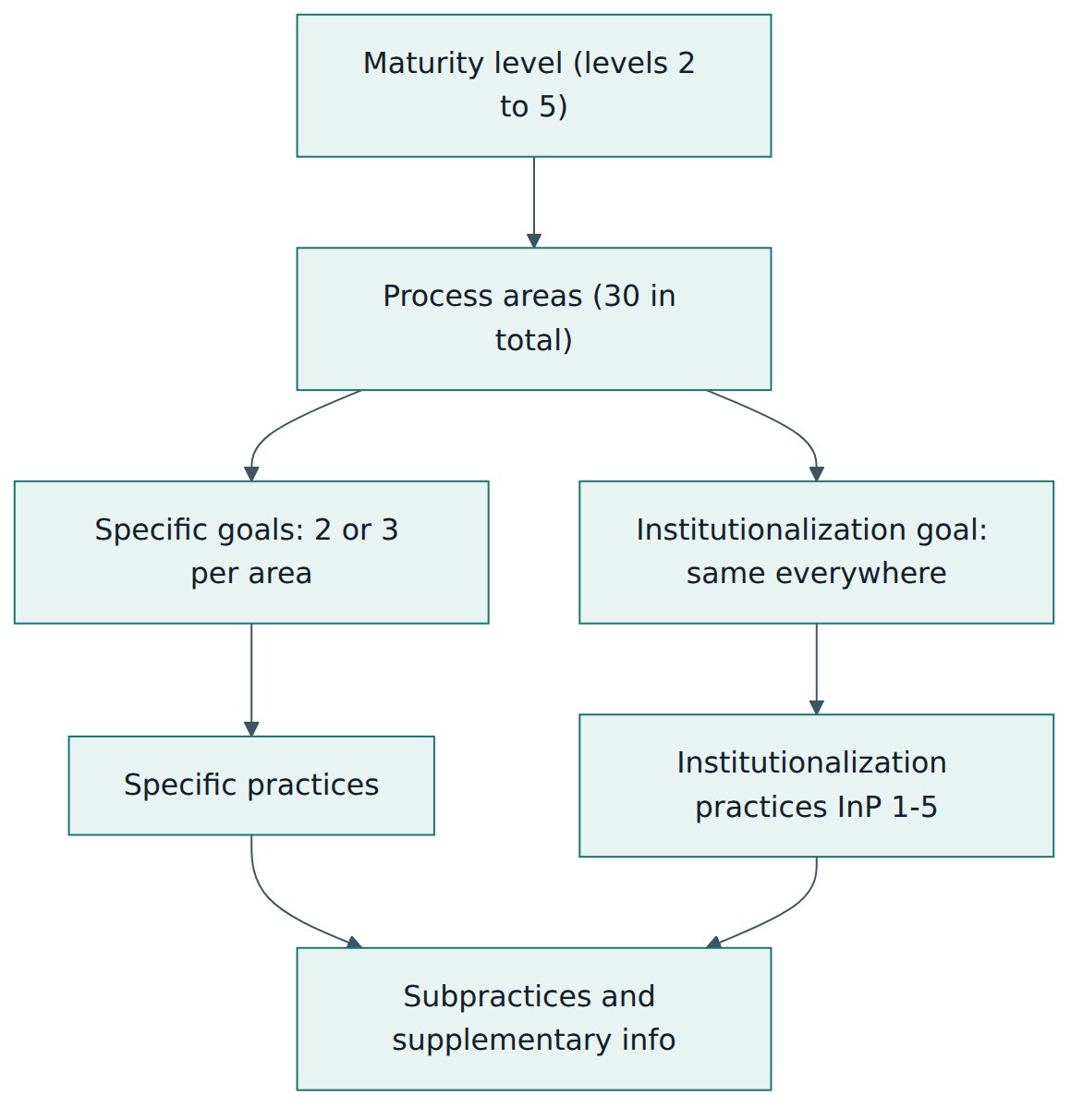
BPMM is organised as a hierarchy. At the top are the five maturity levels. Level 1 has no content: it simply describes an organisation that has not yet achieved level 2. Levels 2 to 5 each contain a set of process areas, 30 in total: nine at level 2, ten at level 3, five at level 4 and six at level 5. Every process area has the same layout: a purpose statement, introductory notes, two or three specific goals, the common institutionalization goal, a table showing which practices support which goal, the specific practices, and a reference to the five institutionalization practices. Most practices are explained further by subpractices and boxed supplementary information such as examples and cross-references.
The specification separates rating components from informative ones. Goals, process areas and maturity levels are what an appraisal rates. Practices, subpractices and supplementary information explain what implementing the goals normally looks like and guide interpretation. An organisation may use alternative practices with different names and scope as long as, in combination, they genuinely achieve the goal.
The 30 process areas
Naming the process areas is the quickest way to see the logic of the model. Read the table from the bottom up: each level adds capabilities that depend on the ones below.
| Level | Management focus (paraphrased) | Process areas |
|---|---|---|
| 5 Innovating | Change management: close the gap between current capability and business goals through prevention and innovation | Organizational Improvement Planning (OIP); Organizational Performance Alignment (OPA); Defect and Problem Prevention (DPP); Continuous Capability Improvement (CCI); Organizational Innovative Improvement (OII); Organizational Improvement Deployment (OID) |
| 4 Predictable | Capability management: manage work quantitatively so that results are predictable and variation is controlled | Organizational Common Asset Management (OCAM); Organizational Capability and Performance Management (OCPM); Product and Service Process Integration (PSPI); Quantitative Product and Service Management (QPSM); Quantitative Process Management (QPM) |
| 3 Standardized | Process management: standard processes, assets, measures and training used across the organisation and its offerings | Organizational Process Management (OPM); Organizational Competency Development (OCD); Organizational Resource Management (ORM); Organizational Configuration Management (OCM); Product and Service Business Management (PSBM); Product and Service Work Management (PSWM); Product and Service Preparation (PSP); Product and Service Deployment (PSD); Product and Service Operations (PSO); Product and Service Support (PSS) |
| 2 Managed | Work unit management: stable, disciplined management inside each work unit | Organizational Process Leadership (OPL); Organizational Business Governance (OBG); Work Unit Requirements Management (WURM); Work Unit Planning and Commitment (WUPC); Work Unit Monitoring and Control (WUMC); Work Unit Performance (WUP); Work Unit Configuration Management (WUCM); Sourcing Management (SM); Process and Product Assurance (PPA) |
| 1 Initial | Fire-fighting: success depends on individual effort and heroics | None |
A few process areas deserve a short explanation because their names are not self-evident. Organizational Process Leadership puts executives in charge of the improvement programme: they state the business reasons for it, set goals and strategy, fund it, and align management responsibilities and reward systems with it. Organizational Business Governance makes executives accountable for managing the organisation's actual work and business results, not just the improvement effort. Work Unit Performance covers the agreements between individuals or workgroups and their manager about what work they will deliver, and the performance of that work. Process and Product Assurance gives guidance on compliance and objectively reviews whether activities and work products conform to laws, regulations, policies, business rules and procedures. At level 3 the six Product and Service process areas cover the business management, work management, preparation, deployment, operation and support of an offering across its whole life.
Institutionalization: the same five practices everywhere
Every process area carries the same institutionalization goal, stating that its practices are institutionalized, and the same five institutionalization practices, often abbreviated InP 1 to InP 5:
- Describe the process – document the process used to perform the area's practices.
- Plan the work – plan the effort, resources and schedule for performing those practices.
- Provide knowledge and skills – make sure the people who perform, support or are affected by the practices have what they need to know.
- Control performance and results – measure and monitor the activities and results, and take corrective action when they drift.
- Objectively assure conformance – have someone independent check conformance with laws, regulations, policies, business rules and procedures, and resolve the gaps found.
At level 2 the first of these is satisfied by a managed process, which each work unit may describe in its own way. From level 3 upwards it must be a defined process tailored from the organisation's standard process. That one difference captures much of the jump from level 2 to level 3. The authors stress that institutionalization is a distinctive feature of maturity models and rarely found in other process standards: specific practices introduced without it tend to fade as soon as the business comes under pressure.
Process area threads
Although each process area lives at exactly one level, the specification links them through five threads. Organizational Process Management covers how executives and organisation-level units start, sustain and direct process improvement (for example OPL, OPM, OIP). Organizational Business Management covers how they plan, resource and direct the work of units (OBG, ORM, OPA). Domain Work Management covers managing the development, preparation, deployment, delivery and support of offerings (for example WUPC and WUMC growing into PSWM and then QPSM). Domain Work Performance covers doing that work (WUP growing into the Product and Service preparation, deployment, operations and support areas). Organizational Support covers the supporting practices of competency development, configuration management and assurance. Threads show who owns each improvement path, executives, unit managers, staff or support groups, and help teams design level 2 processes that can grow into level 3 processes without being thrown away.
The core and domain BPMMs
The six level 3 Product and Service process areas are generic. A domain BPMM, such as the BPMM for Service Operations or the BPMM for Marketing that the specification's informative Annex C gives as examples, keeps the rest of the model unchanged (roughly 80 percent of the content) and replaces or supplements those six areas with typically four to six domain-specific process areas, all placed at level 3. Because the core is shared, appraisal methods, training and improvement approaches can be reused across domains.
Lesson 4 – Maturity levels and how BPMM works in practice
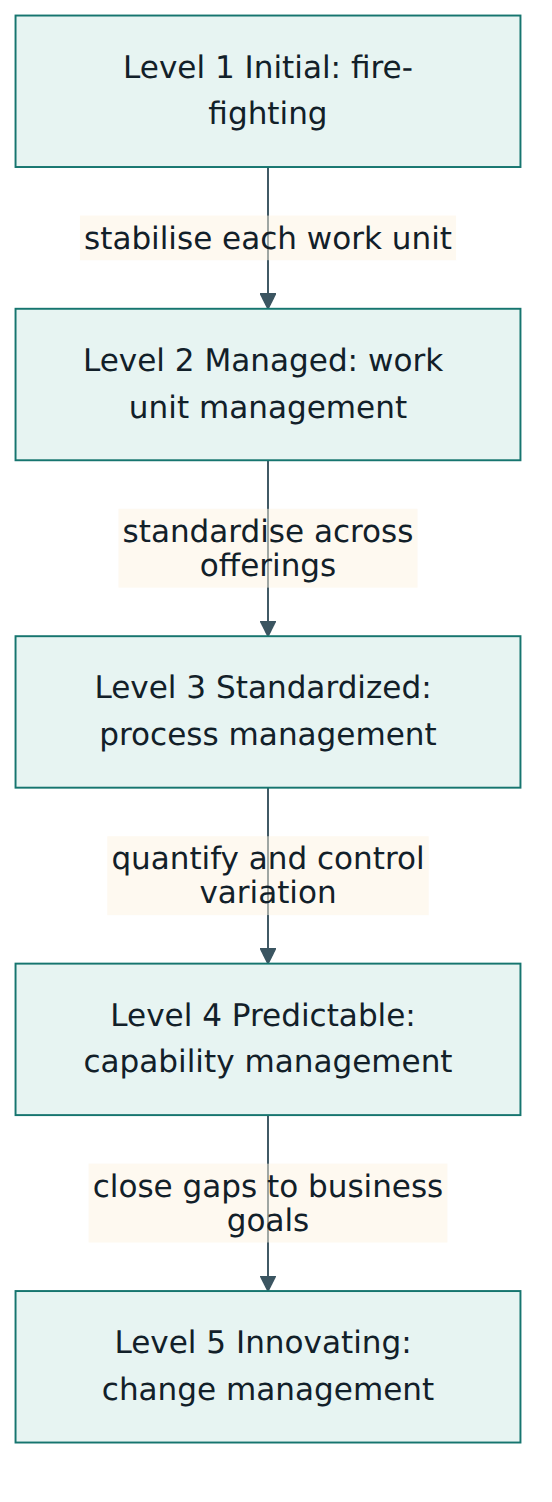
The maturity levels are the heart of BPMM. Each one removes a set of organisational barriers to improvement and installs practices that change the culture. Trying to skip a level usually fails because the practices of the higher level have nothing stable to stand on: you cannot standardise practices that individual units do not yet perform, and you cannot statistically control a process that is carried out differently every time.
Level 1 – Initial
Processes are rarely defined, and those that are defined are rarely followed. People do their jobs in personal ways, and the organisation's capability is really the capability of its best individuals. Over-commitment is typical: units promise what they cannot deliver. Products and services often work, but budgets, schedules and throughput targets are frequently missed, and the organisation struggles whenever requirements or market conditions change.
Level 2 – Managed
The goal of level 2 is a management foundation inside every work unit and project. Executives sponsor the improvement effort and set policies; managers agree requirements with their customers, estimate and plan the work, make realistic commitments based on past performance, track cost, schedule and throughput, control changes to important work products, manage suppliers and have compliance checked objectively. Units may still use different procedures for similar work, and quality is noticed but not yet managed against goals. The pay-off is that disciplined practices survive periods of stress, rework falls and commitments are met.
Level 3 – Standardized
At level 3 the organisation creates standard processes for its offerings, drawing on the best practices already proven in its work units, and provides guidelines for tailoring them to different needs. A dedicated group, often called a process engineering group, coordinates process work. Lessons learned and good process assets are collected and shared, common measures are analysed, and an organisation-wide programme builds the competencies people need for their roles. The focus moves from individual work units to complete product and service offerings, managed end to end: the specification notes that this is a significant change from the project-centred view of earlier CMMs. Interfaces between disciplines are defined and checked for consistency. The pay-offs include economies of scale, more effective automation and productivity growth.
Level 4 – Predictable
At level 4 the organisation sets achievable quantitative goals for performance and quality of its end-to-end work, based on the needs of customers and the business, and manages work against them. "Achievable" means the defined processes and plans have been analysed quantitatively and shown capable of meeting the goals. Selected subprocesses that matter most are controlled with statistical and other quantitative techniques, such as control charts, regression or run charts with thresholds. Because performance is stable, unusual variation can be recognised and its cause removed, and outcomes can be predicted from intermediate results. Level 4 also manages common assets across offerings and integrates the processes of different disciplines, which at level 3 were only connected through well-defined interfaces.
Level 5 – Innovating
At level 5 the organisation understands its critical business issues, for example a competitor offering similar services more cheaply, and sets quantitative improvement goals to address them. Three kinds of improvement run together: defect and problem prevention, in which units analyse causes and stop known problems from recurring; continuous capability improvement, in which everyone proposes incremental, often opportunistic improvements that are evaluated and rolled out in a controlled way; and planned innovative improvement, in which improvement workgroups are given specific quantitative targets and asked to design, pilot and package a solution that will reach them. Whereas level 4 changes processes to reduce variation, level 5 changes them to close the gap between current and desired results.
Running a BPMM improvement programme
BPMM treats process improvement as an organisational change programme, not as a documentation exercise. The specification lists the IDEAL cycle (Initiating, Diagnosing, Establishing, Acting, Learning) among its acronyms and provides guidance on organisational change management in an annex. A practical programme usually follows these steps:
- Initiate. An executive sponsor states the business case: which business results are at stake and why process improvement is the right lever. Funding, governance and a small process engineering group are put in place. This is the substance of Organizational Process Leadership.
- Diagnose. A light appraisal establishes the current strengths and weaknesses against level 2 (or the next target level) and collects baseline business measures.
- Establish. The team sets improvement goals tied to business results, chooses priorities within the target level and writes an action plan with owners and dates.
- Act. Working groups that include practitioners design or improve processes, pilot them in a few work units, measure the effect and then deploy them, with training, tools and objective assurance.
- Learn. Progress is checked with further appraisals and business measures; lessons are captured; the next cycle starts, eventually aiming at the next level.
Typical artefacts include the improvement strategy and goals, process descriptions and procedures, work unit plans and commitments, status reports and measures, configuration baselines, supplier agreements, assurance records and, from level 3, the standard process set, tailoring guidelines, a library of process assets, training plans and an organisational measurement repository. Typical roles are the executive sponsor, a steering group of senior managers, the process engineering group, process owners, work unit managers, the staff who perform the work, the assurance function and, during appraisals, an external lead appraiser.
Keeping the business in view
A common criticism of maturity models is that an organisation can climb levels without improving business results. The BPMM authors accepted the point and built two answers into level 2: Organizational Process Leadership requires the improvement programme to be planned, measured and managed against improvement goals and strategies, and Organizational Business Governance requires the organisation's actual work and results to be managed against business goals. Appraisers are expected to consider whether the measures chosen are reasonable. The authors also advise correlating business results with maturity progress, so that the organisation can see whether its investment pays off.
Lesson 5 – Appraisal, rating and certification
What conformance means for a maturity model
Conformance to a technical OMG specification, such as a data format, can be tested objectively. Conformance to BPMM cannot; it can only be judged inside a real organisation. The specification therefore relies on appraisals that collect several overlapping forms of evidence and use professional judgement. The formal conformance points are maturity levels 2, 3, 4 and 5. Conformance is cumulative: an organisation at a given level must realise every goal of that level and of all lower levels. A goal is realised when the practices actually implemented, whatever they are called, achieve it in combination.
Evidence
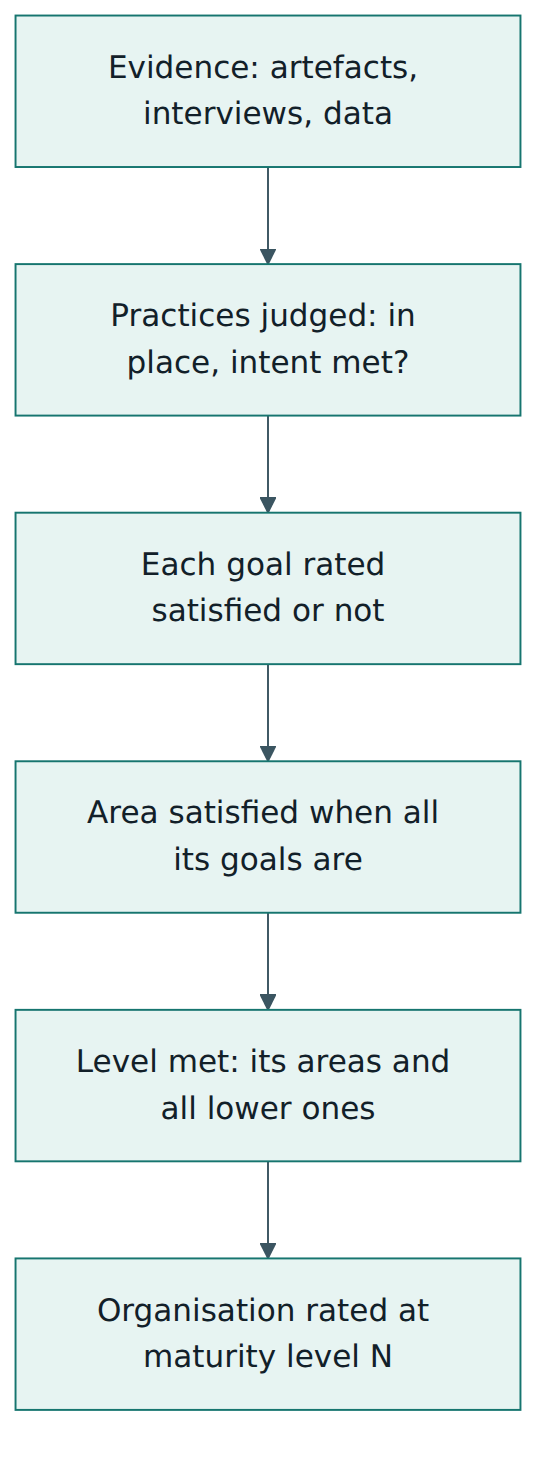
Appraisal teams gather several kinds of evidence and look for agreement among them: work products produced by performing a process; artefacts that support a process, such as procedures, templates and tools; interviews with the people who perform the process, with those who manage or oversee it, and with those who support it; quantitative data about the state of the organisation and the attitudes of its people; and quantitative data about process performance, outcomes and business results. A document that nobody follows is not evidence that a practice is implemented; interviews and work products must confirm it.
The four appraisal types
The specification envisages four appraisal forms with increasing assurance. All are led by a lead appraiser trained in the model and its appraisal method and who comes from outside the organisation.
| Type | Purpose | Characteristics |
|---|---|---|
| Starter | Quick, low-cost overview to launch an improvement programme | A few days; limited interviews; evidence not examined in depth; quantitative data collected |
| Progress | Check status against a maturity level or predict the result of a confirmatory appraisal | Covers all process areas and practices in scope; time-consuming but less rigorous than confirmatory; sufficient for internal status |
| Supplier | Evaluate bidders during source selection and track agreed improvements during a contract | Like a progress appraisal, but the team contains no members of the appraised organisation; data used to verify proposal claims |
| Confirmatory | Establish that a maturity level has been achieved | Thorough, broad sampling across the organisation, all evidence types; the only basis for claiming a level, including publicly |
How ratings roll up
The team judges each practice: is it implemented, and is it achieving its intent? From those findings it rates each goal, in simple terms as satisfied or not satisfied. A process area is satisfied when all its goals are satisfied; a goal or process area that genuinely does not apply is treated as satisfied for rating purposes. A maturity level is achieved when all process areas of that level and all lower levels are satisfied. Once the goals are rated, this roll-up is mechanical.
Capability levels without a continuous representation
BPMM uses a staged representation only: the levels describe the whole organisation. For readers used to CMMI's capability levels per process area, an informative annex explains how to derive something similar. Roughly: a process area is at capability level 1 when all its specific goals are satisfied but the institutionalization goal is not; at level 2 when the institutionalization goal is also satisfied with a managed (locally described) process; and at level 3 when it is satisfied with a defined process tailored from a standard one. Capability levels 4 and 5 cannot be planned in advance for individual areas; they can only be judged after the organisation-level level 4 and 5 practices are in place.
Is there a BPMM certification?
Be careful here. BPMM is not a management-system standard, and no accredited certification body issues "BPMM certificates" to organisations in the way that ISO 9001 certification works. The specification describes rated appraisals led by authorised lead appraisers, and its glossary uses the term "certification program" for qualifying individuals to train or appraise. However, the model has not been revised since 2008, and we could not find a current public register of BPMM appraisers or of appraisal results. In practice, organisations today mostly use BPMM for self-assessment, consultant-led gap analysis, structuring improvement roadmaps and evaluating suppliers. If a supplier claims a BPMM maturity level, ask who performed the appraisal, which type it was, what organisational scope it covered and when it took place, and ask to see the findings.
Lesson 6 – Worked example: a regional insurer stabilises claims handling
This example is fictional and simplified, but it follows the model's logic. The numbers are illustrative only.
The situation
A mid-sized regional insurer, which we will call Northgate Mutual, handles motor and household claims in four regional offices. Each office grew separately and handles claims its own way: different intake forms, different authority limits, different letters to customers. Average settlement time varies widely between offices, complaints are rising, and the board has approved a new claims platform. The chief operating officer has read that many such rollouts fail because of process problems and asks whether Northgate's processes are ready.
Step 1 – Sponsorship and a starter appraisal
The chief operating officer becomes executive sponsor. She writes a one-page business case (faster settlement, fewer complaints, a successful platform rollout), appoints a small process engineering group of three people and engages an external lead appraiser for a starter appraisal. In four days the appraiser interviews managers and staff in two offices, reviews a sample of claim files and collects basic data. Findings: offices accept work without clear agreement on service levels; capacity planning is informal; managers track backlog only when someone complains; letter templates are copied and edited freely; external loss adjusters work without written performance terms; and nobody checks whether the claims manual is followed. Northgate is at level 1, with some strengths in two offices.
Step 2 – Building level 2 in each office
The sponsor and the steering group set improvement goals in business terms and adjust managers' objectives so that process work counts (OPL). They also define the business measures the board will review monthly (OBG). Each regional office, treated as a work unit, then works through the level 2 areas:
- Requirements: each office agrees documented service levels with the claims director and records changes (WURM).
- Planning and commitment: managers estimate claim volumes and staff hours from last year's data and commit only to what their capacity supports (WUPC).
- Monitoring and control: a weekly review compares backlog, settlement time and cost with the plan and triggers corrective action (WUMC).
- Work agreements: team leaders agree daily work allocation and quality expectations with claims handlers (WUP).
- Configuration management: letter templates and the office claims procedure are placed under version control with a change process (WUCM).
- Sourcing: the loss-adjuster firms receive written agreements with turnaround times, and their performance is reviewed (SM).
- Assurance: a small independent team samples claim files monthly against the procedure and regulations and reports non-conformances (PPA).
For every area, the institutionalization practices are applied: each office documents how it does the work, plans the effort, trains the staff, measures the activity and has it checked. Nine months later a progress appraisal finds all level 2 goals satisfied in three offices and two weak areas in the fourth, which are fixed within two months. A confirmatory appraisal then rates the claims organisation at level 2.
Step 3 – Moving to level 3 in time for the new platform
The four offices still handle claims in four different ways, which would mean four sets of requirements for the platform. The process engineering group compares the offices' procedures, picks the best elements and writes one standard claims process with tailoring guidelines: household claims add a property inspection step, high-value claims add a second approval, but intake, triage and customer communication are identical (OPM). A competency framework and training curriculum for claims handlers follow (OCD), together with an organisation-wide approach to assigning and moving staff when volumes peak (ORM) and organisation-level control of shared templates and the procedure set (OCM). Claims is now managed as a product and service offering: its business case and budget (PSBM), its overall work management using tailored defined processes (PSWM), preparation of the new platform and updated process (PSP), the controlled rollout to offices (PSD), daily claims operations (PSO) and the support of systems, supplies and staff that keep operations running (PSS). Because the platform is configured for one standard process instead of four, its requirements shrink and the rollout goes smoothly.
Step 4 – Looking towards level 4
With a common process and common measures, Northgate can now build performance baselines. Analysts plot settlement time for straightforward motor claims on control charts and find that it is stable except for occasional spikes. Each spike is traced to a specific cause, such as a supplier backlog or a system outage, and addressed. Quantitative goals for the next year are set using these baselines rather than guesswork. This is the beginning of level 4 thinking, though Northgate would need much more, including capability baselines across the offering and quantitative management of selected subprocesses, before claiming level 4.
What the example shows
Level 2 came first because standardising four unstable processes would have produced a standard nobody could follow. The business case and measures kept the work focused on results rather than on paperwork. Institutionalization practices made the changes stick when a regional manager left. And the model told Northgate what to achieve, never which forms or tools to use.
Lesson 7 – Relationship to other standards and frameworks
BPMM was never meant to replace detailed best-practice frameworks. Its authors describe it as an overall, staged improvement framework that summarises practices and provides hooks to domain bodies of knowledge, which supply the detail. It can guide improvement on its own or act as an umbrella for implementing other models in the right order.
| Framework | Owner | What it is | Relationship to BPMM |
|---|---|---|---|
| CMMI (current version V3.0) | ISACA (CMMI Institute) | Best-practice model with maturity and capability levels, historically centred on development projects, now covering services, suppliers and more | Shares the same ancestry and staged logic; BPMM can be mapped to CMMI but focuses on transactional, cross-boundary business workflows and on offerings rather than projects at level 3 |
| People CMM | Originally SEI, Carnegie Mellon University | Maturity model for workforce practices | Same authors and architecture; complements BPMM's process view with workforce development and management |
| ISO 9001 | ISO | Requirements for a certifiable quality management system | ISO 9001 says what a quality system must contain and is audited for certification; BPMM gives a staged route for building process capability and is appraised, not certified |
| ISO/IEC 33001 family | ISO/IEC | Framework for process assessment, process capability and organisational maturity | A generic international assessment framework; BPMM brings its own model and appraisal approach and pre-dates the series |
| BPMN 2.0 (also ISO/IEC 19510) | OMG | Graphical notation for modelling business processes | Complementary: BPMN describes how a process flows, BPMM judges how mature the management of the process is; a BPMN diagram can serve as part of a process description |
| PEMM (Process and Enterprise Maturity Model) | Michael Hammer, published in Harvard Business Review, 2007 | Short self-assessment of process enablers and enterprise capabilities | Lighter and quicker to use; BPMM is far more detailed and prescribes which practices to implement at each level |
| ITIL, COBIT and PMBOK Guide | PeopleCert/AXELOS, ISACA, PMI | Domain bodies of practice for IT services, IT governance and project management | Cited by the BPMM authors as sources of detailed practices that BPMM can sequence and institutionalize |
Lean and Six Sigma deserve a word too. The specification mentions mixed results from programmes such as Six Sigma and business process reengineering in organisations without stable processes. Statistical tools work best when a process is performed consistently, which is exactly what levels 2 and 3 provide; BPMM levels 4 and 5 then give such tools a natural home. Academic reviews of business process maturity models, for example by Röglinger, Pöppelbuß and Becker in 2012, note that the OMG BPMM has the most comprehensive documentation of the models they compared and the clearest about which practices to implement at each level, while observing that only rather limited information is available on the empirical validation of the models they compared.
Common pitfalls and best practices
Common pitfalls
- Chasing the level instead of the results. Treating a maturity level as the goal leads to paperwork that satisfies appraisers but does not improve settlement times, costs or customer satisfaction.
- Skipping level 2. Writing a corporate standard process before work units can plan, commit and control their own work produces a standard that nobody can follow.
- Ignoring institutionalization. New practices introduced without documentation, planning, training, measurement and independent checking fade within months, especially when key people move on.
- Copying model text into procedures. BPMM practices describe characteristics of good processes, not the processes themselves; procedures written as copies of model statements are hard to use and misunderstood.
- Automating chaos. Rolling out an enterprise system onto inconsistent processes multiplies the problems and wastes the investment.
- Overstating a rating. Advertising a level based on a starter or progress appraisal, or on a self-assessment, misleads customers; only a confirmatory appraisal supports such a claim.
- Treating BPMM as current certification. Assuming there is an active, accredited certification market for BPMM leads to procurement requirements that suppliers cannot meet in a verifiable way.
Best practices
- Start with the business case. Tie every improvement goal to measurable business results and review them alongside maturity progress.
- Secure real executive sponsorship. Funding, adjusted management objectives and visible attention from the top are level 2 requirements, not optional extras.
- Involve the people who do the work. Build process descriptions with practitioners and harvest the best practices already used in the units.
- Pilot before deploying. Try changes in a few units, measure the effect, then roll out with training and support.
- Design for the next level. Use the process area threads to make level 2 processes easy to fold into level 3 standards.
- Use appraisals for learning. Use starter and progress appraisals to find weaknesses honestly, and save confirmatory appraisals for when the organisation is ready.
- Combine with detailed frameworks. Use BPMM to sequence and institutionalize practices, and ITIL, BPMN, Lean or domain bodies of knowledge for the detail.
Summary and key takeaways
- BPMM 1.0 is an OMG specification from 2008 that applies the staged CMM maturity framework to business processes across the full life of product and service offerings; it has not been revised since.
- Its five levels, Initial, Managed, Standardized, Predictable and Innovating, move an organisation from fire-fighting to work unit management, standard processes, quantitative control and continuous innovation.
- The 30 process areas (9, 10, 5 and 6 at levels 2 to 5) each have two or three specific goals plus one shared institutionalization goal; goals, process areas and levels are the rated components.
- Five institutionalization practices, describe, plan, train, control and assure, make improvements last; at level 3 the process description must be a defined process tailored from a standard.
- Level 3 shifts the focus from individual work units to end-to-end product and service offerings, a key difference from project-centred CMMs.
- Four appraisal types, starter, progress, supplier and confirmatory, offer increasing assurance; only a confirmatory appraisal supports a maturity level claim.
- BPMM tells you what to achieve, not how; it works best combined with detailed practice frameworks and always anchored in business results.
Reflection questions
- Think of a workflow in your organisation that different teams perform differently. Which symptoms of level 1 or level 2 behaviour do you see, and what evidence would an appraiser look for?
- Your company plans a major system rollout next year. Which BPMM process areas would you check first to judge whether the processes are ready, and why?
- How would you explain to a sceptical executive why the organisation should not jump straight to writing standard processes for the whole company?
- Choose one process you know well and describe how each of the five institutionalization practices would apply to it in concrete terms.
- A supplier claims to be "BPMM level 3". What questions would you ask, and what would convince you that the claim reflects real capability?
Further reading and official sources
- Business Process Maturity Model (BPMM) – specification page – Object Management Group
- Business Process Maturity Model, Version 1.0 (formal/08-06-01) – Object Management Group
- Business Process Model and Notation (BPMN) – Object Management Group
- Capability Maturity Model Integration (CMMI) – CMMI Institute, ISACA
- Maturity Models in Business Process Management (Röglinger, Pöppelbuß, Becker) – FIM Research Center / Business Process Management Journal
- The Process Audit (Michael Hammer) – Harvard Business Review
Original tutorial by xOps School (DevOpsSchool Private Limited), written from public sources about BPMM. Not affiliated with or endorsed by the standard's owner; standard names are trademarks of their owners. Buy the official standard from its publisher for the authoritative text.