
Kaizen – Tutorial (about 60 minutes)
- View
Kaizen is a way of working in which everyone in an organisation, from the newest operator to the chief executive, makes small, frequent, low-cost improvements to the work they do, every day, and then locks each gain in with a better standard. It is used in factories, hospitals, banks, warehouses, software and IT operations teams and public services. After this tutorial you will be able to explain where kaizen came from and why it works, use its vocabulary correctly, run a simple improvement cycle with a team, organise a focused improvement event, measure whether kaizen is really taking hold, and avoid the mistakes that turn it into a slogan.
Course overview
Edition and status: Kaizen is a management philosophy and a family of practices, not a published standard. It has no edition number, no owning standards body and no official certification of organisations or people. Its best-known reference texts are Masaaki Imai's books Kaizen: The Key to Japan's Competitive Success (1986) and Gemba Kaizen (1997; second edition 2012). Imai founded the Kaizen Institute in 1985; the Institute uses "KAIZEN™" as a trademark for its own consulting methodology, but it does not own or govern the general concept. Other widely used reference points are the Toyota Production System, which Toyota describes as being improved through kaizen every day; the Lean Enterprise Institute's lean lexicon; Mike Rother's Toyota Kata (2009); and the Shingo Model of the Shingo Institute, which is used to assess improvement cultures. Formal standards touch kaizen only indirectly: ISO 9001 and the other ISO management system standards built on the Harmonized Structure require continual improvement in their clause 10, without prescribing any kaizen method. Verified 2026-10-29.
Who it is for: engineers, team leads, operations and service managers, quality and continuous-improvement staff, project and delivery people, and anyone who has heard "we do kaizen here" and wants to understand what that should actually mean.
Prerequisites: none. Keep one real process from your own work in mind while you read, such as handling a support ticket, packing an order, onboarding a new employee or deploying a release. Every idea in this tutorial can be tried on it.
How to use this tutorial: read the seven lessons in order (about 45 minutes), study the four diagrams, then use the rest of the hour on the reflection questions before you take the 25-question knowledge check.
Learning objectives:
- You will be able to explain the meaning and origins of kaizen, including its roots in Training Within Industry, PDCA, quality circles and the Toyota Production System.
- You will be able to define the core vocabulary of kaizen, such as gemba, muda, mura, muri, standard work, PDCA, SDCA and countermeasure.
- You will be able to describe the building blocks of kaizen: the balance of maintenance and improvement, the three gemba activities, the five golden rules of gemba management and the main forms kaizen takes.
- You will be able to run a daily improvement cycle and plan, execute and follow up a kaizen event, with clear roles and artefacts.
- You will be able to measure kaizen with process, participation and sustainment indicators, and explain why no certificate proves an organisation "does kaizen".
- You will be able to apply kaizen step by step to a realistic service operation.
- You will be able to relate kaizen to lean, Six Sigma, Total Quality Management, ISO 9001, agile retrospectives and Toyota Kata.
Lesson 1 – Meaning, origins and scope
What the word means
In everyday Japanese, kaizen simply means improvement, a change for the better. It is written with two characters usually glossed as "change" and "good". Japanese speakers use it for any improvement, large or small, and the word on its own does not imply "continuous" or "philosophy". Outside Japan, however, the word has taken on a narrower, richer meaning: an ongoing, organisation-wide habit of making many small improvements, involving everyone, guided by facts gathered where the work is done. That is the sense used in management literature and in this tutorial.
Why does a habit of small improvements matter? Three reasons stand out. First, small changes are cheap and quick, so many of them can be made, and their effects accumulate. A team that removes one minute of waste from a daily task every week has, within a year, transformed that task without ever running a project. Second, small changes carry little risk: if an experiment does not work, it can be undone the same day. Third, and most important, the people closest to the work see problems that managers and specialists never see. A system that turns their observations into action uses a source of knowledge that most organisations leave idle.
Where it came from
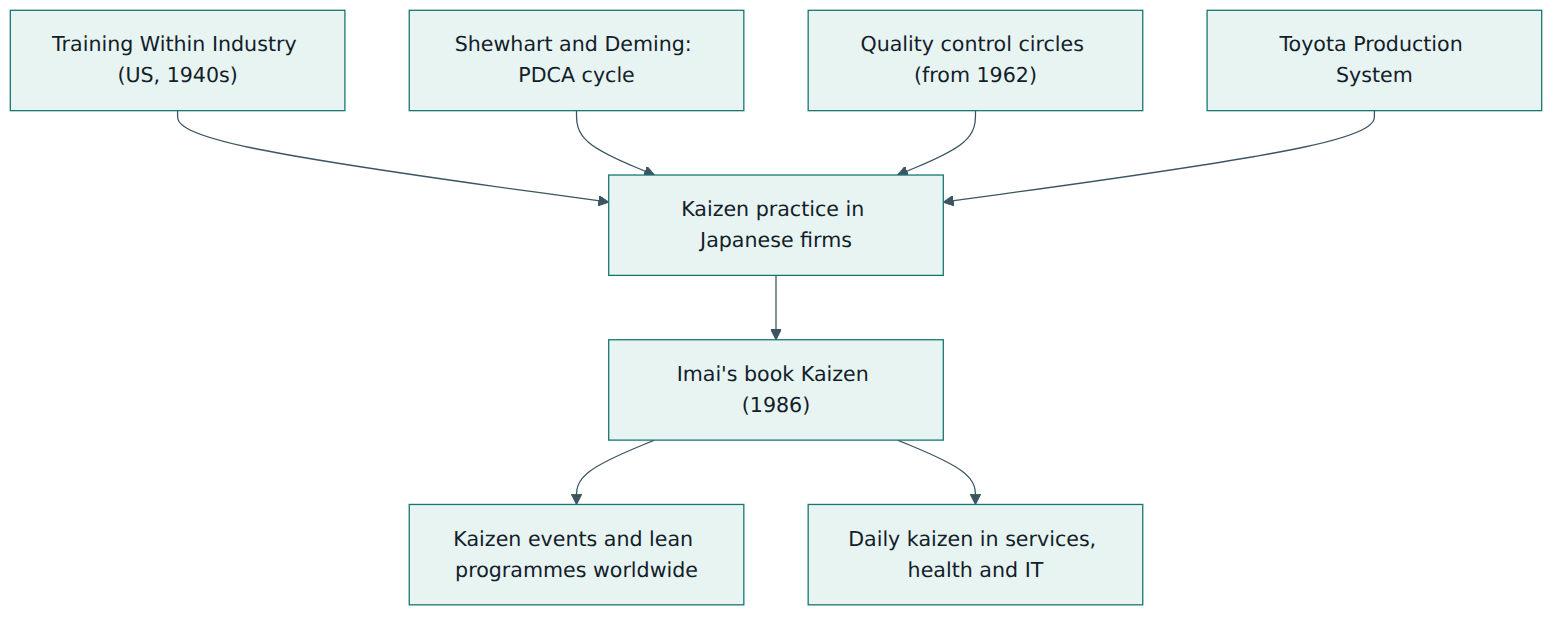
Kaizen is often described as a uniquely Japanese philosophy, but its history is international. During the Second World War the United States ran a programme called Training Within Industry (TWI) to help factories train large numbers of new workers quickly. One of its modules, Job Methods, taught supervisors a four-step routine: break the job down into its details, question every detail, develop a new method, and apply it. After the war, TWI was introduced in Japan as part of industrial reconstruction in the early 1950s, and Japanese companies, Toyota among them, absorbed and adapted it. Job Methods is sometimes called "the original kaizen" for that reason.
At around the same time, the American statistician W. Edwards Deming lectured Japanese engineers and managers on statistical quality control. He taught an improvement cycle that had been sketched earlier by Walter Shewhart; Japanese practitioners turned it into the Plan–Do–Check–Act (PDCA) cycle, which became the engine of kaizen. The Union of Japanese Scientists and Engineers (JUSE) promoted quality education widely, and from 1962 it encouraged the spread of quality control circles: small groups of front-line workers who meet regularly to study and solve problems in their own area, a movement closely associated with Kaoru Ishikawa.
Inside Toyota, Taiichi Ohno and his colleagues built what became the Toyota Production System (TPS). TPS rests on just-in-time production and jidoka (building in quality by stopping when something is wrong), and it treats standardised work as the baseline from which kaizen starts. Toyota also ran an employee suggestion system from the early 1950s. Kaizen became the daily mechanism that kept TPS evolving; Toyota's own description of TPS still says it is being improved continuously.
The word reached a global management audience in 1986, when Masaaki Imai, who had founded the Kaizen Institute the year before, published Kaizen: The Key to Japan's Competitive Success. Imai presented kaizen as the single concept behind many Japanese practices that Western managers had been studying separately: quality circles, suggestion systems, total quality control, just-in-time, and more. In 1997 his book Gemba Kaizen focused on the workplace itself and introduced practical rules for managing there. From the 1990s, as lean thinking spread, Western companies added the "kaizen event", a concentrated improvement workshop lasting several days.
Scope: where kaizen applies
Kaizen began on factory floors, but nothing in it is specific to manufacturing. Any repeated process can be observed, measured and improved: admitting a patient, approving a loan, processing an invoice, answering a support request, running a test suite, releasing software. In knowledge work the "workplace" may be a ticket queue, a deployment pipeline or a shared drive rather than an assembly line, but the logic is the same. Kaizen also applies at different levels: an individual tidying a workstation, a team redesigning its handover, a manager improving the flow across departments.
Kaizen and innovation
Imai contrasted kaizen with innovation. Innovation means large, step-change improvements, often driven by new technology or major investment, made by specialists, at intervals. Kaizen means small, continuous improvements made by everyone, using know-how and common sense rather than money. Neither replaces the other. A new machine, platform or system (innovation) raises performance in a jump; without kaizen, that new level slowly decays as workarounds and disorder creep in. With kaizen, the new level is maintained and steadily improved. Organisations that rely only on big projects tend to show a staircase that sags between steps; organisations that combine both show a rising slope.
Lesson 2 – Key concepts and vocabulary
Kaizen comes with Japanese terms, many of which are now used untranslated. You do not need to use them, but you do need to understand them, because they carry ideas that the English words often miss.
- Kaizen – continuous, incremental improvement carried out by everyone, every day, in every area; the improvements are usually small, inexpensive and based on facts.
- Gemba – "the real place": where value is actually created, such as the shop floor, the ward, the service counter, or the code repository and production system for a software team.
- Gembutsu – the real things at the gemba: the defective part, the rejected form, the failed build, the broken tool. Examining them is the start of fact-based problem solving.
- Genchi genbutsu – a Toyota phrase for going to see for yourself, so that decisions rest on direct observation rather than reports.
- Muda – waste: any activity that consumes resources without adding value the customer would pay for. Lean practice commonly lists seven classic forms (overproduction, waiting, transport, over-processing, inventory, motion, defects), often with an eighth, unused human talent.
- Mura – unevenness: variation in workload or flow, such as a team that is idle on Monday and overloaded on Friday.
- Muri – overburden: asking people or equipment to work beyond a sustainable level. Mura often causes muri, and both create muda.
- Standard (standard work) – the current best known way to do a task, written down and followed, usually with its sequence, timing and expected result. In kaizen a standard is not a rule set in stone; it is the baseline that makes improvement visible.
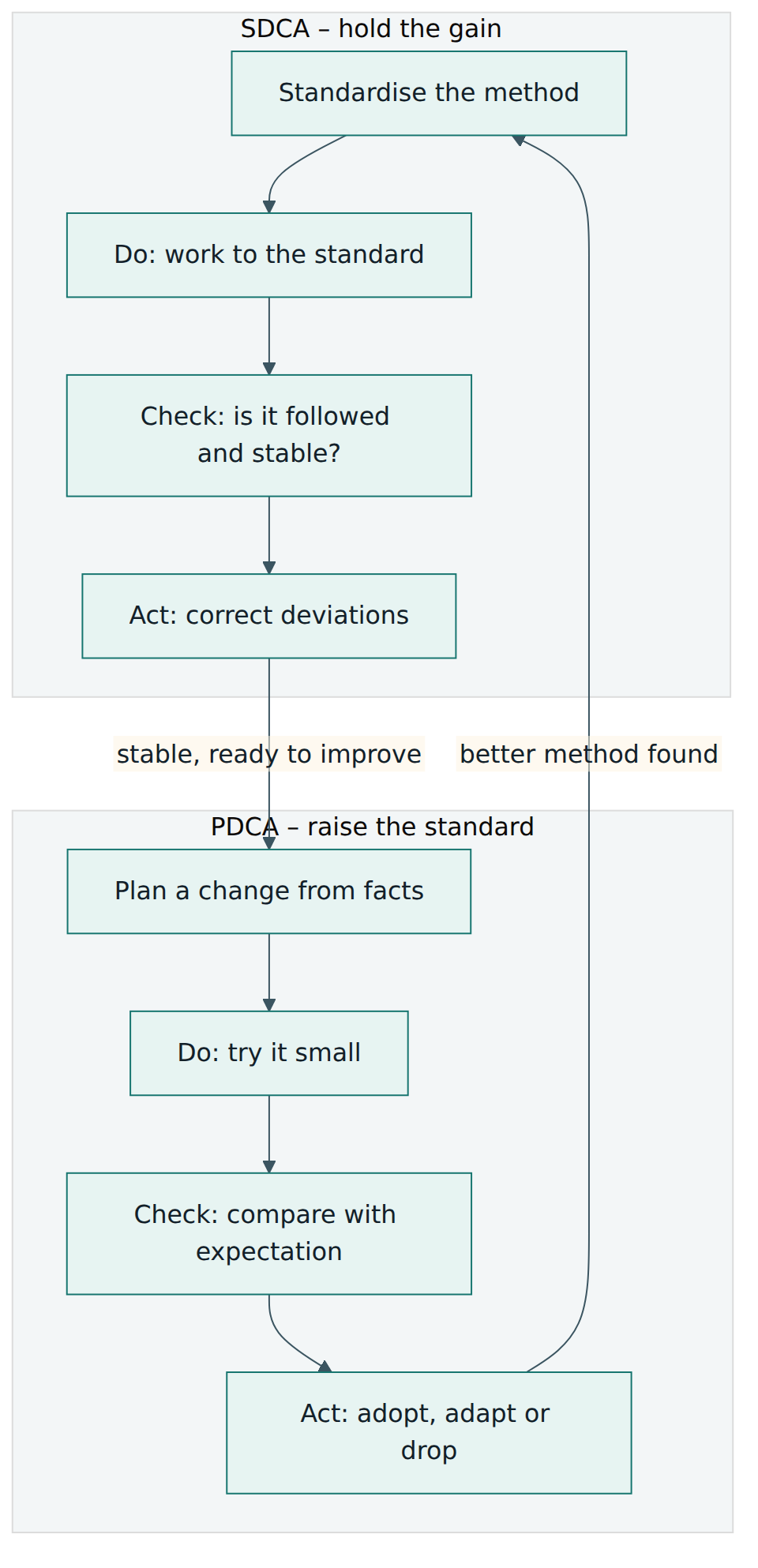
- PDCA – Plan, Do, Check, Act: the experimental cycle used to improve. Plan a change from an understanding of the problem, try it on a small scale, check the result against what you expected, and act by adopting, adjusting or abandoning it. Deming later preferred "Study" to "Check" (PDSA) to emphasise learning.
- SDCA – Standardise, Do, Check, Act: the cycle used to maintain. Establish the standard, work to it, check that it is followed and works, and act on deviations.
- Countermeasure – the action taken against a problem. Kaizen practitioners prefer this word to "solution" because it admits the action is a hypothesis that may need further improvement. A temporary countermeasure contains a problem; a permanent one removes its cause.
- 5S – five workplace-organisation practices: sort (remove what is not needed), set in order (a place for everything), shine (clean and inspect), standardise (make the first three routine) and sustain (keep the discipline). Imai calls this good housekeeping.
- Five whys – asking "why?" repeatedly about a problem until you reach a cause you can act on, a technique associated with Taiichi Ohno. Five is a guide, not a rule.
- Kaizen event – a focused team workshop, typically lasting three to five days, that studies one process and implements an improvement during the week. Also called a kaizen workshop, kaizen blitz or rapid improvement event.
- Suggestion system (teian) – a structured way for employees to propose and, ideally, implement their own improvements, with quick response and recognition.
- Visual management – making the state of the work visible at a glance (boards, signals, charts, labelled locations) so that abnormalities stand out and anyone can see what needs attention.
- A3 – a one-page problem-solving report, named after the paper size, that tells the PDCA story of a problem: background, current condition, target, root cause, countermeasures, plan and follow-up.
Two further ideas tie this vocabulary together. The first is process orientation. Imai argued that Western management tended to judge people only by results, whereas kaizen also values the process that produces results: the effort, discipline and method. A team that follows a sound process and learns from a failed experiment is doing kaizen; a team that hits a target by cutting corners is not. The second is respect for people: kaizen assumes that the people doing the work are capable of improving it, and that management's job is to give them time, skills and support to do so, and never to use improvement as a pretext for cutting jobs. When improvements lead to redundancies, suggestions dry up quickly.
Lesson 3 – The building blocks of kaizen
Kaizen has no clauses or process areas. Instead it has a small set of ideas that fit together into a system. This lesson walks through them in the order in which they build on one another.
Maintenance and improvement
Imai described every job as having two parts. Maintenance means keeping current standards: doing the work the agreed way, training people in it, and correcting deviations. Improvement means raising the standards. Improvement itself splits into kaizen (small steps) and innovation (large leaps). Imai observed that the share of time spent on each depends on the role: front-line workers spend most of their time maintaining standards, with some time on kaizen; supervisors and middle managers spend more on kaizen; top managers spend more on innovation and on setting the direction for kaizen. Everyone, however, has some responsibility for improvement.
This split explains the two cycles. SDCA keeps a process stable: until a process runs consistently to a standard, you cannot tell whether a change improved it or whether you simply had a good day. PDCA then raises the standard. Once a PDCA cycle produces a better method, the new method becomes the standard and SDCA takes over again to stabilise it. The two cycles alternate, like a ratchet that lets performance move up but not slip back down.
The three gemba activities
In Gemba Kaizen, Imai argued that most workplace improvement comes from three low-cost activities, which need common sense more than technology:
- Standardisation: defining and following the best current way to work, so that results are repeatable and problems become visible as deviations.
- Good housekeeping, through 5S: an orderly, clean workplace where tools and information are where they should be and abnormalities stand out.
- Elimination of muda: steadily removing waiting, unnecessary movement, rework, excess inventory and the other forms of waste, while also tackling the unevenness and overburden that generate it.
The order matters. Without a standard there is no baseline; without housekeeping, problems hide in clutter; with both in place, waste becomes easy to see and remove. In an office or IT setting the same three activities look different but play the same role: a clear runbook or checklist, a tidy shared drive and backlog, and the removal of handoffs, approvals and rework that add nothing for the customer.
The five golden rules of gemba management
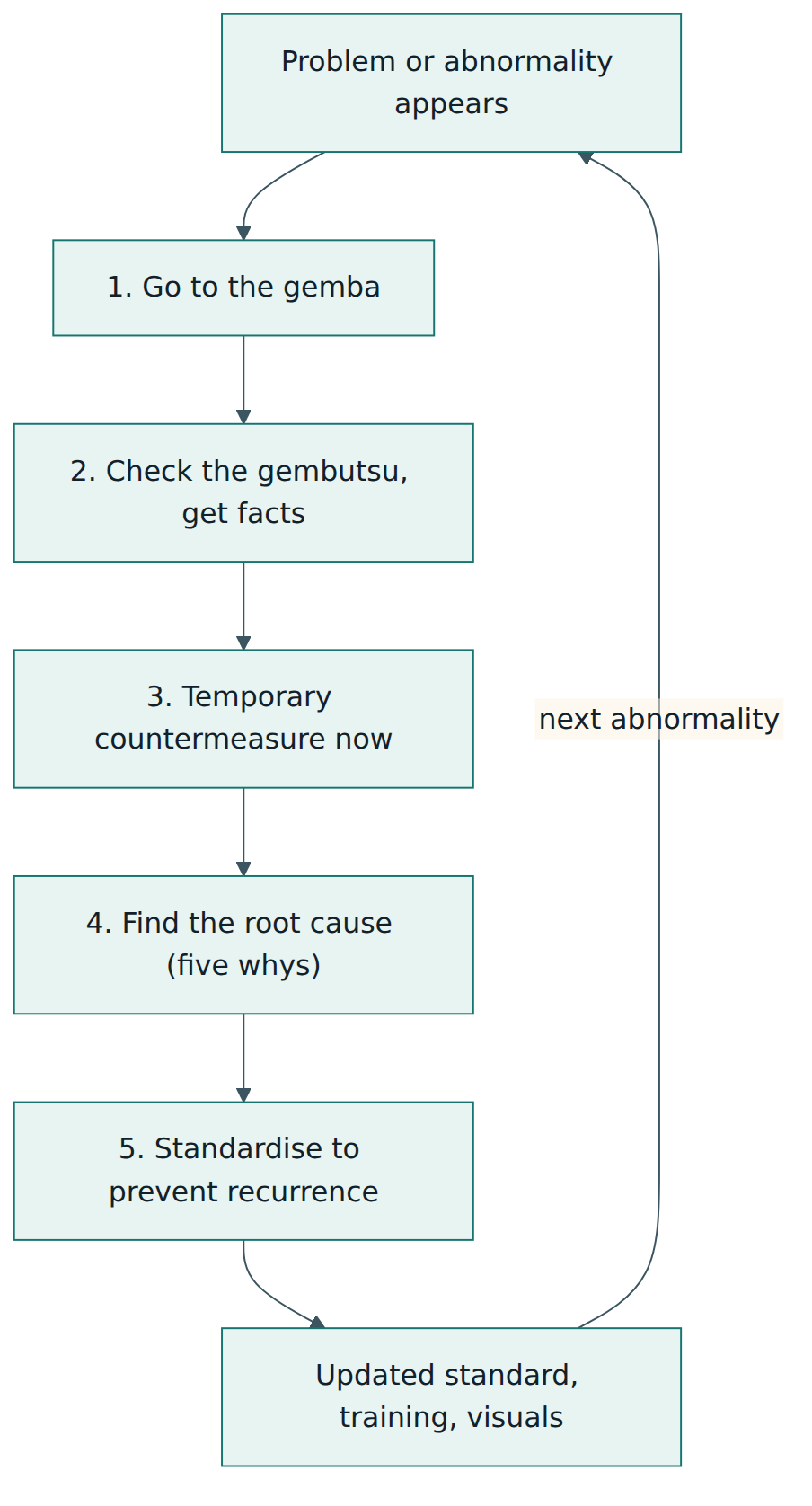
Imai also summarised how a manager should respond when a problem appears. In paraphrase, the five rules are:
- When a problem arises, go to the gemba first, rather than calling a meeting or asking for a report.
- Examine the gembutsu, the actual objects involved, and gather facts.
- Take temporary countermeasures on the spot to protect the customer and keep work going.
- Find the root cause, for example with the five whys.
- Standardise to prevent recurrence, by changing the method, the training or the equipment and updating the standard.
The rules are deliberately ordered. Containment comes before analysis because customers should not wait while you investigate, but containment alone is not enough: a problem that is only contained will return. And analysis without standardisation simply produces knowledge that is lost when people change shifts or jobs.
The forms kaizen takes
Kaizen happens in several forms, and a mature organisation uses all of them:
- Daily kaizen: individuals and teams make small improvements as part of normal work, often supported by a short daily meeting and an improvement board. This is the heart of kaizen.
- Suggestion systems: individuals propose ideas, ideally ones they can implement themselves, and receive a quick answer and recognition. The aim is participation and learning, not the size of each idea.
- Small-group activities: quality circles and similar teams that tackle a recurring problem in their area over several weeks, using structured problem solving.
- Kaizen events: cross-functional teams that study and change one process in a concentrated workshop of a few days.
- Management-led system kaizen: improvement of the flow across many processes and departments, often planned with a value stream map.
Lean writers such as Mike Rother and John Shook distinguish flow kaizen (or system kaizen), which improves how material and information move along the whole value stream and is mainly management's job, from process kaizen, which removes waste within individual steps and is mainly the work teams' job. Both are needed. Process kaizen alone can produce local gains that do not improve the whole: a step that becomes twice as fast but feeds a queue in front of a bottleneck has changed nothing for the customer.
Where to improve: direction and alignment
Because kaizen invites everyone to improve, it needs direction so that efforts add up. Toyota and other mature practitioners use strategy deployment (often called hoshin kanri) to translate a few organisational priorities into targets for each level, so that a team knows which problems matter most this year: safety, quality, lead time, cost or customer experience. Within that frame, teams remain free to choose their own small improvements. Without direction, kaizen becomes a scatter of unrelated fixes; with too much direction, it becomes a top-down project list and loses the engagement that makes it work.
Lesson 4 – How kaizen works in practice
Roles
Kaizen involves everyone, but people play different parts:
- Front-line team members follow the standard, notice problems and ideas, run small experiments and help write the improved standard.
- Team leaders and supervisors run the daily huddle, keep the improvement board moving, coach problem solving and make sure each change is reflected in the standard and training.
- Managers go to the gemba regularly, remove obstacles teams cannot remove themselves, sponsor larger improvements, connect teams' work to the organisation's priorities and model the behaviour they expect.
- Senior leaders set direction, protect time for improvement, keep the promise that improvement will not cost people their jobs, and review progress by visiting the work rather than only reading reports.
- A small continuous-improvement or kaizen promotion office, where one exists, trains people, facilitates events and keeps methods consistent; it supports the line organisation but does not own improvement.
Artefacts
Kaizen relies on simple, visible artefacts rather than elaborate systems. A kaizen board or improvement board shows ideas as cards moving through columns such as "new", "being tested", "done" and "standardised". An idea card records the problem, the proposed change, who owns it and the result. Standard work sheets or checklists describe the current method. An A3 report documents larger problems. Before-and-after records, such as photos, timings or defect counts, show what changed. In a digital team the board might be a column set in the team's work tracker and the standard a page in the runbook, but the content is the same.
Daily kaizen, step by step
A practical daily routine might look like this:
- At the daily huddle (ten to fifteen minutes at the team board), the team reviews yesterday's performance against its targets and notes any abnormality.
- Anyone can raise a problem or idea; it is written on a card in the person's own words.
- The team leader helps the owner frame it as a small experiment: what will we change, what do we expect, how will we know?
- The owner tries the change on a small scale, often the same day or week.
- The result is checked against the prediction; the team decides to adopt, adjust or drop the change.
- If adopted, the standard and any training material are updated, and the card moves to "standardised".
- Recognition is given quickly and publicly, focusing on the learning and effort as much as the gain.
The key design choices are speed and ownership. Ideas that wait months for a committee decision die. Ideas that are passed to someone else to implement teach the proposer nothing. The best systems let people implement most of their own ideas within their authority and reserve escalation for changes that affect safety, regulation, customers or other teams.
Running a kaizen event
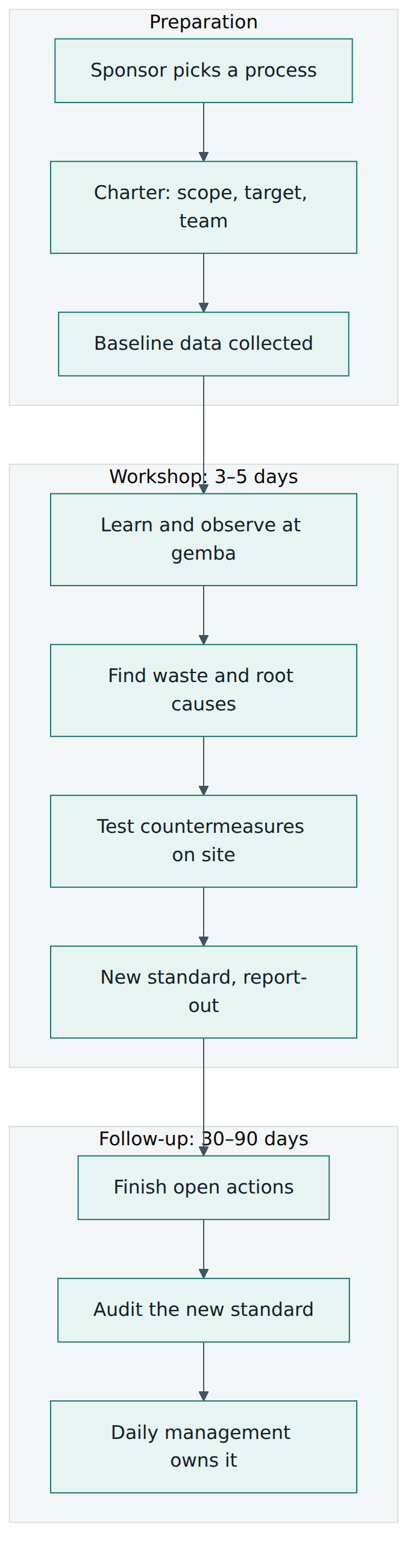
A kaizen event concentrates effort on one process for a short period. It has three phases, and the parts before and after the workshop matter as much as the workshop itself.
Preparation (typically two to four weeks before). A sponsor chooses a process that matters to the organisation's priorities and writes a charter: scope, the problem in measurable terms, a target, the team, constraints and the date of the report-out. The facilitator collects baseline data, arranges for the area to be available and makes sure the people who do the work are on the team, along with someone from each upstream and downstream area and someone with authority to approve changes.
The workshop (usually three to five days). A typical pattern is: train the team briefly in the relevant concepts; go to the gemba and observe the current process, timing steps and mapping the flow; identify waste and root causes; generate and test countermeasures directly in the workplace; write the new standard and train the people who use it; and finish with a report-out to leadership that shows before-and-after measures and the list of open actions.
Follow-up (typically thirty to ninety days). The team completes open actions, checks that the new standard is being followed, tracks the measures to confirm that the gain holds, and hands ownership back to the area's daily management. This is where many events fail: without follow-up, people drift back to the old method within weeks.
Coaching improvement thinking
Many organisations now complement events with a coaching routine so that improvement becomes a daily skill. Mike Rother's Toyota Kata describes an improvement pattern he observed at Toyota: understand the direction or challenge, grasp the current condition, set the next target condition, and then experiment towards it in small PDCA steps, learning from each. A coach supports the learner by asking a short, fixed set of questions in daily sessions: what the learner is trying to achieve now, what the situation actually is, what obstacles stand in the way and which one is being worked on, what the next step is and what is expected from it, and when the result can be seen. Rother presents the improvement and coaching kata as practice routines, derived from his research, for building scientific thinking in any organisation.
Kaizen in knowledge work and IT
In software and IT operations, kaizen often appears as blameless post-incident reviews that end with a concrete improvement, team retrospectives whose actions are actually tracked, automation of a repetitive manual step, a shorter checklist, a clearer definition of done, or the removal of an approval that never rejects anything. The gemba is the place where the work is visible: the ticket history, the pipeline logs, the on-call channel. The same disciplines apply: observe the real work, measure, change one thing at a time, and update the runbook or pipeline so the improvement becomes the new standard.
Lesson 5 – Measurement, assessment and recognition
No certification of kaizen
Because kaizen is not a standard, there is no accredited audit that certifies an organisation as "kaizen compliant", and no official body that certifies kaizen practitioners. Consultancies and training providers, including the Kaizen Institute, offer courses and their own certificates; these show that a person attended or passed a provider's programme, and their value depends on the provider. Lean and Six Sigma certifications often include kaizen content, but they certify a broader body of knowledge. If someone claims their organisation is "kaizen certified", ask who issued the certificate and against what criteria.
Where formal assessment does touch kaizen
- ISO 9001 and other ISO management system standards require organisations to continually improve the suitability, adequacy and effectiveness of the management system (clause 10 of the Harmonized Structure). A certification body will look for evidence that improvement happens and is managed, but any method, kaizen included, can satisfy the requirement.
- The Shingo Model, maintained by the Shingo Institute at Utah State University, assesses organisational culture against guiding principles grouped into cultural enablers, continuous improvement and enterprise alignment. Examiners look for evidence that principle-based behaviour is consistent, sustained and widespread, rather than counting the tools in use. Organisations can challenge for the Shingo Prize or use the Institute's self-assessment.
- Business excellence models, such as the EFQM Model and the Baldrige Excellence Framework, include learning and improvement among the things assessors examine.
- Many companies use internal maturity assessments, often a grid that rates areas from "no standard work and ad-hoc fixes" to "everyone improves daily against clear targets, and gains are sustained".
What to measure
Because kaizen is about results and about the process that produces them, a balanced set of measures has three groups:
- Performance outcomes of the process itself: safety incidents, defect and rework rates, lead time, throughput, cost per unit, customer complaints, and for IT teams change failure rate or time to restore service.
- Participation and flow of improvement: the share of people who have made at least one implemented improvement, the number of ideas implemented per person, and the time from idea to decision and from decision to implementation. These leading indicators show whether the habit is spreading.
- Sustainment: the share of improvements still in place after three or six months, standard-work audit results, and 5S audit scores. These show whether gains are being held.
Be careful with counts. A target for "ideas submitted" invites trivial ideas, and a target for "events held" invites events that change nothing. Use counts to spot trends in engagement, not to rank teams or pay bonuses, and always pair them with outcome and sustainment measures.
Assessing maturity in practice
A simple self-assessment walks the gemba and asks questions such as: Is there a current standard for this work, and is it followed? Can anyone see at a glance whether the area is on target? When did this team last change its standard, and why? How many people have implemented an improvement this quarter? Do managers visit the work and ask about problems, or only about numbers? How quickly does a raised problem get a response? Answers drawn from observation, rather than from slide decks, give the most honest picture.
Lesson 6 – Worked example: a returns-processing centre
This example is fictional but realistic. It shows how the ideas from the previous lessons fit together over about four months.
The situation
Harbourline is an online retailer whose returns centre employs 40 people over two shifts. Customers wait an average of nine working days for a refund after returning an item, and complaints about late refunds have doubled in a year. The operations director's response has been to ask for more staff. The new centre manager, Priya, proposes to try kaizen first, with a commitment from the director that no one will lose their job because of improvements; any freed capacity will absorb volume growth.
Step 1 – Set direction and stabilise
Priya agrees one priority with the director: reduce time-to-refund while keeping refund errors below the current level. She sets up a team board in each shift showing daily volume, items waiting, oldest item waiting and errors. A ten-minute huddle at the start of each shift reviews the board. For the first two weeks the aim is only maintenance (SDCA): the team writes down how returns are currently received, inspected, graded, restocked and refunded, discovers that the two shifts do the inspection differently, and agrees one written standard. Without that baseline, any later change would be impossible to evaluate.
Step 2 – Go and see
Priya and two team leaders spend an hour a day at the gemba. They follow individual parcels from the dock to the refund. Looking at the gembutsu, the parcels and the screens, they see things no report showed: parcels wait in cages for up to three days before being opened; inspectors walk to a printer in another room for every label; one in eight items is set aside because the return reason is unclear; and refunds are issued in a single batch each Friday because a finance approval step was added years ago after a fraud case.
Step 3 – Daily kaizen begins
Team members start posting ideas on the board. Within a month, 23 people have implemented at least one small change. Examples: moving a label printer to each inspection bench removes about 40 walking trips per inspector per shift; a colour-coded shelf label shows which items have waited more than a day; a short checklist for unclear returns cuts the "set aside" pile by half; and 5S on the grading benches frees enough space to process two parcels at once. Each change is a small PDCA cycle, with a prediction written on the card and checked a week later. Successful changes are added to the standard and taught at the huddle.
Step 4 – A kaizen event on the bottleneck
The board now shows clearly that the biggest delay is not inside the centre at all but in the weekly finance approval. That is a system problem across departments, beyond the team's authority, so Priya asks the director to sponsor a four-day kaizen event. The charter targets the refund approval flow, aiming to cut time-to-refund to three working days with no increase in fraud losses. The team includes two inspectors, a team leader, a finance analyst, a fraud specialist, a customer service agent and an IT developer, with a facilitator from head office.
During the event the team maps the flow and finds that the Friday batch exists only because of one historical fraud pattern. Asking why repeatedly, they learn that the real control need is to check high-value items and returns from accounts with unusual patterns, not every refund. They test a rule in which low-risk refunds are released daily at inspection and only flagged cases go to finance. Over the three working days of testing, nothing that the fraud specialist judged risky passes unflagged. The team writes the new standard, updates the inspection checklist and trains both shifts. At the report-out they present the before-and-after flow and a list of seven open actions with owners and dates.
Step 5 – Follow-up and sustain
Over the following 60 days, the IT developer automates the risk flag, the finance analyst monitors fraud losses weekly, and team leaders audit the new standard twice a week. One problem emerges: on busy Mondays inspectors skip the checklist. Rather than blame them, the team applies the five golden rules: they observe Monday work, find that the checklist is on a separate screen, put it into the inspection form itself, and update the standard. Time-to-refund falls to just over three working days and stays there; refund errors do not rise; complaints about late refunds fall sharply.
What made it work
- A clear direction from leadership, plus a job-security promise that made people willing to improve their own work.
- A stable standard first, so improvements could be measured.
- Managers at the gemba, seeing real parcels rather than reports.
- Many small team-owned changes, followed by one focused event on a cross-departmental constraint.
- Follow-up that treated slippage as a process problem, not a people problem.
- Measures that combined outcome (time-to-refund, errors), participation (people with implemented ideas) and sustainment (standard audits).
Notice also what Priya did not do. She did not launch a large IT project, she did not hire consultants for months, and she did not start with a kaizen event on the inspection benches, where most of the visible activity was but little of the delay lay. Kaizen pointed her to the real constraint because the team's own observations, made visible on the board, showed where time was lost.
Lesson 7 – Relationship to other standards and frameworks
Kaizen is a philosophy and a set of habits that many other frameworks borrow, require or build upon. The table compares it with the frameworks people most often confuse it with.
| Framework | What it is | Relationship to kaizen |
|---|---|---|
| Lean management / Toyota Production System | A management system for delivering customer value with minimal waste, built on flow, pull, standard work and respect for people | Toyota's own statement of its values, The Toyota Way 2001, rests on two pillars, continuous improvement and respect for people; kaizen is lean's main engine of improvement, and lean adds value stream thinking, flow and pull |
| Six Sigma | A data-driven method for reducing variation and defects, usually run as projects through DMAIC with trained Belts | Complements kaizen: Six Sigma handles complex, statistically hard problems in projects; kaizen handles many simple problems quickly; combined in Lean Six Sigma |
| Total Quality Management (TQM) | An organisation-wide approach to quality involving all employees, customer focus and process improvement | Kaizen grew up alongside Japanese total quality control; Imai saw quality circles and TQC as parts of the kaizen umbrella |
| ISO 9001 and other ISO management system standards | Certifiable requirements for a management system, with a required continual improvement clause | ISO 9001 requires improvement but not a method; kaizen is one way to meet the requirement and give it life |
| Agile methods (Scrum, Kanban Method) | Iterative ways of delivering work in short cycles with regular inspection and adaptation | Retrospectives and Kanban's evolutionary change are kaizen applied to knowledge work; the same pitfalls apply when actions are not tracked |
| Toyota Kata | Practice routines for the improvement pattern and the coaching that supports it | A structured way to build the daily improvement habit that kaizen depends on |
| Shingo Model | A principle-based model and assessment of operational excellence culture | Assesses whether improvement behaviour is embedded; continuous improvement is one of its three dimensions of principles |
Kaizen versus lean
People often use "kaizen" and "lean" as if they meant the same thing. They overlap heavily, but lean is the broader system: it tells you what to improve towards (value, flow, pull, perfection) and provides structural tools such as value stream mapping, takt time and kanban. Kaizen is the habit and method of improving, whatever the target. You can do kaizen without the full lean toolkit, but you cannot sustain lean without kaizen.
Kaizen versus Six Sigma
Six Sigma uses statistical tools and trained specialists to tackle problems whose causes are hidden in variation. Kaizen relies on observation, common sense and the knowledge of the people doing the work. A sensible organisation lets most problems be solved through kaizen, and escalates the few that resist simple countermeasures to a Six Sigma project. Using a heavy project method for a problem a team could fix in an afternoon is itself a form of waste.
Kaizen and ISO 9001
Organisations certified to ISO 9001 sometimes treat continual improvement as a paperwork exercise: a list of "improvement opportunities" from audits. Kaizen offers a way to make the requirement real, with daily improvement in every team, problem-solving records such as A3 reports, and updated procedures as the natural evidence. Conversely, the management system gives kaizen a structure: documented standards, internal audits that check whether standards are followed, and management reviews that look at improvement results.
Kaizen and agile retrospectives
An agile team's retrospective is a regular moment for reflecting and choosing improvements. It is kaizen in spirit, but many teams list the same complaints sprint after sprint because no one owns the actions, no prediction is made, and nothing is checked. Applying kaizen discipline means choosing one or two small experiments, stating what you expect to happen, checking the result at the next retrospective, and updating the team's working agreement or definition of done when an experiment succeeds.
Common pitfalls and best practices
Pitfalls:
- Treating kaizen as a series of events. A calendar full of kaizen workshops, with no daily improvement between them, produces bursts of change that decay. Counting events as the measure of success makes the problem worse, because it rewards holding workshops rather than holding gains.
- Skipping standardisation. Improvements that are not written into the standard and training are lost when people change shifts, roles or habits.
- Using kaizen to cut jobs. When productivity gains turn into layoffs, people stop proposing improvements. Freed capacity should be redeployed to growth, improvement or new work.
- Solving problems from the office. Decisions made from reports and meetings, without going to the gemba, often treat symptoms or the wrong problem.
- Rewarding the size or count of ideas. Big cash rewards for large savings and targets for idea counts both distort the system; recognition should value participation and learning.
- Leaving ideas to wait. If proposals sit for weeks with no answer, people conclude that management does not care, and participation collapses.
- Local optimisation. Speeding up a step that is not the constraint adds inventory or queues elsewhere without helping the customer.
- Blame. Treating a problem as someone's fault makes people hide problems, which is the opposite of what kaizen needs.
Best practices:
- Start with standards and visual management in one area, so that the baseline and abnormalities are visible before you ask for improvements.
- Build a daily rhythm: a short huddle at a board, a simple idea card, a quick response, and a weekly check of results.
- Let people implement their own ideas within agreed limits, and escalate only those that affect safety, compliance, customers or other teams.
- Treat every change as an experiment, with a written prediction and a check of the result.
- Keep managers at the gemba and teach them to coach with questions rather than give answers.
- Connect kaizen to a small number of clear priorities, so that many small changes move the organisation in the same direction.
- Use kaizen events for cross-functional or larger problems, and always plan the follow-up before the workshop starts.
- Measure outcomes, participation and sustainment together, and use the numbers for learning rather than ranking.
Summary and key takeaways
- Kaizen means continuous, incremental improvement by everyone, every day, everywhere, based on facts observed where the work happens.
- It grew from several sources, including Training Within Industry, Deming's teaching of the PDCA cycle, quality circles and the Toyota Production System, and was popularised worldwide by Masaaki Imai in 1986.
- Kaizen is not a standard: there is no edition, no owner and no certification of organisations, although ISO management system standards require continual improvement and models such as Shingo assess improvement culture.
- Its core logic alternates SDCA to stabilise and PDCA to improve, so that each gain becomes the next standard.
- Standardisation, 5S housekeeping and waste elimination are the main gemba activities, and the five golden rules guide how managers respond to problems.
- Kaizen takes several forms: daily team improvement, suggestion systems, small-group problem solving, kaizen events and management-led flow kaizen.
- Success depends on leadership behaviour: direction, time, job security, presence at the gemba and quick responses to ideas.
- Measure outcomes, participation and sustainment together, and watch for the pitfalls of event-only kaizen, missing standards and counting ideas.
Reflection questions
- Choose one process you work in. What is its current standard, and if there is none, what would you write down first so that improvements could be measured?
- Think of the last problem your team escalated. How would the five golden rules have changed the way it was handled, and which rule was skipped?
- List three examples of muda, one of mura and one of muri in your own work. Which could you remove this week without approval?
- Your organisation wants to report on kaizen to its leadership. Which outcome, participation and sustainment measures would you propose, and how would you prevent them from being gamed?
- Pick a recent improvement in your organisation that did not last. Which part of the cycle was missing: the baseline, the experiment, the check, the new standard, or the follow-up?
Further reading and official sources
- What is KAIZEN™ – Kaizen Institute (founded by Masaaki Imai)
- Toyota Production System – Toyota Motor Corporation
- Kaizen (lean lexicon) – Lean Enterprise Institute
- Kaizen workshop (lean lexicon) – Lean Enterprise Institute
- Plan, Do, Check, Act (lean lexicon) – Lean Enterprise Institute
- The Shingo Model – Shingo Institute, Utah State University
- Continuous improvement – ASQ (American Society for Quality)
Original tutorial by xOps School (DevOpsSchool Private Limited), written from public sources about Kaizen. Not affiliated with or endorsed by the standard's owner; standard names are trademarks of their owners. Buy the official standard from its publisher for the authoritative text.